x vs bluesky for creators
X vs Bluesky for Creators: Which Platform Wins in 2026
X vs Bluesky for creators in 2026, broken down by reach, monetization, discovery, and growth. Pick the platform that actually fits your content workflow.
You're staring at two draft tabs, one on X and one on Bluesky, and the question isn't where the post looks nicer. It's where that post will do work for you. If you're a creator, founder, or writer trying to turn attention into replies, clicks, signups, or sales, x vs bluesky for creators is a business decision, not a personality test.
Here's the blunt version. X is still the bigger distribution engine and the better place for raw reach and direct monetization. Bluesky is the better place to get into tighter communities, surface in niche feeds, and have a calmer conversation with people who care. For a lot of creators, the winning move is both, with a tool handling the duplication so you're not manually copy-pasting your life away.
| Platform | Best For | Weak Spot | Creator Fit |
|---|---|---|---|
| X | Maximum reach, viral swings, native monetization | Messier environment, less control over distribution | Strong for launch-heavy and revenue-first creators |
| Bluesky | Niche authority, community discovery, tighter discussion | Smaller audience, no native monetization | Strong for creators who win through trust and specificity |
The Creator's Dilemma When Two Platforms Both Look Right
You write one strong post, then you hesitate. On one tab, X promises a much larger audience. On the other, Bluesky looks quieter, friendlier, and more likely to reward actual conversation. That hesitation is normal, because the wrong choice costs you real business outcomes, not just a few likes.
The real question is conversion
The smartest x vs bluesky for creators decision in 2026 is not about taste. It's about which platform converts your specific audience into meaningful actions, whether that means replies, link clicks, newsletter signups, product trials, or paid offers. A big audience that ignores you is worse than a smaller audience that responds.
Practical rule: choose the platform that matches the action you need most, not the one that makes you feel more visible.
That's why “should I leave X?” is usually the wrong starting point. If your work depends on mass attention, X still earns the first look. If your work depends on trust, technical credibility, or a tightly defined niche, Bluesky can be the better business channel even when the crowd is smaller.
Ask better questions before you pick a side
Before you commit, answer three things. Who already follows people like you. What do you need from a post. And where does your content style feel natural without forcing you into a performative voice.
If you need a one-post launch mechanism, X is hard to beat. If you need thoughtful replies from a specialized audience, Bluesky can outperform your expectations even with less scale. For many creators, the smartest setup is not exclusive at all, it's a shared posting workflow.
That's why cross-posting tools matter. A layer like MicroPoster, which offers a 7-day trial, exists because most creators don't have to choose only one publishing lane. They need one source of truth, then platform-native delivery everywhere else.
Audience Size and Discovery Mechanics Compared
X still owns the bigger top of funnel by a wide margin. Independent 2026 comparisons put X at roughly 500 million to 600 million monthly active users, while Bluesky sits around 27.5 million to 42 million users, so X is about 17x to 20x larger in addressable audience, according to Voicemoat's 2026 comparison. That gap is the reason launch posts, hot takes, and broad-interest content still travel farther on X.
But size is only part of the distribution story.
How discovery works
X relies on centralized ranking, especially its algorithmic For You feed. Timing, hooks, replies, and engagement velocity matter a lot because the feed decides what gets repeated and widened. Bluesky works differently, with a chronological Following feed and user-built custom feeds under the open AT Protocol, which makes niche discovery more democratic and less dependent on a giant follower base, as described in SocialKit's architecture breakdown.
That changes the creator math. A smaller Bluesky account can still appear in a relevant custom feed if the topic fits that feed's logic. On X, you are more often competing for attention inside a much larger, faster stream, where a post can move quickly or disappear just as fast.
| Platform | MAU Range | Primary Discovery | Discovery Advantage |
|---|---|---|---|
| X | 500 million to 600 million | Algorithmic ranking and For You distribution | Massive top-of-funnel reach |
| Bluesky | 27.5 million to 42 million | Chronological Following feed and custom feeds | Better niche surfacing and community discovery |
What that means in practice
If you are launching a product, promoting a new video, or trying to break out to a wider audience, X gives you the larger stage. If your work depends on being seen by a specific tribe, for example developers, designers, journalists, or people in adjacent creative niches, Bluesky can put you in front of the right people faster than its smaller size suggests.
X rewards sharp timing and repeatable hooks. Bluesky rewards relevance and context. A post can feel loud on one platform and useful on the other, and that difference matters more than raw follower count. For creator business outcomes, X is the broader megaphone, Bluesky is the tighter room.
For creators who want both reach and relevance, a workflow with MicroPoster lets one post travel to both platforms without extra manual work.
What Engagement Patterns Actually Mean for Reach
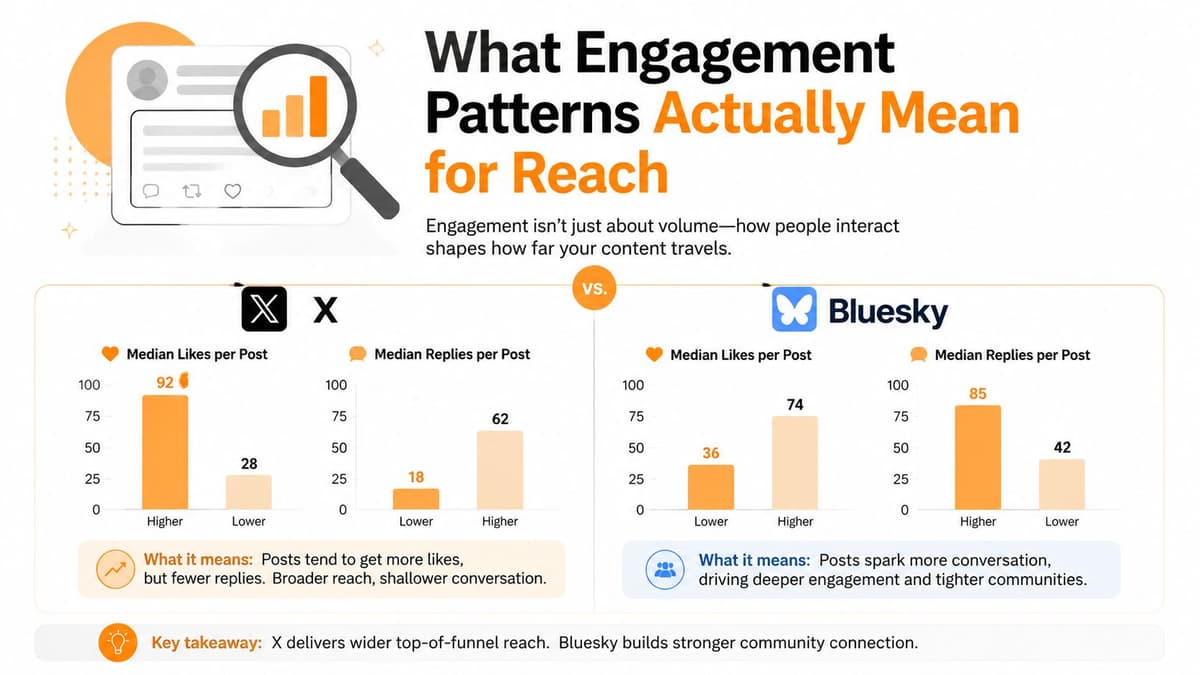
Buffer's analysis of 1.7 million posts found something creators miss all the time, the median post on both X and Bluesky received exactly four interactions, and half of all posts on both platforms got four or fewer engagements, according to Buffer's post-level dataset. That means most content on both platforms lives in the same ordinary range.
The average, though, tells a different story. X averaged 328 engagements per post versus 21 on Bluesky in that same analysis. That spread points to a much heavier viral tail on X, while Bluesky's interaction pattern is more modest and more concentrated around smaller communities, again from Buffer's dataset.
The median says most posts look similar. The average says X still has the kind of outlier reach that can change a creator's week.
Read the numbers like a creator, not a statistician
Don't confuse “average” with your day-to-day baseline. The median tells you what happens to a typical post. The average tells you how often a platform produces unusual winners. X has more of those outlier spikes, which is why it's still where creators swing for viral lifts, major announcement reach, and broad visibility.
Bluesky's engagement pattern is different. It's less about chasing huge spikes and more about earning steady conversation from people who recognize your niche. That makes it stronger for creators who care about replies, deeper trust, and the kinds of interactions that lead to email signups or product curiosity.
Which engagement pattern fits your goal
If your content is designed for reach, X is the place to test it hard. If your content is designed for relationship depth, Bluesky can be the better environment. One platform helps you get seen by more strangers, the other helps you get remembered by the right ones.
The mistake is assuming low average engagement means low value. For a creator selling expertise, access, or a specific point of view, a smaller but more responsive audience can matter more than a giant pile of passive impressions.
Content Formats and What Each Platform Rewards
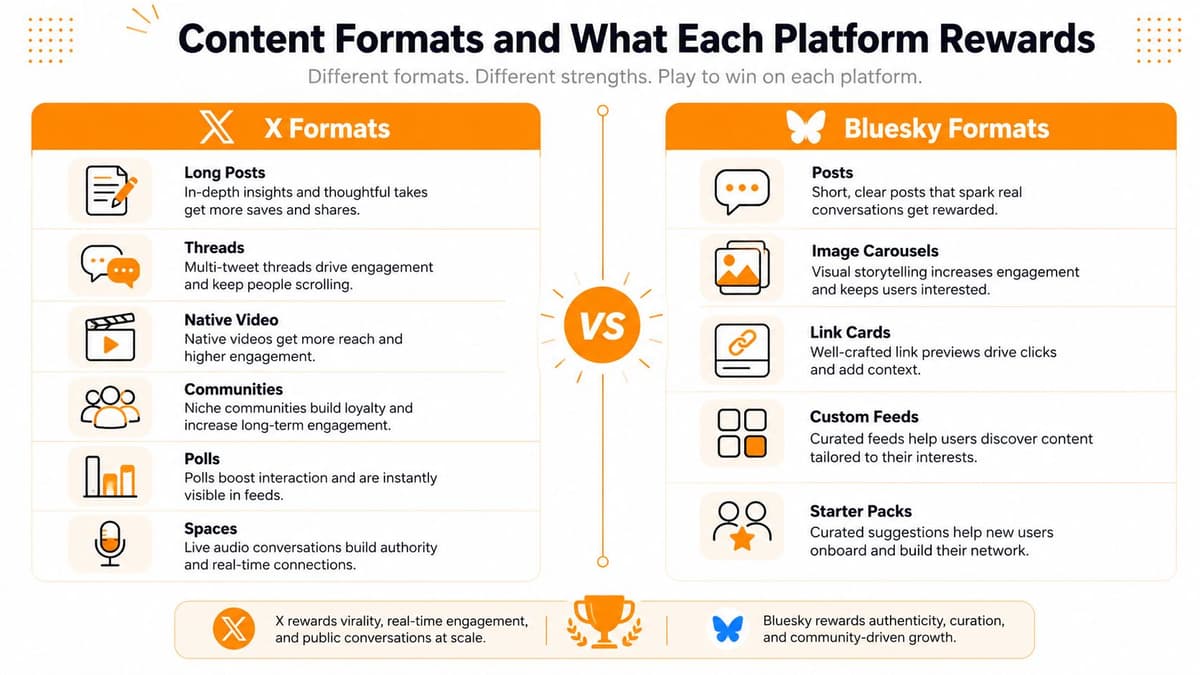
A creator choosing between X and Bluesky is not really choosing a posting app, it is choosing the kind of content that gets traction. X gives you a broad publishing toolkit, including long-form posts, threads, native video, communities, polls, and Spaces, all inside one centralized feed environment. Bluesky stays simpler on the surface, with short posts, longer video posts added later, custom feeds, and community-driven moderation under the AT Protocol.
Format fit matters more than feature count
On X, punchy takes and thread-based storytelling fit naturally. The platform rewards confident opening lines, quick reactions, and posts that invite replies or quote-posts. If your content lives in live commentary, newsy updates, or strong opinions, X is built for that rhythm.
Bluesky fits differently. Niche commentary, screenshots, technical observations, and curated conversations have room to breathe there. Because users can subscribe to custom feeds, your content can get pulled into topic-specific streams without relying on a giant follower base.
For video, match the format to how people consume it. Vertical clips usually fit the mobile-first scroll on both platforms, while horizontal video makes more sense when the content is built for fuller viewing and explanation. A useful guide on that choice is RemotionAI video format insights, especially if you are deciding how much to adapt the same asset for each network.
Useful mental model: X rewards speed and social friction. Bluesky rewards context and topical fit.
The structural edge Bluesky gets too little credit for
The open AT Protocol matters because it gives users portable identity and allows multiple apps or servers to participate in the same ecosystem. Bluesky is not just a cleaner feed, it is a different distribution structure, with more room for feed choice and community-built discovery, as described in SocialKit's platform comparison.
For creators, that changes what format really means. You are not only choosing between a thread and a short post. You are choosing between a centralized ranking system and a network of opt-in feeds. If you want authority, the right format plus the right feed can make a small account feel much larger than it is.
Monetization, Analytics, and What Creators Actually Earn
Money is where the decision gets real. X has native monetization tools, while Bluesky does not yet offer built-in monetization for creators, a gap called out by SocialBee's Bluesky versus Twitter comparison. If your business depends on platform-paid revenue, X is the only clear option right now.
That does not mean Bluesky can't make you money. It usually just makes you money indirectly, through newsletter signups, product interest, high-trust replies, or audience research that sharpens what you sell next.
The monetization split is simple
X offers the more complete direct-revenue stack. Creator subscriptions, ad revenue sharing, tips, and creator revenue share all sit inside the platform's business model, even if individual results vary. Bluesky's value is upstream of money, not inside the app payment flow.
If you want a deeper comparison of how creators think about where social platforms pay, the internal guide on what social media pays the most is worth reading alongside this decision. The short version is that your earning model should drive your platform choice, not the other way around.
Analytics changes how you manage the channel
X's first-party analytics are more mature, which makes it easier to track what your posts are doing without building a separate stack. Bluesky's built-in analytics are lighter, so many creators lean on third-party tracking or simpler manual observation. That's not a dealbreaker, but it does mean X is more operationally complete for creators who manage content like a business.
| Platform | Native Monetization | Analytics Depth | Indirect Revenue Path |
|---|---|---|---|
| X | Yes, multiple native options | More mature first-party analytics | Broader reach into paid offers and monetized content |
| Bluesky | No built-in creator monetization | Lighter built-in analytics | Signups, product launches, and trust-driven conversions |
There's also a mindset shift here. On X, you're often watching for scale and monetized engagement. On Bluesky, you're watching for signal quality, intent, and whether the audience is primed to take a next step. If a post gets fewer raw impressions but brings in better leads, it's still doing the job.
For creators who also use AI-assisted video workflows, ImagineVid's brand video maker face-off is a useful adjacent read, because the same distribution logic applies. Better format fit usually beats bigger reach when your goal is conversion, not just exposure.
Moderation, Community Norms, and Tooling That Saves You Time
X and Bluesky feel different because the rules around moderation, ranking, and community control are different. X is centralized. Bluesky gives more room to community moderation, custom feeds, and user-controlled blocking, which creates a different atmosphere, especially in tech, science, journalism, and creative professional circles.
Tone follows the system
If you want a louder, faster, sometimes rougher distribution environment, X gives you that. If you want a more intentional environment where niche communities can curate their own inputs, Bluesky is usually the cleaner fit. Neither is better in the abstract. The right choice depends on whether your brand can tolerate mess in exchange for scale.
That matters for creators who care about brand safety, and it matters just as much for solo operators who care about mental load. A platform that demands constant moderation attention taxes your time, even when the content performs.
Cross-posting is the sane middle ground
If you already post on X and want a Bluesky presence without doubling your workload, use a tool that mirrors the work for you. MicroPoster is one option in that category. It detects new posts from a source account and mirrors them to X, Bluesky, Threads, and Mastodon, with formatting adapted for threads, hashtags, and link previews. It also offers a 7-day free trial, no credit card required, and cancel anytime.
That setup matters because the hard part is not writing once. The hard part is rewriting the same idea four times under different platform rules. A cross-posting layer lets you keep one source of truth and still show up where your audience is.
A simple operational rule
- Use X for speed: post when timing, commentary, or revenue matters most.
- Use Bluesky for depth: post when niche authority and community tone matter more.
- Use automation for the overlap: let a scheduler or reposting layer handle the duplicate distribution work.
The creator who wins on both platforms usually is not manually juggling both all day. They publish once, adapt intelligently, and spend attention on the content, not the logistics.
Recommendation and Migration Playbook for Creators
If you want the blunt recommendation, here it is. Go X-only if your model depends on maximum reach or direct monetization. Go Bluesky-first if your value comes from niche authority, technical trust, or a concentrated community. Use both if you're like most working creators and don't want to gamble on one channel alone.
The quickest migration path
Start by carrying over the basics. Keep the same avatar, tighten the bio so it reads cleanly on a smaller network, and repost your strongest existing themes instead of trying to reinvent your brand overnight. Then decide which content gets rewritten for platform fit and which content can stay nearly identical.
If you're moving from X into Bluesky, the practical steps are laid out well in MicroPoster's migration guide. The main idea is simple, use one source account, then mirror and adapt instead of maintaining two totally separate habits.
What to watch in the first 30 days
Look at replies, profile clicks, and downstream actions, not vanity metrics alone. If Bluesky gives you better conversations and stronger intent, keep leaning in. If X continues to deliver bigger reach and better revenue, keep it as the main channel.
For most creators, the answer is not a dramatic platform switch. It's a cleaner operating system. Publish once, let the tools do the distribution work, and spend your energy where the audience is converting.
MicroPoster lets you write once and mirror posts to X, Bluesky, Threads, and Mastodon with platform-native formatting, so you can stop duplicating the same update by hand. If you're deciding how to split your time between X and Bluesky, start with a single workflow and test it for yourself with MicroPoster.