threads app growth strategy
8-Point Threads App Growth Strategy for 2026
Unlock explosive growth with our 2026 Threads app growth strategy. Learn 8 actionable tactics for founders and creators to expand their reach and community.
Threads didn't grow like a normal app. It sprinted from 100 million sign-ups in five days to 400 million monthly active users by August 2025, which is a scale curve most social products never touch, let alone sustain The Social Shepherd's Threads statistics roundup. That's the reason a Threads app growth strategy matters now. The winning play isn't chasing one viral post, it's building a repeatable system that turns reach into habit, and habit into a community.
Founders and creators who treat Threads like a conversation layer, not a broadcast slot, tend to get farther. The platform's daily usage, global spread, and reply-heavy behavior make it a different game from Instagram or X, and that changes how you should publish, engage, and automate TechCrunch's report on Threads daily users. If you're looking for investors who understand how social products scale, this database of social media investors is a useful starting point. Keep the goal simple, get to the list quickly, then build a system that saves time while compounding distribution.
1. Multi-Platform Syndication and Cross-Platform Identity
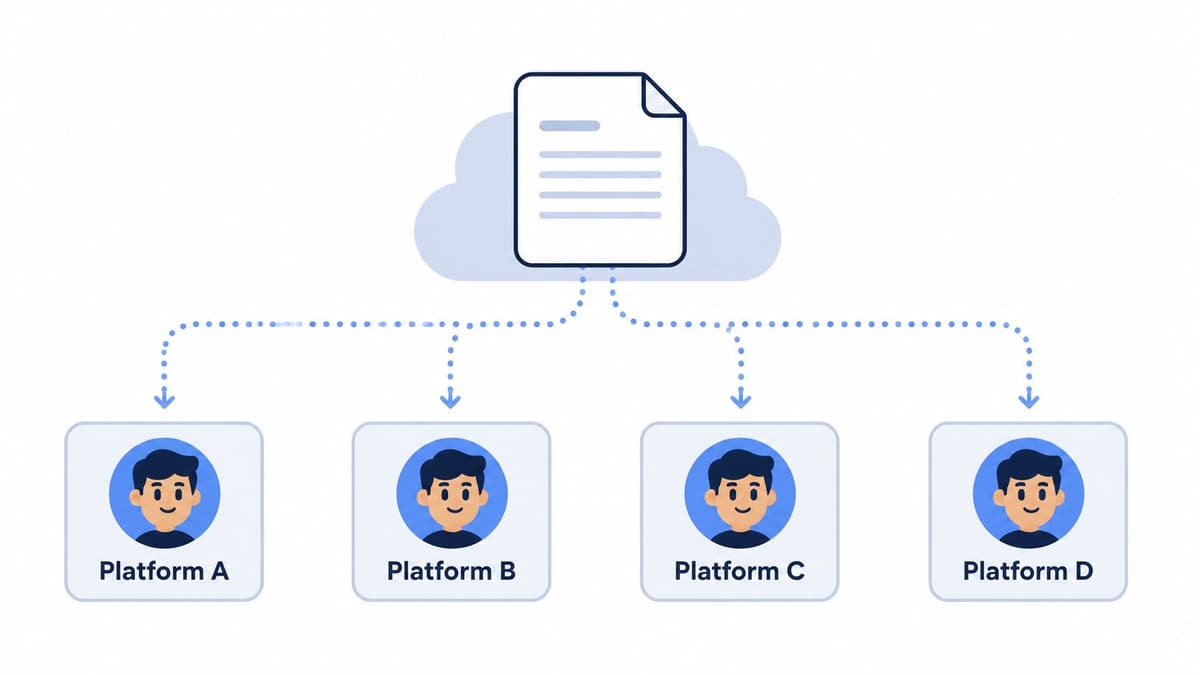
The fastest way to make Threads pull its weight is to stop treating it like an isolated channel. A founder can publish one product update from a single source of truth, then adapt it for Threads, X, Bluesky, or Mastodon without rewriting the core idea from scratch. That keeps momentum high and stops distribution from becoming a second full-time job.
Keep one message, vary the delivery
A developer launching a side project can share the same milestone on Threads and X, but the tone shouldn't be identical. Threads usually works better when the post feels conversational and open-ended, while a more professional network can carry a sharper update or a more formal founder note. The message stays unified, the wrapper changes.
Use your profile bios to make the ecosystem obvious. If someone meets you on Threads and later sees you on another network, they should recognize the same person, product, and point of view immediately. That consistency matters because people rarely discover brands in a straight line anymore.
Practical rule: write once, publish everywhere, but always adapt the final sentence so it feels native to the network.
Tools like MicroPoster's cross-post workflow help you do that without manually copying and pasting all day. You can set one platform as the source of truth, then mirror the post while preserving the voice each network expects. For busy founders, that trade-off is usually worth it, because time saved on distribution can go back into replies and product building.
2. Community-Driven Engagement and Network Effects
Threads rewards people who make other people want to talk. A founder community that shares wins, failures, and hard lessons will usually outlast a feed full of announcements, because the community itself becomes the growth engine. That's the difference between an audience and a network.
The most durable Threads accounts often feel like a recurring room, not a content archive. People come back because they expect to see familiar names, useful disagreements, and specific advice that sounds lived-in rather than polished for broadcast. That's where network effects start to show up in practice.
Build prompts, not just posts
A simple question can outperform a tidy announcement if it gives people room to answer. Instead of publishing a statement that closes the conversation, ask for an experience, a trade-off, or a disagreement. Then reply quickly when the first comments land, because early momentum tells the room that the conversation is alive.
For community builders, recurring formats help a lot:
- Weekly prompts: ask the same kind of question every week so people know when to show up.
- AMAs: use them to surface specific pain points your audience already has.
- Member spotlights: highlight useful replies or standout community members so others feel seen.
MicroPoster's community management guidance is useful if you're juggling multiple conversations and accounts. It's a practical way to keep cadence steady without losing the human side of the work. That matters, because consistency is what makes a Threads community feel dependable instead of random.
3. Strategic Timing and Optimal Post Scheduling
Timing still matters on Threads, but not in the shallow “post at 9 a.m.” way people usually mean. The right timing is the moment your audience is available to reply, not just scroll. If you publish when you're too busy to answer comments, you give up the easiest chance to build early conversation.
Founders should think in local audience habits, not personal convenience. A product update aimed at U.S. startup buyers should land when those people are checking feeds, while a developer announcement for an Indian audience needs a schedule that respects that market's rhythm. Broadly, Threads' audience depth matters because its adoption is globally distributed, with India, Brazil, and the United States identified as top markets by adoption and traffic in recent reporting Sprout Social's Threads statistics.
Test windows, then protect your reply window
Start by posting the same kind of content at different times and watching which windows trigger real replies. Don't just look at impressions. Look at whether people keep the thread alive after the first wave.
A post that lands when you can answer comments for the next 20 minutes usually beats a better post you can't touch.
That's why scheduling matters. A tool with built-in planning and analytics lets you pre-load posts, then free you up to engage when attention is highest. MicroPoster helps with that operationally, especially if you're managing a product launch, a founder account, and a community account at the same time. The goal isn't automation for its own sake. The goal is to remove friction so your best posts don't miss their engagement window.
4. Authentic Personal Branding and Thought Leadership
Threads is a strong fit for people who can sound like a person, not a brand guideline. The accounts that grow tend to show a point of view, not just a content calendar. That's especially true for founders, because people are often more interested in how you think than in polished marketing copy.
The best personal brands on Threads usually feel a little unfinished in the right way. They share conviction, but they also reveal uncertainty, trade-offs, and what changed their mind. That combination builds trust faster than a feed full of abstract advice.
Share the work, not just the wins
If you're a founder, talk about the decision you almost made, not only the decision you shipped. If you're a technical writer, explain the thing you misunderstood before you understood it properly. If you're a creator, show the part of the process that doesn't make the final cut.
A distinctive perspective matters more than trying to sound universally agreeable. Someone should be able to read three posts and know what you care about, where you disagree with the crowd, and what kind of help you're likely to give. That's what turns casual readers into repeat followers.
Engaging with other people's content matters just as much as posting your own. If you want thoughtful replies on your work, you need to be the kind of account that leaves thoughtful replies on others' work. That social pattern is what makes thought leadership feel earned instead of self-declared.
For writers and authors especially, Storyloft's author resources are a solid reference point for building an audience around voice and expertise. The broader lesson holds across niches, though. Be recognizable, be specific, and sound like you've done the work.
5. Thread-Based Content Architecture and Long-Form Storytelling
Threads gives you more room than a single-snack-post platform, and smart founders use that room to build narrative. A thread can carry a tutorial, a founder lesson, a product breakdown, or a lesson learned from a failed launch. That structure keeps people reading because the next post feels like a continuation rather than a repeat.
One useful pattern is problem, tension, resolution. Start with a reason someone should care, then break the idea into steps or decisions that create momentum. When a reader can see a clear path through the posts, they're more likely to keep going and engage along the way.
Write the skeleton before you publish
A good thread usually has a clear opening hook, a few natural turning points, and a finish that doesn't collapse too early. If you're teaching something, don't dump all the value in the first post. Leave enough open space that people need the next post to complete the idea.
Use visuals where they help comprehension, not just decoration. Screenshots, diagrams, and clean product images can make a multi-post story easier to follow, especially when the topic is technical or procedural. Planning that structure in advance also reduces the chance you'll ramble halfway through.
Drafting tools matter here because thread writing is closer to outlining than posting. MicroPoster can help you organize connected posts before they go live, which is useful when you're trying to build a cleaner narrative flow. A founder explaining a product pivot, for example, can map the sequence first, then publish with less friction and fewer half-finished ideas.
6. Data-Driven Content Optimization and Audience Insights
Good Threads growth usually comes from treating each post like a small experiment. You don't need a giant analytics stack to learn what works, but you do need discipline. Track what got replies, what got reposts, what made people visit your profile, and what caused the conversation to stall.
The most important shift is to evaluate engagement quality, not just volume. A feed with a lot of passive likes can look healthy while failing to create real distribution. Reply-heavy posts tell you what your audience wants to discuss, which is usually more valuable than raw reach.

Read comments like product feedback
Comments are not just reactions. They tell you what readers misunderstood, what they want more of, and what they're willing to debate. If one post pulls in practical questions and another pulls in agreement without discussion, that difference matters.
Use that signal to sharpen your content mix. A technical creator might find that deep breakdowns invite more useful replies than quick tips. A founder might discover that behind-the-scenes updates create better conversation than polished announcements. The point is not to guess forever. The point is to learn quickly, then repeat what the audience responds to.
A short comment-analysis workflow can save a lot of time here, especially if you're publishing often. MicroPoster's AI tools help surface patterns in replies and keep the learning loop tight. When you're busy, that kind of feedback loop is the difference between posting more and improving more.
7. Strategic Collaboration and Network Expansion Through Partnerships
Collaboration works on Threads because audiences already expect conversation. A smart partnership doesn't feel like an ad swap. It feels like two credible people having a useful exchange in public, which gives both sides more context and more reach.
The best partners are not random big accounts. They're adjacent voices whose audience already cares about the problem you solve. A startup operator, a design educator, and a tooling creator can all benefit from a shared thread if the topic is narrow enough and useful enough.
Start small, then build trust
Before asking for a co-created thread, spend time showing up in someone else's replies. That makes the eventual ask easier, because you're not appearing from nowhere with a transactional request. You're already part of the conversation.
Good collaboration formats include joint Q&As, linked commentary on the same topic, and cross-promoted insights from two different angles. A founder can partner with a niche educator to unpack a product category. A creator can join another creator to answer audience questions from both communities. The best collaborations create something neither account could have made alone.
Practical rule: if the audience overlap is too broad, the collaboration gets blurry. If it's too narrow, nobody benefits. Pick partners whose followers would actually care about the same conversation.
That balance matters more than sheer follower count. A smaller, aligned audience will often outperform a bigger, indifferent one because the replies are more relevant and the sharing feels natural. Collaboration should add energy to your Threads presence, not just decorate it.
8. Incentivized User-Generated Content and Community Co-Creation
User-generated content turns followers into participants, and participants are much easier to retain than passive readers. If you want the community to help you grow, give people a simple way to contribute something recognizable. That can be a story, a screenshot, a build update, or a before-and-after result.
The strongest prompts usually lower the effort required to join. People shouldn't have to guess what to post, where to post it, or why it matters. The clearer the submission path, the more likely they are to take part.
Make contribution feel worth the effort
Recognition works better than empty exposure. Feature the best submissions, reply to the ones with useful details, and show that you're paying attention to the people doing the work. If you're running a founder community, ask members to share what they're building. If you're a creator, ask followers how they use your framework in real life.
A simple hashtag or a specific submission format can help you aggregate responses without making the process feel rigid. Once the first few people contribute, the rest of the community sees what good participation looks like and follows the pattern more easily.
This is also where light automation helps. You don't need to manually chase every contribution if your publishing and scheduling system keeps the campaign visible. Tools like MicroPoster make it easier to maintain cadence while you focus on the human side, which is the part that builds loyalty.
8-Point Threads Growth Strategy Comparison
| Strategy | 🔄 Implementation Complexity | ⚡ Resource Requirements & Efficiency | 📊 Expected Outcomes | Ideal Use Cases | ⭐ Key Advantages |
|---|---|---|---|---|---|
| Multi-Platform Syndication & Cross-Platform Identity | Medium, initial setup and rule configuration | Requires syndication tools + profile management; very fast distribution | Broader reach, unified analytics, cross-platform follower growth | Product launches, creators managing multiple networks | Saves time, consistent branding, redundancy across platforms |
| Community-Driven Engagement and Network Effects | High, continuous moderation and community nurturing | High time investment; slower growth but high retention efficiency | Loyal user base, strong organic word-of-mouth growth | Niche communities, long-term audience building | Authentic engagement, resilience to algorithm changes |
| Strategic Timing and Optimal Post Scheduling | Medium, data analysis and scheduling setup | Analytics + scheduling tools; increases posting efficiency and velocity | 20–40% uplift in engagement; improved algorithmic visibility | Global audiences, time-sensitive announcements, recurring content | Higher engagement rates, consistent 24/7 presence |
| Authentic Personal Branding and Thought Leadership | Medium, consistent authentic output and engagement | Time-intensive personal effort; slower scale but high-quality returns | Deep trust, higher per-post engagement, partnership opportunities | Founders, experts, long-term reputation building | Defensible audience moat, stronger loyalty and opportunities |
| Thread-Based Content Architecture and Long-Form Storytelling | Medium, planning multi-post narratives and flow | Requires drafting and visual assets; increases time-on-platform per audience | Longer engagement sessions, bookmarks, sequential reading | Tutorials, detailed analyses, storytelling series | Multiple touchpoints, effective for teaching and retention |
| Data-Driven Content Optimization and Audience Insights | Medium–High, data collection, analysis, and iteration | Analytics, sentiment tools, A/B testing; iterative but scalable | Improved content ROI, discovery of high-performing formats | Growth-focused creators, marketers, hypothesis-driven teams | Removes guesswork, compounds improvements over time |
| Strategic Collaboration and Network Expansion Through Partnerships | Medium, partner vetting and coordination | Time to find/coordinate partners; can rapidly amplify reach | Faster audience acquisition, diversified exposure | Co-authored content, cross-promotion, joint events | Accelerates growth, shared effort, broadens audience |
| Incentivized User-Generated Content and Community Co-Creation | Medium, campaign design, incentives, moderation | Requires incentives, curation and moderation; scales content volume | Increased UGC, social proof, extended organic reach | Product communities, contests, hashtag campaigns | Boosts content volume, strengthens community bonds |
Your Next Move From Strategy to Execution
You don't need to do all eight things at once. That's how founders burn out and creators lose momentum. Start with one or two levers that fit your current capacity, then make them boringly consistent. On Threads, the accounts that keep showing up with useful replies, clear positioning, and repeatable formats usually outlast the accounts that chase every trend.
The practical order is simple. Tighten your cross-platform identity, build one community habit, then publish posts that invite replies. After that, layer in scheduling, thread structure, and collaboration once you know what kind of content your audience wants. If you're paying attention, the platform gives you enough feedback to improve fast.
The constraint for many users isn't ideas. It's time. That's where automation becomes a strategic advantage instead of a convenience. A tool like MicroPoster can handle cross-platform syndication, scheduling, and content adaptation so you're not manually copying posts while your best ideas go stale. That matters even more if you're trying to run a startup, ship product, and stay visible on Threads at the same time.
Start your 7-day free trial and use it to turn one good Threads habit into a repeatable operating system. If you already know your audience and you're serious about growing, this is the kind of tool that keeps distribution from becoming the bottleneck.
MicroPoster helps you write once and grow everywhere, which is exactly what a serious Threads app growth strategy needs. It handles cross-posting, scheduling, and smart adaptation so you can stay active on Threads without living inside the app. Visit MicroPoster and see how much easier consistent growth feels when distribution runs in the background.