what is a content calendar
What Is a Content Calendar? Your Secret Weapon for Growth
Uncover what is a content calendar and how it transforms random posts into a growth strategy. Learn to plan, schedule, and automate your content for 2026.

Let's be honest: what's your content creation process really like? If it involves staring at a blinking cursor, desperately trying to think of something clever to post, you’re not alone. This is the daily scramble for so many creators and founders.
A content calendar is your way out. It’s a simple, visual plan for all your upcoming content, turning that daily chaos into a powerful, coordinated strategy. It's the difference between just making noise online and actually building something meaningful.
Your Blueprint for Consistent Content Creation
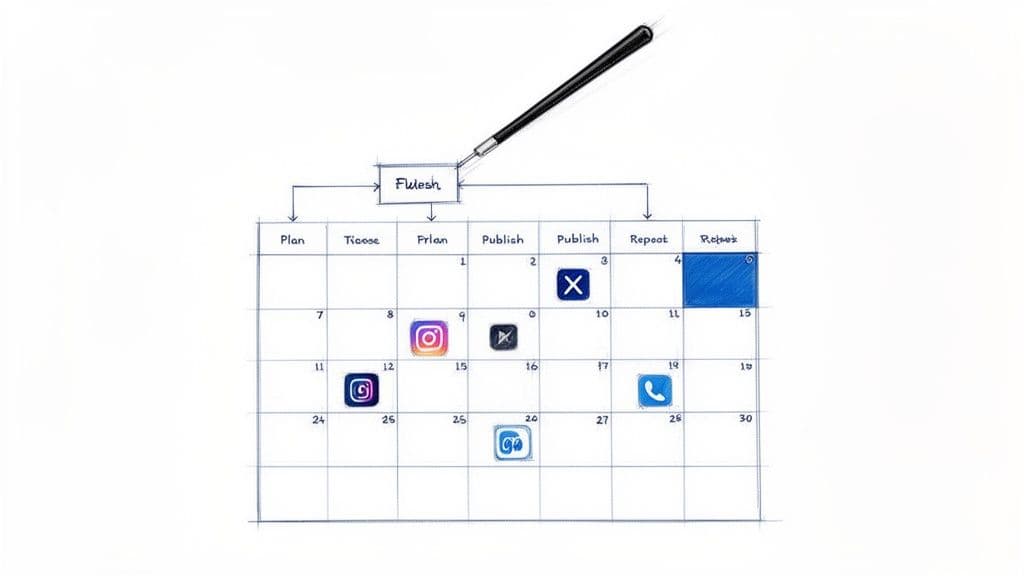
Think of it like building a house. You wouldn't just start nailing boards together and hope it turns into a home, right? You'd start with a blueprint. A content calendar is that blueprint for your brand's presence on platforms like X, Bluesky, and Mastodon.
Without one, you're just guessing—posting on a whim and praying something sticks. But with a plan, every piece of content has a purpose. It stops being a frantic daily chore and becomes a reliable system for growing your audience.
The struggle to stay consistent is real, especially when you're wearing multiple hats. A content calendar directly addresses this pain by shifting your focus from "what do I post today?" to "what story are we telling this month?" This simple change in perspective can be a game-changer.
Here's a quick look at the transformation it brings.
From Content Chaos to Strategic Clarity
| Problem Without a Calendar | Solution With a Calendar |
|---|---|
| Last-minute panic to find content ideas. | Ideas are planned and batched in advance. |
| Inconsistent posting schedule hurts engagement. | Consistent schedule builds audience trust and reach. |
| Content feels random and disconnected. | Posts align with a cohesive brand story and goals. |
| Wasted time and mental energy every day. | Creative energy is freed up for high-value tasks. |
| Missed opportunities for launches or events. | Key dates are mapped out, with content built around them. |
As you can see, it’s not just about getting organized; it's about reclaiming your time and making your efforts count.
The Shift to Smarter Planning
The days of haphazard posting are over. In fact, a recent survey found that over 75% of businesses worldwide now rely on a content calendar. This isn't just a trend; it's a fundamental shift toward working smarter, not harder.
A great content calendar becomes your single source of truth. It’s where your goals, messages, and schedule all come together, giving you the clarity to create with confidence, not stress.
For a busy founder, this clarity is everything. A well-built calendar helps you:
- Maintain a strong presence across platforms without burning out.
- Align every post with your bigger business goals, from product launches to brand campaigns.
- Free up precious mental space so you can focus on what you do best—creating amazing content.
Ready to build a system that works for you? Learning how to create an effective social media content calendar is the first, most critical step toward turning your content into a predictable growth machine.
How Strategic Planning Unlocks Explosive Growth
So, you know what a content calendar is. But let's get to the good stuff: what can it actually do for you? Think of it less like a simple schedule and more like a roadmap that turns your random daily posts into a powerful engine for growth.
We’ve all been there—staring at a blank screen, frantically trying to figure out what to post. A content calendar gets you off that hamster wheel. By planning your content in advance, you stop reacting to the day and start building a brand with intention.
This is the secret to showing up consistently on platforms like X, Threads, and Bluesky without completely burning out. It’s how you move from scrambling for ideas to strategically building a presence.
From Consistency to Credibility
Showing up consistently does more than just fill your feed. For your audience, it builds trust and reliability. They start to learn what to expect from you, and they keep coming back for it.
More importantly, the algorithms notice. Social platforms are designed to promote creators who are active and dependable. A steady stream of content—made simple with a calendar—tells the algorithm you’re serious, which can lead to a real boost in your reach over time.
A content calendar isn't about filling a schedule; it's about building momentum. Each planned post is a brick, and consistency is the mortar that turns those bricks into an unbreakable foundation for your brand.
The Power of Data-Driven Productivity
This isn't just a gut feeling; planning ahead gets real results. Recent studies show that marketers who use a content calendar are 30% more productive than those who don't. That’s time you get back to focus on big-picture strategy instead of putting out daily fires.
Even better, the same research found that brands scheduling their posts see 40% higher engagement rates. Your content simply performs better when it's part of a thought-out plan.
A solid calendar is also your command center for managing multiple accounts. When you use a tool like MicroPoster.so, you can lay out your entire strategy visually and then put the actual posting on autopilot. You write the content once, and your plan works behind the scenes to grow your presence everywhere. You can dive deeper into creating a winning plan with our guide on content strategy for social media.
The Building Blocks of a Powerful Content Calendar
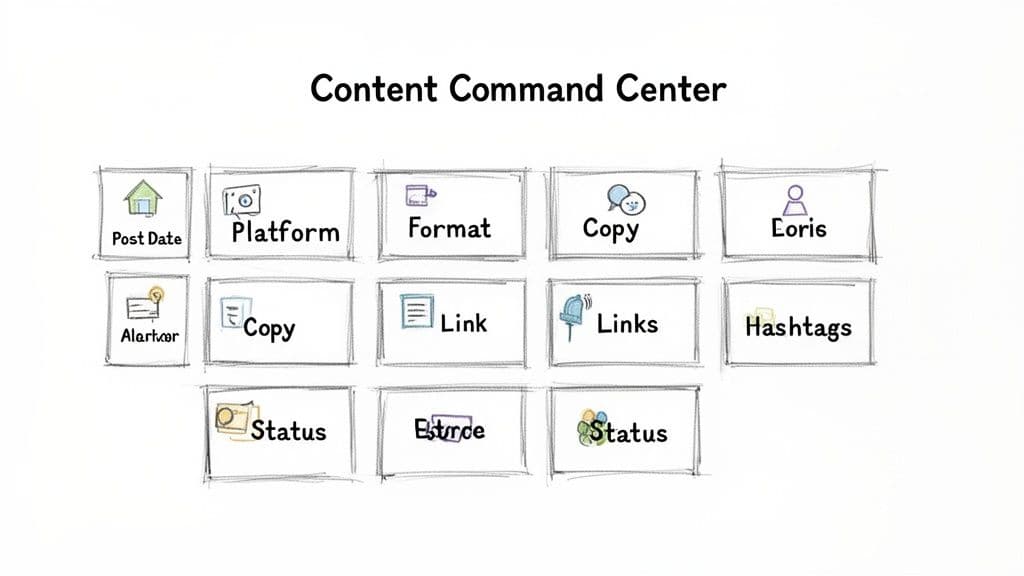
A great content calendar is so much more than a simple list of post ideas and dates. It's your personal content command center, holding all the mission-critical details you need to publish consistently without driving yourself crazy.
Think of it this way: you wouldn't try to fly a plane without a flight plan. Your calendar is that flight plan. It ensures every piece of content has a purpose, a destination, and all the necessary components for a smooth takeoff. For founders juggling a dozen other tasks, that kind of clarity isn't just nice to have—it's essential.
The Essential Calendar Components
So, what information actually goes into a high-performing calendar? It's not just a schedule; it’s a living document that tracks your content from a rough idea all the way to a published post. Here are the non-negotiables:
- Publication Date & Time: This is the absolute foundation. It’s the skeleton you’ll build everything else around.
- Target Platform(s): Where is this going? X, Bluesky, or Mastodon? Knowing the destination helps you tailor the message.
- Content Format: Is it a single punchy post, an in-depth thread, a quick poll, or a video? Decide this upfront to avoid scrambling later.
- The Actual Copy: This is the heart of it. Write the full text here so you aren't trying to be creative on the fly.
- Media & Links: Drop in the exact image, video file, or URL that needs to go with the post. No more hunting for assets at the last minute.
- Strategic Hashtags: Plan your hashtags ahead of time to maximize your reach and tap into relevant conversations.
Your content calendar should be your single source of truth. It’s the one place you can go to see exactly what’s happening, when it’s happening, and why. This eliminates the guesswork and gives you the confidence to execute your plan perfectly.
From Draft to Published
Now, here’s a pro tip that many people miss: add a status tracker. This one simple column transforms your calendar from a static list into a dynamic workflow.
With labels like ‘Draft,’ ‘Needs Approval,’ or ‘Scheduled,’ you get an instant overview of your entire pipeline. You can see what needs work, what's ready to go, and what's already in the queue. For solo founders and small teams, this prevents things from ever falling through the cracks.
This is exactly why a tool like MicroPoster.so integrates this visual workflow directly. It connects your plan to automated execution, creating a genuinely seamless process from start to finish.
Choosing Your Calendar: From Spreadsheets to True Automation
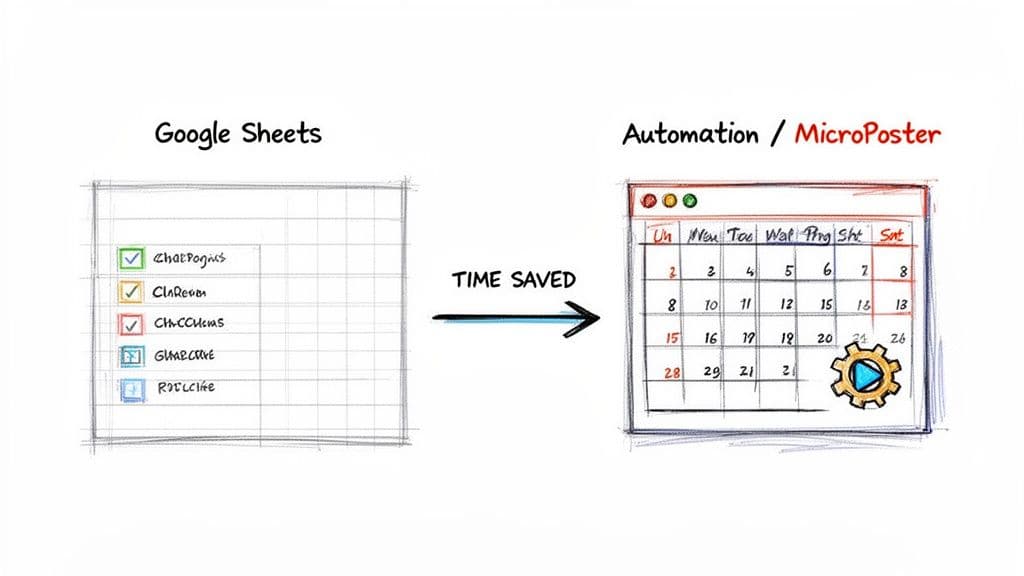
When you're just getting your feet wet, a simple spreadsheet in Google Sheets or Excel feels like the perfect tool for a content calendar. It’s free, you already know how to use it, and it does the basic job of organizing your post ideas and dates. It's the classic DIY approach, and honestly, it’s where most of us start.
But that DIY spirit can quickly turn into a grind. The manual labor piles up faster than you’d think. You're constantly copying and pasting every post, manually uploading every single image, and hopping between browser tabs just to publish your content everywhere. Before you know it, the spreadsheet that was supposed to help you becomes a bottleneck, chaining you to the very repetitive tasks you were trying to escape.
Moving From Just Planning to Actually Doing
This is the point where you start looking for dedicated tools. But be careful—many of them are just prettier spreadsheets that still leave all the heavy lifting to you. The real breakthrough comes from automation. We're talking about tools that don't just help you plan the work but actually do the work for you.
The purpose of a great tool isn't just to organize your ideas; it's to execute them. True efficiency comes from turning your plan into action with minimal manual effort.
This is the exact problem we built MicroPoster.so to solve. It’s not just another calendar; it's a full-blown automation engine built for ambitious founders and creators who value their time.
Instead of just staring at a to-do list, MicroPoster executes it. Its visual calendar is wired directly into a powerful "write once, grow everywhere" system. You can get a deeper look into the mechanics by reading our guide on how to schedule social media posts.
The Automation Advantage
This screenshot shows the visual calendar inside MicroPoster, where your entire schedule is laid out clearly.
What you're seeing isn't just a plan; it’s a living, breathing system that handles your distribution across X, Threads, and Bluesky automatically. While a spreadsheet only tells you what to post, MicroPoster takes that idea and does the rest:
- Auto-threading: It intelligently breaks down long-form content into perfectly formatted native threads for each platform. No more counting characters.
- AI Enhancements: Need to sharpen your message? It helps you refine your copy to make sure it lands with impact.
- Cross-platform Publishing: It takes your core content and mirrors it across all your connected accounts, saving you from the copy-paste-upload cycle.
This direct link between planning and execution is a game-changer. It frees up countless hours, letting you get back to what you do best—creating great content, not just managing it. It’s the logical next step up from a simple calendar.
How to Build Your First Microblogging Content Calendar
Alright, enough theory. Knowing what a content calendar is doesn't get posts on the page. Let's get our hands dirty and build your very first calendar, specifically for the rapid-fire world of microblogging on platforms like X, Bluesky, and Mastodon.
Building a functional calendar is far less intimidating than it sounds. It’s not about finding the perfect, complex software; it’s about creating a simple framework that makes your content feel deliberate and, frankly, easier to create. We can get it done in three straightforward steps.
Step 1: Define Your Content Pillars
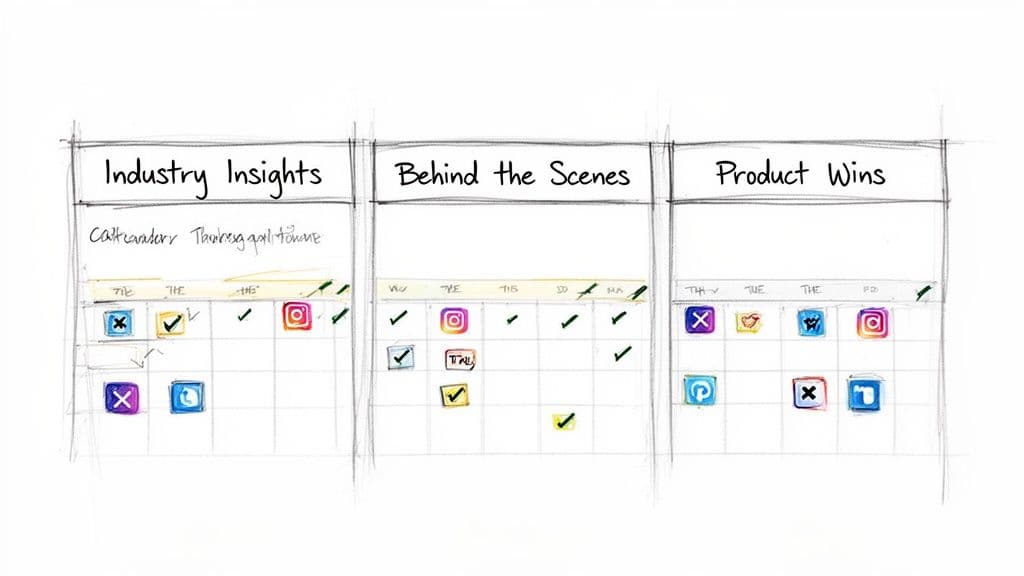
First things first: you need to decide what you're going to talk about. Your content pillars are the 2-4 core topics that define your brand's voice and expertise. Think of them as the recurring columns in your own personal online magazine—they give your audience a reason to follow and keep coming back.
For a founder, creator, or small business owner, your pillars might look something like this:
- Industry Insights: Your unique perspective on news, trends, and what's next.
- Behind the Scenes: Pulling back the curtain on your process, challenges, and wins.
- Product Spotlights: Highlighting how customers succeed with your product or service.
- Community Q&A: Answering questions directly and showing you’re listening.
With these pillars in place, the dreaded "What should I post today?" question disappears. Instead, you just ask, "Which pillar am I focusing on today?"
Step 2: Set a Realistic Posting Frequency
Here’s a hard truth: consistency beats volume, every single time. Don't fall into the trap of promising yourself you'll post seven days a week if you know it isn't sustainable. It's infinitely better to publish three high-quality, planned posts per week than to scramble for seven random ones.
Take an honest look at your schedule. A fantastic starting point is to commit to posting every Monday, Wednesday, and Friday. This establishes a predictable rhythm for both you and your audience.
The real magic of a content calendar is how it turns your lofty goals into a simple, repeatable system. Start small, build the habit, and watch consistency become your biggest advantage.
Step 3: Create Your Content Mix and Schedule
Now, let's put it all together. This is where you combine your pillars (Step 1) with your frequency (Step 2) to create a balanced feed that keeps your audience engaged. A varied mix prevents your content from feeling stale or overly promotional.
Sample Weekly Microblogging Schedule
Use this template to plan a balanced content mix for your week. This structure is easily managed and automated with a tool like MicroPoster.
| Day | Content Pillar | Example Post Idea | Target Platform(s) |
|---|---|---|---|
| Monday | Industry Insights | "Here's my hot take on the latest AI announcement and what it really means for our industry..." | X, Bluesky |
| Tuesday | Behind the Scenes | "A quick look at the whiteboard session where we mapped out our next big feature. It's messy but exciting!" | Mastodon, X |
| Wednesday | Community Q&A | "Someone asked how we handle X. Great question! Here’s a thread on our approach..." | Bluesky, X |
| Thursday | Product Spotlight | "Shoutout to Customer Y for achieving Z with our tool! Here’s how they did it." | X, Mastodon |
| Friday | Industry Insights | "Weekend reading: A deep-dive article I found fascinating and think you will too." | Bluesky |
This simple plan is incredibly powerful. Once you have this structure, you can use a scheduler to load these posts weeks in advance, taking the daily pressure off your shoulders. For those focusing on professional networking, adapting a LinkedIn content calendar template can also provide a great structural starting point.
Answering Your Content Calendar Questions
Getting started with a content calendar always brings up a few practical questions. It's one thing to understand the concept, but another to make it work for you. Let's tackle some of the most common hurdles so you can get started with confidence.
What Is the Best Tool for a Content Calendar?
Honestly, the best tool is the one you’ll actually stick with. When you're just starting out, something as simple as a Google Sheet or even a physical wall planner can work wonders. They’re free and give you a great visual overview of your week.
But as you scale, the manual labor of copying, pasting, and posting across different platforms becomes a serious time-suck. That's when you'll feel the need for a tool that does the heavy lifting.
The real magic happens when your calendar doesn't just show you the plan, but actually executes it for you. The goal is to automate the grind so you can get back to what matters: creating great content.
This is exactly why we built MicroPoster.so. It’s a visual calendar fused with powerful "write once, grow everywhere" automation. You map out your posts, and it handles the scheduling, threading, and cross-posting to X, Threads, and Bluesky. This can easily save you hours of manual work every single week.
How Far in Advance Should I Plan My Content?
A great starting point is planning one to two weeks in advance. This gives you enough runway to create thoughtful, high-quality content without feeling overwhelmed. Critically, it also leaves you flexible enough to jump on timely news or a trending topic.
Once you get into a good rhythm, try extending your planning to a full month. Planning a month at a time helps you see the bigger picture, align your content with product launches or marketing campaigns, and batch-create your posts for maximum efficiency.
How Often Should I Post on Social Media?
Remember this: consistency trumps frequency. It’s far better to publish three high-quality, engaging posts per week than it is to push out seven rushed, low-effort ones.
Start with a realistic schedule you know you can commit to, like posting every Monday, Wednesday, and Friday. This creates a predictable rhythm that your audience can look forward to and, just as importantly, prevents you from burning out. Once that habit is locked in, you can always increase your posting frequency if your strategy calls for it.
Ready to stop scrambling and start growing? A solid content calendar is your roadmap, and MicroPoster is the engine that drives it forward. Stop wasting time on the manual posting treadmill and start building your audience on autopilot.
Try MicroPoster free for 7 days and see how effortless multi-platform growth can be.