social media strategy example
10 Powerful Social Media Strategy Example Breakdowns for 2026
Unlock growth with our deep dive into a powerful social media strategy example for creators and brands. Get 10 replicable plans for X, Bluesky, & more.
Tired of generic social media advice that doesn't deliver results? Growing on platforms like X, Bluesky, and Mastodon demands more than just posting and hoping for engagement. It requires a clear, repeatable plan built on proven tactics. This guide moves beyond abstract theory to provide a deep dive into 10 powerful social media strategy example blueprints you can implement today.
Each playbook is broken down into its core components, including clear objectives, target audience analysis, defined content pillars, key performance indicators (KPIs), and a practical measurement plan. We’ll dissect specific, replicable strategies ranging from long-form thread storytelling and niche authority building to data-driven post optimization and engagement-first community management.
Whether you're an independent creator building a personal brand, a small business seeking organic growth, or an agency managing multiple client accounts, these examples are designed to be adapted and executed immediately. We'll also provide quick workflow tips for each social media strategy example, showing how tools like MicroPoster can help you schedule content, create templates, and cross-post efficiently. Forget random acts of content; it's time to build a predictable growth engine for your social media presence.
1. Thread Strategy (Long-Form Storytelling)
A thread strategy transforms a microblogging platform like X (formerly Twitter) into a powerful medium for long-form storytelling. Instead of a single, character-limited post, you create a connected series of posts that breaks down complex ideas, tells a compelling story, or shares in-depth expertise. This social media strategy example is highly effective for building authority and engaging audiences who crave substance beyond surface-level updates.
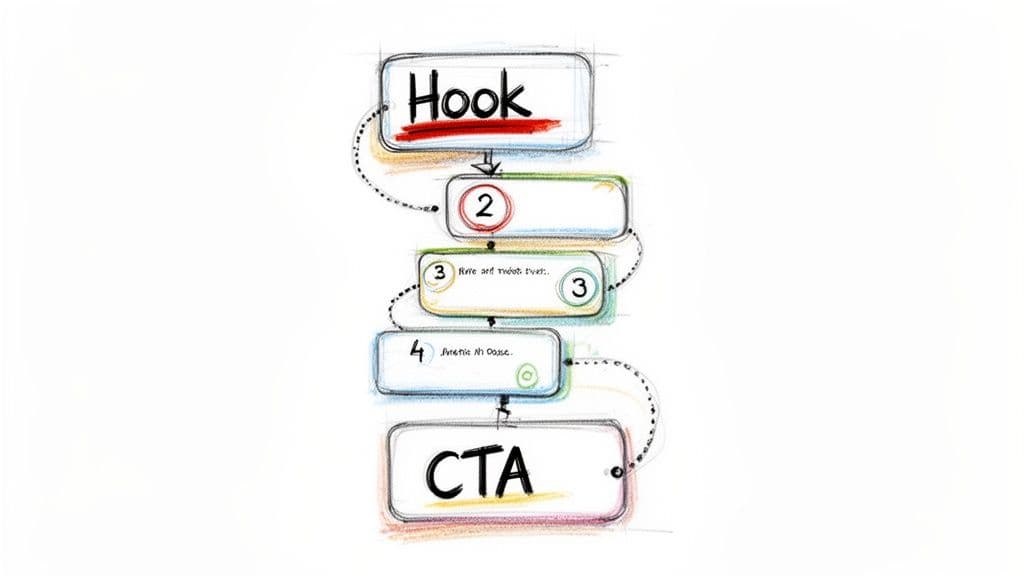
The core principle is to maintain reader momentum. Each post in the chain acts as a stepping stone, drawing the user deeper into the narrative. This method was popularized by thought leaders like Naval Ravikant, who uses threads to distill profound wisdom on wealth and happiness, and has been adopted by creators like Mark Roberstein to explain intricate business concepts clearly.
Why It Works
This strategy excels because it respects the platform's format while delivering high-value content. Threads are more discoverable than a blog link, as the entire story unfolds within the native feed. This increases engagement metrics like time on post, replies, and shares, signaling to the algorithm that your content is valuable.
How to Implement a Thread Strategy
- Start with a Powerful Hook: Your first post must create intrigue and clearly state the value the reader will get by continuing. It needs to be compelling enough to earn the "Show more" click.
- Maintain a Clear Structure: Number your posts (e.g., 1/10) to help readers track their progress. Each post should be concise yet provide a complete thought, ending with a soft cliffhanger that encourages scrolling to the next part.
- End with a Strong CTA: The final post should summarize the key takeaway and include a call to action. This could be asking a question, promoting a newsletter, or linking to a full resource. For a deeper dive, you can learn how to write long-form articles on X.
MicroPoster Workflow Tip
Use MicroPoster’s thread builder to draft, preview, and schedule your entire thread in advance. This ensures a seamless flow and helps you visualize the reader's journey from hook to CTA before publishing.
2. Consistent Daily Posting (Content Cadence)
A consistent posting strategy is built on the principle of reliability. This approach prioritizes establishing a predictable publishing schedule to keep your account active, build audience habits, and maintain favor with social media algorithms. This social media strategy example isn't about posting constantly, but about showing up regularly, whether that’s daily, three times a week, or on specific days, creating an expectation your followers can count on.

The core idea is to become a dependable source of value. By appearing in your audience's feed consistently, you build trust and stay top-of-mind. This method has been mastered by thought leaders like James Clear and Naval Ravikant, who deliver insights on a regular basis, and by brands like Buffer, who have built their authority by consistently sharing social media expertise.
Why It Works
This strategy thrives on the compounding effect of visibility and habit. Social media algorithms tend to favor active accounts, increasing your content's reach. For your audience, a consistent schedule transforms your profile from a random source into a go-to destination, making them more likely to engage with your content regularly.
How to Implement a Content Cadence Strategy
- Define a Realistic Schedule: Start with a manageable frequency, like 3-5 high-quality posts per week. Consistency is more important than volume, so choose a cadence you can sustain without sacrificing quality.
- Batch Your Content: Dedicate a block of time each week to write and plan your posts for the upcoming week or two. This reduces the daily pressure of creating content on the fly and prevents gaps in your schedule.
- Balance Your Content Mix: Plan your posts around different themes or "pillars." A common mix is 40% valuable insights, 30% questions to spark conversation, 20% curated links, and 10% direct engagement or replies.
MicroPoster Workflow Tip
Use MicroPoster’s scheduling calendar to plan and batch your content weeks in advance. The platform's insights can help you determine the best times to post for maximum visibility, ensuring your consistent efforts reach the largest possible audience. Set aside 15 minutes daily just for engaging with replies on your scheduled posts.
3. Engagement-First Commenting Strategy
An engagement-first commenting strategy flips the traditional social media model on its head. Instead of prioritizing broadcasting your own content, you dedicate significant time to leaving thoughtful, value-adding comments on other creators' posts within your niche. This social media strategy example is about building your network and authority by becoming a recognized voice in existing conversations, which in turn drives visibility back to your own profile.
The core principle is to treat every comment as a micro-piece of content. It’s not about generic replies like "great post"; it's about adding insight, asking intelligent questions, or offering a unique perspective. This method has been a growth cornerstone for creators like Ali Abdaal and Lenny Rachitsky, who built immense credibility by consistently contributing to conversations long before they had massive followings of their own.
Why It Works
This strategy is powerful because it aligns directly with platform algorithms that reward genuine interaction. By engaging meaningfully, you not only build relationships with other creators but also expose your profile to their highly relevant audiences. Your insightful comments act as a "top-of-funnel" for your own content, attracting followers who are already interested in your expertise and perspective. It's a method of borrowing an audience's attention to build your own.
How to Implement an Engagement-First Strategy
- Identify Key Accounts: Curate a list of 20-50 creators and thought leaders in your niche. Focus on accounts with high engagement rather than just high follower counts, as their audiences are more likely to participate in discussions.
- Add Genuine Value: Your goal is to make the original post even better. Share a related experience, ask a clarifying question that sparks deeper thought, or offer a respectful counter-argument. Make your comment a reason for others to stop scrolling.
- Be Consistent, Not Spammy: Dedicate a specific block of time each day (e.g., 30 minutes) to this activity. Consistency is more important than volume. Focus on contributing to 10-15 high-quality conversations daily rather than leaving 100 low-value replies.
MicroPoster Workflow Tip
Use MicroPoster’s content discovery features to monitor keywords and track conversations from key accounts in your niche. This allows you to find relevant posts to engage with quickly without endlessly scrolling through your feed, making your commenting time far more efficient.
4. Data-Driven Post Optimization (A/B Testing)
A data-driven post optimization strategy, also known as A/B testing, moves social media management from guesswork to a scientific process. Instead of posting content and hoping for the best, you systematically test variations of your posts to identify exactly what resonates with your audience. This social media strategy example is about using performance metrics to refine your approach and scale successful content patterns.
The core principle is isolating variables to understand their impact. You might test different hooks, calls to action (CTAs), imagery, post formats, or even posting times. This methodical approach was popularized by tech companies and growth marketing communities like Buffer and ConvertKit, who openly share results from their experiments to help others optimize their own content for maximum engagement and reach.
Why It Works
This strategy is powerful because it replaces assumptions with evidence. By testing, you learn your audience's preferences directly, leading to higher engagement rates, better reach, and a more efficient content creation process. The insights gained from A/B testing allow you to create a predictable and repeatable system for generating high-performing content, making it an invaluable tool for sustainable growth.
How to Implement a Data-Driven Strategy
- Isolate a Single Variable: To get clean data, test only one element at a time. For instance, post the same content with two different hooks or the same hook with two different images. This ensures you can attribute performance changes accurately.
- Define Your Success Metric: Know what you are measuring before you start. Are you optimizing for clicks, replies, shares, or reach? Your key performance indicator (KPI) will determine which post variation is the "winner."
- Track and Analyze Results: Use a simple spreadsheet or analytics tool to log each test's variables and results. Over time, you'll identify clear patterns, such as "question-based hooks increase replies by 30%" or "posts with statistics get 2x more shares."
MicroPoster Workflow Tip
Leverage MicroPoster’s virality and readability scores to pre-test your messaging. Before publishing, you can create two drafts of a post with different hooks and compare their scores to predict which one might perform better, saving you time in the live testing phase.
5. Cross-Platform Content Repurposing
A cross-platform repurposing strategy involves creating a core piece of content once and intelligently adapting it for multiple microblogging platforms like X, Bluesky, and Mastodon. This approach maximizes your content's ROI by reformatting the same message to fit each network's unique audience, norms, and features. It’s a social media strategy example designed for efficiency without sacrificing native platform appeal.
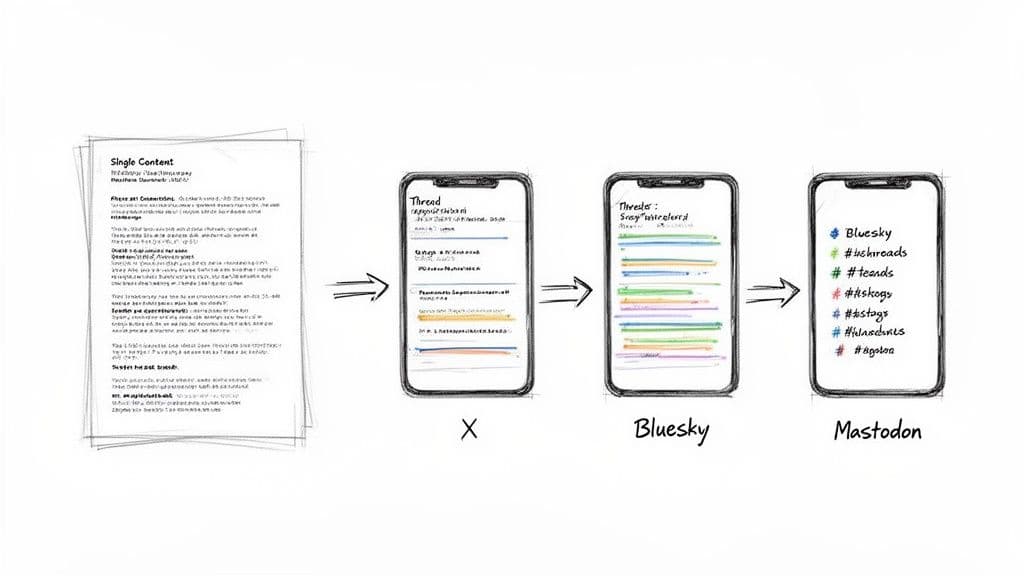
The central idea is "create once, distribute widely." Instead of starting from scratch for each platform, you adapt. This strategy is used by social media agencies managing dozens of accounts and thought leaders like Jack Dorsey, who often posts similar insights across X and Bluesky. It allows creators to maintain a consistent presence across the growing decentralized social landscape efficiently.
Why It Works
This strategy works because it amplifies your reach and saves significant time. By tailoring content to each platform, you respect the community's culture while maintaining a consistent brand message. It acknowledges that a user on Mastodon may have different expectations for tone and hashtag use than a user on X. This thoughtful adaptation leads to better engagement and builds a broader, more diversified audience.
How to Implement a Cross-Platform Content Repurposing Strategy
- Start with a Core Message: Develop your main idea, whether it's an announcement, a key insight, or a story, as a platform-agnostic piece of text.
- Adapt for Each Platform: Customize the core message. For X, use relevant hashtags and a direct tone. For Bluesky, you might adopt a more conversational style. For Mastodon, add content warnings (CWs) where appropriate and use camel-case hashtags.
- Adjust Tone and Context: Ensure the tone of each post matches the platform's community vibe. The same message can be professional on one platform and more casual on another. To truly maximize your reach and efficiency across platforms, explore effective content repurposing strategies that can transform your existing content into new formats.
MicroPoster Workflow Tip
Use MicroPoster’s cross-platform publishing feature to write your core message once, then use the editor to quickly customize it for X, Bluesky, and Mastodon in a single view. You can adjust hashtags, mentions, and tone for each platform before scheduling them to post simultaneously or staggered.
6. Question-Driven Content Strategy
A question-driven content strategy shifts your focus from making statements to asking questions that ignite conversation and community participation. Instead of broadcasting information, you actively invite your audience into a dialogue. This social media strategy example is exceptionally powerful for gathering audience insights, boosting engagement metrics, and making your followers feel heard and valued.
The core principle is to frame content around inquiries your target audience is eager to answer. This approach turns your feed into a collaborative space rather than a monologue. It has been mastered by figures like Lenny Rachitsky, who uses questions to conduct invaluable audience research, and thinkers like Naval Ravikant, whose philosophical questions generate thousands of replies and deep reflection.
Why It Works
This strategy leverages the natural human desire to share opinions and expertise. By asking a compelling question, you lower the barrier to entry for engagement. A reply feels less like a formal interaction and more like joining a conversation. This surge in replies signals to algorithms that your content is valuable, increasing its visibility and reach organically. It also provides a direct line to understanding your audience's pain points, desires, and language.
How to Implement a Question-Driven Content Strategy
- Ask Open-Ended Questions: Avoid simple yes/no questions. Instead, ask "What," "How," or "Why" questions that encourage detailed responses. For example, "What's one productivity hack nobody talks about?" will generate more value than "Do you like productivity hacks?"
- Make It Relevant: Ensure your questions are highly relevant to your niche and the interests of your ideal customer. A startup founder asking, "What would you do in this business scenario?" gets actionable feedback while engaging fellow entrepreneurs.
- Acknowledge and Amplify: Don't just ask and disappear. Actively reply to responses and consider referencing the best answers in a follow-up post or thread. This closes the loop and shows your community that their contributions matter, encouraging future participation.
MicroPoster Workflow Tip
Use MicroPoster’s scheduling feature to time your questions perfectly for when your audience is most active and engaged. You can also create post templates for recurring question formats, like a "Weekly Q&A," to build a consistent and predictable engagement habit for your followers.
7. Niche Authority Building (Vertical Focus)
A niche authority strategy involves concentrating all your content on a single, specific vertical to become the go-to expert in that field. Instead of creating broad, generalist content, you dive deep into one area, attracting a highly dedicated and engaged audience that trusts your specialized knowledge. This social media strategy example is perfect for building a powerful personal brand and a loyal community.
The core principle is to own a topic. By consistently delivering high-value, specific insights, you position yourself as the primary source of information for anyone interested in that domain. This approach was effectively used by creators like Lenny Rachitsky for product growth, Tiago Forte for knowledge management, and Alex Hormozi for business scaling, each becoming synonymous with their respective fields.
Why It Works
This strategy is effective because it cuts through the noise of generalist content. It builds immense trust and credibility, which are precursors to monetization and influence. A highly targeted audience is more valuable to sponsors, more likely to buy your products, and more engaged with your content. The algorithm also rewards this focus, as it can easily categorize your profile and serve your content to the most relevant users.
How to Implement a Niche Authority Strategy
- Define Your Vertical: Choose a niche where you have genuine expertise, passion, or a unique perspective. Your domain should be specific enough to stand out but broad enough to have long-term content potential.
- Create Foundational Content: Develop original frameworks, case studies, or data-driven insights that others in your niche can reference. This establishes you as an original thinker, not just a curator.
- Engage with Peers: Actively participate in conversations with other experts in your vertical. This builds a network effect, cross-pollinates audiences, and reinforces your authority within the community.
- End with a CTA: Conclude your deep-dive posts by inviting followers to join a specialized community, newsletter, or course where they can learn more about your niche.
MicroPoster Workflow Tip
Use MicroPoster’s content calendar to plan and map out your niche topics weeks in advance. Create content templates for your core formats (e.g., "Niche Myth Busting," "Weekly Data Point") to maintain consistency and streamline your creation process, ensuring a steady stream of expert content.
8. Viral Hook and Story Angle Strategy
The Viral Hook and Story Angle Strategy is a social media strategy example designed to stop the scroll and maximize shareability. It works by combining a compelling opening line (the hook) with a unique narrative or contrarian perspective (the angle). This approach leverages psychological triggers like curiosity, surprise, and controversy to make content instantly engaging and memorable.
This strategy moves beyond simply sharing information; it frames it in a way that is inherently more interesting. It's the difference between stating "Productivity is important" and starting with "I wasted 10 years on productivity hacks. Here's what actually works." Thought leaders like James Clear master this by framing concepts like "tiny habits" in a way that is both sticky and actionable.
Why It Works
This strategy is effective because it hijacks the user's attention in a crowded feed. A powerful hook creates a "curiosity gap," compelling the user to read on to find the answer. The story angle then provides the payoff, delivering the information through a personal story, a surprising data point, or a controversial take that encourages comments and shares.
How to Implement a Viral Hook and Story Angle Strategy
- Master the Hook: Start your post with a number, a bold statement, a question, or a surprising fact. Hooks like "Most people get this wrong..." or "Here's the counterintuitive secret to..." are proven to capture attention.
- Develop Your Angle: Don't just present facts; wrap them in a story. Frame a business lesson as a personal failure, or challenge a widely accepted industry belief. The angle is what makes your content unique and provides the substance that follows the hook.
- Ensure Payoff: The body of your post must deliver on the promise of the hook. If your hook is about a surprising discovery, the post must reveal it and explain why it matters. Failing to do this will erode trust with your audience. For a deeper understanding, you can explore what makes a good hook.
MicroPoster Workflow Tip
Use MicroPoster’s AI hook enhancer to generate and test multiple opening lines for the same piece of content. Create a template for your most successful hook-and-angle formats to quickly replicate winning post structures for future content.
9. Community and Conversation Participation Strategy
A community participation strategy shifts the focus from broadcasting content to actively engaging where your target audience already gathers. Instead of waiting for people to find you, you join relevant communities on platforms like X, Discord, Slack, or forums. This social media strategy example is about building authority and relationships by providing value, answering questions, and becoming a recognized, trusted voice.
The core principle is to become an indispensable member of the community. By consistently offering expertise and help without an immediate ask, you build social capital and genuine connections. This strategy has been foundational for community-first creators and founders on platforms like Discord and early adopters on Bluesky, who build their entire brand presence from within these niche ecosystems.
Why It Works
This strategy excels at building high-quality, targeted relationships that lead to loyal followers and customers. It’s an organic approach that positions you as a helpful expert rather than a marketer. By participating in conversations, you gain invaluable insights into your audience’s pain points, language, and needs, which can inform your entire content and product strategy.
How to Implement a Community Participation Strategy
- Identify and Join Relevant Communities: Find 3-5 active communities where your ideal audience spends their time. This could be X Communities related to your niche, industry-specific Discord servers, or private Slack groups.
- Provide Consistent, Non-Promotional Value: Dedicate 15-20 minutes daily to participating. Answer questions, share helpful resources (not just your own), and engage in discussions. The goal is to help, not to sell.
- Become a Trusted Resource: Over time, your consistent, valuable contributions will establish you as a go-to expert. Members will begin to seek you out, follow your profile, and become curious about what you do, creating a natural funnel back to your own content and offerings.
MicroPoster Workflow Tip
Use MicroPoster’s scheduling features to manage your own content, freeing up time for manual, authentic community engagement. You can also use the X Communities feature to seamlessly share your relevant posts into communities you manage, adding context and sparking discussion around your content.
10. Personal Brand and Authentic Voice Strategy
A Personal Brand and Authentic Voice Strategy prioritizes building a following based on a genuine personality, unique perspective, and consistent voice. Instead of chasing fleeting trends or optimizing purely for virality, this approach focuses on showing up as yourself, sharing honest perspectives, and even vulnerability alongside your expertise. This social media strategy example attracts a loyal, high-trust audience that values your specific viewpoint.
The core principle is to build a brand that is an extension of an individual's true character and beliefs. This method was pioneered by thinkers like Paul Graham, who shares authentic essays on startups, and Naval Ravikant, whose consistent philosophical voice has built a massive following. They succeed by being unapologetically themselves, which creates a powerful and sustainable connection with their audience.
Why It Works
This strategy fosters deep trust and loyalty. When followers connect with your authentic self, they are more likely to engage with your content, trust your recommendations, and remain loyal over the long term. It differentiates you in a crowded market by making your unique perspective the primary value proposition, something that cannot be easily replicated. This approach is highly effective for creators, consultants, and founders whose businesses are intrinsically linked to their personal reputation.
How to Implement a Personal Brand and Authentic Voice Strategy
- Define Your Core Values: Identify the principles and beliefs that guide you. Your content should consistently reflect these values, creating a coherent and trustworthy persona.
- Write in Your Natural Voice: Avoid corporate jargon or trying to sound like someone else. Share your genuine perspectives, even if they are contrarian. Focus on clarity and honesty over performative content.
- Show Progress, Not Just Perfection: Document your journey by sharing learnings, insights, and even mistakes. This humanizes your brand and makes your expertise more relatable and credible.
- Engage Authentically: Respond to comments and messages in your own voice. Treat your social media presence as a series of conversations rather than a broadcast channel.
MicroPoster Workflow Tip
Use MicroPoster’s tone enhancer to refine the clarity and impact of your writing without changing your fundamental voice. Draft your posts, then use the tool to check for conciseness and readability, ensuring your authentic message is communicated as effectively as possible.
Comparison of 10 Social Media Strategies
| Strategy | 🔄 Implementation Complexity | ⚡ Resource Requirements & Speed | 📊 Expected Outcomes | ⭐ Key Advantages | 💡 Ideal Use Cases / Tips |
|---|---|---|---|---|---|
| Thread Strategy (Long-Form Storytelling) | Medium–High; planning and sequencing required | Moderate effort per thread; slower to produce than single posts | Higher engagement, sustained reach, evergreen reference | Deep narrative, thought leadership, strong saves/retweets | Educators/thought leaders; start with a hook, number tweets, keep each tweet concise |
| Consistent Daily Posting (Content Cadence) | Low–Medium; systemization and calendar planning | High ongoing effort but batchable; fast per post once set up | Steady organic growth and algorithmic visibility | Habit-building audience; predictable reach and tracking | Brands/creators seeking steady growth; 3–5 posts/week, use scheduling tools |
| Engagement-First Commenting Strategy | Medium; requires authenticity and targeting | Time-intensive daily interactions; quick visibility wins possible | Increased visibility, higher-quality followers, relationship growth | Network effects, less need for original content daily | New creators/community managers; spend ~30 min/day, target 1k–50k creators |
| Data-Driven Post Optimization (A/B Testing) | High; needs tracking, discipline, and experimental design | Moderate–High setup; results emerge over weeks/months | Improved engagement metrics and repeatable patterns | Removes guesswork; scalable content decisions via data | Data-oriented creators/agencies; test one variable at a time, track results |
| Cross-Platform Content Repurposing | Medium; requires platform-specific adjustments | Efficient for reach per content piece; moderate initial setup | Broader audience reach without proportional extra creation | Reduces workload, consistent messaging across platforms | Busy creators/agencies; customize tone/hashtags per platform, stagger posts |
| Question-Driven Content Strategy | Low; craft good questions and moderate moderation | Low to moderate; high reply volume may need management | 2–3x higher engagement and direct audience insights | Conversation starter; algorithmically favored via replies | Community builders/researchers; favor open-ended questions, use polls |
| Niche Authority Building (Vertical Focus) | Medium; requires deep expertise and consistency | Moderate ongoing effort; slower initial growth | Highly engaged, qualified audience; better monetization fit | Faster credibility within niche; higher conversion rates | Experienced professionals; publish original research and many angles |
| Viral Hook and Story Angle Strategy | Medium; creative skill to craft authentic hooks | Fast potential reach but creative time investment | Rapid spikes in impressions and shares; fast audience growth | High virality potential; memorable and shareable content | Growth-focused creators; test hooks, ensure payoff to avoid clickbait |
| Community & Conversation Participation Strategy | Medium–High; community management and moderation needed | Time-intensive and ongoing; slow compounding benefits | Extremely loyal audience and strong advocacy | Trust-building, direct feedback, advocates become promoters | Relationship-focused creators/managers; join 3–5 communities, spend daily time |
| Personal Brand & Authentic Voice Strategy | Low–Medium; consistent self-expression required | Moderate effort; slower growth but sustainable and lower performance strain | Deep long-term loyalty, speaking/book opportunities, durable trust | Unique, hard-to-replicate voice with long-term value | Long-term creators/leaders; share genuine perspective, maintain consistent values |
From Example to Execution: Build Your Winning Strategy Today
We've explored a comprehensive suite of social media strategy examples, moving far beyond generic advice to dissect the specific, replicable systems that power real growth. From the narrative depth of a Thread Strategy to the consistent pulse of a Daily Posting Cadence and the community-building power of an Engagement-First approach, each example serves as a distinct playbook. The common thread weaving through all of them is intentionality. Success isn't accidental; it’s the result of a deliberate plan, consistently executed.
The true value of any social media strategy example lies not in copying it verbatim, but in understanding the principles behind it. We saw how a Data-Driven Optimization strategy uses A/B testing to turn guesswork into a predictable science. Similarly, the Niche Authority Building strategy demonstrates that focused expertise, consistently shared, will always outperform broad, generic content in the long run. These aren't just isolated tactics; they are frameworks for thinking about your content, your audience, and your goals in a more structured way.
Synthesizing the Playbooks: Your Actionable Roadmap
The path forward involves moving from inspiration to implementation. Don't let the variety of options lead to analysis paralysis. Instead, view these examples as a modular toolkit from which you can select the most relevant components for your brand or business.
Here are the core takeaways to guide your next steps:
- Strategy is a System, Not a Secret: The most effective accounts don't rely on a single viral post. They build sustainable systems for content creation, engagement, and analysis, like the ones outlined in our Cross-Platform Repurposing and Viral Hook strategies.
- Consistency Trumps Intensity: A flawless strategy executed for one week is less effective than a "good enough" strategy executed for 90 days. The Consistent Daily Posting and Engagement-First examples underscore the immense power of showing up for your audience every single day.
- Authenticity is Non-Negotiable: Your Personal Brand and Authentic Voice are your greatest differentiators. Whether you're building a niche community or telling long-form stories, your unique perspective is what will attract and retain a loyal following.
Building Your Strategy from the Ground Up
Now, the focus shifts to you. The most critical step is to choose one or two strategies that align with your current resources and primary objectives. Are you focused on establishing thought leadership? The Niche Authority and Thread Strategy examples are your starting point. Are you aiming to build a vibrant, interactive community? Then the Question-Driven Content and Community Participation strategies should be your immediate focus.
To truly move from examples to execution, utilizing a robust social media strategy template is essential for defining goals and building your winning plan. This will help you formalize your objectives, content pillars, and KPIs before you write a single post, ensuring every action you take is purposeful. Adapt the frameworks we've discussed to fit your voice, your audience's needs, and your unique value proposition. Commit to your chosen approach, use tools to streamline your workflow, and measure your progress diligently. The journey from a follower to a leader in your space begins with this first, decisive step.
Ready to turn these strategies into a seamless, automated workflow? MicroPoster is the all-in-one tool designed to help you execute your social media plan with precision, from scheduling threads and daily posts to creating templates that maintain your authentic voice. Stop juggling platforms and start building your presence by visiting MicroPoster to begin your free trial today.