post to x threads and bluesky simultaneously
Post to X, Threads and Bluesky Simultaneously
Master how to post to X, Threads, and Bluesky simultaneously. This guide covers setup, content adaptation, and best practices for 2026 workflows.
You've got a draft ready, a new idea to share, and one annoying choice to make, post it on X, Threads, and Bluesky one by one, or build a workflow that gets it out everywhere without turning distribution into a second job. If you're juggling founders, a tiny content team, or your own writing schedule, the manual version usually starts with energy and ends with copy-paste fatigue.
The better approach is to post to X, Threads and Bluesky simultaneously with a system that keeps the content native on each network. That matters because the primary advantage isn't just speed, it's repeatable reach, cleaner formatting, and less time spent fixing awkward cross-posts after they've already gone live. Tools like MicroPoster are built around that idea, and it includes a 7-day free trial if you want to test the workflow without committing upfront.
Why Manual Cross-Posting Is Holding You Back
Manual posting looks harmless until you've done it a few dozen times. You write one sharp update, trim it for X, stretch it for Threads, then squeeze it into Bluesky without breaking the tone or the link preview. The work isn't hard in isolation, it's just repetitive enough to steal the time you should be spending on the next post, the reply thread, or the product update that needs your attention.
Reach compounds even when each post looks modest
The case for simultaneous publishing gets stronger when you stop thinking in viral spikes and start thinking in volume across multiple surfaces. In Buffer's analysis of 1.7 million posts, the median engagement was exactly four interactions on X, Threads, and Bluesky each, which suggests that typical posts on all three platforms start from a similarly low baseline of attention rather than one channel reliably outperforming the others by default. That's useful because it reframes the goal, not as chasing a single winner, but as stacking small chances to be seen across networks where audience overlap isn't complete. Buffer's cross-platform engagement analysis
Practical rule: If a post takes only a minute to adapt but reaches three separate feeds, the aggregate upside is often better than obsessing over one “perfect” channel.
That logic also lines up with broader batching discipline. If you already batch writes, tips for batching social media content can help you build a cleaner production cadence around one source draft and multiple destination posts.
Connecting Your Accounts for a Centralized Workflow
A centralized workflow starts with account authorization, not passwords. That's the part people still get wrong when they try to stitch together posting tools by hand. The right setup uses secure OAuth connections, so you approve access once and keep control of the accounts without handing over your login details.

Connect once, then stop context switching
Start by linking your X, Threads, and Bluesky profiles inside a single dashboard. With a tool like MicroPoster, the idea is simple, connect each account through the platform's OAuth flow, confirm the permissions, and let the system handle publishing on your behalf. You're not logging in and out of three apps every time you want to ship one thought.
That matters because the connection stage sets up everything that follows. Once the accounts are authorized, you can keep the source of truth in one place, draft once, and route the same idea to all three networks without rebuilding the workflow every time.
A clean setup should feel boring. If it asks for passwords in ways that don't make sense, or pushes you toward manual browser gymnastics, it's already creating friction you'll pay for later.
Later, if you want a quick visual walkthrough of the connection flow, the embedded demo below shows how the process is organized in practice.
Setting Up Your First Automated Reposting Rules
Once the accounts are connected, the main advantage is found in rules. A serious cross-posting system doesn't just blast everything everywhere, it decides what content deserves to move, what needs a thread, and what should stay platform-specific. That's the difference between automation that saves time and automation that creates cleanup work.

Build rules around content type, not hope
The most reliable setup starts with a source account and a destination list. From there, define what gets reposted, text-only updates, single-image posts, or video posts, and leave out formats that need more hands-on care. Automation tutorials show exactly this kind of filtering and post-processing, including optional follow-up comments and hashtags, which is why granular rules matter more than blanket republication. Cross-posting rule setup example
In practice, that means you can create a clean default like, “new text posts on X go to Threads and Bluesky,” while excluding the messy stuff that doesn't travel well. If you want a deeper walkthrough of how a source-post workflow maps to Threads, the guide at https://microposter.so/blog/crosspost-x-to-threads is the relevant internal reference.
Keep the automation narrow at first. It's easier to expand a stable rule set than to debug an overcomplicated one after it's already publishing.
Make the source post the canonical version
Treat one post as the master draft and let the system distribute it. That keeps your edits organized and makes it easier to see what changed for each destination. If your tool supports scheduling, queuing, or immediate publish, use that to separate creation from distribution, so you're not editing in the middle of a launch window.
The important part is that the automation reflects your actual publishing habits. If most of your updates are short text posts, don't force every format into the same rule. If you use mixed media, set the filter so only the posts that can travel cleanly are cross-posted automatically.
Mastering Content Adaptation for Each Network
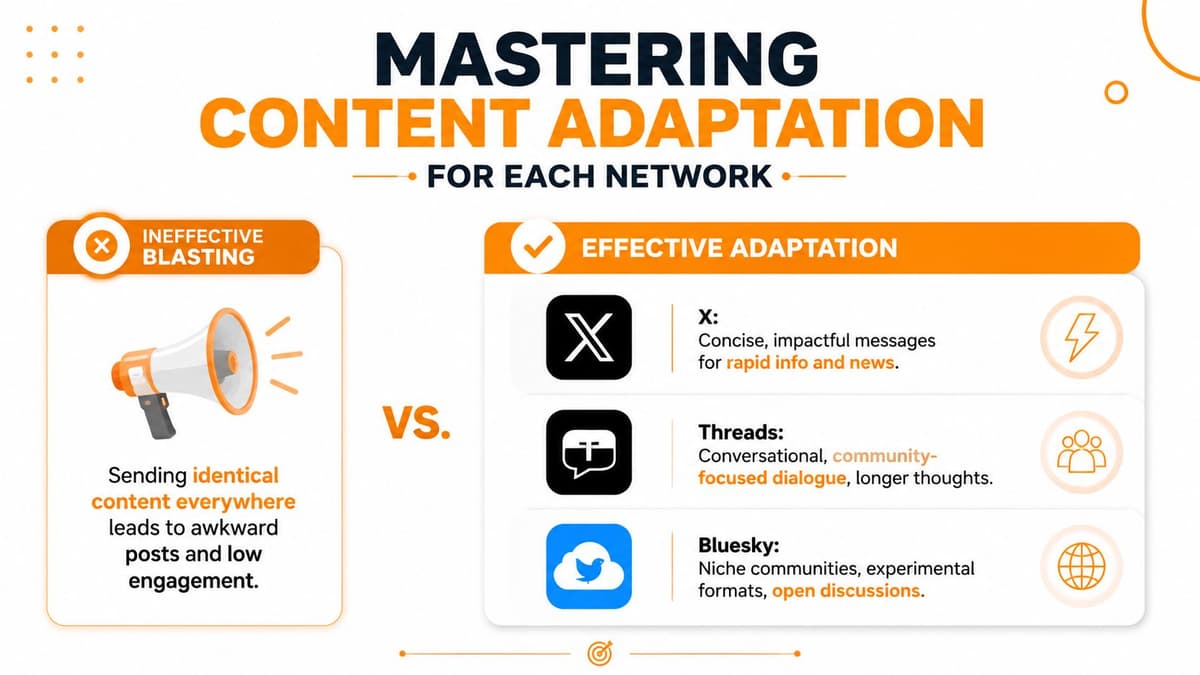
The fastest way to make cross-posting look amateur is to copy the exact same message everywhere. X, Threads, and Bluesky do not behave like interchangeable boxes, they have different text limits, different media ceilings, and different expectations around how a post should read. That's why native feel matters more than raw duplication.
The format mismatch is the real problem
A 2026 comparison notes that X allows 280 characters for free users, Threads allows 500 characters, and Bluesky allows 300 characters. It also reports native thread support across all three, but different media behavior, including up to 4 images on X, up to 10 images on Threads, and up to 4 images on Bluesky. Platform comparison for X, Threads, and Bluesky
That variance is why direct mirroring breaks down. A post that fits Threads comfortably can feel cramped on X or Bluesky, and media that works on one network can look awkward on another. The right workflow keeps the master draft within the lowest common constraint, then splits long updates into native thread or reply chains when needed.
MicroPoster handles this kind of adaptation by transforming the source post rather than flattening it. That includes splitting long updates, resizing media for native uploads, and mapping mentions so the output doesn't look manually stitched together.
Adapt the mechanics, not just the wording
The technical side matters just as much as copy. If links belong in a reply on one network but not another, move them intentionally. If an image set works on Threads but not in Bluesky's tighter format, adjust the asset count before publishing.
You'll also get better results when you treat hashtags and mentions as platform-specific objects, not universal ones. That means preserving meaning while changing structure, so the post lands with the right length, the right preview behavior, and the right readability on each feed.
For a broader look at AI-driven rewriting workflows, the internal guide at https://microposter.so/blog/ai-tool-to-rewrite-social-media-posts fits well alongside this adaptation model.
Advanced Strategies for a Native Feel
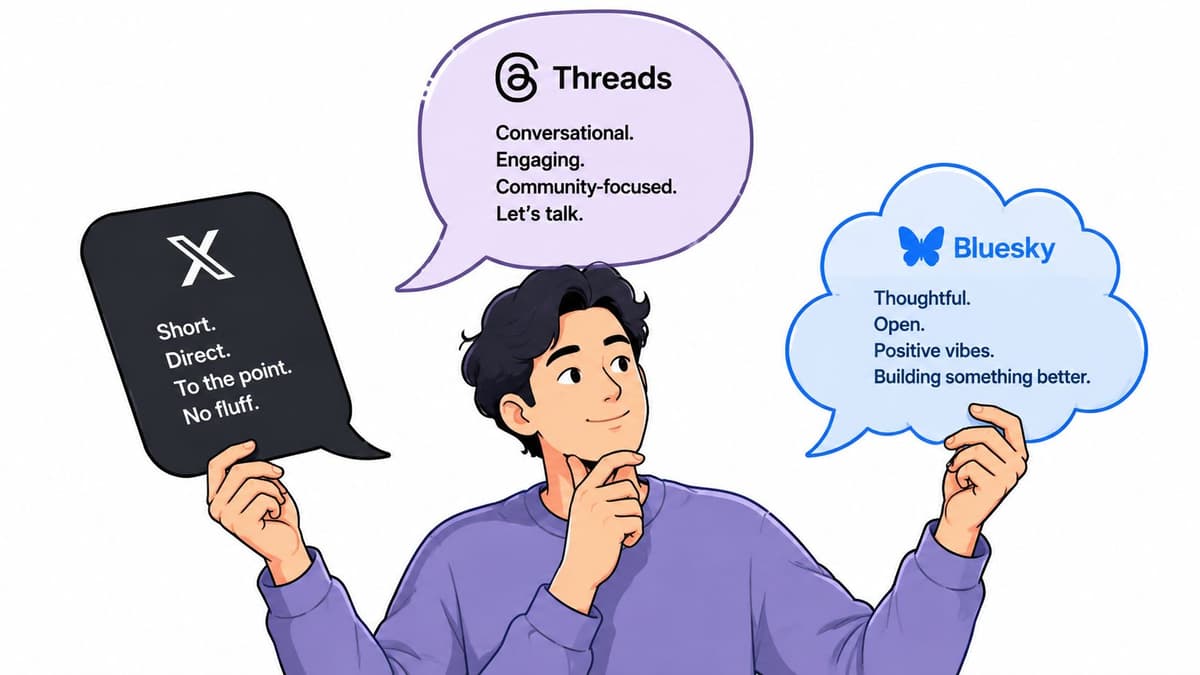
Technical correctness is only half the game. A post can fit the character limit and still feel off if the tone clashes with the platform. Bluesky and Threads usually reward a more conversational voice, while X often benefits from a sharper opening hook, and that difference shows up fast when you reuse the same sentence structure everywhere.
Write for the feed, not just the draft
Independent guidance notes that Bluesky and Threads often reward more conversational posts while X can favor a sharper hook, and it also points out that audience overlap between X and Bluesky is relatively low. That's why the question isn't just whether a post can be mirrored, it's whether it should be rewritten at all. Platform-culture differences in cross-posting
A good rule is to keep the core idea stable and vary the packaging. Use a tighter opener for X, leave more breathing room for Threads, and keep Bluesky clear and conversational without overstuffing it with tags. If a post depends on inside references, niche community language, or a very specific audience joke, rewrite it instead of forcing a clone.
If the post only works because of context from one network, it's probably too platform-specific to mirror verbatim.
Decide what gets rewritten and what stays fixed
Hashtags are a good example. Some posts need almost none, some need a few, and some need platform-specific cleanup so they don't look spammy. The same applies to mentions and calls to action, if the destination audience needs a softer lead-in, adjust it.
This is also where a tool earns its keep. MicroPoster can keep the same core message while adapting tone, thread structure, and mention mapping so the output feels less like a recycled broadcast and more like a native post written for that feed.
Troubleshooting Common Cross-Posting Pitfalls
The biggest failure in simultaneous posting is usually misfit, not delivery. The post goes out, but the version on the destination network feels clipped, awkward, or structurally broken. That leads to truncated text, weak link visibility, or a feed preview that looks nothing like the draft you approved.
Fix the structure before you blame the platform
Cross-posting tools keep running into the same problem, content reaches the feed but loses shape along the way. Smart workflows handle that by auto-splitting long updates, resizing media, and optimizing links so previews hold together and formatting stays intact. The point is to adapt the post before it publishes, so the output still feels native on each network.
The better habit is to diagnose the post, not the platform. If a preview looks off, check whether the text ran past the target network's limit, whether the media count exceeded what that destination supports, or whether the link belongs in the main post instead of a follow-up reply.
A post can also fail in subtler ways. Mention mapping may be off, thread structure may collapse, or a tag that works on one feed may make another version look forced. MicroPoster's cross-posting approach handles those adjustments directly, so the same draft can be reshaped for each network without the clunky copy-paste feel that generic reposting creates.
Watch for these failure modes
- Broken previews: The link placement or card handling did not match the destination network's expectations.
- Truncated copy: The draft was written for the wrong character limit, so the end got cut off or collapsed awkwardly.
- Awkward thread splits: Long-form updates need native splitting, not a blunt copy-paste that breaks the argument into jagged pieces.
- Mismatched media: A post can still look wrong if images or video are copied without resizing or count checks.
- Poor mention handling: Usernames that make sense on one platform can look broken or irrelevant on another if they are not remapped.
The fix is the same in every case, keep one canonical draft, then let the tool reshape it per network before publishing. That is how you post to X, Threads and Bluesky simultaneously without making every feed look like an afterthought.