ai tool to rewrite social media posts
Unlock Efficiency: AI Tool to Rewrite Social Media Posts
Stop adapting content manually. Use an AI tool to rewrite social media posts efficiently. Save hours & promote across X, Threads, & more with one click.

You write one product update, then lose the next hour turning it into five different posts.
The LinkedIn version needs context and polish. The X post needs a sharper hook. Threads wants a looser tone. Bluesky often rewards a more conversational voice. Mastodon punishes lazy cross-posting faster than anticipated. By the time you've adapted everything, the momentum behind the original idea is gone.
That workflow used to feel normal. It isn't anymore. If you're looking for an AI tool to rewrite social media posts, the main goal isn't better wordsmithing in isolation. It's building a repeatable system that turns one idea into native posts across every platform you care about, without dragging you into copy-paste work all day.
Why Manual Social Media Rewriting Is Obsolete
Founders still try to brute-force this. They draft in Notes, paste into ChatGPT, trim for X, expand for LinkedIn, remove hashtags for one network, add line breaks for another, then schedule manually in separate tabs. It works for a week. Then the backlog starts.

The old trade-off was simple. You could either publish platform-native content or protect your time. You usually couldn't do both. That trade-off has broken down because the volume and fragmentation of social distribution are too high for manual adaptation to stay efficient.
According to 2026 generative AI marketing data, 83% of marketers report that generative AI helps them produce significantly more content. That's not a novelty stat. It's a signal that manual-only workflows are being replaced because they can't keep up with current publishing demands.
Manual rewriting creates hidden costs
The obvious cost is time. The less obvious cost is inconsistency.
On Monday, your LinkedIn post is thoughtful and clear. On Tuesday, your Threads version sounds stiff because you rushed it. On Wednesday, your X post gets trimmed so aggressively that the point disappears. That isn't a creativity problem. It's a systems problem.
Three things usually go wrong:
- Context gets stripped out: The shorter the turnaround, the more likely you are to lose the point of the original post.
- Platform culture gets ignored: A good cross-post isn't only about length. It's about rhythm, formatting, and what readers on that network expect.
- Publishing gets delayed: The friction of rewriting often becomes the reason a post never goes live everywhere it should.
Practical rule: If a task happens every day and requires the same judgment calls, it should become a workflow, not a habit.
AI rewriting changed the job
The useful shift isn't "AI writes my posts for me." That's lazy, and readers can tell.
The useful shift is this: AI handles the first adaptation pass, while you keep control over message, brand voice, and final edits. That turns rewriting from a repetitive task into a quick review step. Instead of spending your energy on mechanics, you spend it on positioning.
That's why an AI tool to rewrite social media posts matters now. Not because rewriting is exciting, but because wasting human attention on repetitive formatting is expensive.
When to Rewrite and When to Mirror
It's easy to overcomplicate this. Not every post needs a fresh rewrite, and not every post should be mirrored unchanged.
The smart approach is to decide based on the job the post is doing. Some updates only need distribution. Others need adaptation because the format, tone, or audience expectation changes from network to network.
Mirror when the message is the product
Pure mirroring works when the exact wording matters more than platform polish.
That usually includes:
- Launch announcements: If you're sharing a release, shipping update, or waitlist opening, consistency often matters more than stylistic variation.
- Time-sensitive notices: Downtime, deadline reminders, event start times, and quick alerts should stay tight and identical.
- Short opinion posts: If the original already fits the destination platform, changing it can weaken the edge.
In those cases, mirroring preserves speed and message integrity. You don't need an AI rewrite for every sentence. You need reliable distribution.
Rewrite when context changes the outcome
Rewriting matters when the same core idea needs a different wrapper to land well.
A few common examples:
| Content type | Mirror or rewrite | Why |
|---|---|---|
| Product changelog | Mirror | The information is the priority |
| Founder lesson | Rewrite | Tone and pacing differ across networks |
| Long-form insight | Rewrite | Length and structure need platform-specific treatment |
| Event reminder | Mirror | Clarity beats customization |
| Community question | Rewrite | Each platform responds to different conversation starters |
A post can be "the same idea" and still need a new structure. LinkedIn usually rewards a more developed setup. Threads often benefits from a lighter voice. X demands compression and sharper hooks. Mastodon readers often respond better when the post feels native instead of syndicated.
Mirror for distribution. Rewrite for resonance.
Use a three-part decision filter
Before you adapt anything, run a fast check:
What is the goal?
If the job is reach, mirroring may be enough. If the job is discussion or conversion, rewrite.Does platform culture materially change the read?
If yes, adapt the tone, line breaks, and opener. If not, keep it close to the original.Will a rewrite improve the first five seconds?
If the answer is no, don't create extra work just because you can.
Often, teams waste a lot of effort. They rewrite low-stakes posts and mirror high-impact posts that needed a native introduction.
A practical founder workflow
A clean workflow looks like this:
- Mirror operational posts: shipping notes, maintenance updates, new feature links.
- Rewrite authority posts: lessons learned, product philosophy, customer pain points.
- Rewrite discussion posts: questions, contrarian takes, behind-the-scenes decisions.
- Mirror first, then selectively rewrite winners: if a mirrored post starts getting traction, adapt it further for the networks where the conversation could deepen.
That last point matters. You don't need to perfectly customize everything upfront. You need to know which content deserves extra treatment.
How to Prompt an AI for Platform-Perfect Content
Most bad AI output starts with a bad prompt.
People type "rewrite this for LinkedIn" and then complain that the result sounds generic. Of course it does. You gave the model no audience, no structure, no constraints, and no signal about what must stay intact. According to Hootsuite's social-first AI guidance, 43% of social managers note "robotic" output from generic AIs, and more specific prompts around tone and storytelling can reduce the 40% authenticity loss associated with over-automation.
The prompt needs five parts
A useful rewrite prompt is closer to a creative brief than a command.
Include these parts:
- Source context: What the original post is about and what must not change.
- Target platform: Name the destination network so the model adjusts for format and tone.
- Voice direction: Tell it how the post should sound. Direct, playful, technical, founder-like, calm, skeptical.
- Formatting constraints: Character limit, thread format, line breaks, hashtags, emoji use, CTA style.
- Output instructions: Ask for one version, multiple variants, or a specific structure.
A weak prompt asks for a rewrite. A strong prompt gives the AI a job.
Copy these prompt templates
| Scenario | Prompt Template |
|---|---|
| Turn a product update into a Threads post | Rewrite this product update for Threads. Keep the core message and feature details intact. Use a casual founder tone, short lines, and light personality. Remove corporate phrasing. End with a question that invites replies. |
| Turn a short X post into a LinkedIn post | Expand this short post into a LinkedIn update for startup founders. Keep the original claim, add context on why it matters, and structure it with a strong first line, a short middle section, and a clear closing takeaway. Avoid hype. |
| Adapt a LinkedIn post for X | Rewrite this LinkedIn post for X. Compress it into a concise post with a sharper hook and one clear takeaway. Keep it readable and direct. No filler. |
| Turn a feature launch into a Mastodon thread | Rewrite this launch post for Mastodon as a short thread. Split it into logical parts, preserve the product details, and keep the tone human and informative. Avoid sounding like an ad. |
| Rework a formal announcement for Bluesky | Rewrite this announcement for Bluesky. Make it conversational and native to the platform. Keep the meaning, simplify the language, and use a more relaxed opening. |
| Create variants for testing | Rewrite this post into three versions for the same platform. Version one should be direct. Version two should be story-led. Version three should be question-led. Keep the same core message in all three. |
Add brand guardrails before you regenerate
If the first output sounds off, don't immediately start editing line by line. Tighten the prompt.
Add guardrails like:
- Keep these words: product name, category, positioning phrase
- Avoid these habits: motivational fluff, exaggerated claims, spammy CTAs
- Match this tone: like a technical founder explaining a decision, not a social media manager writing campaign copy
- Preserve this structure: strong opening, one key proof point, one CTA
Generic prompts create generic brand voice. Specific prompts give you usable drafts.
One practical move is to keep a short "voice block" saved in a text snippet tool. Paste it into every rewrite prompt. That alone cleans up a lot of mediocre outputs.
Use external references the right way
If you're rewriting posts tied to campaigns, launches, or ongoing experiments, it helps to show the AI examples of the style you're aiming for. For visual-first channels, looking at real TikTok projects can help you reverse-engineer pacing, hooks, and framing before you adapt the message into text-led social formats.
If you want more examples of specialized tools and where standalone writers fit into the stack, this roundup of social media co-writer AI tools is useful background.
What works and what doesn't
What works is narrow prompting, clear constraints, and one human pass before publishing.
What doesn't work is asking a general AI to "make this better" and expecting platform-native content. Better according to what? Better for whom? Better in what format? The model can't infer your publishing strategy from a vague sentence.
Integrate AI Rewrites with Full Automation
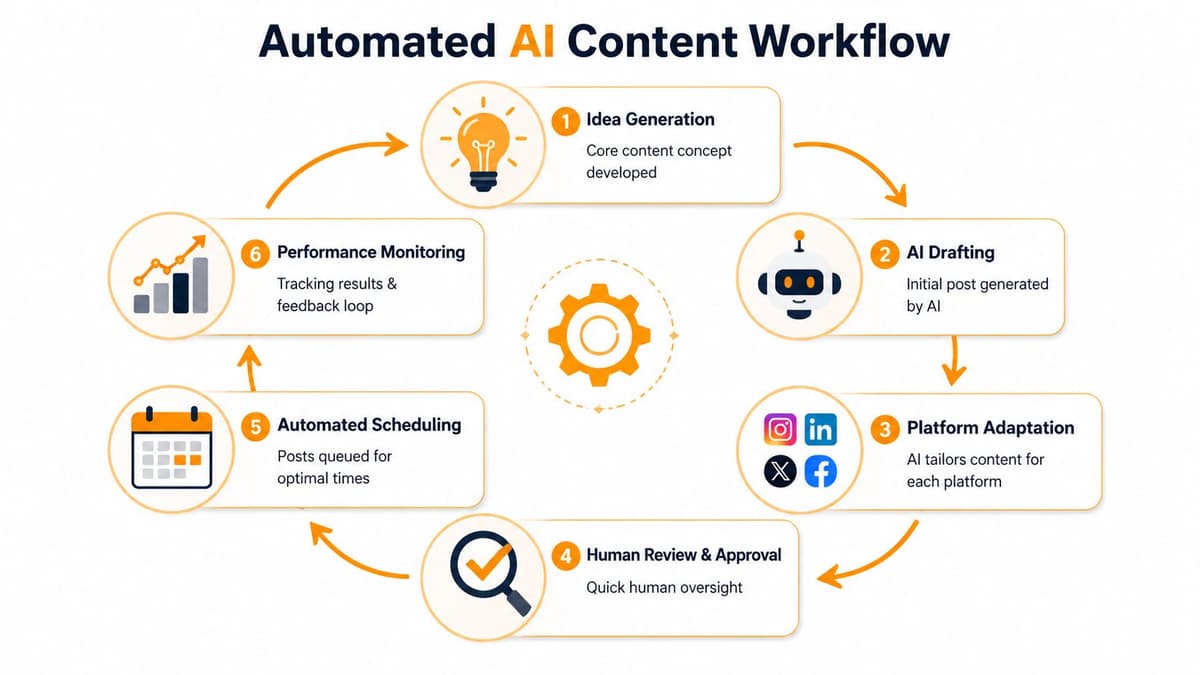
A lot of teams stop too early. They find an AI tool to rewrite social media posts, generate decent variations, and still end up doing the slowest part by hand.
They copy text from one app into another. They split threads manually. They fix broken mentions. They resize visuals for native uploads. They schedule each platform separately. The writing got faster, but the workflow is still fragmented.
Rewriting alone doesn't solve distribution
This is the missing layer. Good output is only useful if it reaches the right networks in the right format without creating more admin work.
The gap gets worse outside the usual LinkedIn and X workflow. According to reported platform adaptation gaps for decentralized social networks, existing tools often fail to adapt content for platforms like Bluesky, which grew to over 30 million users by April 2026, and that gap forces founders to waste 2-3 hours daily on manual cross-posting.
That tracks with what operators run into in practice. General AI writers can rewrite text, but they usually don't handle the operational details that make publishing feel native on each network.
The automation layer should handle these jobs
A complete setup needs more than rewriting. It should also manage:
- Thread logic: Split long posts where the platform requires it.
- Handle mapping: Convert mentions to the right account names per network.
- Media formatting: Resize images and videos for native display.
- Link presentation: Keep previews clean and avoid awkward formatting.
- Posting rules: Decide when to mirror exactly and when to apply adaptation.
If you're evaluating broader stacks, this guide to marketing automation software for small business is a useful reminder that distribution systems matter as much as content generation systems.
A workflow that actually saves time
Here's the practical version that works for small teams and founder-led brands:
Write the source post where you naturally publish first
That might be X, Threads, or another primary account.Use AI only for the adaptation step
Don't outsource your core thinking. Use AI to convert format, tone, and structure.Automate native publishing rules
Let the system decide whether a post should mirror cleanly or be split into a thread, reformatted, or lightly rewritten.Review only exceptions
High-stakes posts, launches, and sensitive messaging deserve a human pass. Routine posts shouldn't need handholding.
One tool built for this layer is MicroPoster's automated content distribution workflow. It detects new posts from a source account, mirrors them to X, Threads, Bluesky, and Mastodon, and handles things like auto-threading, handle mapping, media resizing, tone refinement, and scheduling rules through one system.
A rewriting tool gives you drafts. An automation layer gives you reach.
The strongest setup is boring
That's a compliment.
The best multi-platform workflow doesn't feel creative while you're operating it. You write once. The system adapts and distributes. You check edge cases, then move on to product, sales, hiring, or whatever grows the business.
If your current process still requires opening four dashboards every time you publish a post, you don't have an AI workflow yet. You have a faster version of the same bottleneck.
Measure and Optimize Your AI-Powered Content Strategy
Teams are now able to generate more content. The harder question is whether the rewritten versions are doing anything useful.
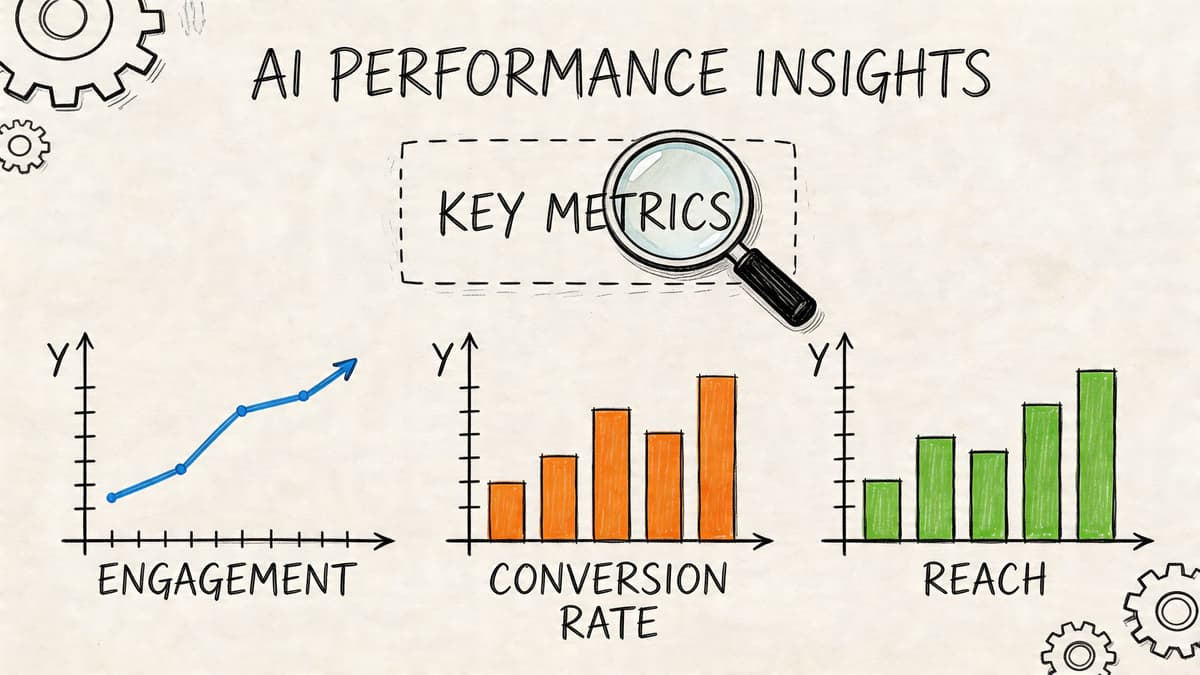
That uncertainty is common. According to reporting on AI content measurement struggles, 68% of social media managers say they struggle to quantify engagement lifts from AI content. The same source notes that AI-driven timing optimization has been shown to boost engagement by 25%. The implication is straightforward. Creation is only half the problem. Measurement and timing decide whether the system compounds or stalls.
Track outcomes by post type, not just by platform
A lot of reporting is too broad to be useful. Looking at "how Threads performed this month" won't tell you whether AI rewrites are helping.
Break it down by content job:
- Announcement posts: Did the rewritten versions preserve clarity and clicks?
- Authority posts: Did platform-specific versions generate more replies, saves, or meaningful discussion?
- Conversation starters: Which version created the strongest comment quality, not just reaction volume?
- Traffic posts: Which format delivered the cleanest path from impression to click?
This helps you compare like with like. A rewritten discussion post shouldn't be judged by the same standard as a mirrored release note.
Watch for low-quality gains
AI can improve surface metrics while hurting brand perception.
If engagement rises but the comments get thinner, you may be optimizing for curiosity instead of relevance. If a post gets more reach but fewer qualified clicks, the hook may be overpromising. If every platform starts sounding the same, your rewrites are too formulaic.
A healthy review loop asks:
- Did the rewrite improve attention?
- Did it preserve the original point?
- Did it bring the right kind of response?
Better numbers aren't enough if the audience feels the content got flatter.
Use comments as signal, not noise
Comments often tell you more than raw reactions do. They show whether your framing was clear, whether objections repeat, and whether a certain platform wants a different angle for the same topic.
That kind of analysis is where integrated publishing tools become more useful than standalone text generators. If your system can surface audience patterns and suggest better send times, you stop treating every post as an isolated event.
A quick walkthrough helps make that concrete:
A simple optimization loop
Keep the loop tight.
- Publish one core idea across multiple networks
- Compare native versions by content type
- Review comments for language patterns and objections
- Adjust prompts and formatting rules
- Test again with the next post
Don't chase a perfect dashboard. You need enough feedback to make the next rewrite better than the last one.
Your AI Rewriting Questions Answered
Will AI rewrites make my posts sound fake
They can, if you use broad prompts and publish the first draft untouched. The fix isn't avoiding AI. It's tightening the brief and keeping a fast human review step. The strongest setups use AI for adaptation, not identity.
Is pure mirroring ever enough
Yes. Short announcements, launch notices, and operational updates often work well as mirrored posts. Rewriting helps most when tone, context, or structure materially affect how the post lands on that platform.
Why not just use ChatGPT and schedule manually
You can. Many people do. The issue is that a general-purpose model handles text better than distribution. Once you're manually moving posts across apps, fixing formatting, and scheduling one network at a time, the operational drag comes back.
Which platforms matter most for adaptation
The answer depends on where your audience is, but the need for adaptation is usually highest on networks with distinct tone and formatting norms. The more a platform punishes generic cross-posting, the more careful you need to be about native structure.
How much should I edit AI output
Less than you'd think if the prompt is solid, more than you'd like if the prompt is vague. The goal is not heavy rewriting after generation. The goal is to make the AI deliver a draft that only needs judgment, trimming, and brand checks.
What should I automate first
Start with repetitive distribution tasks. Thread splitting, scheduling, mention cleanup, media formatting, and rule-based mirroring create the biggest time savings because they don't need your creativity.
If you already publish regularly and want less copy-paste work between networks, MicroPoster is the simplest next step. It gives you one place to adapt, schedule, and distribute posts across X, Threads, Bluesky, and Mastodon, with a free trial so you can test the workflow before changing your routine.