
text based social platforms
A Creator's Guide to Text Based Social Platforms
Discover the power of text based social platforms. Learn key strategies for X, Bluesky, Mastodon, and Threads to grow your audience and build your brand.
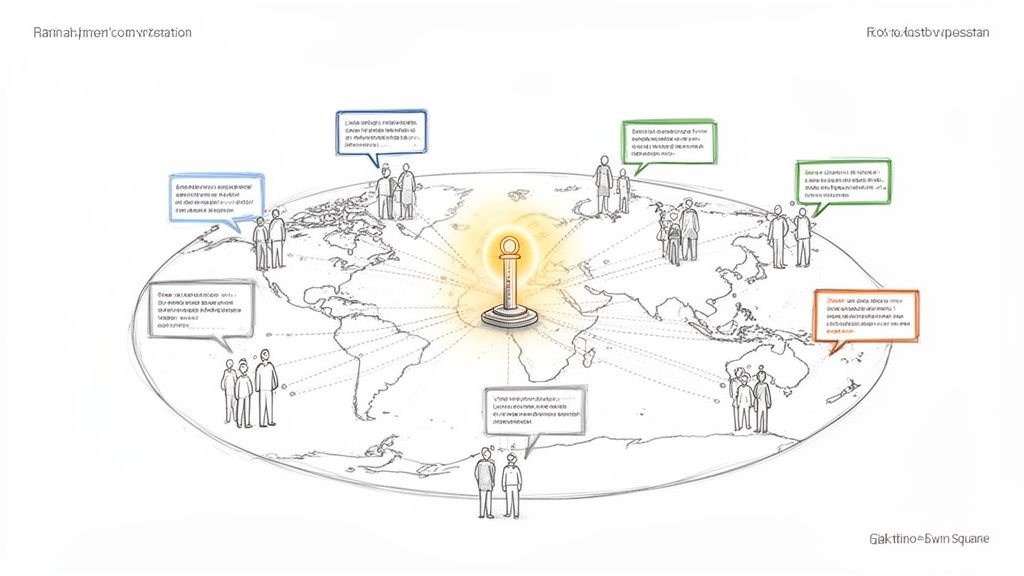
At their core, text-based social platforms are the digital equivalent of a bustling town square. They’re where conversations ignite, news breaks, and ideas are debated in real-time—all powered by the written word.
These networks champion direct, unfiltered engagement over highly produced visual content, making them incredible for building genuine communities and establishing thought leadership.
So, What Are Text-Based Social Platforms?
Think of a social network, but strip away the perfect photos and slick videos. What you’re left with is the essence of communication: words. That’s the heart of a text-based platform. These networks are designed for quick-fire conversations, live reactions to events, and sharing thoughts as they happen.
Unlike platforms where visual appeal is everything, text-first environments reward sharp thinking, humor, and expertise. This often forges a more direct and authentic bond between you and your audience.
The Unmistakable Power of Words
In a media world overflowing with visuals, a text-focused strategy gives you a serious edge. It lets you build authority and connect with people based on the strength of your ideas alone. This isn't just about tweeting your lunch; it's a strategic move. The question, "Is Texting Social Media?" is a great starting point, as it gets to the conversational core of these platforms.
For anyone serious about building a loyal, tuned-in audience, getting this right is non-negotiable. These platforms are perfect for:
- Building Thought Leadership: You can share your expertise and unique take on things in a direct, conversational way.
- Fostering Community: Jump into real-time discussions and create a home for people who share your interests.
- Driving Traffic: A short, punchy post can be the perfect hook to send followers to your latest blog post or newsletter.
At their heart, text-based platforms are about connection through conversation. They level the playing field, allowing the best ideas—not just the best visuals—to win.
This guide will zero in on the major players defining this space: X (what we used to call Twitter), Bluesky, Mastodon, and Threads. We’ll dig into what makes each one unique and lay out the strategies you need to succeed. To go a bit deeper, it helps to understand what microblogging is and why it’s such a powerful format.
From Twitter's Launch to the Rise of the Fediverse
To really get a feel for today's text-based social scene, we need to jump back to 2006. That’s when Twitter arrived, and its famous 140-character limit wasn't just a technical quirk—it was a game-changer. It forced everyone to communicate in a whole new way: short, sharp, and to the point.
This brevity completely rewired how we share and consume information online. Suddenly, breaking news, fleeting thoughts, and brand announcements all had to fit into the same tiny package. This simple constraint paved the way for two powerful features that came to define the first decade of microblogging.
The Centralized Town Square
The first wave of these platforms was all about building one giant, public space where everyone could shout and be heard. Imagine early Twitter as a single, global town square.
- Hashtags (#): This wasn't a corporate invention; users came up with it. Hashtags gave us a simple way to group conversations, turning isolated posts into massive, searchable discussions on everything from the World Cup to political movements.
- Threads: When 140 characters just wasn't enough, people started replying to their own posts to create longer stories. This user hack eventually became a built-in feature for deep dives and detailed explanations.
For over a decade, this centralized model was king. One company owned the platform, set the rules, and controlled the data. It was an incredibly efficient way to reach millions of people fast, but cracks started to show. People grew worried about censorship, data privacy, and the sheer power these companies held.
A Shift Towards Decentralization
The last few years have been a major turning point. A growing number of users and creators started looking for more freedom and control, which led to the rise of decentralized alternatives. The core idea here is to build a network of interconnected, independent communities instead of one giant, walled-off platform.
This movement is more than just new apps—it's about shifting power from corporations back to users. It’s about giving people real ownership over their data, their online experience, and the rules of the community.
This is where the Fediverse enters the picture. Think of it as a "federated universe" of social networks, like Mastodon, that can all talk to each other. It’s a radical departure from the closed-off systems we’re used to. You can dig deeper into how decentralized social media platforms are building this new reality.
Understanding this history is key. It highlights the deep-seated differences between a platform like X, which carries the legacy of the centralized era, and upstarts like Bluesky and Mastodon, which are charting a course for a more open, user-controlled future.
Choosing Your Platform: X vs. Bluesky vs. Mastodon vs. Threads
Picking the right text-based social platform is a bit like choosing a venue for your act. Are you trying to fill a massive stadium with a global audience, book a trendy new club with a built-in fanbase, or build a following across a network of small, dedicated community halls? The best choice really comes down to your goals, your style, and who you're trying to talk to.
The scene is basically split between the old guard—the centralized giants—and a new wave of decentralized challengers. You can see this evolution pretty clearly, moving from a traditional, company-controlled model to a more open, user-driven ecosystem.
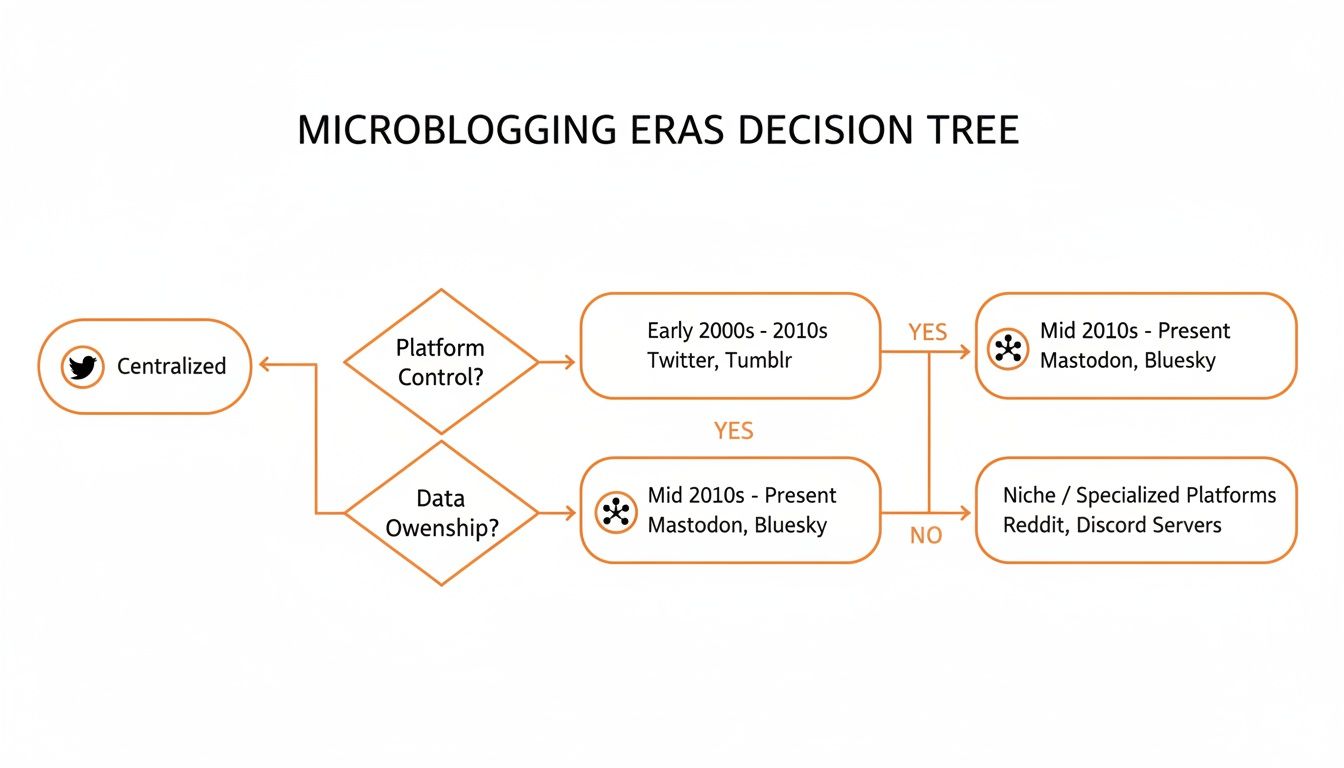
This split shows a real fork in the road. Platforms like X and Threads are the legacy, centralized path, while newcomers like Bluesky and Mastodon are forging a decentralized future. Let's break down what each one offers.
Platform Feature and Audience Comparison
To help you decide where to plant your flag, here’s a side-by-side look at what makes each platform tick. Think about which features and audience demographics align best with your creator strategy.
| Feature | X (Twitter) | Bluesky | Mastodon | Threads |
|---|---|---|---|---|
| User Base | Massive, global, and diverse (300M+ active users). | Growing rapidly, early-adopter tech and media-savvy crowd. | Niche, fragmented across servers, tech-focused, academic, hobbyist. | Huge initial user base from Instagram; leans towards lifestyle & creatives. |
| Control | Centralized. Owned and controlled by a single company (X Corp). | Decentralized. Built on the AT Protocol, allows for custom feeds. | Federated. Network of independent servers ("instances"). | Centralized. Owned and controlled by a single company (Meta). |
| Vibe & Culture | Fast-paced, chaotic, news-driven, high potential for virality and conflict. | Feels like early Twitter; more relaxed, experimental, and community-focused. | Varies by server. Can be highly moderated, academic, and community-led. | Generally more positive and conversational; less "breaking news" intensity. |
| Discovery | Powerful algorithm, trending topics, and hashtags. | Custom feeds created by users, "what's hot" feed, no algorithmic timeline. | Hashtags and boosts are key; discovery is manual and community-driven. | Algorithmic feed, tightly integrated with Instagram's network. |
| Best For | Breaking news, live events, brand announcements, reaching a broad audience. | Building a community from the ground up, engaging with early adopters. | Deep dives into niche topics, finding specific interest groups, user control. | Creators with a strong Instagram presence, visual-first content, brand-safe talk. |
Ultimately, there's no single "best" platform. The right choice is the one that best serves your specific content and community goals.
X: The Incumbent with Massive Reach
X (what we all still call Twitter) is the undisputed heavyweight champion of the text-based world. With hundreds of millions of users, its reach is just staggering. If your game is breaking news, live commentary, or jumping on global trends, X is almost always the place to start.
But that massive scale is also its biggest hurdle. The sheer volume of noise makes it incredibly competitive. To stand out, you need to be relentless, strategic, and ready for a fast-paced fight for attention.
Bluesky and Threads: The Modern Contenders
Threads had a massive head start, piggybacking on Instagram's user base to become an instant player. Its clean look and focus on more positive conversations feel like a breath of fresh air for anyone burnt out by X's chaos. It’s a natural fit for creators who are already big on Instagram.
Meanwhile, Bluesky has carved out its own space, attracting users who want a clean slate. With over 41 million users and a growth rate of 0.3 new users per second, its 372.5% year-over-year growth shows people are hungry for alternatives. You can dig into more of these growth trends on metricool.com to see the bigger picture.
This isn't just about features; it's about the culture. Threads feels familiar and safe, thanks to its Instagram connection. Bluesky feels like an exciting new frontier, packed with a highly engaged, early-adopter community.
Mastodon: The Community-First Federation
Mastodon plays by a totally different set of rules. It’s not one single site but a network of thousands of independent servers, known as "instances," each with its own focus and moderation. This network is the core of what people call the "Fediverse."
- Niche Communities: You can find an instance for just about anything—from programming and science to art and literature. This lets you have much deeper, more relevant conversations.
- User Control: You pick your server, which means you have more say over your experience, your data, and the rules you want to follow.
- Interoperability: Even though you're on different servers, you can still follow and chat with people across the entire Mastodon network. It all just works.
Mastodon is perfect for creators who prioritize building a tight-knit community over chasing massive reach. It takes a little more effort to find your footing, but the payoff is a dedicated, highly targeted audience that’s genuinely invested in what you have to say.
Mastering the Essential Content Formats
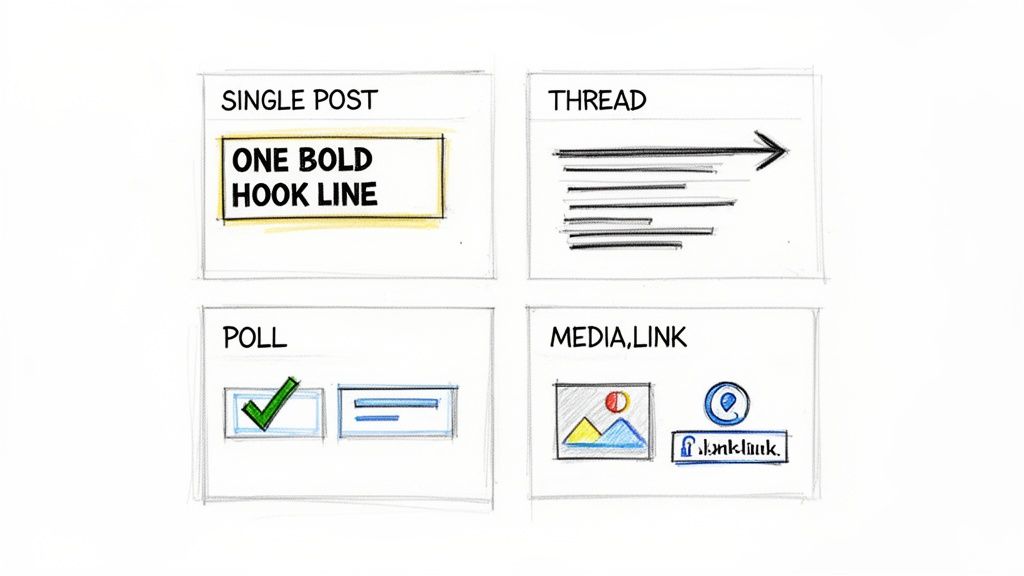
Success on text-based social platforms isn't just about what you say—it's about how you say it. A brilliant idea is your starting point, but packaging it in the right format is what actually stops the scroll and gets people to listen. It's the difference between shouting into the void and starting a real conversation.
The most basic building block is the single post. Think of it as a digital elevator pitch. You have just a few seconds to make an impression with a concise, powerful message.
A truly effective single post nails three key things:
- The Hook: A killer opening line that snags attention. This could be a bold claim, a relatable problem, or a thought-provoking question.
- The Core Value: The main takeaway. This is the statistic, the piece of advice, or the insight you want your audience to remember.
- The Call-to-Action (CTA): A clear next step. Tell them exactly what to do, whether that's "reply with your thoughts" or "check out the link in my bio."
Structuring Viral Threads for Storytelling
But what happens when you have more to say than a single post can handle? That's where threads (or "skeets" on Bluesky) come into play. A thread lets you unpack a bigger idea, tell a compelling story, or walk your audience through a step-by-step process.
The trick to a great thread is to treat it like a mini-narrative. Your first post needs a powerful hook that promises value and makes people want to know what's next. Then, number each post (like 1/5, 2/5, and so on) to guide them through the story. Each part should build on the last, keeping the momentum going until you reach a satisfying conclusion. You want to make it impossible for them not to click "show more."
Threads transform your feed from a series of disconnected statements into a compelling narrative. They are one of the most powerful tools for establishing authority and providing deep value on any text-based social platform.
Using Polls and Media to Boost Engagement
Beyond standalone posts and threads, you need to add some texture to your feed. Polls are a fantastic, low-effort way to get a conversation going and learn what your audience is thinking. A simple question can easily pull in hundreds of votes and replies, giving you direct insight into your community's opinions.
Adding media at the right moment can also make your text pop. A well-placed GIF can inject some humor, while a simple chart can bring the data in your thread to life. Sharing links to interesting articles or your own blog posts also positions you as a helpful curator of information. To keep things fresh, it's always a good idea to explore different social media content ideas and see what resonates.
Mixing these formats keeps your feed from getting stale and predictable, making your profile a much more interesting place to be.
Strategies for Growing and Monetizing Your Audience
Turning a follower count into a real community is where the magic happens on text-based social platforms. Forget chasing viral hits. Sustainable growth comes from showing up consistently, delivering real value, and earning trust one conversation at a time. This shifts your profile from being a simple megaphone to a central hub for the people you want to reach.
The whole process starts with defining a clear and consistent niche. You can't be everything to everyone, so don't even try. Figure out what you want to be known for—maybe it's marketing insights, web development shortcuts, or just killer creative writing prompts—and own it. Having a sharp focus makes it incredibly easy for the right people to find you, follow you, and stick around.
Once you’ve planted your flag, your main job is to talk to people. Seriously. Don't just post and ghost. Ask questions, reply to comments, and dive into other relevant discussions. When you actively participate, you show everyone that you're a real member of the community, not just another person trying to sell something.
Building Your Community with Platform Features
Today's text-based platforms are packed with tools designed to help you build a community, not just an audience. Instead of shouting into the void of the main feed, you can carve out dedicated spaces for your most engaged followers. Using these features puts you on the fast track to growth by connecting you with people who are already passionate about your topic.
- X Communities: Think of these as dedicated forums right on X. By creating or joining a Community in your niche, you’re instantly in a room full of people who care about the same things you do.
- Bluesky Custom Feeds: This is a killer feature on Bluesky. It lets anyone curate a special timeline based on certain keywords or accounts. If you build a go-to feed for your area of expertise, you become the trusted source for the best content.
The goal is to move from being a voice in the crowd to being the host of the party. By using platform-native tools, you create destinations where your community can gather and interact.
Pathways to Monetization
Making money from your presence should feel like a natural next step, not a sleazy sales pitch. Once you've built up trust and authority, your audience will actually be interested in what you have to sell because they already see you as a credible expert. The key is to present solutions to their problems, not just push products.
Think of it like a value ladder. You start at the bottom rung, offering tons of high-quality insights for free in your daily posts and threads. From there, you can introduce low-cost ways for people to get even more value, eventually leading them to your more premium offerings.
Here are a few proven ways to make money on these platforms:
- Promoting a Newsletter: Tease valuable tips in your posts and encourage people to subscribe for the full story. This lets you build an audience you actually own, away from the platform.
- Selling Digital Products: Package your expertise into an ebook, a set of templates, or a short course that solves a very specific problem for your followers.
- Offering Consulting or Services: After you've established yourself as an expert, people will want to hire you. You can start promoting one-on-one coaching, freelance projects, or other professional services directly to an audience that already trusts you.
Building Your Creator Toolkit for Publishing and Growth
 Let's be honest: trying to manage multiple text based social platforms by hand is a recipe for burnout. If you're constantly jumping between tabs for X, Bluesky, and Mastodon, your content strategy will quickly become a disorganized mess.
Sure, each platform has its own basic scheduler, but they all live on their own little islands. That forces you to constantly switch gears, making it nearly impossible to keep your brand voice consistent or your workflow efficient. This is exactly why a unified creator toolkit isn't a luxury—it's essential for any serious growth.
Unifying Your Publishing Workflow
The right management tool can take your process from chaotic to controlled. Instead of cobbling together drafts in different apps, a purpose-built platform like MicroPoster gives you a single command center for all your content.
This kind of setup solves the classic problems creators face by bringing everything under one roof:
- A Single Content Studio: You can draft, edit, and even get AI-powered ideas for better hooks and the right tone, all without leaving the dashboard.
- Smart Cross-Posting: Write your core message once, and the tool automatically tweaks it to fit each platform’s specific character limits and formatting quirks.
- Strategic Scheduling: This is way more than just "post at 2 PM." Think visual calendars and analytics that show you the absolute best times to post for maximum engagement.
Centralizing your efforts is becoming more critical as new platforms emerge and explode in popularity. Just look at Threads—it hit 100 million users in an unbelievable two days, one of the fastest growth sprints we've ever seen in social media. You can read more about Threads' incredible growth on The Social Shepherd. Managing an ever-expanding ecosystem like this is only feasible with a central dashboard.
A creator toolkit isn’t just about saving a few minutes here and there. It’s about building a system that lets you focus on what really matters: creating great content and actually talking to your audience. It turns the daily grind into a sustainable engine for growth, helping you publish smarter and more strategically across all the networks you care about.
Common Questions About Text-Based Platforms
When creators and brands first start exploring text-based social platforms, a few key questions always seem to pop up. Let's tackle them head-on so you can build your strategy with confidence.
Should I Be on Every Platform or Just One?
It's tempting to try and be everywhere, but that's usually a recipe for burnout. For almost everyone starting out, the best move is to master one or two platforms where you know your ideal audience spends their time.
Focus on quality and consistency first. Once you've built a solid foundation and a workflow that doesn't overwhelm you, then you can think about expanding your reach to other networks.
How Is This Different from a Blog?
Think of it this way: your blog is your home base, while text-based platforms are the bustling town squares. Your blog is where you publish in-depth, long-form content that you own and control completely.
The social platforms are where you share quick insights from that content, jump into real-time conversations, and ultimately point people back to your home base.
The real magic of platforms like X and Bluesky is the speed. You can build a community and get feedback almost instantly—something a blog just can't do on its own.
Can a Brand Really Succeed Without Focusing on Video?
Absolutely. While video has its place, these platforms prove that powerful ideas, clearly communicated, are more than enough to build a dedicated following.
For consultants, writers, developers, and anyone in a knowledge-based business, a sharp written voice is often the most direct way to showcase expertise and earn trust. It’s a different kind of connection—one built on intellect and shared ideas, which often creates a fiercely loyal audience over time. It’s all about the substance of your message, not the production value.
Ready to streamline your content creation and grow your audience? MicroPoster provides a unified content studio, smart scheduling, and AI-powered tools purpose-built for text-first networks. Start publishing smarter and faster by visiting https://microposter.so.


