
decentralized social media
Decentralized social media platforms: Build your brand on open networks
Explore decentralized social media platforms, how Mastodon and Bluesky work, their pros and cons, and how to build your brand presence.
Decentralized social media isn't just a new buzzword; it's a fundamental shift in how we connect online. Instead of platforms being owned and operated by a single massive corporation, these are networks built on open, shared technology. The result? You get more control over your data, your identity, and your online experience. Power moves from a central boardroom to a distributed network of users and communities.
Why Should We Care About Decentralized Social Media?
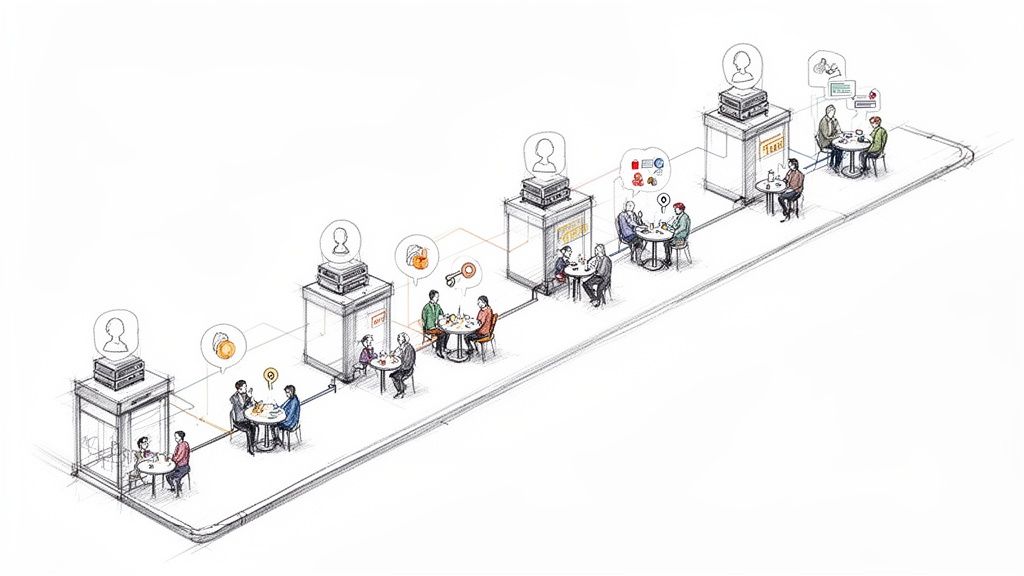
Think of today’s big social media platforms like a giant shopping mall owned by one company. They decide which stores get the best spots, they track every move you make, and they set all the rules. If they decide to ban you, you’re kicked out of the entire mall for good.
Decentralized networks are more like a vibrant city street full of independent shops and cafes. Each one has its own vibe and its own owner, but they all share the same street. You can easily walk from one to another, and your friends can still find you. This is the core idea behind federation—a network of independent servers that can all talk to each other.
How Open Protocols Make It All Work
The magic behind this is the use of open protocols, like ActivityPub (the engine for Mastodon) or the AT Protocol (which powers Bluesky). The best analogy here is email. It doesn't matter if you use Gmail, your friend uses Outlook, and your mom uses Yahoo; you can all send messages to each other because email runs on a shared, open protocol (SMTP).
This open approach unlocks a few game-changing benefits:
- You Can Actually Move: Your online identity and your followers aren't trapped on one platform. If you don't like the rules or the vibe on one server, you can often pack up and move to another one without losing your entire community.
- It's Harder to Silence People: Since there’s no single "off" switch, one company can't just delete your account and erase you from the network. While an admin of a single server can moderate their own space, they can't de-platform you everywhere.
- You Control Your Feed: Many of these platforms give you back a simple, chronological timeline. Better yet, they often let you choose from different algorithms or "feeds" to decide what you see, breaking free from the mysterious, engagement-obsessed algorithms of traditional social media.
This is a huge shift. Your account stops being a temporary rental on someone else's property and starts becoming your own permanent address on the open web.
Taking Back Ownership of Your Digital Self
For creators and brands, this is a really big deal. It’s a potential end to the constant fear of having your account suspended without warning or watching an algorithm change decimate your reach overnight. When you build an audience on a decentralized network, you're forging a more direct and durable connection with them.
Sure, there’s a bit of a learning curve. Getting familiar with things like what is microblogging is a good starting point. You might also bump into some Web3 concepts, as some networks use cryptographic keys to secure your identity. Understanding what a Web3 wallet is can be helpful, as it often acts as your universal login and digital passport across this new, decentralized internet.
The Great Migration to Decentralized Networks
People aren't just leaving familiar social media platforms for fun; they're being pushed out by a long list of frustrations. For years, the internet's town square was run by a handful of tech giants. Now, that same centralized control is sparking a mass migration to decentralized networks. This isn't just about finding a new app—it's a full-blown search for a more stable, genuine, and user-owned online home.
At the heart of this exodus is a deep-seated weariness with unpredictable policy changes and algorithms that feel like a total black box. Users and creators are simply fed up with platforms that can change the rules of the game overnight. One of the biggest drivers is the desire to escape the risks of censorship and content bans on centralized platforms, which can wipe out a creator's entire business without any warning or a clear way to appeal.
The Breaking Point for Centralized Control
We saw a clear turning point during the chaos at platforms like X (formerly Twitter). Abrupt moves, like suddenly charging for previously free API access, sent a shockwave through the developer community. It crippled countless third-party tools and research projects that people actually depended on. These weren't just minor technical glitches; they were a loud-and-clear signal that the platform's stability was gone.
This kind of environment has created a powerful demand for alternatives where the ground beneath your feet doesn't shift every other week. Users are actively looking for spaces free from:
- Invasive Data Harvesting: Many are tired of being the product, with their personal data fueling aggressive and often creepy advertising.
- Opaque Algorithms: Creators feel powerless as their reach gets squeezed by algorithms designed to maximize "engagement," often by rewarding outrage and negativity.
- Fear of Deplatforming: The constant threat of getting suspended for unclear reasons makes building a community on a centralized platform feel like building a house on someone else's land.
A Case Study in Explosive Growth
You can see this migration in action by looking at the incredible growth of Mastodon, a flagship platform in the decentralized "Fediverse." As frustration with the old guard boiled over, Mastodon's user base absolutely exploded. In late 2024, the network shot up from around 500,000 active users in early 2022 to over 10 million—a mind-boggling 20-fold increase.
This wasn't a random surge. It happened in lockstep with major controversies, like Twitter's chaotic rebrand to X and the rollout of paid features that alienated millions. The moment X jacked up its API prices, developers and power users fled, and Mastodon saw hundreds of thousands of new sign-ups almost overnight.
This massive influx proves there's real market demand. People aren't just window-shopping decentralized social media; they're actively moving in. They're voting with their feet for a digital world built on open protocols, not walled gardens.
This migration isn't just about running away from the problems of Web2 social media. It's about running toward the promise of Web3: real ownership, a portable identity, and communities built on trust, not corporate agendas.
This whole trend is tightly woven into the rise of the digital creator economy, which is all about building direct relationships with your audience. For a creator, truly owning your audience means your connections are yours to take with you. Your social graph can't be yanked away by some executive decision. Getting a handle on these new networks isn't just a niche hobby anymore; it's a strategic necessity for anyone serious about building a resilient brand online. The future of community is being built on a foundation you can actually own.
Comparing the Top Decentralized Platforms
Stepping into the world of decentralized social media can feel a bit like exploring a new city. Each platform has its own architecture, its own culture, and its own unique vibe. To figure out where you fit in, you need to understand the fundamental differences between the main players.
The biggest split is between federated networks like Mastodon (powered by ActivityPub) and Bluesky (powered by the AT Protocol), versus blockchain-based networks like Farcaster and Lens Protocol. Think of it this way: federation is like a network of interconnected neighborhoods, while blockchain is like giving every citizen a universal, portable ID card they can use anywhere in the city.
For many, the move away from traditional social media is driven by a search for more control and a real sense of ownership over their digital lives.
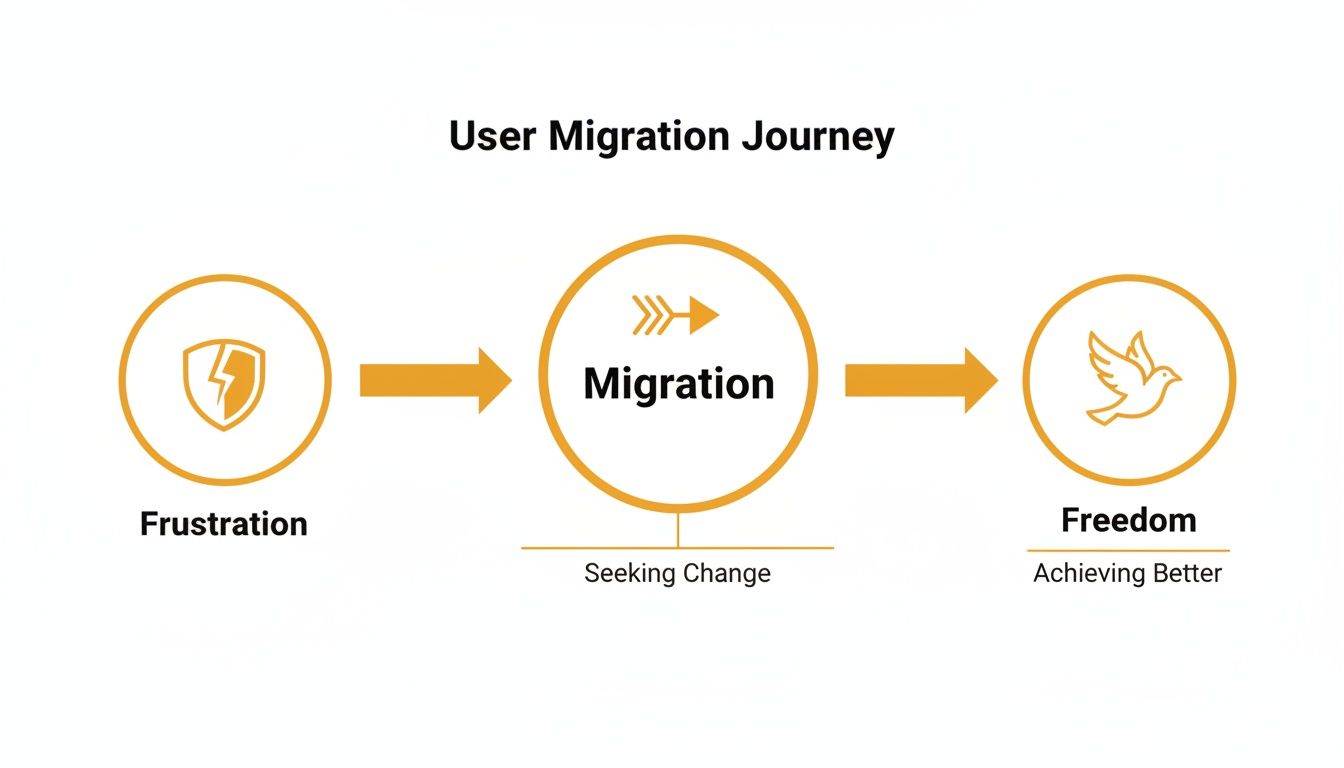
This journey from frustration to freedom is what’s fueling the growth of these new platforms.
Mastodon and the Fediverse
Mastodon is the most established player here, running on a protocol called ActivityPub. This protocol links together thousands of independent servers, or “instances,” into a massive interconnected network called the "Fediverse." When you join Mastodon, you’re really just picking a home server, which comes with its own community and its own moderation rules.
Your experience is filtered through three main timelines:
- Home: A clean, chronological feed of only the accounts you follow.
- Local: Every public post from users on your specific server.
- Federated: Posts from all the other servers your home server is connected to.
This makes your choice of server really important. A server dedicated to tech enthusiasts will have a completely different Local feed than one focused on artists. The community here is generally tech-savvy, privacy-focused, and prefers thoughtful conversation over chasing viral trends. For brands, this means you have to show up and participate genuinely; just broadcasting marketing messages won't work.
Bluesky and the AT Protocol
Bluesky, which started as a project inside Twitter, is built on the newer Authenticated Transfer Protocol (AT Protocol). Its whole mission is to blend the user-friendly feel of a big-name app with the freedom of decentralization. Unlike Mastodon's server-based model, Bluesky puts the emphasis on account portability.
Your identity is a Decentralized Identifier (DID), not something tied to one server. This is a game-changer. It means you can move your entire account—followers, posts, and all—to a new host without starting from scratch.
The real magic of Bluesky is its "Custom Feeds" feature. Absolutely anyone can build and share their own algorithm, which means you can subscribe to countless different ways of discovering content. It’s like having a marketplace of timelines to choose from, instead of being stuck with just one.
The culture on Bluesky feels like a mix of ex-Twitter users, tech folks, and creatives, giving it the familiar energy of a mainstream platform in its early days.
Farcaster and Lens Protocol
Jumping deeper into Web3, we find networks like Farcaster and Lens Protocol, which are built directly on the blockchain. On these platforms, your social identity and your connections are assets you truly own, often in the form of NFTs stored in your crypto wallet.
- Farcaster: This protocol is all about creating a decentralized social graph that anyone can build on. You register your identity on the Optimism blockchain, which gives you the right to post messages. Apps, or "clients," like Warpcast, are then built on top of this shared social foundation.
- Lens Protocol: Lens works similarly, where your profile is an NFT. Every follow, post, and interaction is recorded on the blockchain. This makes your entire social graph portable, allowing you to take your followers with you from one Lens-powered app to the next without missing a beat.
These platforms are naturally attracting a crypto-native crowd. Their growth points to a massive demand for networks where user ownership isn't just a promise—it's cryptographically guaranteed. In fact, blockchain-based social platforms are projected to hit over 40 million monthly active users by 2026. This model lets you mint your profile as an NFT, so you could take 50,000 followers from one app to another instantly. You can find more insights on these Web3 social trends and what they mean for the future.
Decentralized Social Platforms at a Glance
This core difference in architecture—federated servers versus portable blockchain identities—shapes everything from the user experience to how the platforms are governed. The table below provides a quick cheat sheet to help you compare them.
| Platform | Underlying Protocol | Key Feature | Best For |
|---|---|---|---|
| Mastodon | ActivityPub | Federation of independent servers (instances) | Niche communities and topic-focused engagement. |
| Bluesky | AT Protocol | Portable accounts and marketplace of custom algorithms. | Creators wanting a familiar UX with broader audience reach. |
| Farcaster | Farcaster Protocol | Shared, open social graph on the blockchain. | Developers and creators focused on true digital ownership. |
| Lens Protocol | Lens Protocol | Social graph composed of NFTs you own. | The crypto-native community and brands building in Web3. |
Each of these platforms offers a different vision for what social media can be. Whether you value tight-knit communities, algorithmic choice, or verifiable ownership, there's a decentralized option starting to take shape.
2. Opportunities and Challenges for Brands and Creators
For creators and brands, the rise of decentralized social media feels like stepping onto a new frontier. It's an exciting landscape, buzzing with promise, but it’s also marked by unfamiliar terrain. Making the leap requires a clear-eyed look at both the powerful advantages and the very real obstacles.
Deciding whether to build a presence on networks like Mastodon or Bluesky isn’t just a tactical choice; it’s a strategic one. It demands a shift in mindset—away from chasing massive, algorithm-driven reach and toward cultivating deep, authentic community engagement.
Let’s break down the practical pros and cons to help you set the right expectations.
The Big Opportunities
The main draw of these networks is the incredible level of control they offer. Unlike traditional platforms where you’re essentially renting your audience from a corporation, decentralization hands you the keys to your own community. This unlocks some game-changing benefits.
True Audience Ownership: When someone follows you on a decentralized network, that connection is yours. It's not tied to a single company's database, meaning you can often move to a different server or even a new app without having to rebuild your audience from scratch.
Immunity to Algorithm Whims: That constant anxiety of an algorithm update wiping out your reach? It’s gone. Most decentralized platforms feature chronological feeds by default or give users the power to choose their own content discovery algorithms. Your content actually reaches the people who follow you.
Direct Access to Niche Communities: These platforms are often organized around servers (instances) or feeds dedicated to specific interests—from coding and sci-fi to vintage photography. This structure lets you connect directly with highly engaged, self-selected communities that value genuine participation over broadcast-style marketing.
This setup naturally filters for authenticity. Success here isn’t measured by viral metrics but by the quality of your interactions and the value you bring to conversations.
Building a presence on a decentralized network is an investment in a resilient, portable social graph. You're creating an asset that can't be devalued overnight by a policy change or a company's shifting priorities.
This direct access fosters a level of trust and loyalty that’s hard to find on platforms designed to maximize ad revenue. The users here are often early adopters and tech-savvy folks who appreciate brands that respect the community-first vibe.
Navigating the Inherent Challenges
Despite the compelling upsides, these networks are still in their early days, and you have to be prepared to navigate some significant hurdles. The experience is fundamentally different from the polished, all-in-one ecosystems you’re used to.
One of the first things you'll notice is the steeper learning curve. Getting started means wrapping your head around new concepts like servers, federation, and custom feeds. This initial friction can be a barrier for teams accustomed to the plug-and-play nature of mainstream apps.
Plus, the toolset for brands is still being built. You won't find the sophisticated advertising platforms, detailed analytics dashboards, or native influencer marketing tools you might be used to. This makes measuring ROI and scaling your efforts a bit more complicated.
Fragmented User Experience: Because these networks are federated, the user experience can vary quite a bit. A user’s "local" feed is shaped by their home server, which can sometimes fragment conversations and make it harder to get a unified view of your audience.
Content Discovery Is Different: While you escape the tyranny of the algorithm, you also lose its discovery benefits. Gaining visibility relies more on manual engagement, smart hashtag use, and becoming a trusted member of a community—and that takes a real time investment.
Moderation Varies Widely: Each server or community sets its own moderation rules. While this offers choice, it also means brand safety isn't guaranteed across the entire network. You have to do your homework to make sure you're participating in communities that align with your brand values.
To succeed here, you need to embrace a builder's mentality. It’s about contributing to the conversation, not just managing another marketing channel. The brands that will thrive are the ones that invest in genuine participation and see the current limitations not as deal-breakers, but as the price of admission to the future of social media.
Creator and Brand Cheat Sheet: Decentralized vs. Centralized
To put it all into perspective, here’s a quick side-by-side comparison. Think of this as your cheat sheet for weighing where to invest your time and energy.
| Aspect | Decentralized Platforms (e.g., Mastodon) | Centralized Platforms (e.g., X) |
|---|---|---|
| Audience | Owned: Your follower list is portable and not locked to one platform. | Rented: The platform owns the audience graph and can limit your access at any time. |
| Reach | Chronological & Direct: Your content reliably reaches your followers. No algorithm manipulation. | Algorithmic: Reach is determined by a complex, ever-changing algorithm you can't control. |
| Community | Niche & Engaged: Deeply focused communities built around specific interests. | Broad & General: Massive user base, but often less focused and can feel transactional. |
| Advertising | Minimal to None: Organic engagement is the primary growth model. | Advanced & Integrated: Sophisticated ad tools for precise targeting and scaling. |
| Analytics | Basic: Limited native tools for tracking performance and ROI. | Comprehensive: Detailed analytics dashboards to measure every aspect of a campaign. |
| Brand Safety | Variable: Moderation is handled by individual server admins. Requires due diligence. | Centralized & Defined: Platform-wide moderation policies, though enforcement can be inconsistent. |
| Control | High: You control your data, identity, and community experience. | Low: You are subject to the platform's rules, policies, and business decisions. |
Ultimately, the choice isn't necessarily about picking one over the other. Many brands will find success by using both, playing to the unique strengths of each environment. Decentralized platforms offer a chance to build a resilient, core community, while centralized networks remain powerful tools for broad-stroke marketing and brand awareness.
How to Grow Your Presence on Decentralized Networks
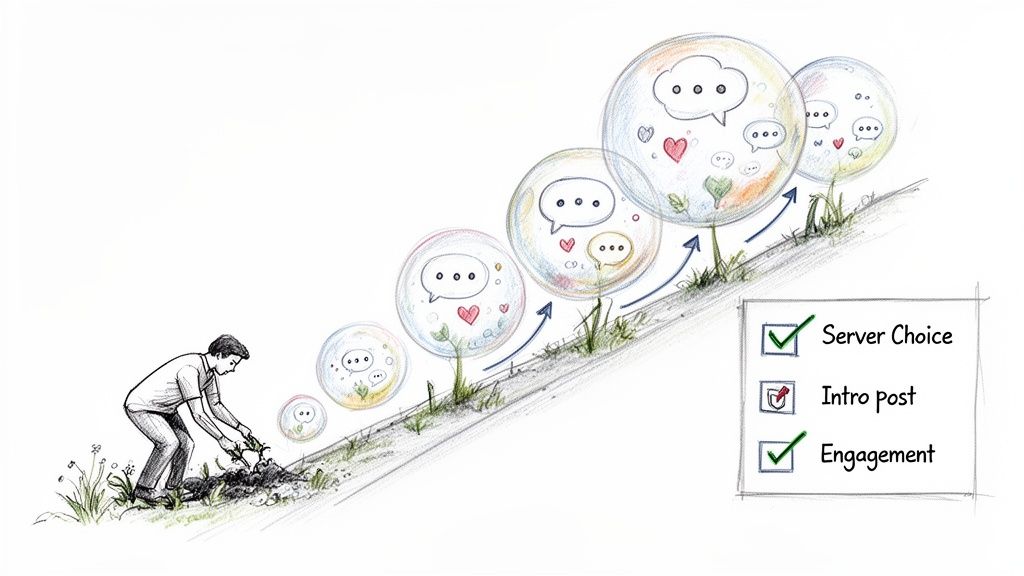
If you're used to the growth hacks of centralized social media, you need to hit the reset button. Growing a following on decentralized platforms isn't about chasing viral trends or gaming an algorithm. It's about earning your place in a community.
The playbook that works on Twitter or Instagram often falls flat here. You can't just broadcast to a passive audience and expect results. The real goal is to get involved in genuine conversations and build relationships from the ground up. This means shifting your mindset—you're not just posting on a platform, you're joining an entire ecosystem of interconnected communities.
Choose Your Community Wisely
Your very first move is deciding where to plant your flag. This is especially critical on federated networks like Mastodon, where your "home server" (or instance) shapes your entire initial experience and defines what you see in your local feed.
Think of it like choosing a new neighborhood. A server built for tech enthusiasts will have a completely different vibe, set of rules, and conversation style than one created for artists or academics.
Here’s how to pick the right spot:
- Match Your Niche: Find a server where your people already hang out. If you’re a software developer, joining a tech-focused instance is a no-brainer.
- Check the House Rules: Always read the server's moderation policies and code of conduct. Make sure they align with your brand's values and create the kind of atmosphere you want to be a part of.
- Think About Server Size: A huge, general-purpose server gives you a wider potential reach, but the local feed can be a firehose of noise. A smaller, niche server offers a more focused community, making it far easier to build real connections.
On a platform like Bluesky, the game is a bit different. It’s less about picking a server and more about strategically participating in custom feeds. Find the feeds relevant to your industry, and you’ll get your content seen by the right eyeballs.
Make a Memorable First Impression
Alright, you're in. Now what? Your first post is your digital handshake, so don't blow it on self-promotion. You need to craft a thoughtful introduction that shows you’re here to contribute, not just to shill your products.
A great intro post usually covers these bases:
- Who you are: A quick line about your background and what you do.
- What you talk about: List the main topics you're passionate about.
- Why you’re here: Share what brought you to the decentralized web.
- A call for connection: Ask for recommendations on who to follow in your field.
Most importantly, use the #introduction hashtag. It’s a network-wide tradition that helps everyone discover new and interesting people. Tack on a few other relevant hashtags like #Tech, #Art, or #Marketing to signal your interests to the rest of the fediverse.
On decentralized networks, your introduction isn't just a formality; it's your entry into the community's conversation. A well-crafted intro that shows personality and a genuine desire to connect can earn you your first wave of engaged followers.
Master the Art of Conversation
Engagement is the name of the game here. Most feeds are chronological, which means consistent, valuable interaction is what gets you noticed. The "schedule and forget" approach is a dead end.
Engage, Don't Just Broadcast Your entire growth strategy should be built on two-way conversations. That means:
- Responding Thoughtfully: When someone replies, keep the ball rolling. Ask follow-up questions. Show you're actually listening.
- Boosting Great Content: On Mastodon, a "boost" (their version of a retweet) is a powerful endorsement. When you share content from others, you build goodwill and prove you’re an active part of the community.
- Exploring Local and Federated Feeds: Don't just stay glued to your home feed. Dive into your server's local timeline and the wider federated timeline to find new discussions to jump into.
The formula is simple: add value before you ask for anything. Become known as a helpful, interesting voice in your niche, and people will naturally want to follow you. This is the core of building a solid online presence anywhere, really. If you want to dive deeper, we cover this in our guide on building a powerful personal brand on social media.
Use Hashtags for Discovery
Without a central algorithm deciding who sees your content, hashtags become your best friend. They are the main way people outside your immediate circle will ever find your posts.
Here are a few tips to use them like a pro:
- Get Specific: Instead of a generic tag like
#marketing, go for something more targeted like#ContentMarketingor#SEOtips. You'll reach a smaller but far more interested audience. - Use CamelCase: Capitalize the first letter of each word in a hashtag (like #DecentralizedSocialMedia). It makes them way easier to read, especially for people using screen readers.
- Don't Spam: A few highly relevant hashtags are much more effective than a wall of generic ones. Stick to the core topics of your post.
- Follow Hashtags: You can follow hashtags just like you follow people. This pulls content from across the network into your feed, giving you a constant stream of new conversations to join.
By carefully choosing your community, nailing your introduction, prioritizing real conversation, and using hashtags smartly, you can build a loyal following. This community-first approach is what turns the unique structure of decentralized social media from a challenge into your greatest strength.
So, what does all of this mean for the future of social media?
It's pretty clear this isn't just a passing fad. Decentralized social media points to a massive change in how we think about the internet itself—one that’s more open, durable, and puts users back in the driver's seat. The big idea here is simple but incredibly important: protocols, not platforms.
Think of it this way: instead of everyone being forced into a few massive "walled gardens" owned by giant corporations, we're building an interconnected web of smaller networks that can all talk to each other. This model is a game-changer for creators and users. It means you actually own your data, communities can't be easily shut down or censored, and you're no longer at the mercy of some mysterious algorithm update that wipes out your reach overnight.
Why This Matters for Your Brand
Okay, I get it. This new ecosystem is still a bit wild and takes some getting used to. But the long-term payoff is just too big to ignore. When you build a presence on these networks, you're not just renting space on someone else's property—you're building an asset you can take with you anywhere. Your community, your followers, your content... it all belongs to you.
The real promise of a federated web is that your digital identity, your creative work, and the audience you've built are yours and yours alone. No company can pull the plug on your community with a flip of a switch. That's the foundation for what's coming next.
The takeaway here is simple: it’s time to start paying attention. By dipping your toes in now, you’re putting your brand on the ground floor of a major shift in how we connect online. Start an account, join a few conversations, and begin building an audience on a foundation that you truly control. Your brand's future community just might depend on it.
Got Questions? We've Got Answers
Diving into decentralized social media can feel like learning a new language. A few questions always pop up, so let's clear the air and get you comfortable with how this new social world works.
Do I Have to Pick One Mastodon Server and Stick With It?
Not at all. You can absolutely have accounts on different servers, but you'll have one that acts as your "home base."
Think of your home server like your main email provider—it's where your primary profile lives. This server shapes your local community feed, but it doesn't trap you there. You're free to follow, chat with, and see posts from people across the entire network, no matter what server they're on. Best of all, if you ever feel like moving, you can migrate your account to a new server without losing your followers.
Is Decentralized Social Media Just an Unmoderated Wild West?
That's one of the biggest myths out there. Moderation is decentralized, not absent. In fact, you often have more control over your experience, not less.
Every server sets its own rules and has its own team to enforce them. You get to choose a community whose moderation policies you actually agree with.
Server admins also have the power to block or "defederate" from other servers that are full of spam, hate speech, or just plain toxic behavior. This lets communities build the kind of online space they want to be a part of.
This community-led approach puts the power back in your hands, creating a more predictable and tailored environment.
How Can I Measure Success Without All the Usual Analytics?
Good question. Success on decentralized platforms looks a little different. It's less about chasing huge, passive follower counts and more about building a genuinely engaged community.
Instead of focusing on vanity metrics, you'll want to track things that show real connection and influence:
- Replies and Conversations: How many real back-and-forth discussions are you starting? This is where the magic happens.
- Boosts: This is Mastodon's version of a retweet. It's a clear signal that people found your content valuable enough to share with their own followers.
- Community Health: Are your interactions positive and meaningful? Are you becoming a trusted voice within your niche communities?
Tracking these kinds of metrics gives you a much truer sense of your brand's actual impact.
Juggling content for X, Bluesky, and Mastodon can quickly become overwhelming. With MicroPoster, you can write your post once, have it automatically tailored for each platform, and schedule everything from a single, clean dashboard. Start publishing smarter and faster by grabbing your free trial at https://microposter.so.


