
personal branding on social media
Personal Branding on Social Media: Build Your Authority and Grow Your Audience
Discover personal branding on social media with a practical guide to defining your niche, creating engaging content, and growing an authentic audience.
Building a personal brand on social media is all about intentionally shaping how people see you. It's not about being the loudest voice in the room, but about becoming the most trusted one in your specific field. You do this by consistently sharing your unique expertise and personality, building a real community around your name. Done right, this turns your profile into a magnet for the right kind of opportunities.
Define Your Brand Before You Ever Hit 'Post'
Jumping onto platforms like X, Bluesky, or Mastodon without a clear plan is like setting sail without a map. You might drift, but you won't get where you want to go. A strong personal brand starts with a solid foundation—and no, this isn't about inventing a fake persona. It's about figuring out what makes you uniquely valuable and amplifying that.
Before you even think about your first post, you need to get crystal clear on who you are and what you stand for. Getting this groundwork right ensures every piece of content you create is purposeful and builds a cohesive story. If you want to dig deeper into this initial phase, there are some great resources on effective brand building on social media.
Find Your Niche at the Intersection
Your niche isn’t just what you're good at. It’s that sweet spot where what you love, what you know, and what a specific audience needs all come together. Don't just pick a topic you have skills in; choose something you're genuinely obsessed with. That passion is what will keep you going on the days you don't feel like creating.
To nail down your niche, you need to answer three questions honestly:
- What am I actually passionate about? What could I talk about for hours without getting bored? This is your engine.
- Where do I have proven expertise? What have I done in the real world that gives me unique insights? This is your value.
- Who needs this knowledge, and what are their biggest problems? What specific pain points can I solve for a certain group? This is your audience.
The magic happens right where those three circles overlap. For example, "social media marketer" is way too broad. But a "social media marketer who helps early-stage B2B SaaS founders land their first 50 demo sign-ups using X threads"? That’s a powerful, focused niche.
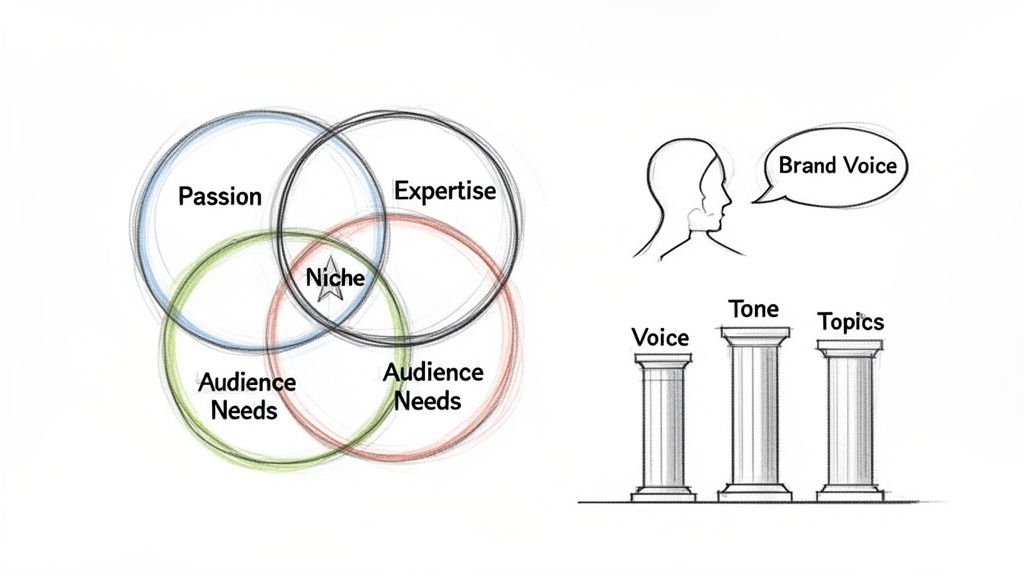
This simple model is the key. It shows you exactly how your unique strengths can solve a real problem, forming the unshakable core of your brand.
Find Your Authentic Voice
Your brand voice is your personality, just in written form. Are you witty and a bit contrarian? Or are you more of an empathetic, supportive guide? Maybe you’re the data-driven analyst or the big-picture creative thinker. There's no single "right" voice, but being consistent is everything.
Your voice should feel natural to you, otherwise, you'll burn out trying to maintain it over hundreds of posts. Think about it this way: if your followers saw one of your posts without your name attached, they should still know it was you. That's how you build trust and become instantly recognizable in a noisy feed.
Your personal brand has to be a real reflection of who you are. In a world full of AI-generated content, human-led stories, raw insights, and genuine connection are what will make you stand out.
This isn’t just a nice idea; it’s a real market shift. People are tired of robotic "slop" and are craving authenticity. Real, unscripted storytelling and live engagement that can’t be faked by a bot are becoming the cornerstones of successful brands.
Lock in Your Core Content Pillars
You can't be the go-to expert on everything. If you try to cover too many topics, you’ll just dilute your message and leave your audience confused.
The solution? Establish three to five core content pillars. These are the main themes you’ll talk about over and over again, and they should all connect directly back to your niche.
Let's go back to our SaaS marketer. Their content pillars might look something like this:
- Lead Gen Tactics on X: Actionable playbooks for finding and engaging potential customers.
- Thread & Long-Form Breakdowns: Deconstructing what makes a piece of content actually work.
- Marketing Psychology: Diving into the "why" behind what makes people click and convert.
- Startup Growth Stories: Sharing real-world lessons and case studies from the B2B trenches.
These pillars are your guardrails. They keep your content calendar focused, ensuring every post reinforces your expertise and gives your audience predictable value. People will know what they're getting when they follow you, and that’s exactly why they'll stick around.
Crafting Content That Builds a Community
Alright, you’ve done the foundational work. You know your niche, you've defined your voice, and you have your content pillars ready to go. Now for the fun part: turning that strategy into actual content that people want to read.
This is where your personal brand really starts to breathe. The goal isn’t just to fill a content calendar; it’s to create posts that stop the scroll, deliver real value, and kickstart conversations. That’s how you turn a list of followers into a genuine community.
On platforms like X, Bluesky, and Mastodon, you're primarily working with two formats: short, punchy single posts and detailed, value-packed threads. A single post is perfect for a quick take, a provocative question, or a reaction to a trending topic. A thread, on the other hand, is your mini-masterclass—your chance to teach, tell a story, or unpack a complex idea. This is how you build deep authority.
The Anatomy of an Engaging Post
Here’s a little secret: every post that performs well follows a simple, predictable structure. It grabs attention, gives something of value, and then asks for something in return. If you can master this flow, you’ll have a reliable system for creating content that connects, time and time again.
Think of it like this:
- The Hook: Your first line has one job and one job only: to make someone read the second line. It has to be intriguing, controversial, or so relatable it feels like you're reading their mind.
- The Value: This is the meat of the post. It’s the unique insight, the actionable tip, or the personal story that fulfills the promise you made in the hook.
- The Call-to-Action (CTA): This is your invitation to the party. A lame CTA like "What do you think?" gets you lame, one-word answers. A specific, compelling CTA gets you thoughtful replies.
The real secret to great content isn't being complicated; it's being crystal clear. A powerful hook, one solid point of value, and a direct call-to-action will beat a rambling, unfocused post every single time.
This simple three-part formula is the engine that drives community. It shifts people from just passively scrolling to actively participating.
Hooks and CTAs That Actually Work
Let's get practical. Generic advice leads to forgettable content. Your hooks and CTAs need to be sharp and tailored to your audience. Honestly, the difference between a post that gets 10 likes and one that sparks 50 comments often boils down to just these two elements.
Here’s how to craft hooks that make people slam on the brakes:
- Go against the grain: "Everyone is obsessed with getting more followers. They're wrong. Here's the metric that actually moves the needle."
- Use a shocking stat: "90% of startups fail, but it's not for the reason you think."
- Ask a deeply relatable question: "Ever sit in a meeting feeling like a total imposter, even when you knew your stuff? Let's talk about it."
- Make a bold promise: "I'm about to walk you through the exact 4-step framework I used to double my email list in 30 days."
Once you've delivered the goods, you need a CTA that pulls people in. Ditch the generic questions and try one of these instead:
| CTA Type | Example | Why It Works |
|---|---|---|
| Share an Experience | "What's the single best piece of career advice you've ever received? Share it below." | It prompts storytelling and creates a personal connection. |
| Seek Specific Advice | "I'm working on a new landing page. What's one element you believe is absolutely non-negotiable?" | This makes people feel valued and positions them as an expert. |
| Encourage Debate | "My take: cold DMs are completely dead for lead gen. Argue with me in the replies." | It invites passionate responses and gets a real discussion going. |
| Prompt a Simple Answer | "If you could only use one marketing tool for the rest of your life, what would it be? Drop your pick." | This is low-friction and super easy for anyone to answer quickly. |
These aren't just templates; they are strategic ways to start a conversation. A great hook brings new people in, the valuable content makes them stay, and a compelling CTA turns them into part of the community. If you really want to level up this part of your strategy, check out our deep-dive guide on how to build an online community. This is how you stop broadcasting and start building something that lasts.
Building a Sustainable Content Workflow
Consistency is the engine that drives a personal brand, but you can't run on fumes forever. Sooner or later, you'll burn out. The real secret to a lasting presence isn't about posting more; it's about building a smart, sustainable system that protects your time and energy. It's about showing up reliably without the daily scramble to create something new from scratch.
This means shifting your mindset from a reactive, post-by-post grind to a more strategic, planned-out approach. The goal is simple: separate the creative part (coming up with ideas and writing) from the logistical part (formatting and publishing). This single change can transform content creation from a daily chore into a manageable, even enjoyable, part of your week.
Master the Art of Batching and Scheduling
Instead of staring at a blank screen every morning, trying to conjure up a brilliant post, block out dedicated time each week to batch your content. Think of it as a creative sprint. It could be a two-hour session on a Sunday afternoon where you write all your core posts for the week ahead. During this time, you just write—no distractions, no formatting, just getting your ideas out.
Once your drafts are done, you schedule them. This is where tools like MicroPoster become absolute game-changers. You can load up your entire week’s content, set it to publish at the best times for your audience, and then forget about it.
This system does more than just save time. It frees up your mental energy during the week so you can focus on what really matters: engaging with your community, replying to comments, and building relationships.
Repurpose Your Best Content Like a Pro
Creating great content is hard. Why let it die after just one post? Repurposing is the ultimate efficiency hack. A single high-performing piece of content—that detailed thread, a deep-dive post, or a short video—can fuel an entire week's worth of new material.
Start by identifying your "pillar" content. Then, break it down.
- Pull out key quotes: Turn the most powerful sentences into standalone quote posts.
- Create single-tip posts: Extract each actionable step from a thread and give it its own bite-sized post.
- Run a poll: Take a debatable point from your content and ask your audience to weigh in.
- Share a key statistic: Highlight a compelling data point and ask people for their take.
The goal isn't to be repetitive. It's to reinforce your core message in different ways to reach different people. Some followers love in-depth threads; others just want a quick, visual tip.
This diagram shows the core elements that make content worth repurposing in the first place.
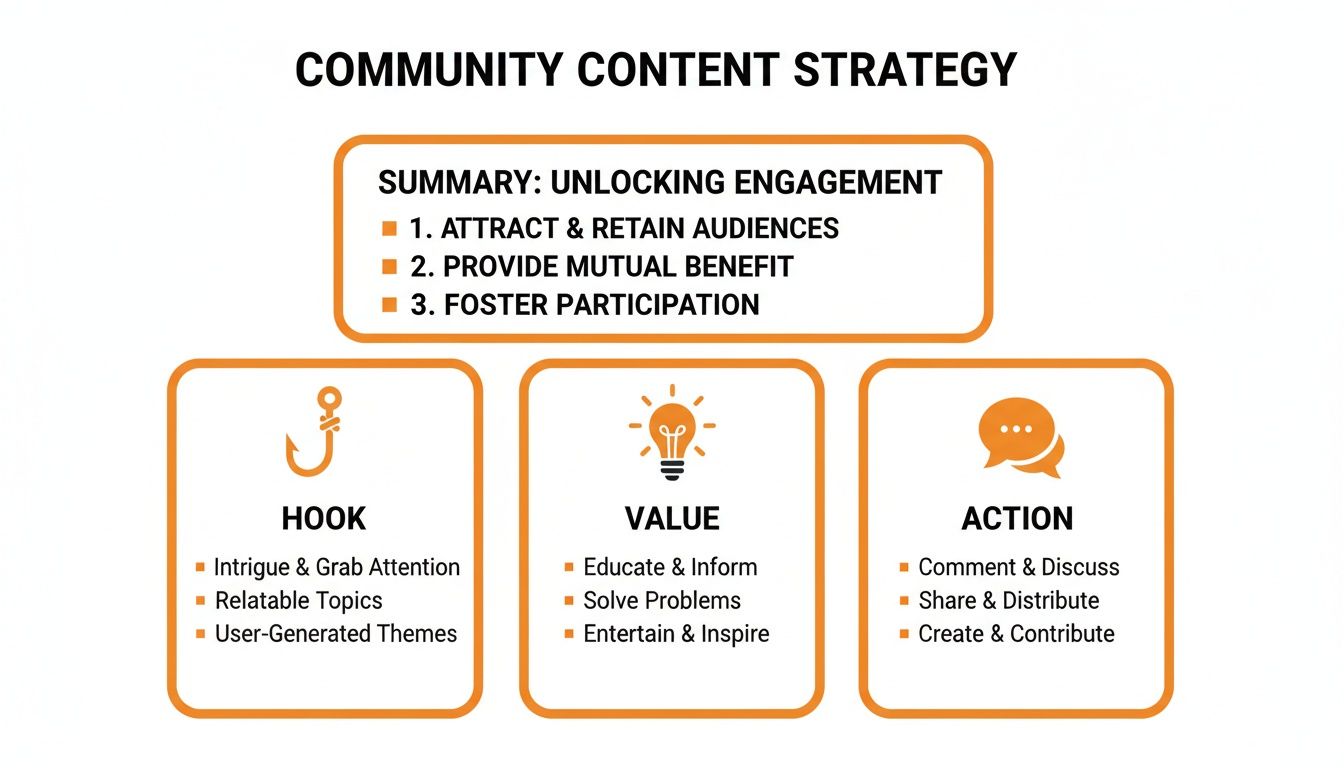
When you nail the hook, deliver real value, and include a clear call to action, you create content with built-in repurposing potential. Smartly reusing what already works is central to an efficient workflow. For a deeper look, check out our guide on automated content distribution, which takes these ideas to the next level.
Smart Ways to Get More Eyeballs on Your Content
Let's be real: creating amazing content is only half the job. If no one ever sees it, your personal brand is basically invisible. You can't just post and pray. You need a solid plan to get your insights in front of the right people. That means showing up where your audience already gathers and giving them a reason to follow you back to your profile.
Think of it like being a guest at a party, not the host. You wouldn’t walk in and immediately start shouting about yourself, right? Of course not. You’d find an interesting conversation, listen for a bit, and then chime in with something thoughtful that makes people pay attention. That’s exactly how you should approach social media.
Engage With Big Accounts to Borrow Their Audience
One of the quickest ways to grow is to ethically "borrow" the audience of larger accounts in your niche. These people have already done the hard work of building a relevant following. Your job is to show up in their comments and replies—not with a lazy "great post!" but with something genuinely valuable.
When a major voice in your field posts something, don't just hit the like button and move on. Jump into the replies. Add a comment that builds on their point, offers a respectful counter-perspective, or asks a really smart follow-up question.
This does two things for you almost instantly:
- You get noticed. The account owner and their most dedicated followers will see your thoughtful contribution.
- You showcase your expertise. Your reply is like a mini-audition, proving you know your stuff without having to be salesy about it.
For instance, if a marketing expert posts about a new trend, your reply could be: "Totally agree. We've seen this work wonders for B2B tech companies, especially when they combine it with [specific tactic]. One of our clients saw a 20% bump in demo requests." See? You've added specific, immediate value and positioned yourself as an expert.
Become a Regular in Niche Communities
Beyond just engaging with individual accounts, you need to plant yourself firmly in the communities where your ideal audience hangs out. On X, this could mean joining relevant Communities or jumping into trending topics related to your content pillars. Find the online hubs where your people are asking questions and sharing their frustrations.
Your goal is to become a helpful, recognizable name. Answer questions, share resources, and offer solutions without expecting anything in return. This is how you build trust at scale. Before you know it, people will start seeking you out directly, and your profile will become a magnet for high-quality followers who are already interested in what you have to say.
The secret to powerful personal branding isn't broadcasting—it's being consistently and generously helpful in the right places. Your reputation will always grow faster than your follower count.
This strategy is more critical now than ever. Feeds are incredibly saturated, and people are exhausted by generic content. Don't just take my word for it; look at the data. One study found that by 2025, Instagram's overall engagement rate had plummeted to just 0.50%—a massive 28% drop from the year before. This tells us that users are just scrolling past the noise and only stopping for content that feels human and offers real value.
Cross-Promote Your Best Stuff
Finally, make sure your best work gets the attention it deserves by promoting it across different platforms. If you write a fantastic, in-depth thread on X, don't just let it die there. Share a link to it on your Bluesky or Mastodon profile with a hook that makes people want to click. This kind of cross-pollination introduces your brand to new audiences without you having to create completely new content from scratch.
This simple tactic ensures your best ideas get maximum visibility. And as your brand grows, you can start thinking about monetizing that expertise. A great next step is to learn how to create and sell digital products, which can seriously expand your impact. By being smart about your engagement and promotion, you ensure your personal brand doesn’t just exist—it thrives.
Measuring What Matters to Refine Your Strategy
Posting content without looking at the data is like shouting into the void. You might be making noise, but you have no idea if anyone is actually listening. Growth isn't an accident; it's a direct result of paying close attention to your analytics and making smart, informed decisions based on what you find.
This is where you stop guessing and start knowing. Let's cut through the vanity metrics and focus on the numbers that signal real, sustainable brand health.
Look Beyond Follower Counts
Let's get one thing straight: obsessing over your follower count is the biggest mistake you can make. It feels good, sure, but it tells you almost nothing about the actual strength of your brand. A million followers who don't care about what you say are far less valuable than 1,000 true fans who hang on your every word.
Your focus needs to shift to the metrics that reveal genuine connection. These are the numbers that show people aren't just scrolling past your content—they're stopping, thinking, and acting on it.
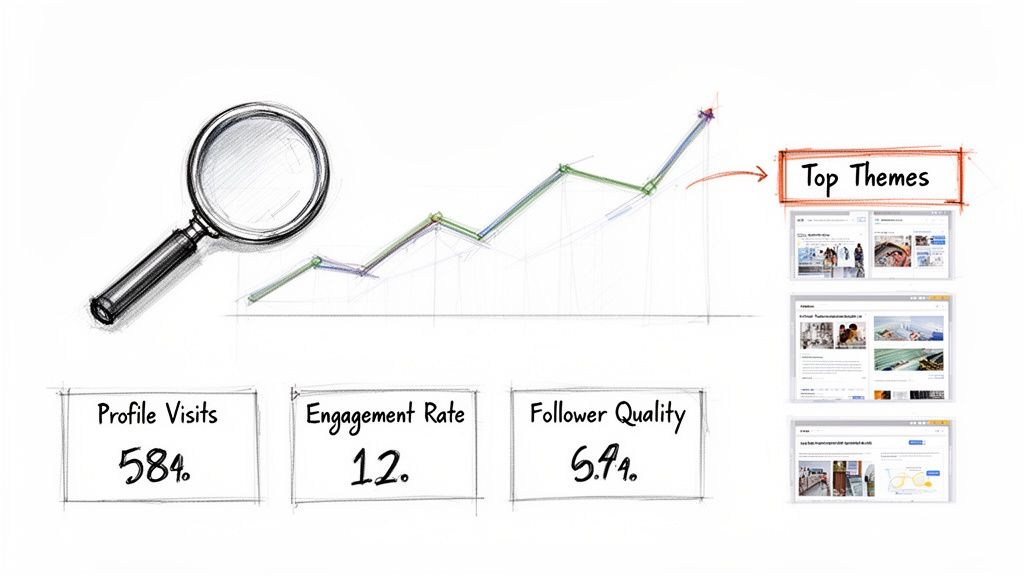
Here’s what you should be tracking instead:
- Engagement Rate: This is your holy grail. It’s the percentage of people who see your content and react with likes, replies, and reposts. A high engagement rate means you’re not just posting; you’re connecting.
- Profile Visits: Someone saw a single post and was so intrigued they clicked through to see who you are. This is a massive buying signal—they want more from you.
- Link Clicks: If you’re trying to drive traffic to a newsletter, blog, or product, this is your ROI. It’s the metric that proves your brand has influence beyond the platform itself.
- Impressions vs. Engagement: Looking at these two side-by-side tells a powerful story. Huge impressions but low engagement? Your hooks are great, but the content inside isn't delivering on the promise.
When you track these metrics, you get a much sharper picture of how well you're actually building a community, not just an audience.
Perform a Simple Monthly Content Audit
You don't need a PhD in data science for this. Just set aside 30 minutes once a month to review your posts. This simple ritual is your secret weapon for making your content better and better over time.
It’s a straightforward process. Just open your profile’s native analytics tab or use a tool like MicroPoster for a more organized view. Find your best-performing posts based on the meaningful metrics we just covered.
Now, play detective and ask yourself a few questions:
- Which topics popped? Did your deep dive on marketing psychology get way more love than your posts about startup news?
- What format worked best? Were your long-form threads sparking incredible conversations while your single-image posts fell flat?
- Which hooks actually stopped the scroll? Was it the controversial take, the surprising stat, or the vulnerable personal story?
Jot down your findings in a simple document or notebook. After a couple of months, you won't just see data—you'll see clear, actionable patterns.
Data is just your audience telling you exactly what they want more of. Your only job is to listen and give it to them.
This isn’t about chasing a magic formula. It's about building an intuition for what your audience loves, backed by cold, hard proof.
Double Down on What Works, Ditch What Doesn’t
Once you've identified your winning themes and formats, the next step is deceptively simple: do more of what works and stop doing what doesn’t. This is the feedback loop that separates the pros from the amateurs.
If your data shows that threads breaking down complex topics get 3x the engagement of anything else you post, that's a massive signal. Your content calendar for the next month should be packed with them.
On the flip side, if your quick industry hot-takes are consistently met with crickets, it’s time to either radically change your approach or cut them loose. Don't be precious about a content pillar that isn't pulling its weight. Your time is your most valuable asset—invest it where you’ll get the best return.
To make sense of it all, focus on a few key performance indicators. This table breaks down what you should be watching and why it's so important for building your personal brand.
Key Metrics for Personal Brand Growth
| Metric | What It Measures | Why It Matters |
|---|---|---|
| Engagement Rate | The percentage of your audience that actively interacts with your posts. | Indicates how well your content resonates and connects with your followers. A high rate is a sign of a healthy, active community. |
| Profile Visits | The number of users who clicked through to view your main profile page. | Shows strong interest in your brand beyond a single post. This is a critical step before someone decides to follow or click your link-in-bio. |
| Link Clicks | The number of clicks on any links shared in your profile or posts. | This is the ultimate measure of action. It shows your audience trusts you enough to leave the platform based on your recommendation. |
By consistently reviewing these numbers and tweaking your strategy, you create a powerful cycle of improvement. This is how you build a personal brand that doesn't just grow in followers, but in real influence and impact.
Got Questions? Let's Get Them Answered.
Building a personal brand is a marathon, not a sprint. Along the way, you're bound to hit a few roadblocks or have questions pop up. Here are some of the most common ones I hear from creators, along with my advice for navigating them.
How Do I Deal With Trolls and Negative Comments?
If you're creating content online, negative feedback is pretty much a guarantee. It’s part of the territory. The trick isn't to avoid it, but to know exactly how you'll handle it before it happens. Reacting emotionally is a trap; responding strategically is a skill.
First things first, take a breath and figure out what you're dealing with. Is it actual constructive feedback, or is it just noise from someone trying to stir up trouble?
- Legit Criticism: Someone took the time to offer a thoughtful counterpoint. The best move? Thank them. Acknowledging their perspective with a bit of grace can flip the entire interaction. It shows the rest of your community that you're confident and open-minded.
- Trolls: These are the comments designed to get a rise out of you. Don't take the bait. Your best weapons are the ignore, mute, and block buttons. Engaging a troll just amplifies their voice and gives them the attention they're desperately seeking. It’s a no-win game.
At the end of the day, you're the curator of your own space. You get to decide which conversations are worth your energy.
How you handle negativity says more about your brand than your content ever will. A measured response builds trust and shows leadership. Getting dragged into a public spat? That can tear down the credibility you've worked so hard to build.
Should I Be on Every Single Platform?
Absolutely not. It's a classic rookie mistake. You'll end up stretched thin, burning out, and creating a bunch of mediocre content that doesn't resonate anywhere.
Instead, pick one or two platforms and go deep. Master them. Each network has its own unwritten rules, its own culture, and its own audience. You can't just copy and paste.
Figure out where your ideal audience actually hangs out. If you're talking to people in tech, X (formerly Twitter) and maybe even LinkedIn are probably your home turf. If your content is highly visual, another platform might be the right fit. Nail your primary platform first. Build a real, engaged community there. Once you have that solid foundation, you can start thinking about expanding.
How Do I Get Over Feeling Like a Fraud?
Ah, imposter syndrome. It's the silent partner of almost every creator I know, no matter how big their audience gets. It’s that voice in your head whispering, "Who are you to be talking about this?" The only real way to silence it is to take action.
Here are a few things that have helped me and countless others:
- Focus on helping just one person. Seriously. Stop trying to be the world's foremost expert. Just create content for the person who is two steps behind you on the path. That’s it.
- Document your journey instead of just creating content. This is a game-changer. Share what you're learning, your mistakes, your process. It shifts the entire dynamic. You’re no longer a guru on a stage; you’re a guide on the same path, just a little further ahead.
- Start a "wins" folder. Screenshot every piece of positive feedback, every thank-you message, every testimonial. When that feeling of doubt creeps in, open it up. It’s hard evidence that you're making a real impact.
Remember, your unique experience is your greatest asset. You don't have to know everything to be valuable. Your story is what makes your brand authentic and connects you with others.
Ready to stop juggling tabs and start building your brand on X, Bluesky, and Mastodon with a real strategy? MicroPoster brings your content studio, scheduling, and growth tools into one place so you can build a community without the burnout. Start your free 7-day trial of MicroPoster today and feel the difference.


