how to build online community
How to Build Online Community That Thrives
Learn how to build online community with a practical blueprint for launching, engaging, and growing a loyal audience.

Before you can even think about growth hacks or engagement metrics, you have to get the foundation right. Building a vibrant online community isn't about luck; it's about making a series of smart, intentional decisions from day one. Skipping this part is the number one reason most communities fizzle out.
Let's walk through how to build a solid base that will support your community long-term.
Laying the Foundation for a Thriving Community
This initial stage is all about strategy. Before you write a single post or send the first invite, you need to slow down and get crystal clear on your vision. This isn't just about picking a catchy name; it's about architecting an entire ecosystem where people genuinely want to be.
The absolute core of this process is nailing down your community's "why." This becomes your North Star—the purpose that guides every piece of content, every moderation call, and every new member you welcome.
Define Your Community's Core Purpose
What is the singular, driving goal of this community? You have to be specific. Is it a support network for founders trying to survive their first year? A creative hub for artists all using the same niche software? A place for die-hard fans of a specific podcast to connect and geek out?
A vague mission like "a space for marketers" is a recipe for a ghost town. It's too broad.
A much stronger purpose is something like: "a private group for B2B SaaS marketers to share proven demand-gen tactics without all the noise of public forums." See the difference? The second one immediately sets expectations and promises real, tangible value.
A community without a clear purpose is just a group chat. Defining your 'why' gives members a compelling reason to join, participate, and stick around.
To really sharpen your focus, ask yourself these questions:
- Transformation: What change will people experience by being here? (e.g., They’ll become more confident public speakers.)
- Outcome: What tangible result can they achieve with the group's help? (e.g., They’ll finally launch their first successful product.)
- Connection: Who will they connect with that they couldn't otherwise? (e.g., They’ll find potential co-founders and early collaborators.)
Your answers to these questions are the bedrock of your community’s entire identity.
Pinpoint Your Ideal Member
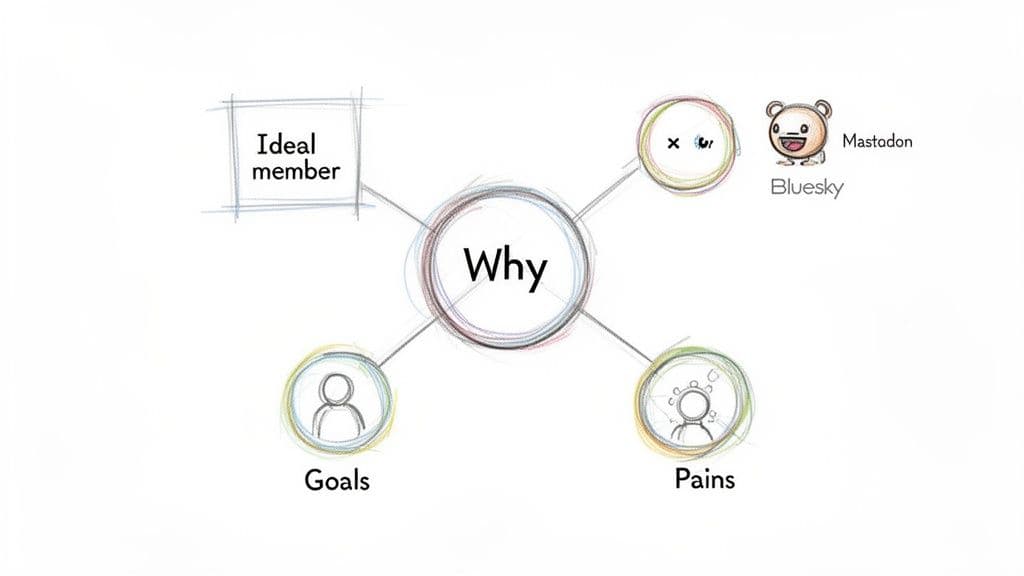
Once you know your "why," you have to figure out "who" it's for. And I mean really figure it out. Going beyond simple demographics is non-negotiable. Think of it as creating an "ideal member profile"—like a user persona, but laser-focused on their community behavior and needs.
You need to get inside their head. What are their biggest pains, their loftiest goals, their deepest motivations? What problem is keeping them up at night that your community is uniquely positioned to solve?
For example, a community for freelance writers might assume its members just want job boards. But after digging deeper, they might discover the real pain point is the profound isolation and the desperate need for peer feedback. Understanding that distinction is everything.
This deep empathy allows you to craft content and spark conversations that resonate on a personal level, making new members feel seen and understood from the moment they join.
Choose the Right Home for Your Community
Where you decide to build your community is a critical choice. In fact, finding the best online community platforms that fit your vision is one of the most important decisions you'll make. The platform itself shapes the conversational style, the norms, and the overall vibe.
For the kind of text-first communities we're talking about, platforms like X, Bluesky, and Mastodon offer very different environments.
Choosing the Right Platform for Your Community
Your platform choice is critical. This table compares key features and community dynamics across popular microblogging networks to help you decide where to build your home base.
| Platform | Best For | Key Community Feature | Creator Advantage |
|---|---|---|---|
| X | Broad reach and public conversations | X Communities (formerly Twitter Circles) | High potential for virality and attracting a diverse audience. |
| Bluesky | Niche, interest-based groups | Custom Feeds and granular moderation | Deeper engagement within highly specific, self-moderated topics. |
| Mastodon | Decentralized, creator-owned spaces | Federated instances (servers) | Complete control over community rules, data, and experience. |
Ultimately, your choice should reflect where your ideal members already are and what kind of space they'd feel comfortable in. Are they power users on X, or would they thrive in the focused, ad-free environment of a private Mastodon server? Matching the platform to the person is a foundational move that will pay dividends in engagement and growth down the line.
Weaving Your Content and Engagement Strategy
A solid community platform is your foundation, but a truly great community lives and breathes through its conversations. Think of compelling content as the fuel for those conversations. Without a clear strategy, you’ll find yourself scrambling for ideas or, even worse, posting things that get nothing but crickets. This is about creating a sustainable rhythm that sparks real dialogue, not just one-word replies.
Your mission is to establish the community's heartbeat—a consistent, valuable flow of posts, questions, and ideas that pull people in without burning you out. You're not just a broadcaster; you're the facilitator of fantastic discussions.
Nail Down Your Core Content Pillars
Before you can create a content calendar, you need to define your content pillars. These are simply the 3-5 core themes your community will always circle back to. Imagine them as the main channels on your community's "TV network." They give you structure and predictability, which helps members know exactly what to expect.
Let's say you're building a community for freelance writers. Your pillars might look something like this:
- Finding Clients: Practical tips, cold pitch templates, and real success stories.
- Honing the Craft: Writing exercises, deep dives on editing techniques, and new tool recommendations.
- Running the Business: Honest discussions about pricing, contracts, and productivity hacks.
- Member Wins: A weekly thread where everyone can share their latest published piece or a recent success.
These pillars directly address what your ideal member actually cares about, ensuring every post serves a purpose. More importantly, they give you a creative framework so you're never staring at a blank screen wondering what to post next. Having a well-defined content strategy for social media is a massive advantage for any community builder.
Master the Art of the Conversation Starter
The gap between a thriving community and a digital ghost town often comes down to the quality of your prompts. A generic question like, "What are your goals?" is just too broad and frankly, a little intimidating. A great conversation starter is specific, open-ended, and incredibly easy to answer.
Instead of asking, "Any questions about marketing?" get more granular. Try something like, "What's one small marketing experiment you ran this month that surprisingly worked?" See the difference? This prompt is tactical, invites a story, and doesn't demand a perfectly polished essay in response.
A great prompt makes people feel smart for answering. It lowers the barrier to participation and signals that all contributions, big or small, are welcome.
Here are a few formats I’ve seen work wonders:
- "What's your take on...": Pick a recent industry trend or a slightly controversial opinion and ask for perspectives.
- "Share a recent win...": This is a simple, positive prompt that gets people celebrating each other.
- "I'm struggling with X, how have you handled it?": When a community leader shows a little vulnerability, it gives everyone else permission to be open and ask for real help.
Create Interactive Community Experiences
While text-based chats are the core, interactive experiences can seriously ramp up engagement and make members feel like they're part of something, not just consuming content. These don't have to be complicated, high-production events. Simple, recurring formats can be incredibly effective.
Try to mix in different types of activities to keep things fresh and appeal to different personalities—not everyone loves typing out long posts.
- Weekly Q&A Threads: Dedicate a specific thread each week for an "Ask Me Anything" (AMA) or for members to ask the group a burning question.
- Member-Driven Polls: Use polls to spark debate, not just to collect data. Ask things like, "Which tool is more essential for your workflow: A or B? Defend your choice in the replies!"
- "Build-in-Public" Threads: Document a small project you’re working on—maybe designing a new logo or writing a blog post—and ask for feedback at each stage. This creates a powerful sense of shared ownership.
Ultimately, this is about more than just broadcasting information. It's about actively connecting with people and fostering genuine relationships, which is the whole principle behind social selling for relationship building. Every reply, poll, and Q&A is another chance to strengthen the bonds in your community, creating a dynamic space people can't wait to come back to.
Launching and Scaling with Sustainable Growth Loops
Your community launch isn't a big, one-off event—it’s the first push of a flywheel. A successful kickoff isn't about getting a massive flood of sign-ups on day one. It's about creating a genuinely welcoming and interesting place from the get-go. This initial vibe sets the tone for everything that comes next as you shift from launch-day hustle to building systems that keep the community growing on its own.
The real goal here is to get away from constantly chasing new members one by one. You want to build powerful growth loops—self-reinforcing systems where your best, most engaged members naturally attract other high-quality people just like them.
Seeding Initial Conversations and Onboarding
Nobody wants to be the first person to speak at a party. An empty community feels the same way—intimidating. So, before you open the doors wide, you need to "seed" the space. Gather a small, trusted group of founding members—these could be colleagues, loyal social media followers, or past clients who already get your vision and are excited to help you start.
Work with this core group to get a few great conversations going before anyone else shows up. This one move completely changes the first impression for new arrivals. They land in a place that’s already buzzing with activity, not a digital ghost town. It instantly goes from, "Am I the only one here?" to, "Wow, this looks interesting."
At the same time, you need to nail your onboarding process. This is so much more than a generic welcome email. A great onboarding flow should:
- Restate the community’s purpose and ground rules right away.
- Prompt new members to introduce themselves with a simple, low-pressure question.
- Point them to key resources, like a "Start Here" thread or an FAQ.
- Tag a couple of those founding members to personally welcome them.
This kind of hands-on, personal welcome makes new members feel seen and valued from the moment they join. That feeling dramatically increases the chances they’ll stick around and start participating themselves.
Building Your First Growth Loop Through Content
Your most powerful growth loops will almost always be fueled by the content created inside the community. When a member shares something genuinely helpful or fascinating from your group, they're giving an implicit, powerful endorsement. The trick is to foster content that's so good, people can't help but share it.
This is where having a simple, repeatable content process makes all the difference. The flow below shows how you can consistently turn core ideas into the kind of interactive content that sparks real conversation.
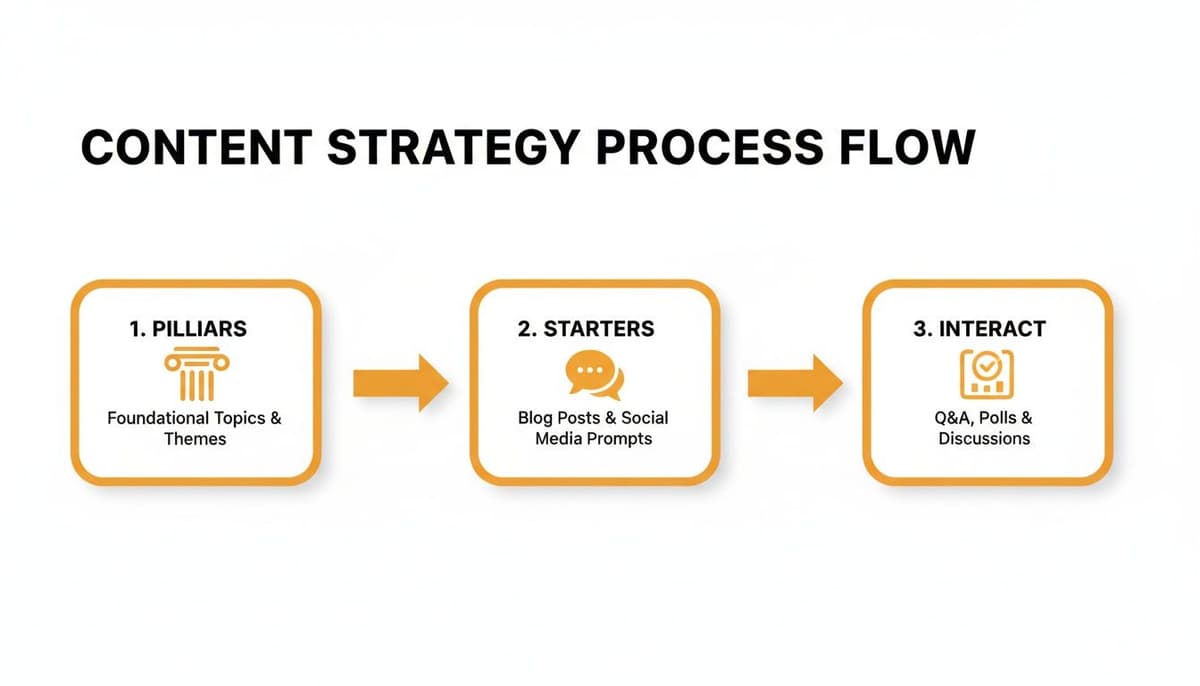
This process—moving from big-picture pillars to specific conversation starters and interactive posts—is designed to create content that’s actually worth sharing outside your community walls, which in turn fuels your growth.
Think about it: a thread that solves a common, painful problem for your ideal member is pure gold. Someone might screenshot a brilliant answer and post it on X, tagging the original author and your community. That single action is incredible social proof, driving curious, like-minded people to see what you're all about.
Consistency over the long term is what truly builds a powerhouse community. In fact, research shows that established communities reap massive rewards. According to the Higher Logic Association Community Benchmarks report, online communities operating for over five years see an average of 673 logins per month and 203 new threads started monthly. As you can see from these powerful community benchmarks, it’s the steady, consistent effort that builds deep, lasting engagement.
Activating Members as Informal Ambassadors
Your most passionate members are your single greatest growth asset. You don’t need a complicated ambassador program with t-shirts and titles to get them involved. The best approach is often just to recognize and empower the people who are already shouting you out.
When you make your members feel like heroes, they become your best marketers. Publicly celebrating their contributions is the simplest, most effective way to encourage more of the same.
Keep an eye out for members who consistently post great answers, welcome newcomers, or share community content. Once you spot them, you can empower them in simple ways:
- Give Them a Spotlight: Create a "Member of the Week" post highlighting their expertise and what they’ve brought to the group.
- Ask for Their Opinion: Shoot them a private message asking for feedback on a new idea or content format. This shows you truly value their perspective.
- Provide Early Access: Give them a sneak peek at an upcoming event or piece of content as a small thank you.
These simple acts of recognition build incredible loyalty. They turn passive members into active advocates who will organically recommend your community to their own networks, not because you asked them to, but because they feel a genuine sense of ownership and pride. This creates a powerful, trust-based growth engine that scales right along with your community.
Exploring Monetization That Serves Your Members
Let's talk about monetization. For many community builders, just the thought of asking for money feels a bit uncomfortable. But the trick is to stop thinking about it as a transaction. Instead, think of it as creating a way to offer even more value to the members who are most committed to what you're building.
When you get it right, a paid offering doesn't divide your community—it deepens it. You're creating an inner circle for your most invested members, which in turn gives you the resources to serve both the free and paid parts of your community even better.
Building Your Premium Value Proposition
Okay, before you even think about a price tag, you have to nail down what people are actually paying for. Why would someone want to join a smaller, more exclusive group? It's almost never just about getting more content; it’s about getting better access, deeper connections, or specialized tools they can't find anywhere else.
Avoid the classic mistake of just locking your existing content behind a paywall. That feels like you're taking something away. The real magic happens when you build something new and exclusive that solves a bigger, more specific problem for your ideal member.
- Direct Access: This is huge. Think weekly "office hours" or a private Q&A thread where paid members get your undivided attention and feedback.
- Exclusive Resources: What could you create that would be a game-changer for them? A library of practical templates, detailed guides, or maybe some behind-the-scenes content could be incredibly valuable.
- A Focused Network: Sometimes, the value is simply being in the room. A private space, free from the noise of a larger public forum, filled with other highly motivated people is a powerful draw.
The goal is to craft an offer so compelling that your most engaged followers see it as the logical next step. They aren't just buying information; they're investing in their own growth and in connecting with like-minded peers.
Designing Your Tiers and Funnel
You don't need some complex, five-tiered pricing menu when you're starting out. In fact, a single, clearly defined premium tier is often the most powerful way to begin. It draws a clean line: here's the free public community, and here's the paid private one.
Your free content on platforms like X or Bluesky naturally becomes the top of your funnel. It's where you cast a wide net, build trust, and attract the right kind of people with broad-strokes value.
Your public content should solve the "what" and the "why." Your paid community is where you help them with the "how."
This creates a smooth, natural journey for your members. Someone might find you through a viral thread, join your free community for the general conversation, and then, when they're ready to get serious, they upgrade to the paid tier for direct guidance and a focused peer group. It feels helpful and organic, not like a hard sell.
This model is working wonders for creators right now. A recent study showed that a massive 77% of creators see better revenue and follower growth after launching a paid community. Another analysis of over 100,000 subscriptions found that 70% of creators with paid tiers were making a median of $1,000 per month from just 26 members. This really shows how powerful a small, dedicated group can be. For those using MicroPoster, you can use the unified studio to craft those exclusive threads and long-form posts that seamlessly guide people from the public square into your valuable private space. You can dig into more stats on community monetization to see just how scalable this can be.
Keeping the Focus on Member Value
Once you launch a paid tier, the dynamic shifts. Your members aren't just followers anymore; they're investors in you and the community. Your number one job is to make sure they consistently feel like they're getting an incredible return on that investment.
Keep the lines of communication wide open. Constantly ask for feedback and be transparent about where you're taking things. What tools do they need next? What topics should you tackle in the next Q&A? Let their needs drive the evolution of what you offer.
At the end of the day, successful monetization isn't about what you can get from your members. It’s about creating a relationship where you provide so much specific, undeniable value that your most dedicated members are genuinely happy to support your work, ensuring the whole community can grow and thrive for years to come.
Measuring Community Health Beyond Follower Counts
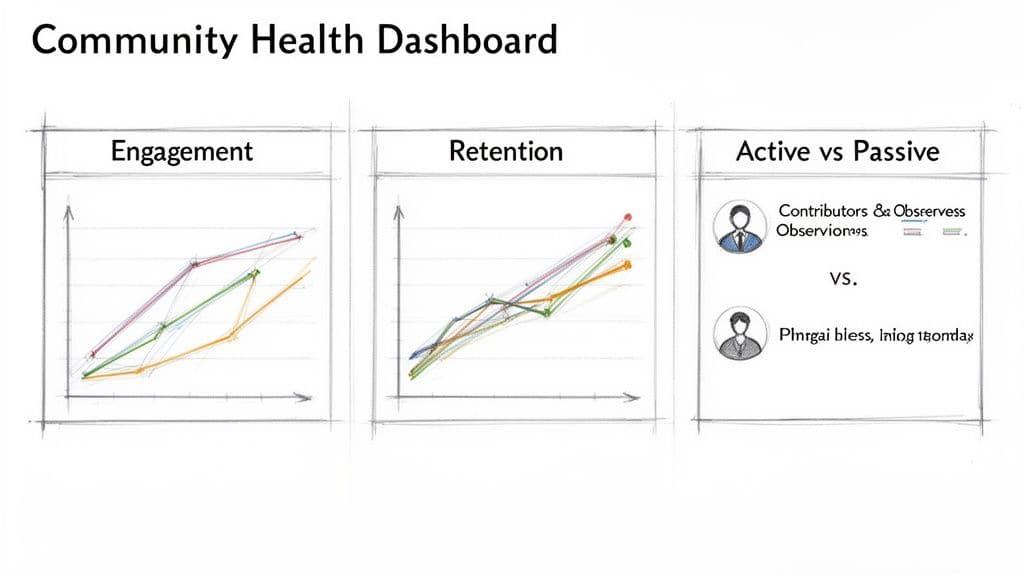
If you're serious about building a community, you have to look beyond the numbers that feel good but mean very little. I've seen countless founders get excited about a massive follower count, but if no one is talking, you’ve built an audience, not a community.
The real health of your space lies in the daily pulse of interaction. It's about the quality of the conversations and the loyalty of your members. Shifting your focus to these deeper metrics is what separates a flash-in-the-pan group from a sustainable, thriving ecosystem. It's how you make smart decisions and invest your energy where it'll actually matter.
Core Metrics That Actually Matter
Let's ditch the vanity metrics for a minute and track what really reveals the story of your community's engagement. These are the indicators that show you how people are behaving, not just how many of them have clicked "follow."
Engagement Rate: This is your most vital sign. I’m not talking about likes. I’m talking about the percentage of your members who are actively replying, kicking off new threads, and jumping into polls. A high engagement rate in a small, tight-knit group is infinitely more valuable than a low one in a massive, silent one.
Member Retention Rate: Of the people who join, how many actually stick around? Tracking this monthly or quarterly tells you if your community is delivering on its promise. If you see a high churn rate, that's a red flag—it’s a clear signal that something is off with your content, moderation, or the overall value you're offering.
Active Contributor Ratio: This one is crucial. It compares the number of people creating posts and replies to those who are just passively reading. A healthy community needs a growing base of contributors, not just a sea of silent observers. You might have heard of the 1% Rule, where roughly 1% of users create content, 9% engage, and 90% just watch. Your job is to slowly nudge people out of that 90% bracket.
Translating Data into Actionable Insights
Collecting data is only half the battle. Knowing how to read it is where the magic happens. Your metrics dashboard should be a source of clear answers that helps you steer the ship with confidence, not guesswork.
Your community data tells you a story. Learn to read between the lines to understand what your members truly want, need, and value from the space you've created.
For instance, if you notice that threads about a specific software tool consistently get double the average engagement, that’s a loud and clear signal. That single insight tells you to create more content on that topic—maybe a deep-dive guide, a Q&A with an expert, or a dedicated "tips and tricks" thread.
On the flip side, if the member-driven polls you’re running are consistently falling flat, it's probably time to pivot. Are the questions too generic? Are you posting at the wrong time of day? The data pushes you to ask better questions and experiment with your strategy. For an even deeper look, you could use a tool that analyzes social media comments to spot recurring themes and sentiment that raw numbers alone will miss.
Identifying Your Most Valuable Members
Your analytics are also your best friend for identifying your super-users. These are the people who consistently provide value, welcome newcomers, and act as informal ambassadors. They are the absolute lifeblood of your community, and you need to know who they are.
Look for patterns in your data:
- Who consistently gets the most thoughtful replies?
- Who starts the conversations that others can't wait to jump into?
- Who is always the first to give a warm welcome to a new member?
Once you've spotted these power users, engage them directly. A simple "thank you," a public shout-out, or asking for their private feedback on a new idea can go a long way. It reinforces their loyalty and quietly encourages others to step up. This is how you use data to nurture a genuinely vibrant and healthy community, not just chase a bigger follower count.
Frequently Asked Questions About Building an Online Community
Even with the best blueprint, you're bound to hit a few questions once you're actually in the thick of building your community. Let's dig into some of the most common hurdles creators run into and give you some real-world answers.
Here are some quick-fire answers to the questions I hear most often.
| Question | Answer |
|---|---|
| How much time does it take to build an active online community? | In the first few months, expect to dedicate 5-10 hours per week. This initial phase is hands-on: sparking conversations, welcoming members, and moderating. As your founding members become more active, the community develops its own pulse, and your time commitment can ease up. |
| What are the biggest mistakes to avoid when starting a community? | Launching to an empty room is a big one. Also, failing to set clear guidelines from day one invites chaos. Finally, inconsistent engagement from you, the leader, will cause members to lose interest and drift away. Your presence sets the tone. |
| How do I keep my community safe from spam and trolls? | Start with clear, visible rules. Then, be proactive with moderation. You can't be there 24/7, so empower trusted members to become moderators. A "report" feature is also crucial, as it turns moderation into a shared responsibility. |
Let's break down those answers with a bit more detail.
How Much Time Does It Really Take?
This is the big question, and the honest answer is it takes more time upfront than most people expect. For the first few months, you should realistically budget 5-10 hours a week to actively get things moving. That time is spent personally welcoming new people, kicking off interesting discussions, and gently guiding the conversation.
The great news? This is a front-loaded effort. You're putting in the sweat equity to build momentum. Once your core group of members starts interacting on their own, the community begins to take on a life of its own. Your job slowly shifts from being the main event to being the host of the party. But that initial push is absolutely critical.
You're not just creating a space; you're building a culture. That requires your consistent, hands-on presence early on to establish the vibe you want.
What Are the Biggest Mistakes People Make?
Having seen dozens of communities launch, I can tell you that most of them stumble over the same few hurdles. If you can sidestep these common pitfalls, you're already way ahead of the game.
- Launching to an empty room: This is a killer. Never, ever open the doors until you've invited a small "founding members" crew to get some conversations going. Nobody wants to be the first person to speak at a silent party.
- Vague or non-existent guidelines: Without clear rules of engagement, your space can quickly devolve into chaos, spam, and off-topic arguments. Post your moderation policy where everyone can see it before you even let the first person in.
- The disappearing leader: If you vanish for days at a time, so will your members. Your consistent presence signals that this community matters and is a priority.
How Do I Keep My Community Safe?
A safe community is a prerequisite for an active one. People won't open up and share if they're worried about spam, trolls, or being harassed. Your first and most important tool is a clear set of community guidelines that defines what is and isn't acceptable.
Beyond that, you need to be proactive. This doesn't mean you have to be online 24/7. As your community grows, identify some of your most trusted, active members and ask them to be moderators. Giving them the power to help keep the space clean also creates a powerful sense of shared ownership. It makes moderation a team effort, not just your burden.
Ready to build and manage your community across X, Bluesky, and Mastodon without the burnout? MicroPoster provides the unified content studio and smart scheduling tools you need to publish consistently, spark engagement, and grow your audience. Start your free 7-day trial of MicroPoster today and publish smarter.