
automated content distribution
A Creator's Guide to Automated Content Distribution
Master automated content distribution on platforms like X and Bluesky. Learn to plan, schedule, and measure a strategy that drives real organic growth.
Automated content distribution is simply a system you set up to schedule and publish your content across different platforms without having to do it all by hand, every single time. It turns your content strategy from a frantic daily chore into a calm, planned operation.
This is how you get your time back and stop the creative burnout before it starts, all while keeping a consistent presence online.
Why Automated Content Distribution Is a Modern Necessity
We’ve all been there. Staring at that blank "What's happening?" box on X (formerly Twitter) or the "Create a post" prompt on LinkedIn, feeling the pressure to come up with something brilliant on the spot. Doing this multiple times a day, across multiple platforms, is more than just tedious—it's completely unsustainable.
This manual grind almost always leads to inconsistent posting, a brand voice that’s all over the place, and a ton of missed chances to connect with your audience when they're actually online.
This is exactly where automated content distribution stops being a "nice-to-have" and becomes a core part of a smart creator's toolkit. It’s not about spamming your followers with robotic, "set it and forget it" content. It's about building a strategic system to plan, repurpose, and schedule your best ideas well in advance.
When you get this right, you can:
- Maintain a Consistent Presence: Your audience hears from you regularly, which builds trust and keeps you top of mind.
- Batch Your Creativity: Instead of constantly switching gears, you can dedicate focused blocks of time to just creating content. The quality skyrockets.
- Engage More Authentically: When the pressure to post is gone, you can spend your time on social media actually talking to people and building real relationships.
- Optimize for Peak Times: You can schedule posts to go live exactly when your audience is most likely to see them, no matter what time zone you're in.
The Grind Versus The Workflow
The difference between manually posting every day and running a well-oiled automated system is night and day. One path leads straight to burnout, while the other creates a foundation for sustainable growth and a stronger community.
The numbers back this up. The global marketing automation market hit $6.65 billion in 2024 and is projected to reach $15.58 billion by 2030. That’s a huge jump, and it shows just how many creators and businesses are investing in these systems to get a handle on their multi-platform publishing. You can dig into more of the data in these marketing automation statistics.
This image really captures the feeling of moving from chaos to calm.
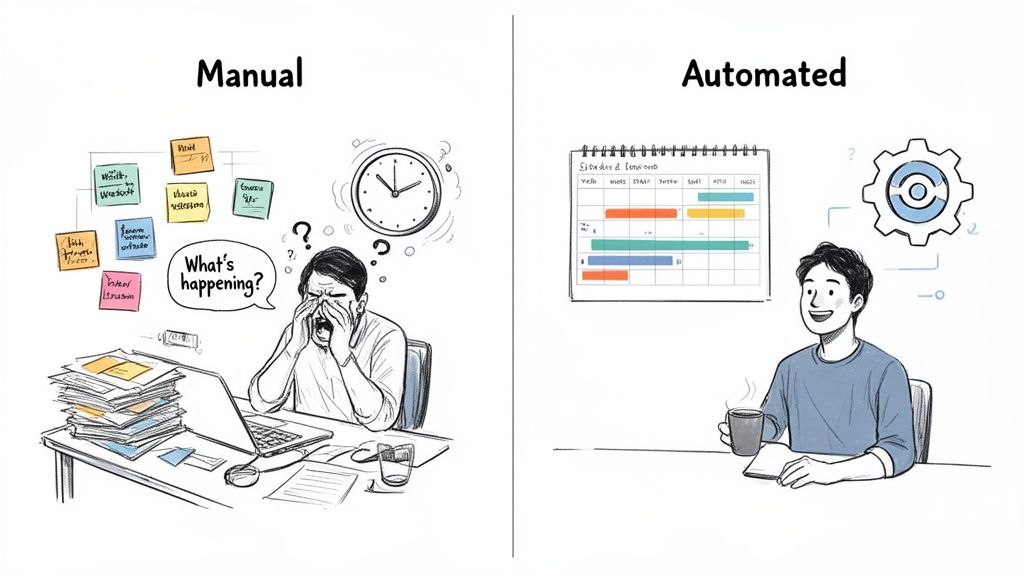
It’s the perfect visual for the mental shift that happens. Automation isn’t about getting rid of the human touch; it’s about organizing the mess so your human touch can actually shine through.
Key Takeaway: True automated content distribution isn't just about scheduling posts. It’s a complete workflow that weaves together planning, batch creation, smart scheduling, and strategic repurposing to build a powerful online presence without burning you out.
To really nail this down, let’s look at a direct comparison of the two approaches.
Manual Posting vs Automated Distribution
Here's a breakdown of what you're actually trading when you move from a manual process to an automated one.
| Aspect | Manual Approach | Automated Approach |
|---|---|---|
| Time Investment | Daily, reactive effort; hours spent on repetitive tasks. | Upfront planning; minimal daily management. |
| Consistency | Sporadic and inconsistent; dependent on daily mood and workload. | Consistent and reliable; maintains a steady cadence. |
| Strategic Depth | Often spontaneous and lacks a cohesive long-term vision. | Based on content pillars and audience data. |
| Growth Potential | Limited by the creator's personal bandwidth and time. | Scalable and optimized for continuous audience growth. |
As you can see, the automated approach isn't about working less—it's about making the work you do count for more. It shifts your energy from repetitive tasks to high-impact strategy.
Building Your Automated Distribution Blueprint
Diving headfirst into automation tools without a clear strategy is a classic mistake. It's like trying to build a house without a blueprint—you'll end up with a mess, not a masterpiece. Before you automate anything, you need a solid plan to guide your efforts.
This plan is your strategic foundation. It's what separates meaningful, consistent content that builds a real audience from just adding more noise to the internet.
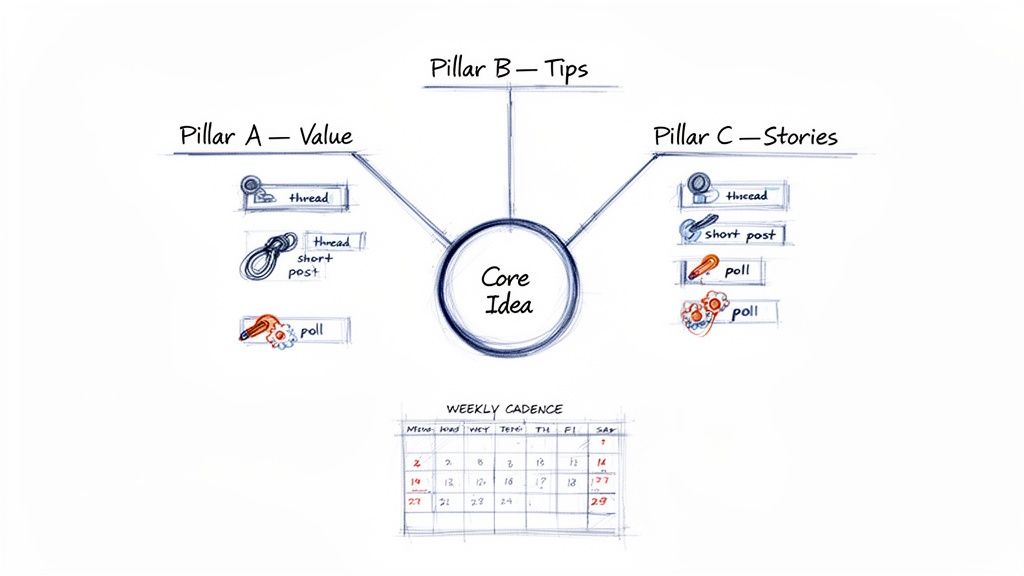
Define Your Core Content Pillars
First things first: what are you actually going to talk about? Your content pillars are the handful of core themes you want to be known for. Think of them as the 3 to 5 central topics that everything you create will ladder up to.
For example, a freelance developer might build their brand around these pillars:
- Modern JavaScript Frameworks: Deep dives, quick tips, and news on tools like React or Vue.
- The Business of Freelancing: Real talk on finding clients, pricing work, and managing the books.
- Developer Productivity: Workflows, tools, and mental models for getting more done.
Sticking to your pillars keeps your content focused and prevents you from chasing random trends. Every single post reinforces your expertise and attracts the right people to your audience.
This isn't just theory; it's how top creators stay consistent without burning out. Data shows that 63% of marketers already automate email, while 50% focus on social media management, and 49% specifically automate social posting. The trend is clear: systemizing content is the key to sustainable growth.
If you're looking to build out your own systems, this complete guide to content automation workflows is a great place to start digging into the nuts and bolts.
Map Pillars to Platform-Specific Formats
Once your pillars are locked in, it's time to think about how they'll show up on different platforms. A single idea can be sliced and diced into dozens of formats, each one tailored to the specific vibe of networks like X, Bluesky, or Mastodon.
This is where you translate high-level themes into actual, tangible content. Let's take our developer's "Developer Productivity" pillar and map it out:
- X (Twitter): Perfect for short, punchy "hot takes," detailed threads breaking down a workflow, or quick polls on favorite VS Code extensions.
- Bluesky: This platform leans more conversational. Think about asking for community input on developer burnout or sharing a personal story about a productivity win.
- Mastodon: Ideal for in-depth, hashtag-heavy posts that share valuable resources, mini-guides, and spark discussions across different communities.
Doing this mapping exercise from the get-go is critical. It forces you to think about content repurposing from day one, which is the secret to getting the most mileage out of every idea.
Establish a Realistic Publishing Cadence
One of the biggest pitfalls is setting an insanely ambitious posting schedule you can't possibly maintain. Consistency beats frequency every single time. Your goal should be a realistic cadence that you can stick with for the long haul without your quality dropping off a cliff.
Start by outlining a simple weekly schedule. Something like this:
| Platform | Monday | Tuesday | Wednesday | Thursday | Friday |
|---|---|---|---|---|---|
| X (Twitter) | 2 Posts | 3 Posts | 1 Thread | 3 Posts | 2 Posts |
| Bluesky | 1 Post | 1 Post | 1 Post | - | 1 Post |
| Mastodon | - | 1 Post | - | 1 Post | - |
A schedule like this gives you a clear target. You're no longer waking up and frantically thinking, "What should I post today?" You know exactly what's needed for the entire week.
This makes batching your content incredibly effective. You can block out a few hours on a Sunday afternoon, create all your posts for the week, load them into your automation tool, and then spend the rest of your time actually engaging with your community.
Mastering Cross-Platform Content Repurposing
The biggest mistake I see in automated content distribution is treating it like a copy-paste job. Firing the exact same post across every platform isn't just lazy—it's the fastest way to kill engagement and alienate the communities you're trying to build.
Each network has its own vibe, its own rhythm, its own unspoken rules.
Real success comes from repurposing, not just reposting. It’s about taking your core idea and smartly adapting it to feel native on each platform. This is the difference between being a welcome voice in the conversation and just another brand shouting into the void.
Understanding Platform Nuances
Before you can adapt, you have to know the lay of the land. The way people talk on X is a world away from how they connect on Bluesky or Mastodon. If you ignore these differences, you're setting your content up to fail.
Let's break down what actually works on each:
- X (formerly Twitter): Think fast, high-volume, and immediate. This is where you go for real-time commentary and threads that unpack big ideas into small, digestible chunks. Punchy takes that spark debate work wonders here. The audience expects a steady drip of valuable, bite-sized info.
- Bluesky: The atmosphere here is far more conversational and community-driven. It’s less about screaming the latest news and more about building genuine connections. You’ll find that thoughtful questions, personal stories, and posts that invite real discussion get the best traction.
- Mastodon: This is a space that rewards depth and discoverability, all driven by federated communities and hashtags. Longer, more detailed posts stuffed with relevant hashtags can find a seriously dedicated audience. It's a fantastic spot for sharing mini-guides, resources, and connecting with niche groups.
Adapting your content simply means respecting these unique environments. The ultimate goal is to make your automated workflow feel completely human to the people on the other end. If you want to really nail this, you should explore these actionable content repurposing strategies.
A Practical Repurposing Workflow
Let’s get practical. Imagine you just wrote a killer 10-part thread for X that breaks down your top productivity hacks for developers. Here’s how you could spin that one piece of content for other platforms without just hitting copy-paste.
The Source Content: A 10-part X thread on productivity hacks.
- For Bluesky: You wouldn't dump the whole thread. Instead, you'd pick the single best hack—maybe the one that got the most replies on X. You'd then rewrite it as a standalone post, wrap a personal story around it, and end with an open-ended question like, "What's one non-obvious productivity hack that's saved you hours?" This is designed to start a conversation, which is perfect for Bluesky's community feel.
- For Mastodon: Here, you have more room to breathe. You could group three related hacks from your thread into a single, more in-depth post. You’d add more context, maybe link out to the tools you mentioned, and—this is crucial—load it up with specific hashtags like
#Productivity,#DevLife,#Coding, and#WorkflowOptimization. This helps people discover your content across different servers.
This approach gives you maximum mileage from every single idea. For a deeper dive, check out our guide on powerful content repurposing strategies for microblogging.
The Mantra: Adapt, don't just copy-paste. This is the core principle that allows you to get all the efficiency of automation without sacrificing the authentic, human touch that actually builds a loyal audience.
Using Tools to Reformat Seamlessly
Now, this level of adaptation might sound like a ton of manual work, which kind of defeats the point of automation, right?
Not quite. Modern tools are built for this exact challenge.
Take a platform like MicroPoster, for example. Its content editor is designed specifically for this workflow. You can draft your main content (like that X thread) and then, in the same window, create different versions for your other networks. The tool helps you quickly reformat, tweak the tone, and adjust for character counts, making the whole adaptation process incredibly fast.
This is becoming the new standard. In major markets like the US and Europe, where creators rely heavily on microblogging platforms, tools that can auto-reformat content and schedule it for peak times are seeing 64% adoption rates when combined with AI enhancements.
Ultimately, this kind of strategic repurposing is what separates a truly effective automated distribution system from a noisy, ineffective one. You respect the audience, you honor the platform, and you get far better results for it.
Setting Up Your Automation Engine in MicroPoster
Alright, you've got your repurposing strategy mapped out. Now it's time to build the machine that puts it all into action. This is where a few hours of setup today will save you dozens of hours every single month. We'll use MicroPoster as our home base to build a workflow that posts for you, so you can focus on genuine engagement.
This isn't just about scheduling posts and walking away. It's about building an intelligent engine that understands your content pillars, speaks in your brand voice, and works tirelessly in the background.
Creating Your Core Content Templates
Consistency is king online, and templates are your fastest path to the throne. Instead of staring at a blank screen for every post, you can create reusable formats for your go-to content series. This keeps your brand voice locked in and makes content creation ridiculously fast.
Think about your weekly rhythm. What are the content formats you always come back to?
- Weekly Win Wednesday: Maybe it's a template that kicks off with a celebratory hook, has a spot for a quick story about a recent success, and wraps up with a question for your audience.
- Tech Tip Tuesday: You could have a pre-made structure for sharing a quick, actionable tip, complete with placeholders for code snippets or screenshots.
- Deep Dive Friday: How about a thread template designed to break down a complex topic, with numbered posts and your standard call-to-action already at the end?
In MicroPoster, you can build these right in the content studio. Set up the structure, save it, and just load it up when you need it. That one simple action cuts out a massive amount of repetitive work.
Automating Hashtags and Content Categories
Let’s be honest, manually typing the same hashtags for every post in a certain category is a drag. It’s also easy to forget one. A much smarter way is to link your hashtag groups directly to your content pillars inside your automation tool.
For instance, create a category called "Freelance Business" and load it up with tags like #freelancing, #solopreneur, and #clientwork. The next time you write a post for that pillar, you can add the entire group with a single click.
This little trick does more than just save time. It forces strategic consistency, making sure every single piece of content is properly optimized to be discovered by the right people.
You can even get more granular. Maybe your X posts get a broader set of tags, while your Mastodon posts need more niche, community-focused ones. Setting up different groups for different platforms is what makes your automation feel less like a robot and more like a savvy assistant.
This whole process really boils down to a simple, powerful flow: source, adapt, and distribute.
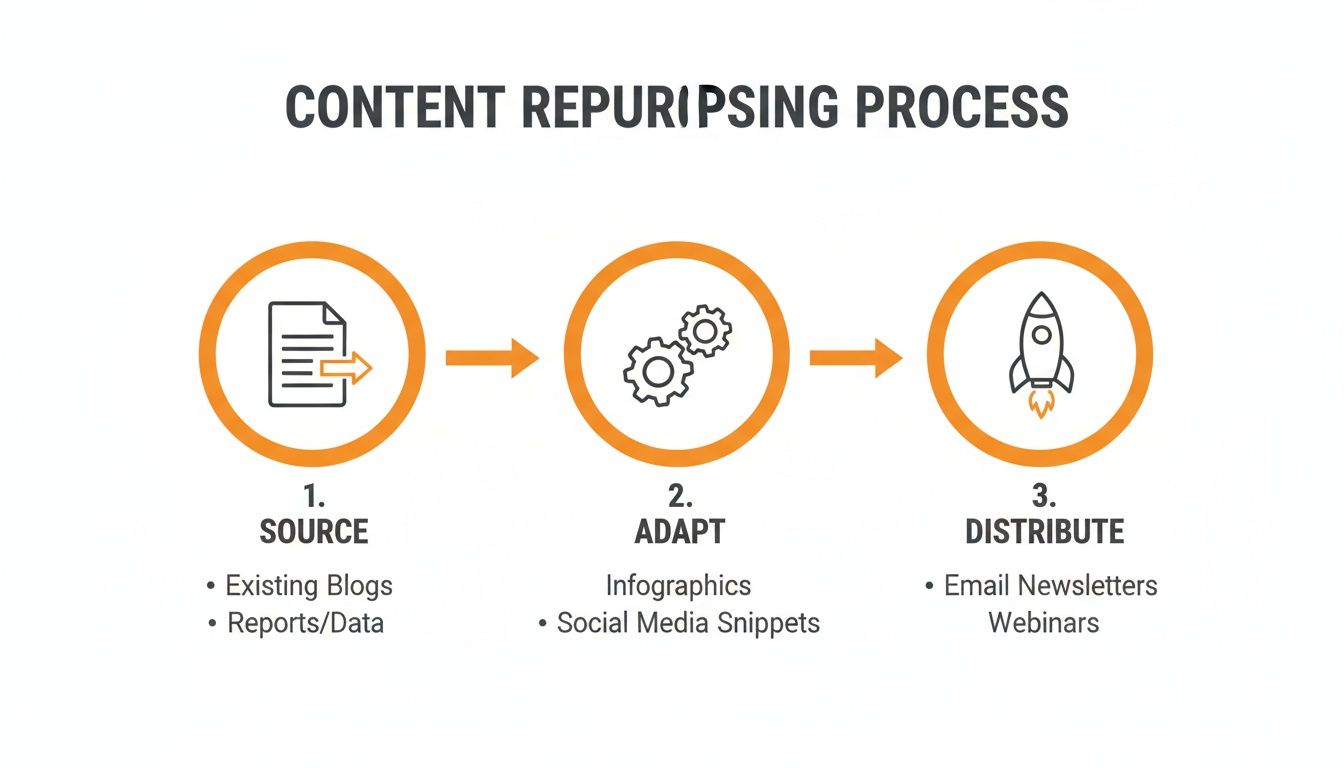
You start with a core idea, tweak it for each platform's unique audience, and then let your automated engine handle the distribution.
The table below gives you a few practical examples of how you could set up rules in MicroPoster to make this happen automatically.
Example MicroPoster Automation Rules
| Content Type | Trigger / Schedule | Action in MicroPoster | Goal |
|---|---|---|---|
| Weekly Newsletter Snippet | Every Tuesday at 9:00 AM | Post a 280-character summary to X | Drive traffic to the new newsletter issue |
| "Best Of" Evergreen Post | Every Friday at 2:00 PM | Pull one post from the "Evergreen" queue and post to Mastodon | Fill content gaps with proven, high-value posts |
| Blog Post Announcement | Manual trigger | Cross-post a 3-part thread to X and Bluesky with different CTAs | Maximize visibility for a new long-form piece |
| Quick Tip | Any post tagged #QuickTip | Add to a "Tips" collection and schedule to re-post in 60 days | Recycle valuable micro-content for new followers |
These are just starting points, of course. The real power comes when you tailor these rules to your specific content and audience.
Configuring Your Evergreen Content Queue
Some of your content is too good to only be seen once. Your best threads, most insightful posts, and killer guides are assets that can keep delivering value for months, if not years. This is your evergreen content, and it deserves a permanent spot in your automation strategy.
An evergreen queue is basically a hand-picked collection of your greatest hits that your system automatically re-shares over time.
This ensures that your new followers always get a chance to see your best work without you having to manually dig up old posts. It's the easiest way to get more mileage out of the content you’ve already poured your heart into.
Setting this up in a tool like MicroPoster is straightforward:
- Find Your Winners: Dive into your analytics. Pull out the posts with the best engagement, clicks, and reply rates.
- Add Them to a Queue: Tag these posts as "evergreen" and drop them into a dedicated library.
- Set the Pace: Tell the system to grab one post from this queue and publish it every few days, maybe to fill gaps in your regular schedule.
Suddenly, your content calendar is always stocked with proven material, keeping your profile active even when you're swamped with other work.
Using AI to Sharpen Your Posts Before Scheduling
The final piece of a truly advanced setup is using AI as a sparring partner to polish your content right before it goes live. Modern tools often have AI assistants built right into the editor, which can be an incredible final check.
Before you hit "schedule," you can use these features to:
- Refine Your Hooks: Get a few alternative opening lines to see if one grabs attention better.
- Strengthen Your CTAs: Ask the AI to rephrase your call-to-action to be clearer or more compelling.
- Adjust the Tone: Quickly tweak a post to sound more authoritative, conversational, or witty for a specific platform.
This isn't about handing the keys over to AI. It's about using it to sharpen your own writing and ideas. For anyone managing content across multiple accounts, this can be a lifesaver. To see how this works in a real-world tool, check out how MicroPoster's auto-crossposting features integrate these kinds of AI enhancements.
Get this engine built correctly, and you’ll completely change your relationship with content creation. It stops being a daily chore and becomes a strategic, automated workflow that runs itself.
How to Measure and Fine-Tune Your Automated Content Strategy
Getting an automated content distribution system running is a massive win, but it’s really just the starting line. Automation on its own can easily become a high-speed noise machine. The real growth comes from closing the feedback loop—using actual data to sharpen your strategy and get smarter with every single post.
This is where we go beyond the easy, feel-good metrics like likes and retweets. They're nice, but they don't paint the whole picture of your community's health or your content's real impact.
Moving Past Surface-Level Metrics
To figure out what’s actually resonating, you have to look at the numbers that signal genuine interest and connection. These are the metrics that tell you whether your automated content is building a loyal audience or just shouting into an empty room.
I recommend focusing on these key indicators:
- Reply Rates and Conversation Depth: Are people leaving thoughtful comments or just dropping a quick emoji? High-quality replies are a gold-plated sign that your content is making people think and engage.
- Profile Clicks: This one is huge. A click on your profile means your content was so compelling that someone stopped scrolling and decided they needed to know more about you. It's a massive indicator of intent.
- Follower Growth Velocity: Don't get hung up on the total follower count. Instead, track the rate of growth. A steady, week-over-week increase shows that your strategy has real momentum.
By zeroing in on these engagement-based signals, you get a much more honest assessment of what your audience truly values.
The Power of a Monthly Content Audit
One of the best habits you can develop is a simple monthly audit. This is your dedicated time to step back from the daily grind, look at the data, and ask some tough questions about your automated workflow. You don't need a crazy-complex spreadsheet—just an hour of focused review.
The goal is to answer questions like:
- Which of my content pillars sparked the most conversation? Did my posts on "freelance business" get way more replies than my "developer productivity" tips?
- Are my automated threads leading to more profile clicks than my single posts? This is crucial for understanding which formats are hitting the mark.
- When was the best time to post last month? Dig into your platform analytics. You'll often find that the generic "best time to post" advice doesn't apply to your specific, growing audience.
My Takeaway: Automation is what makes this kind of analysis possible. It provides the clean, consistent data you need to make smart, iterative improvements. Without a consistent schedule, your data would be too messy to pull any real insights from.
This steady stream of data helps you spot patterns you’d otherwise miss. You might discover your Bluesky audience is super active on Sunday mornings, or that your X threads get the most traction when you post them in the evening.
Refining Your Schedule and Cadence
Once you have these insights, you can start making small, informed tweaks to your automation engine. We're not talking about a complete overhaul every month. Think of it as continuous, minor adjustments that build on each other over time.
For instance, if your data shows that posts ending with a question get 50% more replies, you can update your content templates in MicroPoster to include questions more frequently. If you notice follower growth spikes on Wednesdays, maybe that's the day you schedule your most valuable, in-depth content.
This iterative process transforms your automated distribution from a rigid schedule into a living system that learns and adapts. And the results speak for themselves. Automated workflows can generate up to 30 times more revenue per recipient than old-school campaigns because they're so timely and targeted. This is why agencies managing multiple accounts are seeing 24% more organic growth by using AI-assisted strategies to mirror content across platforms. You can dig into more stats on the impact of marketing automation on business growth.
Ultimately, this cycle of measuring and optimizing is what makes sure your automation is truly working for you, helping you build a real, engaged community far more effectively.
Watch Out for These Automation Traps
Setting up an automated content system feels like a game-changer. And it is. You reclaim hours, your posting stays consistent, and you can finally think bigger. But this new power comes with a few classic blunders that can quietly sabotage all your hard work.
Remember, automation is just a tool. It's not a substitute for genuine human connection. The real goal isn't just to pump out more content; it's to spark better conversations and build a real community. Stepping around a few common traps is all it takes to make sure your automation is working for you, not against you.
Sounding Like a Robot
This is the most common—and most damaging—mistake I see. It’s that tell-tale sign that every post has the exact same structure, uses the same link shortener, and completely lacks the spontaneity that makes social media feel, well, social. Your audience can spot this a mile away.
This "content drone" effect is an engagement killer. It strips all the personality from your profile, and people follow people, not scheduling software.
How to fix it: It’s actually pretty simple. Batch your creation, but not your humanity. Block out some time to write and schedule your core content for the week. But then, and this is the important part, commit to spending just 15-20 minutes each day actually being on the platforms. Reply to comments, jump into relevant discussions, share a spontaneous thought. This hybrid approach delivers the consistency of automation with the authenticity of real-time interaction.
The "Post and Ghost"
This one is a close cousin to the robotic voice. You've seen it: a scheduled post goes live, a great conversation starts in the replies… and the original poster is nowhere to be found. A post that gets people talking is a massive opportunity, and it’s completely wasted if you're not there to participate.
It sends a pretty clear message: "I want your attention, but I don't really care what you have to say." Do this enough, and you'll train your followers not to bother engaging at all.
How to fix it: Think of your scheduled posts as conversation starters, not broadcast announcements. When a post goes live, try to check in on it within the first hour. Be there to answer questions, thank people for their ideas, and keep the discussion going. This small habit reinforces that there's a real person behind the account who's actually eager to connect.
My Two Cents: The whole point of automating content is to free up your time for more meaningful, high-touch engagement. If you aren't reinvesting that saved time back into your community, you're missing the single biggest benefit.
Ignoring How Each Platform Works
Blasting the identical message across X, Bluesky, and Mastodon is a surefire way to be ignored. Each platform has its own unwritten rules, its own formatting quirks, and its own conversational style. A brilliant X thread just doesn't work when it's dumped as a single, massive wall of text on Bluesky.
This one-size-fits-all approach just signals that you don't really get the communities you're trying to reach.
How to fix it: Adopt the "adapt, don't just copy-paste" mindset we talked about earlier. A good automation tool should make it easy to create platform-specific variations from a single core idea. Tweak the opening hook for X, rephrase the call-to-action for Bluesky, and add the right community hashtags for Mastodon. It's a small upfront investment in customization that pays off big time in engagement, because your content will finally feel native to each platform.
Drowning Your Audience
When it comes to content, more isn't always better. It’s so tempting to fill every single slot in your calendar, but posting too often can overwhelm your followers and lead to a wave of unfollows. This is especially true if the quality starts to dip because you're just focused on hitting a quota.
The demand for automation is definitely on the rise. A massive 96% of marketers have either used or plan to use these tools, and 91% say the need is growing fast. This push, especially from marketing (26%) and operations (38%) teams, highlights the drive for efficiency. You can dig into more stats about the rise of marketing automation on emailvendorselection.com. But remember, that efficiency should be in service of quality, not just quantity.
How to fix it: Start with a baseline posting schedule and only scale up when the data tells you to. Watch your analytics—especially reply rates and follower growth—to see if your audience wants more. It is always, always better to post one fantastic, conversation-starting piece of content a day than five mediocre ones that just become part of the noise. Quality and consistency will beat pure volume every time.
Ready to build an automated content system the right way? MicroPoster gives you a unified content studio and smart automation tools to publish strategically across X, Bluesky, and Mastodon—without falling into these common traps. Start your free 7-day trial of MicroPoster today and turn your content into real conversations.


