how to grow on twitter
How To Grow On Twitter A Proven Playbook For Real Growth
Learn how to grow on Twitter with a proven playbook. Optimize your profile, create content that connects, and build an engaged community.
Trying to grow on X (formerly Twitter) isn't about chasing viral hits or stumbling into luck. It's about building a system. Get three things right—a compelling profile, a reliable content engine, and real community engagement—and you'll build a loyal audience that actually listens.
A Modern Blueprint For Sustainable Twitter Growth
Let's get one thing straight: the old tricks are dead. Follower trains, engagement pods, and pumping out generic content won't get you anywhere meaningful today. Sustainable growth on X demands a much smarter approach.
It’s less about just having an "account" and more about building a small media company of one. Every tweet, every reply, and every line in your bio shapes how people see you. The goal is simple: become a go-to resource in your niche. People stick around when they know you consistently deliver value, whether that's through sharp insights, helpful tutorials, or just entertaining commentary.
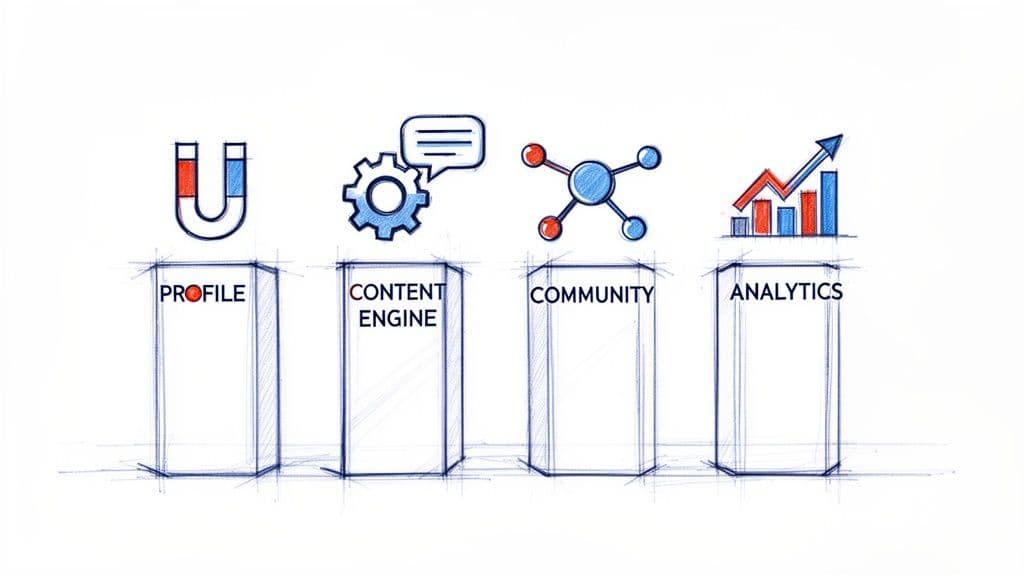
The Four Pillars of Growth
So, how do you actually build this? I've found it comes down to focusing on four core pillars. Each one supports the others, creating a feedback loop that pulls in new followers while making your existing audience even more loyal. These aren't just one-and-done tasks; they're the daily practices of every successful account.
- Pillar 1: Magnetic Profile: Your profile is your digital handshake. It has about three seconds to convince a stranger you're worth following. It needs to be crystal clear about who you are and what’s in it for them.
- Pillar 2: Content Engine: This is your factory for creating value. It’s the system you build to consistently produce high-quality content that speaks directly to the people you want to attract. No engine, no growth.
- Pillar 3: Community Building: Real growth happens in the replies, not just on your timeline. This is all about proactively building relationships and turning a list of followers into a genuine community.
- Pillar 4: Analytics and Iteration: You can't improve what you don't measure. This is where you dig into the data, figure out what's hitting the mark, and ruthlessly cut what isn't working.
The founders winning today are the ones who turned distribution into a math problem. They test constantly, analyze what works, and double down on their winning content formats.
To give you a clearer picture, here’s a quick breakdown of how these pillars fit together. We'll dive much deeper into each one, but this gives you the high-level game plan.
The Four Pillars of Sustainable Twitter Growth
This table summarizes the core components for building a successful presence on X. Think of it as your strategic cheat sheet, breaking down each pillar into its main goal and the first few things you need to do.
| Pillar | Core Objective | Key Action Items |
|---|---|---|
| Magnetic Profile | Convert visitors into followers by clearly communicating your value proposition. | Write a benefit-driven bio, use a high-quality photo, and create a strategic pinned tweet. |
| Content Engine | Establish authority and attract your target audience with consistent, high-value content. | Define your content pillars, master writing threads, and experiment with different formats. |
| Community Building | Foster loyalty and expand your reach through genuine interaction and relationship building. | Leave thoughtful replies on larger accounts and actively engage with your own audience. |
| Analytics & Iteration | Optimize your strategy for maximum impact by understanding your performance data. | Regularly review your analytics to identify top-performing content and audience trends. |
Each of these pillars is a skill in itself. Mastering them is what separates the accounts that stagnate from the ones that achieve unstoppable momentum. Throughout this guide, we'll give you the exact tactics to make it happen.
Crafting A Profile That Converts Visitors Into Followers

Think of your X profile as your digital storefront. The moment someone lands on it, you have maybe three seconds to answer their silent question: "What's in it for me?" A weak profile gets a quick glance and an even quicker click away. But a great one? That's what turns a casual visitor into a loyal follower.
This isn't just about looking professional; it's about strategic communication. Every single piece of your profile—from your name down to your pinned tweet—has to work together to tell a clear, compelling story about the value you offer. If someone can't immediately grasp why they should follow you, they just won't.
The Anatomy of a High-Impact Profile
Your profile is essentially a miniature landing page. Every component has a job to do, and that job is to guide the visitor's eyes straight to the "Follow" button.
- Profile Picture: Let's keep this simple: use a clear, high-quality headshot. A smiling face is always best. People connect with people, not logos.
- Header Image: This is your billboard. Use it to visually communicate your expertise, flash some social proof (like "As featured in..."), or even promote your newsletter.
- Name: Your real name is usually best. Feel free to add a little flair that gives context, like "Alex Valdes | Building in public 🚀". It adds personality and signals what you're about.
- Bio: This is the most important text on the entire page. We’ll dive deeper into this in a second.
- Link: Don't just dump your homepage here. Be strategic. Point to a high-value resource—a free guide, a newsletter sign-up, or your latest YouTube video.
- Pinned Tweet: This is your headline. It's your prime real estate to hook new visitors with your absolute best stuff.
Writing a Bio That Sells
You’ve only got 160 characters for your bio, so you need to make every single one count. A great bio accomplishes three things. First, it clearly states who you help and how you help them. Ditch the jargon. Instead of "Growth Marketing Synergist," try "I help SaaS founders get their first 100 customers." See the difference?
Next, sprinkle in some keywords your ideal follower might actually search for. Think "copywriting," "web design," or "startup founder." This is a simple way to improve your discoverability on the platform.
Finally, you need a clear call-to-action (CTA). Guide them to your link. Something as simple as "👇 Grab my free email course below" works like a charm.
A killer bio isn't about you—it's about your potential follower. Frame everything in terms of the value they get by joining your world.
Your Pinned Tweet as a Strategic Asset
Your pinned tweet is far more than just your most popular post. It's the welcome mat for your entire profile.
This is your chance to showcase a "greatest hits" thread that's packed with value, tell a personal story that forges an instant connection, or offer a freebie that people genuinely want. A strong pinned tweet takes the promise you made in your bio and immediately proves it.
It's the one-two punch: the bio tells them what you do, and the pinned tweet shows them. Nail this combination, and the decision to follow you becomes a no-brainer. This is the foundation for everything else you'll do to grow your audience on X.
Crafting a Content Strategy That Pulls in Your Ideal Audience
If your profile is the storefront, your content is what you're selling every single day. A sharp profile gets people to stop and look, but it’s your content that convinces them to stick around, buy into your message, and become true fans. Without a solid strategy, you're just tweeting into the wind.
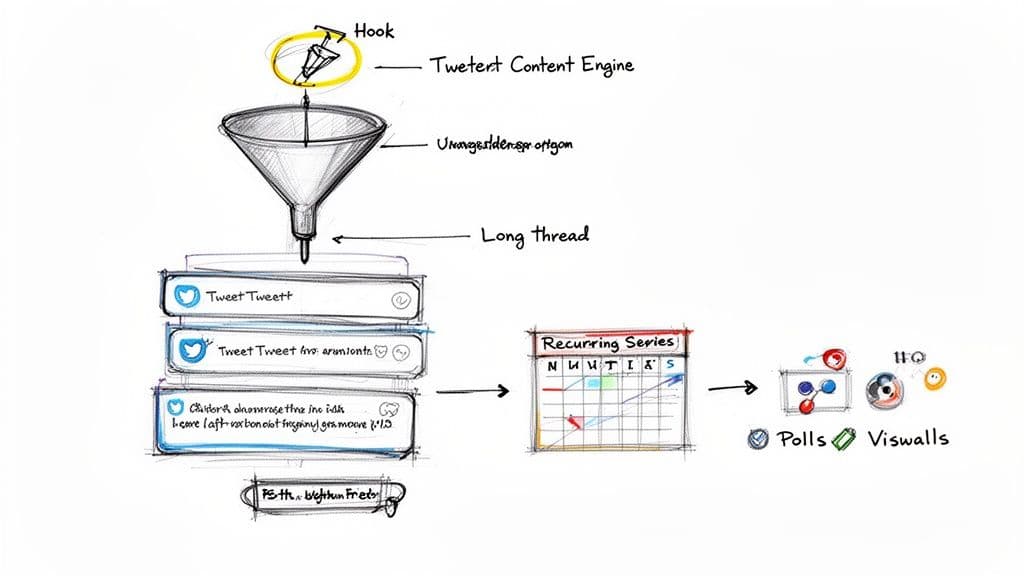
The real goal isn't just to post random thoughts. It's to build a reliable "content engine" that consistently churns out valuable, engaging material for the right people. This is the difference between being just another account and becoming a go-to voice in your niche. When people know what to expect from you—and know it’ll be high-quality—they have a real reason to follow.
Nail Down Your Content Pillars
Before you even think about writing a tweet, you need to figure out your content pillars. These are the 2-4 core topics you’re going to own. Think of them as the main themes of your account. They provide focus and immediately signal to visitors what you're all about.
For instance, a freelance copywriter’s pillars might look something like this:
- Copywriting Frameworks: Practical models and actionable tips for writing copy that converts.
- Client Acquisition: Real-world advice on how to find, pitch, and land freelance clients.
- Creator Mindset: Talking through productivity, imposter syndrome, and the business side of freelancing.
Sticking to these pillars helps you build topical authority fast. Your followers quickly learn that when they need advice on copywriting or freelancing, you're the person to check in with. That kind of clarity is what attracts your ideal audience and keeps them engaged.
Your content pillars are your promise to your audience. They define the value you deliver consistently, which is the bedrock of building trust and authority on any platform.
Master the Art of the Thread
Quick, single tweets are great for daily engagement, but threads are where you build deep connections and see serious growth. They give you the space to tell a story, teach a complex topic, or lay out a framework in a way a single 280-character tweet never could.
Threads are a growth powerhouse, and the numbers back it up. Multi-post threads often pull in 3x more engagement than single tweets and can drive follower gains of 15-25% for creators who use them consistently. Back in 2022, accounts that posted 3-5 threads a week saw their impressions jump by 67% because the algorithm rewarded that kind of in-depth content.
A killer thread really comes down to two key parts.
- The Hook: This is your first tweet. It has one job: get people to click "Show more." A great hook teases the value inside, sparks curiosity, or makes a bold promise you're about to deliver on.
- The Narrative: Every tweet that follows should build on the last. You need to keep delivering value while pulling the reader along. Always wrap it up with a strong summary or a clear call-to-action, like asking a question or reminding them to follow for more.
Getting good at threads takes practice. This is where a tool like MicroPoster's editor really helps. It lets you fine-tune your hooks, checks readability to keep your points punchy, and suggests relevant hashtags to stretch your reach. It turns a good idea into a piece of content that actually works.
Look Beyond Just Threads
While threads are your heavy hitters, a smart strategy includes different content formats to keep your timeline from getting stale. Mixing things up keeps your audience interested and caters to people who prefer different types of content. Once you’ve got your organic content flowing, you can also learn how to promote a tweet to give your top-performing posts an extra push.
Here are a few other high-impact formats to work into your schedule.
- Insightful Single Tweets: Never underestimate a single, powerful idea. Share a contrarian take, a surprising stat, or a lesson you learned the hard way.
- Recurring Series: Give your audience something to look forward to. Think "Marketing Tip Tuesday" or a "Friday Q&A." Consistency builds habits.
- Engaging Polls: Polls are a super easy way to start a conversation and get direct feedback. Ask questions tied to your content pillars to learn more about what your audience is struggling with.
- Visual Content: Don't sleep on images, GIFs, and short videos. A simple chart, a behind-the-scenes picture, or a quick screen recording can often make a point much faster than text alone.
When you build your strategy on strong pillars and mix in these different formats, you create a content engine that works. This system doesn't just grow your follower count; it builds a loyal community that genuinely values your expertise and looks forward to what you have to say next.
Mastering Engagement And Building A Strong Community
Look, creating killer content is only half the job. If you just post and ghost, you're treating X like a billboard when it’s really a massive, non-stop party. Real, lasting growth isn't about shouting into the void; it's about building real relationships, one person at a time. Getting this right is what flips passive followers into a genuine, ride-or-die community.
Engagement isn't something that just happens to you. You have to go out and make it happen. The best way to get on people's radar is to jump into conversations that are already buzzing. Don't wait for them to find you—go find them. This is how you become a regular, trusted voice in your space.
Become A High-Value Commenter
One of the most powerful and criminally underrated growth hacks is leaving thoughtful replies on posts from bigger accounts in your niche. Forget the generic "Great post!" or "Agree!" comments. They're basically invisible. Your goal is to actually add to the conversation.
Think of your reply as a mini-tweet. Here's how to make it pop:
- Add a new angle: Offer a fresh perspective or a point that complements what the original poster said.
- Share a personal story: Drop a quick, relevant anecdote that backs up their message.
- Ask a smart question: Pose a question that gets people thinking and encourages more discussion.
When you consistently leave insightful comments, two things happen. First, the original poster starts to recognize your name. Second, and more importantly, their audience sees your comment, thinks "Hey, this person knows their stuff," and clicks over to your profile. Boom—new, highly relevant followers.
"Your timeline is for your audience. The replies are for your next audience. Make every single one count."
Turn Your Mentions Into A Community Hub
Just as crucial is how you treat the conversation on your own turf. Every single comment on your posts is an opportunity to build a connection. When someone takes time out of their day to reply to you, you absolutely have to reply back. Ignoring your comments is the fastest way to signal that you don't care, and it will kill your engagement.
Don't just hit 'like' and move on. Ask them a follow-up question. Thank them for sharing their view. Get a real back-and-forth going. This simple act makes people feel seen and valued, which makes them way more likely to engage with your stuff in the future. It shows your account is a two-way street, not a monologue.
For a deeper dive into these ideas, you might find our guide on how to build an online community super helpful. It really expands on these core tactics.
Spark Conversations With Interactive Tools
Beyond just replying, X gives you some great built-in tools designed to get people talking. Using them strategically can turn your feed from a simple timeline into a buzzing, interactive space.
- Run Insightful Polls: Stop asking random questions. Use polls to test your ideas, understand your audience's biggest struggles, or settle a friendly debate in your industry. A marketer could ask, "For an early-stage startup, what's more critical: SEO or Paid Ads?"
- Ask Open-Ended Questions: A great question can be way more powerful than a great statement. Try ending your threads with questions like, "What's the biggest mistake you made when you first started?" This invites personal stories and generates a ton of authentic engagement.
- Leverage X Communities: If you've built up a dedicated following, creating a Community gives your biggest fans a private space to connect with you and each other. It’s the ultimate way to turn a scattered audience into a tight-knit tribe.
Engagement Tactics High-Impact vs Low-Impact
Not all engagement is created equal. Some actions build real relationships and authority, while others are just vanity metrics. Here’s a breakdown of where to focus your energy.
| Tactic | Impact Level | Why It Works (or Doesn't) |
|---|---|---|
| Leaving insightful, value-add replies | High | Positions you as an expert, attracts the right followers, and builds relationships with larger accounts. |
| Replying to every comment on your posts | High | Fosters loyalty, encourages future engagement, and tells the algorithm your content is valuable. |
| Hosting a live X Space | High | Creates a deep, real-time connection with your audience and allows for genuine back-and-forth conversation. |
| Just 'liking' a reply | Low | Acknowledges the comment but doesn't build a relationship or encourage further discussion. It's a dead end. |
| Replying with a generic "Thanks!" | Low | Better than nothing, but it’s a missed opportunity to ask a question and deepen the connection. |
| Following hundreds of random accounts | Low | Creates a noisy feed for you and doesn't guarantee reciprocal engagement. It's a spray-and-pray tactic that rarely works. |
Focusing on the high-impact tactics is what separates the pros from the amateurs. It’s about quality over quantity, every single time.
When you mix proactive outreach (commenting) with dedicated community management (replying), you create a powerful growth flywheel. Engagement attracts more engagement, the algorithm rewards you for it, and your account grows not just in numbers, but in genuine influence and connection.
Creating A Smart System For Posting And Automation
Consistency is the absolute engine of X/Twitter growth. But let's be honest—it’s also the number one reason people burn out and quit. If you're trying to manually come up with brilliant content multiple times a day, every single day, you're on a fast track to exhaustion.
The secret isn't to work harder. It's to build a smarter system that works for you.
This means getting out of that reactive, "Ugh, what do I post today?" mindset. Instead, you build a proactive, repeatable workflow. Once you systematize your content creation and scheduling, you free up all that mental energy for the one thing you can't automate: genuine, human-to-human engagement.
Batch Your Content To Get Your Time Back
Content batching is a game-changer. The idea is simple: instead of scrambling for ideas daily, you carve out one dedicated block of time each week to plan, write, and schedule everything at once.
Picture this: you spend a couple of focused hours on a Sunday afternoon and knock out an entire week's worth of tweets and threads. This doesn't just save you a ton of time. It actually leads to better, more cohesive content because you’re in a state of deep focus, not just firing off random thoughts.
To really scale your output without living on the platform 24/7, it helps to understand the wider concept of content automation. This is your key to maintaining a high-quality presence without the daily grind.
Build A Functional Content Calendar
Your content calendar is your blueprint for consistency. It doesn’t need to be some complex, color-coded monstrosity—a simple spreadsheet or a dedicated tool works perfectly. The whole point is to map out your posts ahead of time to make sure you have a healthy mix of your content pillars and formats.
Here’s a quick and practical example for a creator focused on web design:
- Monday: A thread breaking down a recent client project (Value/Case Study).
- Tuesday: A single, punchy tweet about a common design mistake (Quick Tip).
- Wednesday: A poll asking the audience about their favorite design tool (Engagement).
- Thursday: A quick tip paired with a screenshot or GIF (Visual/How-To).
- Friday: An open-ended question to get a conversation going for the weekend (Community).
This kind of structure completely eliminates daily decision fatigue. It ensures your timeline stays active and valuable, even when you're swamped with other work. A solid system is what builds momentum.
Burnout is the enemy of growth. Automation and scheduling are your shield. The goal is to build a content machine that runs on a system, not on your daily willpower.
Use Smart Automation To Maximize Your Impact
Once you’ve batched your content, the next step is automating its delivery. This is where a great Twitter post scheduler becomes your best friend. These tools handle the boring, repetitive work of publishing, letting you focus on strategy and interaction.
For example, with a tool like MicroPoster, you can upload all your batched content into a central content studio. From there, you just schedule it all to go live at the perfect times. The real magic here is tapping into peak engagement hours. Data shows that tweets sent at optimal times—typically 9 AM to 3 PM on weekdays in major markets like the US and Japan—get 30% more impressions on average.
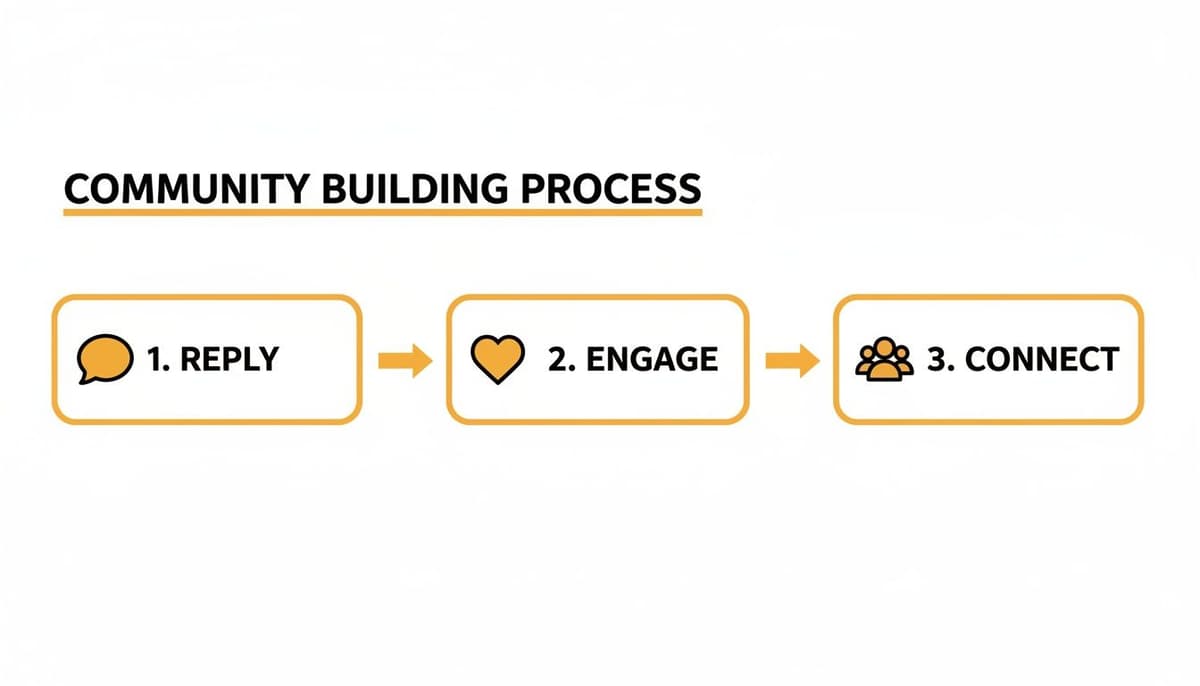
This simple flow is a great reminder: consistent engagement, replying to others, and making genuine connections is how you turn a list of followers into a real community.
Smart scheduling tools remove all the guesswork. They analyze when your audience is most active and can automatically publish your content at those peak times. This one feature can dramatically boost the reach and impact of every single thing you post. By automating the "when," you ensure your best content gets the visibility it deserves, pushing your growth forward while you're already thinking about what's next.
Common Questions About Growing On Twitter
Every creator hits a point where they wonder, "Am I actually doing this right?" Even with a solid plan, the day-to-day reality of growing an audience on X is full of tricky questions and frustrating plateaus.
Let's cut through the noise. This isn't about vague theories; it's about giving you direct, no-fluff answers to the questions that pop up when you're in the trenches, trying to make real progress.
How Long Does It Realistically Take To Grow A Following On Twitter?
This is the big one, isn't it? The honest answer is there's no magic timeline. But from what I've seen, creators who stick to a focused strategy start seeing real, undeniable traction within 3-6 months.
Don't get discouraged early on. Grinding out those first 1,000 followers is always the hardest part because you're literally building momentum from zero. Growth on X isn't a straight line—it compounds. The real drivers are showing up with valuable content every single day (at least 1-3 times) and spending a solid 15-30 minutes engaging in your niche. It’s less about one viral hit and more about building a daily habit that the algorithm learns to trust.
Your first goal isn't just followers—it's proving you're consistent. Once you show the platform and your audience that you're a reliable source of value, the growth engine starts to kick in on its own.
Should I Focus On Follower Count Or Engagement Rate?
Engagement. Every single time. When you're starting out, your engagement rate is a far better measure of your account's health than a vanity follower metric. I'd take a hyper-engaged audience of 500 people over a silent, passive audience of 5,000 any day of the week.
Why? Because high engagement tells the X algorithm that your content is genuinely interesting. This pushes your tweets out to more people, attracting the right kind of followers—the ones who actually care about what you're saying. If you can maintain a healthy engagement rate (anything above 1-2% is great), follower growth becomes a natural byproduct. Your job is to start conversations.
What Are The Biggest Mistakes To Avoid When Growing On Twitter?
So many new creators shoot themselves in the foot with the same few mistakes. Just avoiding these common traps can put you miles ahead of the pack.
Here’s what not to do:
- Ghosting your audience: Vanishing for days or weeks at a time is a momentum killer. The algorithm rewards consistency, period.
- Shouting into the void: If your feed is just you posting your own stuff with zero replies to anyone else, you're using a megaphone at a dinner party. It doesn't work.
- Having a confusing profile: Your bio and header have about three seconds to tell a new visitor why they should care. If it's generic, they're gone.
- Publishing "empty" content: Is your post actually insightful, helpful, or entertaining? If not, it's just noise. Every tweet needs a purpose.
- Flying blind: You can't improve what you don't measure. Ignoring your analytics is like trying to navigate a new city without a map—you'll just go in circles.
How Do I Find The Right Hashtags To Use For Growth?
Forget what you think you know about hashtags. The secret is to get specific. Broad tags like #business or #marketing are so overcrowded that your tweet will disappear in seconds. Your content has a much better shot with targeted, niche-specific hashtags.
A simple rule of thumb is to use 1-3 highly relevant hashtags per tweet. Don't overdo it. A great approach is to pair one moderately popular tag with one or two smaller, community-focused ones that your ideal audience is actively following. The best way to find these is to see what the established voices in your space are using—not to copy, but to learn what works.
Ready to stop guessing and start growing with a smarter system? MicroPoster provides the unified content studio and automation tools you need to publish consistently, engage effectively, and build a real community without the burnout. Plan, schedule, and optimize your content across X, Bluesky, and Mastodon with a suite built for serious creators. Start your free seven-day trial of MicroPoster today.