personal brand
A Practical Guide to Building Your Personal Brand
Build a personal brand that opens doors. This guide offers real-world advice on defining your niche, creating content, and growing an authentic community.

Let's be honest: the term "personal brand" gets thrown around a lot. It sounds like something reserved for influencers or CEOs, but it's really just about being intentional with how you show up in the world.
Think of it this way: your personal brand is the authentic story of your value, your skills, and your unique personality. It’s not about crafting a fake, polished persona. It’s about getting crystal clear on what you stand for and then consistently sharing that message with the right people. This isn't just vanity; it's a strategic way to build your professional reputation.
Why Your Personal Brand Is Your Greatest Asset

Before you write a single post, you need to build a strong foundation. This means taking the time to truly understand who you are, what you bring to the table, and who you're trying to reach. Skipping this foundational work is a recipe for generic, forgettable content. Doing it right ensures every post, comment, and interaction is purposeful, building a brand that feels both genuine and sustainable.
And make no mistake, this stuff matters. The numbers don't lie. Research shows that 44% of employers have hired someone specifically because of their personal branding content. On the flip side, a massive 54% have rejected candidates because of a lackluster or negative online presence. Your digital footprint isn't just an afterthought anymore—it's a critical piece of your career puzzle. You can find more personal branding trends and insights to see just how much of an impact it has.
Finding Your Unique Value Proposition
The heart and soul of your brand is your unique value proposition (UVP). It’s the thing that makes you you and not just another person with a similar job title. Your UVP isn't just one thing; it's the powerful intersection of three key elements:
- Your Expertise: What are you actually good at? This goes beyond your resume. It includes the hard skills you've learned and the soft skills—like leadership or creative problem-solving—that you've honed over time.
- Your Passions: What could you talk about for hours, even if no one was paying you? Your genuine excitement for a topic is contagious, and it will make your content infinitely more interesting.
- Your Unique Perspective: How do you see the world? Your background, your wins, your failures—all of it has shaped a worldview that is 100% unique to you. This is your secret weapon.
Imagine these three areas as overlapping circles. Your brand’s sweet spot is right in the middle, where your skills, interests, and unique viewpoint all come together. That’s where you’ll create content that’s not only incredibly valuable but also impossible for anyone else to copy.
A strong personal brand isn't about being an untouchable expert. It's about being a relatable guide, sharing what you know from your distinct point of view to help others on their own journey.
Conducting a Personal SWOT Analysis
To put all this into practice, a personal SWOT analysis is one of the most effective tools I've found. It forces you to get brutally honest with yourself and look at your brand from all angles—the good, the bad, and the unexpected.
Grab a notebook and divide a page into four quadrants:
- Strengths (Internal): What are your superpowers? Think unique skills, deep knowledge, or a killer network.
- Weaknesses (Internal): Where are your blind spots? Be real about knowledge gaps or skills that need work. This is about self-awareness, not self-criticism.
- Opportunities (External): What’s happening in your industry? Look for trends, new technologies, or underserved needs you could step in to fill.
- Threats (External): What could get in your way? This could be direct competitors or bigger industry shifts that might disrupt your plans.
This isn't just an academic exercise. It’s a strategic map. You'll figure out how to lean into your strengths, manage your weaknesses, jump on opportunities, and navigate potential threats. Doing this work upfront helps you build a brand that’s resilient, self-aware, and built to last.
Here's a simple framework to pull all these ideas together into a cohesive brand identity. Take 30 minutes to fill this out—it will save you hours of confusion down the road.
Your Core Personal Brand Identity Framework
| Component | Guiding Questions | Example |
|---|---|---|
| Mission | What is the ultimate goal of my brand? Who do I want to help and how? | To help early-stage startup founders navigate the challenges of their first two years in business by sharing practical, no-fluff marketing advice. |
| Unique Value Proposition | What unique blend of expertise, passion, and perspective do I offer? | "I combine 10+ years of scrappy B2B marketing experience with a passion for psychology to help founders build brands that connect on a human level." |
| Core Values | What 3-5 principles guide my actions and content? | Authenticity, Practicality, Community, Generosity. |
| Target Audience | Who is my ideal follower? What are their biggest pain points and goals? | First-time B2B SaaS founders, pre-Series A, who are overwhelmed by marketing and need a clear, actionable plan. |
| Brand Voice | How do I want to sound? What are 3-4 adjectives that describe my tone? | Knowledgeable but approachable, witty, and direct. Like a helpful mentor, not a stuffy consultant. |
| Key Differentiators | What makes me different from others in my space? | "I focus exclusively on text-first platforms and teach sustainable, low-budget growth strategies, unlike consultants who push expensive ad campaigns." |
Once you’ve filled this out, you have a compass. Every time you're about to create a piece of content, you can glance back at this table and ask, "Does this align with my brand identity?" It’s your north star for building a consistent and powerful presence online.
Creating Content That Builds Authority
 Think of your identity framework as the blueprint for a house. The content you create is the actual structure you build with it. Without a smart content strategy, even the strongest personal brand foundation will sit there unnoticed. This is where your brand stops being an abstract idea and starts delivering real value, building your reputation with every single post.
But the goal isn't just to "post more." It's to build a reliable system—a content engine—that establishes you as a credible authority, pulls in the right kind of audience, and does it all without burning you out.
Selecting Your Core Content Pillars
Trying to be an expert on everything makes you an expert on nothing. The most successful personal brands don't cast a wide net; they dig deep into a few specific, related topics. These are your content pillars, the 3-5 core subjects you’re going to own.
Your pillars should live at the intersection of what you know best and what your audience needs most. They give your content a sharp focus and make it incredibly easy for people to understand exactly what you're all about.
- Pillar 1: Your Core Expertise: This is your bread and butter, the topic you could talk about for hours. For a software developer, this might be "scalable backend systems."
- Pillar 2: Your Sub-Niche: Think of this as a supporting topic that shows your range. That same developer might choose "cloud infrastructure" or "developer productivity."
- Pillar 3: Your Human Element: This is where you connect your work to your values or experiences. It could be "mentorship in tech" or "building healthy remote work habits."
Imagine a freelance copywriter. Their pillars might be: 1) direct response copywriting techniques, 2) client acquisition for freelancers, and 3) the psychology of ethical persuasion. This mix shows deep expertise, solves a critical business problem for their audience, and adds a unique philosophical angle.
Your content pillars are your promise to your audience. They set expectations and build trust by delivering consistent value on the topics you've chosen to master.
Developing an Authentic Voice and Compelling Hooks
With your pillars in place, the next step is figuring out how you say what you say. Your brand voice is simply your personality translated into text. It’s what makes you sound like a trusted colleague instead of a corporate press release.
Drop the jargon and stiff, academic language. Just write like you talk. A great way to find your voice is to record yourself explaining a complex topic out loud. Then, just transcribe what you said—that natural, conversational flow is the perfect starting point.
Once you have your voice, you need to grab people's attention in a noisy feed. That all comes down to the hook—the first one or two sentences of any post. A great hook makes a specific promise, asks a challenging question, or states a controversial opinion.
Check out the difference between a weak hook and one that stops the scroll:
| Weak Hook (Easily Ignored) | Strong Hook (Stops the Scroll) |
|---|---|
| "Today I want to talk about marketing." | "Most marketing advice is a waste of time. Here's what actually works." |
| "It's important to be productive." | "You don't have a time management problem. You have a priority problem." |
| "Here are some tips for building a personal brand." | "I built my personal brand with zero budget. Steal my strategy." |
A killer hook opens a loop in the reader's brain. It makes them so curious that they just have to stick around to see how you close it.
Choosing Effective Content Formats
On platforms like X or LinkedIn, the structure of your ideas matters just as much as the ideas themselves. Different formats have different jobs to do when it comes to building your authority.
Two of the most effective formats you can use are:
- Insightful Threads: A thread (or carousel post) lets you break a big idea down into a series of bite-sized, connected pieces. It’s perfect for telling a story, walking through a tutorial, or sharing a step-by-step framework. This format positions you as a teacher who can make complicated things feel simple.
- Value-Packed Single Posts: These are your quick wins—short, punchy posts that deliver a concentrated dose of value. They're ideal for sharing a contrarian opinion, a surprising statistic with your take, or a quick, actionable tip your audience can use immediately.
In today's world, trust and authenticity are everything. With research showing that only 31% of Americans trust mainstream media, people are increasingly turning to individual creators and experts they feel they know. Authentic brands thrive by sharing real stories and showing their human side instead of a polished, salesy front. This trend is visible in the explosive growth of platforms like YouTube, which now makes up over 10% of all TV viewing globally. You can dig deeper into emerging trends for personal brands to better understand this massive shift.
From Audience to Community: Building Real Connections
Posting content is just the starting point. The real work—and where your brand truly comes alive—is in the conversations that happen afterward. You have to stop thinking of yourself as a broadcaster and start acting like a host. An audience consumes, but a community participates. They talk back, they share, and they become your biggest advocates.
This shift is everything. It's the difference between having a platform that feels like a stage and one that feels like a lively roundtable discussion. When someone takes the time to leave a thoughtful comment, don't just hit 'like' and scroll on. See it for what it is: an invitation to connect.
Spark Meaningful Two-Way Conversations
The easiest and most effective way to build engagement is to reply to comments with a question. Forget the generic "Thanks!" or "Great point!" Go deeper. This one simple change shows you’re actually listening, not just chasing metrics.
- Instead of this: "Great advice on productivity!" -> "Thanks!"
- Try this: "Great advice on productivity!" -> "Glad it helped! What's the biggest productivity blocker you're dealing with right now?"
See the difference? You’ve just turned a polite compliment into a real conversation. You're also mining for gold—uncovering pain points and new ideas for future content. It’s a small tweak that builds incredible momentum over time, turning your comment threads into a destination.
And then there are DMs. So many people get this wrong. Skip the automated, spammy "Thanks for the follow!" messages entirely. Use DMs for what they're for: building actual relationships. If you notice someone consistently leaving smart comments, shoot them a personal message. A simple "Hey, just wanted to say I really appreciate your insights on my posts" goes a long, long way. That’s how you create true fans.
Your goal isn't just to be seen. It's to make other people feel seen. When someone feels heard and valued, they stop being a follower and start becoming a part of your story.
The Power of Proactive Engagement
Community building isn't just about what happens on your own profile. One of the best ways to grow your network is to become a known voice in other people's conversations. This is the classic "give before you get" rule of networking, applied to social media.
Set aside 15-20 minutes a day to find relevant posts from others in your niche. Your mission? Leave genuinely thoughtful comments. Don't just echo what they said. Add to it, offer a different angle, or share a quick personal story that relates. You'll quickly get noticed as a helpful expert, and curious people will click back to your profile to learn more.
This human-centered approach isn't just a feel-good strategy; it directly impacts your bottom line. People feel a real connection to personal brands, which shapes their loyalty and buying habits. In fact, 76% of consumers report feeling more connected to companies whose leaders are active on social media. What’s more, 57% are willing to pay more for products from brands they feel connected to. You build that connection one genuine interaction at a time. You can dig deeper into the data on how brand engagement drives business outcomes.
Create a Real Sense of Belonging
At the end of the day, people stick with communities where they feel a shared identity. They want to be part of something bigger. You can create that feeling by being intentional.
- Use inclusive language. Talk in terms of "we" and "us." Frame your content around a shared journey you're all on together.
- Spotlight your members. When someone leaves a brilliant comment, ask if you can share or quote them in a future post. It’s a powerful way to reward participation.
- Create your own lingo. Inside jokes or unique terms can make your community feel like an exclusive club that people are excited to be a part of.
When you put these tactics into practice, you’re no longer just collecting followers. You're building a living, breathing community that doesn't just support your brand—it becomes a core part of it.
Using Tools to Grow Without Burning Out
Let's be honest: building a personal brand demands relentless consistency. But that doesn't mean you have to be chained to your keyboard 24/7. The real secret to long-term growth isn’t about working harder; it’s about working smarter. This is where the right tools come in, acting as a force multiplier for your efforts and helping you scale your presence without hitting a wall.
Think of a tool like MicroPoster as your brand's command center. It helps you shift from being a reactive content creator—always scrambling for the next post—to a strategic operator who can plan, schedule, and automate the tedious stuff.
Master Your Content Workflow with Scheduling
The daily pressure to come up with something valuable to post is one of the biggest reasons creators burn out. Instead of living on that content treadmill, you can use a scheduler to batch all your creative work into focused, highly productive sessions.
- Plan Ahead: Block out a few hours one day a week and just write. Get all your threads, single posts, and polls drafted in one sitting while you're in the zone.
- Set It and Forget It: Load everything into a visual calendar. You can see your entire week or month at a glance, making sure you have a good mix of content from your core pillars.
- Maintain Momentum: Life happens. A scheduled content queue means your brand stays active and visible even when you’re deep in client work, traveling, or just taking a much-needed break.
This simple shift in workflow eliminates the daily "what do I post today?" anxiety. It frees up your mental energy for what really matters: engaging with your audience and creating those big, cornerstone pieces of content.
Burnout doesn't come from hard work. It comes from feeling like your hard work isn't getting you anywhere. Automation and scheduling put you back in the driver's seat, making your efforts feel strategic instead of scattered.
Repurpose Content to Maximize Your Reach
Not every piece of content needs to be built from scratch. In fact, one of your best-performing blog posts or threads is a goldmine of smaller ideas that can be spun out into new formats. This is one of the most effective growth hacks you can use.
Let's say you wrote a 1,200-word article on a key topic in your niche. You can easily slice that up into:
- A 5-part thread that summarizes the main takeaways.
- Ten individual posts, each exploring a single point in more detail.
- Three poll questions sparked by the article’s core arguments.
- A quick carousel for LinkedIn visualizing the main framework.
Tools with a central content studio make this dead simple. You can draft the long-form piece and then break it down into smaller posts, all in the same place. This keeps your core message consistent across every format and platform. You can learn more about how to automate social media posts to make this even more efficient.
The process below shows this powerful flow of audience building, which gets a massive boost when you have a steady stream of repurposed content meeting people where they are.
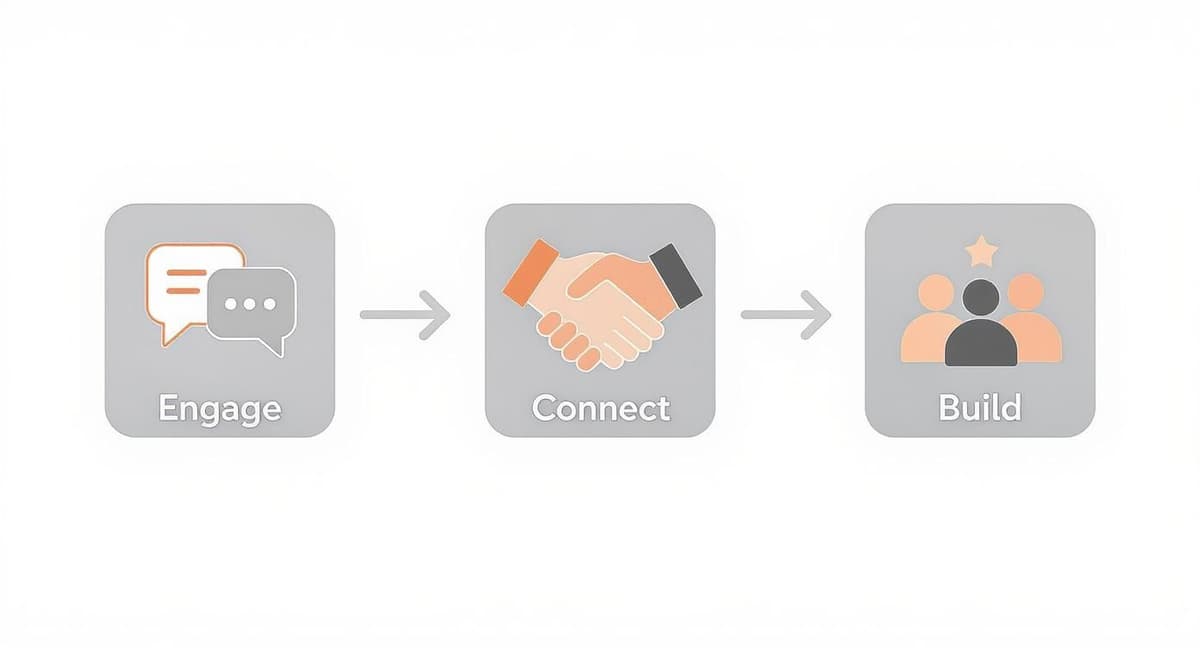
This cycle of engagement and connection—not just broadcasting—is exactly what a smart repurposing strategy fuels.
Automate Growth Ethically
Let’s get one thing straight: growth automation isn't about spam or fake engagement. Done right, it's about systematically putting yourself in the middle of relevant conversations where you can provide real value. It’s how you get discovered by new audiences without spending your entire day hunting for opportunities.
You can set up workflows to monitor specific keywords or hashtags that are vital to your brand. For instance, a web developer could keep an eye on conversations that include "Next.js performance" or "help with React."
When a relevant conversation pops up, you get a heads-up and can jump in with a helpful, non-salesy comment. This positions you as a go-to expert and naturally brings curious people back to your profile. It’s a strategic way to be in the right place at the right time, consistently, so you can focus on what you do best.
How to Measure and Refine Your Strategy
Putting content out there without ever looking at the data is like driving blind. You might be moving, but you have no clue if you're actually headed in the right direction. A powerful personal brand isn’t just built on good ideas; it’s honed through a constant cycle of analysis and adjustment.
This is where you need to roll up your sleeves and get friendly with your analytics. Don't worry, you don't need to become a data scientist overnight. It’s all about learning to spot patterns and understanding what your audience truly finds valuable. That way, you can give them more of what they love and less of what they scroll past.
Moving Beyond Vanity Metrics
First things first: we need to stop obsessing over vanity metrics. I’m talking about the flashy numbers like follower counts and likes. They feel great, sure, but they tell you very little about the actual health of your brand. A post can rack up a thousand likes and still generate zero real conversations or profile clicks.
Instead, let's zero in on the metrics that signal a real connection. These are the numbers that show people aren't just passively consuming your content but are actually leaning in, engaging with your ideas, and wanting to learn more about you.
These are the metrics that really matter:
- Engagement Rate: This is the big one. It’s the percentage of people who saw your post and actually did something—commented, shared, replied. It's the most reliable indicator of how well your message is landing.
- Profile Visits: When someone reads your post and gets curious enough to click over to your profile, you've done something right. This is a massive signal that you're attracting the right crowd.
- Comments per Post: A healthy stream of thoughtful comments means you're sparking genuine conversations. This is how you build a community, not just an audience.
Your goal isn't to get the most likes; it's to start the best conversations. A handful of insightful comments from the right people is far more valuable to your personal brand than hundreds of passive likes from a disengaged crowd.
Establishing a Simple Review Cadence
You don't need a complex dashboard or expensive software to track your progress. All you need is a simple, consistent routine to stay on track and make smarter decisions. This regular check-in keeps your overall content strategy for social media sharp and effective.
By creating a habit of reviewing your analytics, you turn data from something intimidating into your most powerful strategic tool.
Weekly Check-In (15 Minutes) Think of your weekly review as a quick pulse check. Just open a simple spreadsheet and make a note of the following for everything you published that week:
- Top Performing Post: Find the post with the highest engagement rate. What was the topic? What format did you use? How did you hook the reader?
- Lowest Performing Post: Now, find the post that fell flat. Be brutally honest with yourself—why do you think it didn't connect?
- Key Conversation Starter: Which post got people talking the most? Look for themes in the comments that you could explore in future content.
This quick analysis helps you spot immediate trends and double down on what’s working right now.
Monthly Review (1 Hour) Your monthly review is for looking at the bigger picture. This is where you zoom out and analyze the broader patterns in your performance.
The table below breaks down the key metrics you should be tracking to gauge the health and growth of your personal brand. These numbers tell a story about what's working and where you have opportunities to improve.
Essential Personal Brand Performance Metrics
| Metric | What It Measures | Why It Matters | How to Improve It |
|---|---|---|---|
| Overall Engagement Rate | The average engagement across all your posts for the month. | It shows the general health and resonance of your content over time. | Test different content formats (e.g., threads, single posts, polls) and analyze which ones spark the most interaction. |
| Follower Growth | Your net new followers for the month. | While a vanity metric on its own, consistent growth shows your content is successfully attracting new people. | Post consistently, engage in other relevant conversations, and create highly shareable content. |
| Profile Clicks | The total number of people who visited your profile. | This is a direct measure of how compelling your content is at driving deeper interest in who you are and what you do. | Optimize your bio and pinned posts. End your best content with a call-to-action that encourages a profile visit. |
By tracking these numbers month-over-month, you start to see whether your strategy is gaining momentum. You'll get a clear picture of which content pillars are fueling growth and which formats consistently knock it out of the park. This data-driven loop of creating, measuring, and refining is the real engine behind sustainable, long-term growth for your personal brand.
Common Personal Brand Questions
Building a personal brand can feel like navigating a maze. As you start putting all this into practice, you're bound to hit some roadblocks or have questions pop up. It happens to everyone. Let's tackle some of the most common hurdles I see people face so you can keep moving forward.
How Do I Build a Personal Brand if I'm Not an Expert?
This is probably the biggest mental block for most people starting out. The good news? You don't need to be the world's leading authority to create a powerful brand.
The trick is to shift your mindset from "expert" to "guide." Think of yourself as being just a few steps ahead of your audience. Your job is to turn around and share what you're learning as you go. People are hungry for that kind of real-time insight.
Document your journey—the wins, the "aha!" moments, and even the mistakes. This approach is incredibly magnetic because it’s authentic. Honestly, that relatability often builds a much stronger connection with an audience than a dry, authoritative voice ever could. You'll attract a community that wants to learn right alongside you.
Authenticity is your greatest asset. Your audience doesn't expect perfection; they expect a real person they can learn from and connect with. The journey is often more compelling than the destination.
How Much Time Should I Spend Weekly to See Results?
It's all about consistency over intensity. I've seen it time and time again: spending a focused 30-60 minutes each day is way more effective than trying to cram everything into a single five-hour marathon on a Saturday. That daily rhythm creates a momentum that sporadic effort just can't match.
To make that daily time count, focus on three things:
- Creating: Batch-write your posts. Get a week's worth of content done in one sitting so you're not always scrambling.
- Engaging: Spend 15 minutes a day in the trenches. Reply to comments on your posts and jump into other relevant conversations.
- Consuming: Actively read what others in your niche are talking about. It keeps you sharp, inspired, and informed.
Find a sustainable pace. You don't have to post multiple times a day. For most people, posting 3-5 times per week while engaging daily is the sweet spot for seeing real, tangible growth.
Is a Personal Brand Just Being Myself Online?
Yes and no. The foundation is absolutely you—your personality, your quirks, your voice. But a personal brand is about being yourself with intention.
It’s a strategic process. You're consciously deciding which parts of your personality, skills, and values you want to be known for in a professional context. It's less about sharing what you had for breakfast and more about curating a message that consistently delivers value to a specific audience.
Think of it as actively shaping how people see you professionally, rather than just broadcasting random thoughts. Your brand is where who you are meets what you want to be known for.
What's the Best Way to Handle Negative Comments?
First off, take a deep breath. Getting a negative comment often means you’re doing something right—your content is finally reaching beyond your immediate circle. It's a sign of growth.
The first step is to figure out what you're dealing with. Is it constructive criticism or just a troll trying to get a rise out of you?
If the feedback has some merit, thank the person. Treat it as a free consultation to make your content or perspective even better. But if it's just pure negativity or bait, the best move is usually to ignore it completely. At most, give a single, calm, unemotional reply and then mute or block them.
Never get into a flame war with a troll. It's exactly what they want. Your time and energy are your most valuable assets—spend them on the people who are genuinely engaged and supportive.
Ready to build your personal brand with less stress and more strategy? MicroPoster provides the tools you need to schedule content, repurpose your best ideas, and automate your growth, all from one powerful command center. Start your free trial and publish smarter.