copy posts x threads
How to Copy Posts Between X and Threads Automatically
Learn how to automatically copy posts between X and Threads. Our guide covers smart threading, handle mapping, and the best tools for effortless cross-posting.

You post on X. Then you open Threads, paste the same text, fix the line breaks, re-upload the image, remove one mention that doesn't map cleanly, and trim or expand the copy so it doesn't look awkward. Do that a few times a day and you've built yourself a tedious distribution job.
That workflow breaks down fast for founders, indie hackers, and small teams. The problem isn't only time. Manual reposting makes you inconsistent. You skip Threads when you're busy, you publish late, or you simplify the post so much that it loses the point.
If you want to copy posts between X and threads without turning publishing into admin work, automation is the obvious starting point. The better move is intelligent automation: not just mirroring text, but adapting it so the post still feels native where it lands.
Why You Need to Automate Between X and Threads
Manual cross-posting feels harmless when you're doing it once. It becomes expensive when it turns every update into two publishing tasks instead of one.
That matters more now because Threads isn't a side channel anymore. Buffer's analysis of 10.2 million posts published in 2024 found that Threads posts had a 6.25% median engagement rate, compared with 3.6% on X, which means Threads delivered a 73.6% higher engagement rate for the posts analyzed in that dataset (Buffer's Threads vs. Twitter analysis).

The real cost is inconsistency
Founders usually don't have a content problem. They have a distribution problem. Product updates, launch notes, hiring posts, customer wins, and sharp opinions already exist. What slips is the second step: getting those posts everywhere they should go.
If you publish natively on X first, there's a strong chance Threads becomes an afterthought. If you write separately for both, your throughput drops. In practice, that means fewer experiments, fewer touchpoints, and more dead time between posts.
A decent cross-posting system fixes three things:
- It removes duplicate work so one post can feed multiple channels.
- It shortens delay between the original post and the mirrored one.
- It keeps you present on both networks even when you're focused on shipping, support, or sales.
Practical rule: If posting to the second platform feels optional in your workflow, it won't happen reliably.
Reach is no longer the only metric that matters
X still has major scale, but engagement and mobile usage have shifted the strategic picture. That's why simple “post once, maybe repost later” habits don't hold up.
For teams building their own publishing stack, it also helps to understand the infrastructure side of multi-network distribution. If you want a technical view of how modern posting systems connect across platforms, you can explore Mallary.ai's API solutions as a useful reference point.
The practical takeaway is simple. If you already write for X, you should have a repeatable way to push those posts to Threads without touching every post twice. Otherwise, you're choosing friction over exposure every single day.
The Foundation Secure Account Connections
Users often hesitate at the same moment: connecting accounts. That's reasonable. If a tool asks for passwords, walk away.
Modern cross-posting tools use OAuth 2.0, which means you authorize access through X and Meta's own permission flow instead of handing your login credentials to the tool. The app gets a scoped permission token. You keep control, and you can revoke access later from your platform settings.
What OAuth actually means in plain English
Think of OAuth as a permission slip, not a key handoff. You approve a specific app to take specific actions, such as reading new posts or publishing to a connected account.
That matters because mobile usage now has real strategic weight. By January 2026, Threads reached 141 million daily active mobile users while X was at 125 million on iOS and Android, according to Similarweb data reported by MediaPost (MediaPost coverage of Threads surpassing X in mobile users). If your audience consumes social primarily on mobile, account connectivity isn't a technical checkbox. It's the mechanism that keeps your content flowing where people see it.
What the connection flow should look like
A trustworthy setup usually follows this sequence:
You choose the source account Your original post starts at this stage. For many people, that's X.
You choose the destination account
The mirrored version should appear in this account, specifically Threads.You approve access in the native authorization window
You're redirected to X or Meta, log in there, and approve the requested permissions.You return to the tool with permissions attached
The platform confirms the app can now perform approved actions.
Don't treat OAuth as “trusting the tool with your password.” Properly implemented, it does the opposite. It avoids password sharing entirely.
What to check before you click approve
A quick review avoids most setup anxiety:
- Scope of access. Confirm the app only requests the permissions needed to read and publish posts.
- Revocability. Make sure you can disconnect it from X or Instagram settings later.
- Clear platform support. Threads publishing depends on the Meta side being connected correctly.
- Documentation quality. If the setup docs are vague, support will probably be vague too.
If you want a broader technical primer on how social APIs fit together, MicroPoster's guide on mastering APIs for social media is a practical background read.
Setting Up Your First Automated Post Mirror
The easiest workflow is still the preferred one: post on X as usual, then let the system copy it to Threads in the background.
That only works if detection is fast and publishing is reliable. Tools like MicroPoster use secure OAuth 2.0, poll the X API every 30 seconds for new content, and mirror posts to Threads through Meta's Graph API within 60 seconds, with a 98% delivery success rate in internal benchmarks (MicroPoster's X to Threads cross-posting details).
Start with one clean rule
Don't overbuild the first version. Set up one source, one destination, and one simple trigger.
A workable first mirror usually looks like this:
Source account
Your main X profile where you already publish.Target account
Your Threads account for mirrored distribution.Trigger condition
Every new post, unless you want to limit automation to selected content.Default handling
Preserve thread structure, carry over media, and publish automatically.
That's enough to test the flow without drowning in edge cases.
The setup sequence that works
Here's the order I'd use:
Connect X and Threads through OAuth
This confirms the app can detect source posts and publish destination posts.Define the mirror direction
If X is where you write first, make X the source and Threads the target.Choose automatic or selective syncing
Automatic works well for founder updates and repeatable content. Selective mode is safer if your X feed mixes personal posts with business posts.Turn on formatting rules
Keep thread preservation on. Let the system handle media resizing and mention mapping by default.Post a live test
Use a short text post first, then test an image post, then a multi-part thread.
A good test isn't one post. It's three formats in a row: text-only, media, and thread.
After you've seen the mirror work once, review how the copied post looks on Threads. That's where the difference between “it posted” and “it posted well” becomes apparent.
A walkthrough helps if you want to see the flow before touching settings:
What not to do on day one
The most common mistake is adding filters, delays, hashtags, exclusions, and manual edits before the core mirror is even stable.
Keep the first pass boring. Once the pipeline reliably copies posts between X and threads, then start tuning. The win is getting distribution out of your hands, not building a tiny social ops department for yourself.
Intelligent Content Adaptation for Each Platform
Simple mirroring starts to fail.
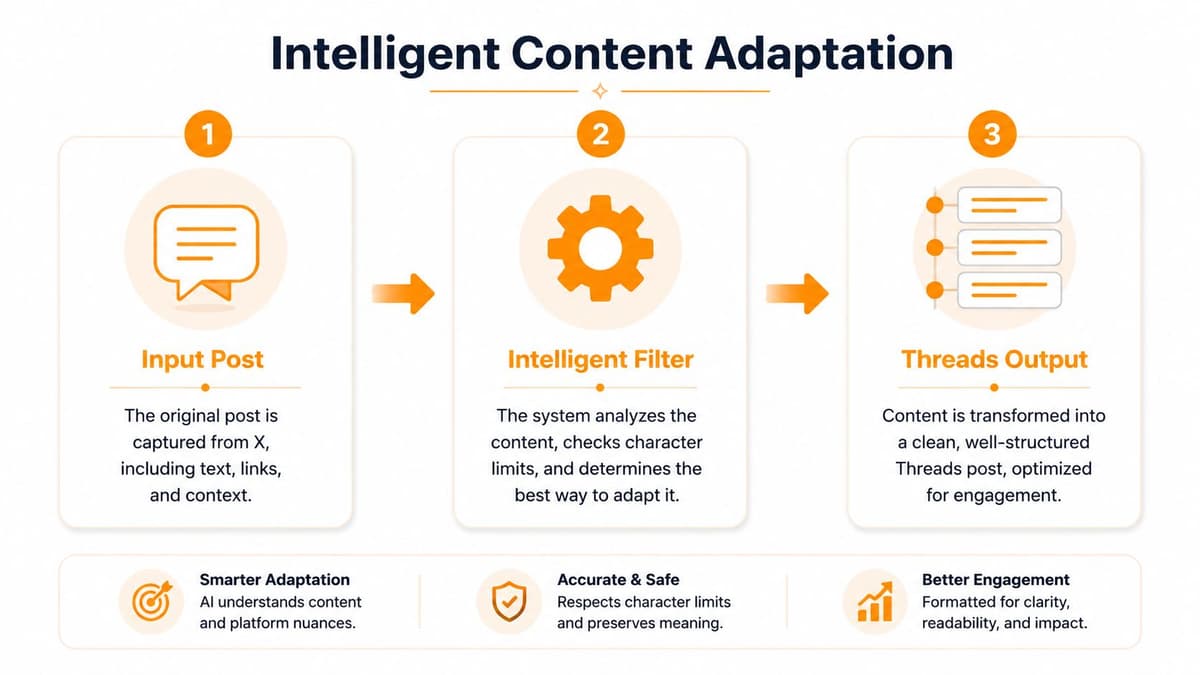
X and Threads may look similar on the surface, but they reward different writing patterns. A post can technically fit on both and still feel wrong on one of them. Intelligent adaptation handles that gap by translating the post structure, not just copying the text blob.
Where copied posts usually break
A few failure points show up over and over:
| Problem | What goes wrong | Better handling |
|---|---|---|
| Long text | The post lands as an awkward wall or broken sequence | Split it into a readable conversation |
| Multi-part threads | The narrative order gets lost | Preserve reply-chain structure |
| Mentions | A handle exists on one platform but not the other | Map or rewrite mentions before publishing |
| Media | Images or GIFs don't display natively | Resize or convert before upload |
These aren't cosmetic issues. They change how the post reads and whether people engage with it.
Adaptation is mostly rules, not magic
The strongest systems do a few practical things behind the scenes. From the verified product details, MicroPoster can detect X posts over 500 characters and split them into Threads conversations, resize images to 1080x1350px, map handles through fuzzy matching, and preserve reply chains while auto-formatting the final output for Threads.
That matters because a founder thread on X often relies on pacing. One short post sets the hook, the next expands it, and the final post points to the product or lesson. If your tool flattens that into one clumsy block, it strips out the rhythm that made the original work.
- Handle normalization helps when usernames don't line up cleanly across platforms.
- Media transformation matters when X-native formats need conversion before Threads will accept them properly.
- Reply-chain preservation keeps a thread readable instead of turning it into disconnected fragments.
Native-looking posts outperform copied-looking posts, even when the core idea is identical.
The writing still matters
No tool can rescue weak copy. It can, however, stop decent copy from being damaged in transit.
That's especially useful when you draft with AI and then need to make the result sound less synthetic before distributing it across networks. If you use AI in your workflow, a quick pass to humanize chatgpt text can help smooth out stiff phrasing before the post gets mirrored.
For a closer look at adapting social posts for network-specific constraints, this MicroPoster guide on how to adapt tweets for Mastodon and Threads is worth reading.
The important shift is this: when you copy posts between X and threads well, you're not duplicating content. You're preserving intent while changing the packaging.
Beyond Copying Strategic Cross-Posting
Automation saves time. Strategy decides whether that time turns into growth.
The weak version of cross-posting is pure duplication with no thought behind it. The stronger version uses rules. You keep the same core message, but you adjust the delivery so each platform gets a version that matches how people read and react there.
X threads can generate 2 to 3 times more engagement than single tweets, but mirroring that format to Threads needs adaptation. Copying the structure without considering each platform's user behavior and algorithmic preferences can reduce performance (video discussion on X thread engagement and cross-posting adaptation).

When pure mirroring works
Pure mirroring is fine when the post is straightforward and the value is in speed:
- Product updates that need consistent wording everywhere
- Launch announcements where timing matters more than nuance
- Feature releases with a clear image and short explanation
- Hiring posts where you want broad visibility fast
In these cases, consistency beats overthinking.
When you should vary the post
Some content benefits from small changes on Threads:
- Remove or soften the hard sell if the original X post is very punchy.
- Expand a compressed argument if the X version was written to fit a tighter style.
- Clean up hashtags or links if they interrupt the reading flow.
- Rewrite the opener if the original depends on X-native tone.
A founder update is a good example. On X, a sharp first line and compact thread may work well. On Threads, a slightly more conversational setup can make the same idea feel more natural.
Field note: Don't automate sameness. Automate distribution, then add just enough variation to avoid looking lazy.
Strategy looks a lot like channel design
The same principle shows up in support and operations. Teams that think in channels instead of isolated tools usually build better systems. If you work across community, support, and social, Mava's piece on omnichannel customer service strategies is a useful parallel. The idea is the same: one core signal, adapted across touchpoints.
The practical lesson is simple. Your cross-posting setup should answer two questions before it runs:
- Should this post be mirrored exactly?
- If not, what rule should change it before publishing?
That's the difference between a bot and a disciplined content system.
Common Issues and Getting Started
Most cross-posting issues are boring, which is good news. Boring problems are usually fixable.
The snags you'll actually hit
Rate limits
X API limits can interrupt immediate posting. A solid tool handles this with queuing instead of dropping the post.Media mismatches
Some source media won't translate perfectly. GIF handling and native upload differences are common trouble spots.Handle mapping errors
If the same handle doesn't exist on Threads, the mirrored post can publish with a broken mention or need a manual rewrite.Formatting surprises
Long posts, line breaks, and thread segmentation may need one pass of adjustment in your rule settings.
If a mirrored post fails, don't assume the whole workflow is broken. Check the specific post type first. Most failures come from one unsupported media case or one account mapping issue, not from the connection itself.
The easiest way to build confidence is to start narrow. Mirror text posts first. Then test images. Then test a thread. Once those formats behave, leave it running.
If you're tired of manually reposting every launch note, build-in-public update, or product thought, try MicroPoster. It gives you a simple way to automate cross-posting between X and Threads with a 7-day free trial, so you can test the workflow on your own accounts before committing to anything.