best time to post on instagram on friday
Best Time to Post on Instagram on Friday Revealed
Discover the best time to post on instagram on friday with data-driven windows, niche exceptions, testing methods, and scheduling tips using MicroPoster.

Friday is the most misleading day in Instagram scheduling. One 2026 guide built from five studies recommends 10 AM to 12 PM and 4 PM to 6 PM as strong Friday windows, while Sprout Social’s 2026 analysis says Fridays show no significant peak engagement hours at all, and Buffer’s broader 2026 analysis of 9.6 million posts points to very different time patterns depending on location and reporting method (MeetEdgar, Buffer).
That sounds messy because it is. But it’s also useful.
If you’ve ever posted a strong Reel or carousel on Friday and watched it stall, timing may have been the problem. Friday behavior shifts fast. People start the day in work mode, drift into break mode by lunch, and then split into very different patterns by afternoon and evening. Some are still checking updates. Others are already mentally offline.
That’s why the best time to post on instagram on friday isn’t a single hour. It’s a set of windows, plus a testing system. You need a baseline, a way to adjust for your audience’s time zone, and a workflow that doesn’t force you to sit at your phone every Friday.
Introduction to Friday Instagram Timing
Friday punishes lazy scheduling.
A lot of posting advice works well enough from Monday through Thursday. Friday is different because audience attention becomes fragmented. Some people scroll during work breaks. Some browse while planning dinner, travel, or weekend purchases. Some disappear entirely after the afternoon.
That split explains why experts looking at large datasets can reach different conclusions. One source sees useful windows. Another sees inconsistency. Both can be right, because they may be looking at different audiences, industries, and geographies.
Think of Friday like an airport before a holiday weekend. The terminal is crowded, but not everyone is headed to the same gate. If you show up at the wrong one, you miss your people.
You don’t need perfect certainty to improve results. You need a smart starting point.
This guide takes the practical route:
- First, it explains why Friday engagement behaves differently.
- Then, it turns conflicting studies into usable posting windows.
- Next, it shows when broad advice breaks down for B2B, ecommerce, and creator-led accounts.
- Finally, it gives you a testing workflow and a way to automate scheduling so you’re not guessing every week.
If your audience spans regions, or if you repost content across channels, timing gets even harder. That’s where a structured process matters more than a generic chart.
Understanding Friday Engagement Patterns
Friday isn’t weak in a simple way. It’s unstable.
Sprout Social’s 2026 reporting describes Fridays as a day with no true peaks, even though its broader cross-industry data shows overall engagement often clustering between 11 AM and 6 PM on many days. For Friday specifically, it flags 3 PM to 5 PM as a cautious window while activity tapers, and it notes that Tuesdays and Wednesdays are stronger overall, while weekends perform worst (Sprout Social).
Why Friday feels unpredictable
User mindset changes in stages.
During the morning, many people still behave like weekday users. They check updates, clear messages, and sneak in short scroll sessions between tasks. Around lunch and early afternoon, that behavior often shifts from task-focused to escape-focused. By late afternoon, many users are mentally done with work, but that doesn’t guarantee they’ll engage with your post. Some keep scrolling. Others stop opening the app or move from browsing to offline plans.
That’s why broad averages can blur what’s really happening.
Practical rule: On Friday, “more people online” doesn’t automatically mean “better response to your post.”
How the algorithm changes the stakes
Instagram doesn’t just care when you publish. It cares what happens right after you publish.
A useful way to explain this is a relay race. Your post starts the race the second it goes live. If your early viewers like, save, share, or comment quickly, the baton keeps moving. If early engagement is slow, the handoff gets weaker.
On Friday, that relay race is harder to predict because audience attention is less synchronized than it is midweek.
Here’s the practical result:
- Morning posts can work when your followers are still in routine mode.
- Mid-afternoon posts may catch people during a final break, but expectations should stay modest.
- Late-evening posts often struggle for many accounts because users shift from scrolling to doing.
For a broader planning view across the week, MicroPoster’s guide to best day for social media posts is helpful because timing decisions make more sense when Friday is compared against stronger midweek days.
What confuses most teams
Many marketers ask, “So should I post on Friday or skip it?”
Don’t think in yes-or-no terms. Think in fit.
A founder posting product updates to a professional audience may do well in the morning. A food creator may get stronger response around lunch. A nightlife brand may care more about later windows. Friday doesn’t reward averages. It rewards alignment between the post, the audience, and the moment.
Friday is less like a universal peak and more like a moving target. The closer your schedule matches your audience’s routine, the better your odds.
Identifying Global Ideal Posting Windows for Friday
The cleanest answer is this: there isn’t one global Friday slot. There are a few candidate windows, and they need to be translated into local audience time.
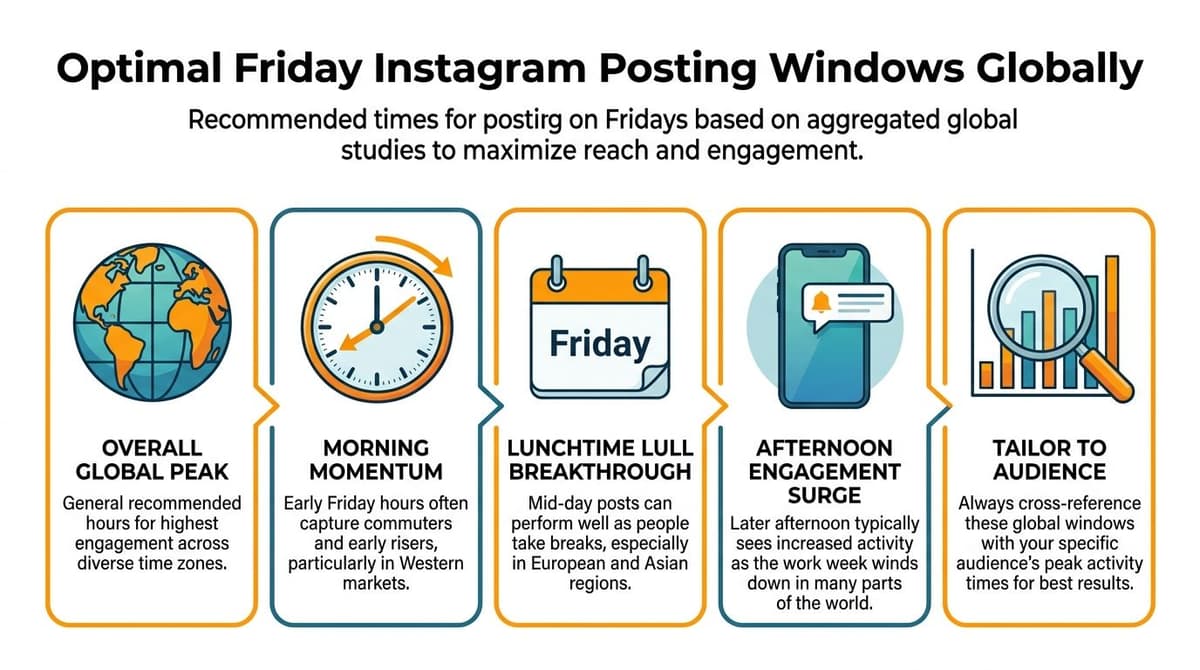
MeetEdgar’s 2026 guide, built from aggregated findings across five studies, recommends 10 AM to 12 PM and 4 PM to 6 PM local time on Fridays. The same summary notes that five studies flagged Friday evenings after 7 PM as underperforming. Evergreen Feed adds more nuance, highlighting 8 AM to 10 AM for a +23 to 35% engagement boost, 12 PM to 1 PM for lunch-hour reach, 3 PM to 4 PM for afternoon wind-down behavior, and later options such as 5 PM to 7 PM and 9 PM to 11 PM for leisure scrolling. Sprout Social pushes the other way, saying Fridays have no significant peak engagement hours and warning against 3 AM to 7 AM dead zones (MeetEdgar).
That sounds contradictory. It’s better read as layered guidance.
The windows worth testing first
Use these as starting points in your audience’s local time:
| Window | Best fit | Why it matters |
|---|---|---|
| 8 AM to 10 AM | B2B, founders, professional audiences | Lower competition and strong visibility in some datasets |
| 10 AM to 12 PM | Broad weekday audiences | Still catches routine Friday behavior |
| 12 PM to 1 PM | Creators, visual brands, casual browsing | Lunch-break scrolling is easier to win with lighter content |
| 3 PM to 4 PM | Productivity, motivation, timely promos | Good for wind-down behavior, but not a universal peak |
| 4 PM to 6 PM | Mixed audiences in local markets | Often recommended, but results vary by niche |
| 9 PM to 11 PM | Select leisure-driven audiences | Better as a niche test than a default choice |
How to think globally without getting lost
If your audience is spread across regions, a chart in one time zone can mislead you fast. An 8 AM ET post hits 5 AM PT and 12 PM GMT, which is exactly why broad lists often feel inconsistent.
That’s also why it helps to compare Instagram advice against broader guides on peak engagement times across social media platforms. Cross-platform timing isn’t identical, but it teaches the right habit. Always translate “best times” into audience geography before you trust them.
A simple global rule set
Use this if you want a practical baseline:
- Start with local morning if your followers are professionals or tech-oriented.
- Try local lunch if your content is visual, easy to consume, or shareable.
- Use late afternoon carefully when your audience is still active before signing off.
- Treat post-7 PM as account-specific, not universal.
- Avoid blanket posting in the early-morning dead zone unless your own analytics prove otherwise.
If your audience spans more than one region, “best time” really means “best time in each cluster.”
Addressing Industry Specific Timing Exceptions
General Friday windows help, but industry intent changes the picture.
A founder sharing product notes isn’t competing for the same attention as a fashion creator, a local café, or a retail store pushing a weekend offer. The same hour can feel productive to one audience and irrelevant to another.
B2B and founder-led accounts
Professional audiences often respond earlier.
The 8 AM to 10 AM Friday window can bring a +23 to 35% engagement increase compared with afternoon slots in the cited reporting, especially where visibility is high and competition is lower. That makes it a sensible slot for product updates, launch notes, hiring posts, or educational carousels aimed at founders and operators (SupGrowth).
If you run a SaaS account or personal founder brand, morning often fits the audience mindset better than late afternoon.
Ecommerce and retail brands
Retail is different because Friday browsing often shifts toward weekend planning.
SupGrowth highlights 11 AM and 2 PM to 4 PM as useful conversion-oriented windows on Friday, tying them to “pre-weekend intent.” It also notes that 11 AM to 1 PM supports steady casual engagement for visual and carousel content, while 2 PM to 4 PM can align with shopping behavior as users finalize weekend plans (SupGrowth).
That makes practical sense:
- a lunch-hour post can spark product discovery
- an afternoon post can catch people closer to purchase mode
- a late-night post may get views, but not necessarily buying intent
Creators and lifestyle accounts
Creator-led brands often have more flexibility, but not infinite flexibility.
Visual content can fit lunch breaks well because users are browsing casually. Entertainment and leisure-focused niches may also justify evening testing. Still, Friday evening isn’t automatically a win. If your followers go offline after work, a polished post can miss the window entirely.
Your niche changes what “good timing” means. Friday rewards audience intent more than broad averages.
A simple way to decide is to ask one question: when does your audience want this content? Not when are they awake. When are they receptive.
Testing and Refining Your Timing with Analytics
Many teams stop their testing prematurely. They try one Friday slot, see mixed results, and decide timing doesn’t matter.
Timing does matter. Bad testing hides it.
Buffer’s 2026 analysis of 9.6 million posts suggests Friday peaks at 10 p.m., 9 p.m., and 6 a.m., while Backstage points to 3 p.m. ET, and Sprout Social reports no Friday peaks overall. That gap tells you something important. Generic recommendations break down once geography and audience mix enter the picture (Buffer).
Step one, test windows, not random timestamps
Don’t compare 9:07 AM against 9:43 AM. That’s too narrow to teach you much.
Instead, test windows. For example:
- Morning test around your local 8 AM to 10 AM block
- Lunch test around 12 PM to 1 PM
- Afternoon test around 3 PM to 5 PM
- Optional evening test if your niche supports it
Hold the content style as steady as possible. If one week is a carousel and the next is a casual Story screenshot, you won’t know whether timing or format caused the difference.
Step two, segment by audience geography
Many accounts make mistakes at this stage.
If you serve users in the US and Europe, one post may perform “fine” overall while underperforming in both regions. It just averages out. Time zone spread can hide your strongest slot.
Use your audience data to split followers into rough clusters:
| Audience mix | What to test |
|---|---|
| Mostly one country | Focus on local morning, lunch, and late afternoon |
| US East + West | Test separate windows that don’t crush one coast |
| US + Europe | Prioritize overlap or schedule localized variants |
| Global niche audience | Test region-based batches rather than one universal post |
If you’re juggling several brand accounts while doing this, a practical resource on how to manage multiple Instagram accounts like a pro can help you keep experiments organized.
Step three, track the right signals
Don’t judge Friday performance by likes alone.
Use a simple spreadsheet and log the same fields every week:
- Post format
- Posting window
- Primary audience region
- Reach
- Shares
- Saves
- Comments
- Profile actions or clicks, if relevant
For educational posts, saves may matter more than likes. For ecommerce content, clicks and intent signals matter more than vanity engagement. For creator brands, shares may tell you more than comments.
Step four, run enough repetitions to spot a pattern
A single Friday means almost nothing.
Friday behavior is noisy by nature. You need repeated tests with similar content types before you can make a scheduling call. Don’t chase one lucky spike or overreact to one slow post.
Field note: If Friday results feel inconsistent, that may be the real signal. It often means your account needs segmented timing rather than one fixed slot.
Step five, adjust your system, not just your calendar
Once you identify a winning window, operationalize it.
That might mean batching founder updates for morning, scheduling visual content for lunch, or reserving late tests for specific campaigns. If your content also gets reposted to X or Threads, time-zone-aware tools can help keep the distribution aligned instead of creating new manual work.
One practical option is MicroPoster, which supports scheduling and reposting across platforms with time-zone-aware send timing, plus AI assistance for adapting posts and managing multi-account workflows. Used carefully, that can reduce the friction that usually kills consistent Friday testing.
Scheduling Automation Using MicroPoster
Friday timing gets harder the moment you manage more than one account, more than one region, or more than one platform.
The problem isn’t just choosing a posting hour. The core problem is execution. You need the post to go out on time, in the right format, with the right caption length and link handling, without forcing someone on your team to babysit it.
Evergreen Feed’s Friday late-night analysis points to a useful edge case. Posting between 11 PM and 12 AM can benefit from engagement velocity and “top of feed” positioning for Saturday early risers, and it notes that 11 PM UTC can line up with useful windows across North American and European markets at the same time (Evergreen Feed).
That kind of timing is exactly where automation matters.
What automation solves on Friday
Manual scheduling breaks down in three common situations:
- You post for multiple regions. One Friday slot won’t fit everyone.
- You mirror content across networks. Instagram timing may not match X or Threads behavior.
- You want niche tests. Late-night or localized experiments are easy to plan and easy to forget.
A scheduling system helps you turn testing into a repeatable process instead of a weekly scramble.
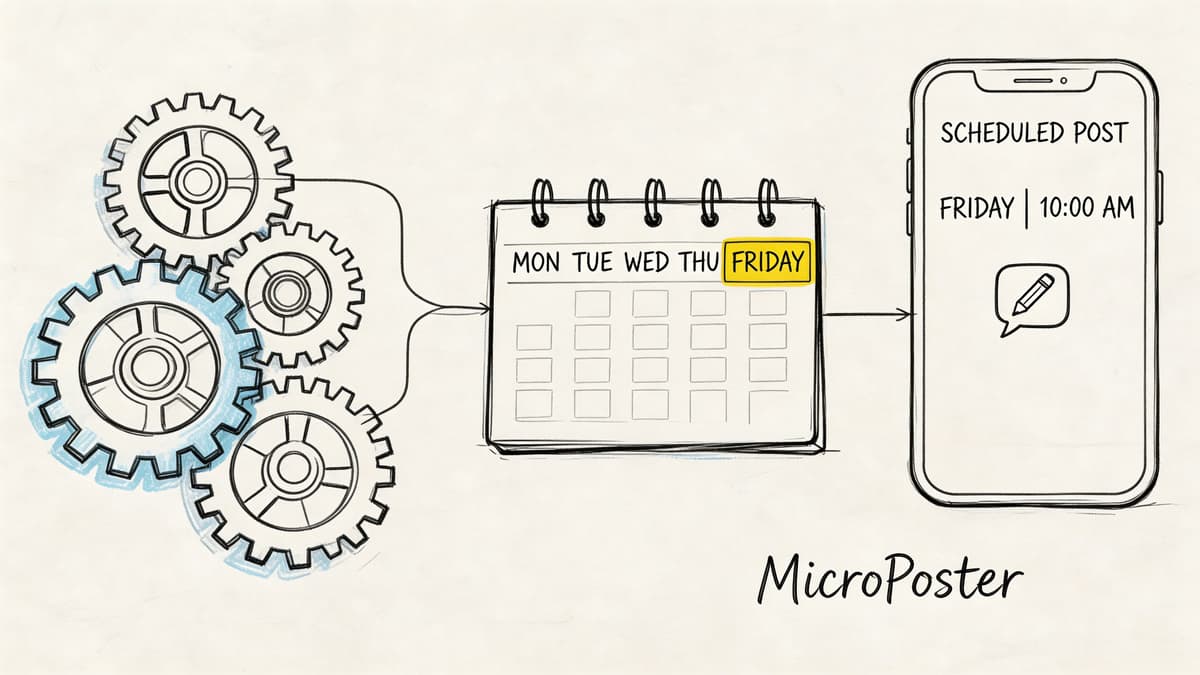
How to use a rule-based approach
The most useful setup is simple:
- Pick your candidate Friday windows.
- Group posts by purpose, such as founder updates, promos, carousels, or community posts.
- Assign each group to a time rule.
- Review outcomes and keep only the windows that earn their place.
MicroPoster’s regular schedule posts feature fits that style of workflow. You can map recurring posting logic to specific windows, then let the system handle timing while you focus on content quality and analysis.
Why this matters beyond Instagram
Founders and small teams rarely publish for one platform only.
A product update might start on Instagram, then need a thread for X, a shorter variant for Threads, and formatting changes for other networks. If you do that manually every Friday, timing discipline slips first. Then consistency slips.
A tool that detects source posts, adapts them, and schedules them in a calendar-based workflow can remove a lot of the busywork. That matters more on Friday because timing windows are narrower and less forgiving than they are midweek.
Good scheduling isn’t just about saving time. It protects the timing decisions you worked to validate.
For teams that already know their strongest Friday windows, automation isn’t a convenience feature. It’s how those insights make it into production.
Conclusion and Action Plan
The best time to post on instagram on friday isn’t one universal slot. It’s a shortlist.
For many accounts, the strongest places to start are morning, lunch, and late afternoon in the audience’s local time. For some niches, evening or even late-night tests can make sense. But Friday data is inconsistent enough that no chart should replace your own results.
Keep the process simple.
- Choose two or three Friday windows based on your audience and industry.
- Test similar content across those windows instead of changing everything at once.
- Segment by geography if your followers span regions.
- Track saves, shares, reach, and response quality, not just likes.
- Lock in winning windows and stop posting by habit.
If you run a founder brand, creator account, or small team, the greatest advantage comes from turning those choices into a repeatable system. That means fewer last-minute posting decisions and more consistent execution across Instagram and the rest of your channels.
The teams that get Friday right usually aren’t guessing better. They’re testing better, then automating what works.
If you want that process to feel lighter, MicroPoster is built for it. You can schedule recurring posts, mirror content across X, Threads, Bluesky, and Mastodon, adapt posts with AI, and manage timing without storing passwords. It offers unlimited scheduling on Creator and Pro plans, plus a 7-day free trial with no credit card required.