best times to post
Best Times to Post on Social Media: A 2026 Data Guide
Unlock peak engagement with our guide to the best times to post on social media in 2026. Discover platform-specific data, testing tips, and scheduling secrets.
Posts that earn engagement in the first minutes usually get a larger second wave of distribution. That pattern explains why publish time still matters across social media, even though each platform ranks content differently. Timing affects who sees the post first, how quickly they react, and whether the algorithm gets enough early signals to keep showing it.
A weak post will stay weak at any hour. A strong post published into a low-attention window often underperforms because it misses the audience segment most likely to comment, save, reply, or share right away.
That is the main job of timing.
Use broad benchmarks as a starting point, then test them against platform intent and your own audience behavior. LinkedIn usage clusters around work routines. TikTok and Instagram often benefit from leisure-time browsing. X, Threads, and Bluesky react more to habit loops tied to news checks, commute gaps, and short bursts of conversation. Mastodon adds another variable because server culture and time zone concentration can change the rhythm of engagement.
This guide focuses on more than generic posting windows. It explains why certain hours work, where those assumptions break, and how to build a simple testing cycle instead of copying a chart and hoping it fits. If you want a narrower Instagram example for end-of-week scheduling, see this guide on the best time to post on Instagram on Friday.
If you're building a social media posting schedule 2025, start with local-time windows, compare engagement velocity across two or three recurring slots, and separate by content type. A product update, a meme, and a hiring post often peak at different hours, even on the same account.
The useful question is simple. When is your audience most likely to engage fast enough to extend reach? The sections below answer that by platform, then show how to test and automate the schedule that fits your audience instead of someone else's.
1. Instagram Post Between 11 AM - 1 PM and 7 PM - 9 PM Local Time
Instagram rewards momentum. If a post gets quick likes, saves, comments, or shares, it's more likely to stay visible in feeds and recommendation surfaces. That's why lunch breaks and evening wind-down hours are such practical starting points. People have a few minutes, they're in browsing mode, and they're more likely to react instead of scroll past.
Buffer's platform analysis of over 9.6 million Instagram posts in 2026 points to Thursday at 9 a.m. as the single best slot, with Wednesday at 12 p.m. and Wednesday at 6 p.m. close behind. More broadly, Wednesday and Thursday lead Instagram engagement, evening hours from 6 p.m. to 11 p.m. perform well across most days, and the weakest zone is between 1 a.m. and 5 a.m.
Here's the practical translation. If you want a usable weekly rhythm, test midday and evening first.
Why these windows work
Lunch-hour posting catches the “quick check” habit. Evening posting catches longer sessions, especially for visual content people consume when work is over and attention is less fragmented.
A food creator posting a recipe at noon lines up with meal context. A lifestyle brand sharing a carousel at night meets users when they're browsing with fewer distractions. Same platform, different mindset.
For teams publishing consistently, scheduling helps. If your audience is concentrated in one region, queue posts for that local lunch and evening window. If you publish across time zones, tools like MicroPoster can help you keep timing precise without turning your week into a manual posting routine.
Before you test, this deeper Friday-specific breakdown on the best time to post on Instagram on Friday is useful because Friday often behaves differently from stronger midweek days.
A quick visual explainer helps if you want the platform mechanics in video form:
Practical rule: On Instagram, test one midday slot and one evening slot for the same content type before you change your creative. Otherwise, you won't know whether timing or content caused the result.
2. X (Twitter) Post Between 8 AM - 10 AM and 5 PM - 6 PM Weekdays

On X, relevance has a very short half-life. A post can lose momentum within minutes if it misses the first wave of replies, reposts, and clicks. That is why weekday mornings, especially 8 AM to 10 AM, consistently outperform slower hours for many accounts.
The logic is behavioral as much as technical. Morning users are checking news, industry chatter, markets, sports, and overnight updates in a focused scanning mode. X's ranking system also reacts quickly to early engagement, so posts that earn fast interaction in those first minutes are more likely to keep circulating. By 5 PM to 6 PM, the mindset shifts. People are less likely to reward raw news, but more likely to engage with commentary, recap threads, and sharper personal takes.
Use the time window to match the job of the post.
- 8 AM to 10 AM: breaking updates, product news, links to fresh analysis, event commentary, timely announcements
- 5 PM to 6 PM: opinion threads, lessons learned, contrarian takes, short summaries of the day, lighter conversational posts
This distinction matters because X is not just a publishing channel. It is a live reaction system. If your post asks people to process new information, publish when they are actively scanning. If it asks them to reflect or debate, test the end of the workday.
A simple testing framework works better than guessing. Pick one content type, such as founder commentary or product updates. Publish similar posts at 8:30 AM, 9:30 AM, and 5:30 PM across three to four weeks. Then compare not just impressions, but reply rate, repost rate, link clicks, and how long engagement continues after the first hour. That tells you whether your audience rewards immediacy or discussion.
Cross-posters should be careful here. Threads and X may look similar, but user behavior is not identical. This comparison of the best time to post on Threads vs X shows why copying the same schedule across both platforms usually leaves reach on the table. The same caution increasingly applies to Bluesky, where conversation patterns can be less news-driven and more community-centered.
One useful side effect of getting X timing right is content spillover. A strong morning thread can later be adapted into a LinkedIn post, especially if you want to promote your podcast on LinkedIn or turn audience questions into a more professional angle for a different network.
Practical rule: On X, test timing and post type together. Morning is usually better for urgency. Late afternoon is usually better for interpretation. If you test both with the same format, you will get cleaner answers faster.
If you publish daily, schedule around these windows first, then adjust by audience geography and niche. Finance, tech, politics, and sports often skew earlier because the audience is trained to check for updates fast. Creative, media, and personality-led accounts often get more from the 5 PM to 6 PM slot because the conversation is less transactional and more social.
3. LinkedIn Post Between 7 AM - 9 AM and 12 PM - 1 PM Tuesday-Thursday
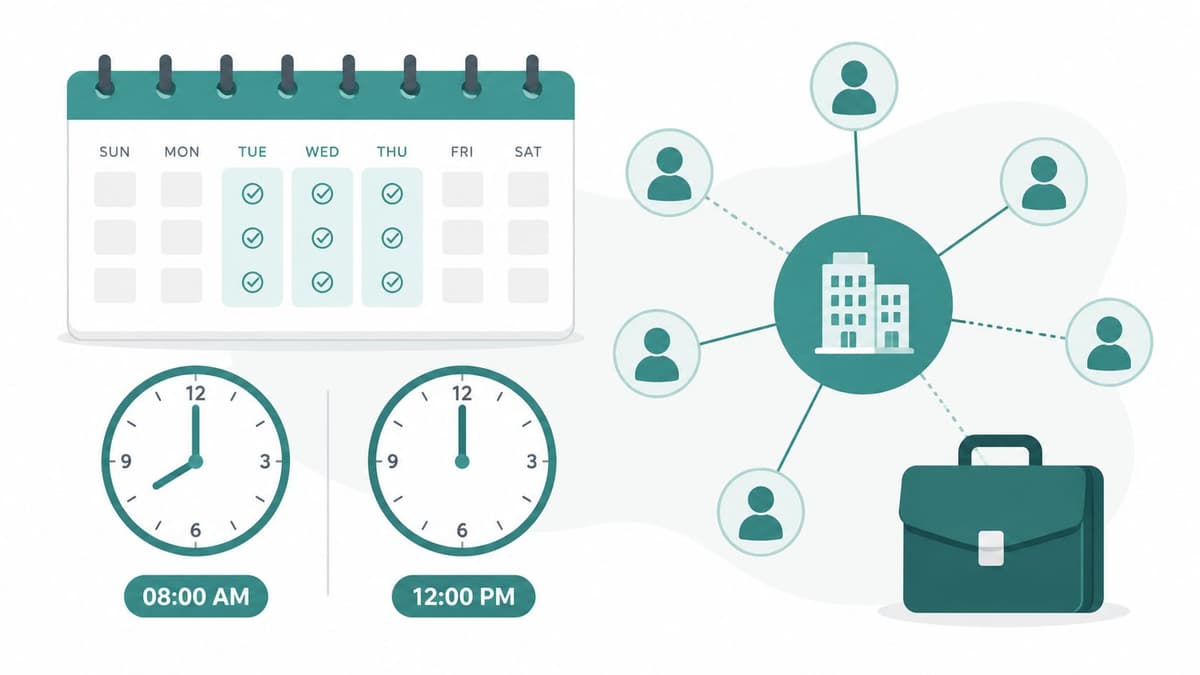
LinkedIn usage clusters around work rhythms. That is why 7 AM to 9 AM and 12 PM to 1 PM, especially Tuesday through Thursday, are reliable starting points. Early mornings catch professionals before meetings take over. Midday reaches people during a short break, when they are more willing to read, save, or comment on something useful.
The psychology is different from entertainment-first platforms. LinkedIn users usually open the app with a professional filter already on. They are scanning for ideas they can apply, signals about hiring and industry movement, or posts that help them look informed in front of colleagues. Timing works best when it matches that intent.
Tuesday through Thursday usually outperform the edges of the week for a simple reason. Monday attention is fragmented by planning and backlog. Friday attention drops as calendars loosen and work priorities shift. The middle of the week gives you a cleaner test environment, which makes it easier to tell whether the post itself worked or whether timing distorted the result.
Post format matters here because LinkedIn engagement often unfolds in stages. A short insight post published at 8 AM can get quick reactions from commuters and early desk workers. A deeper post at 12:15 PM may earn fewer instant likes but more saves, longer dwell time, and better comment quality because readers have a little more cognitive space.
A useful starting framework looks like this:
- 7 AM to 9 AM: Executive insights, founder lessons, contrarian takes, market observations
- 12 PM to 1 PM: Hiring posts, event invites, case studies, deeper text posts, carousels
- Tuesday to Thursday: Best days for testing because audience behavior is more stable
If LinkedIn supports your broader creator or B2B strategy, the same discipline that helps you promote your podcast on LinkedIn applies here. Match the content to the reader's mental state. Do not just fill an open slot in your scheduler.
One mistake B2B teams make is judging timing only by the first hour. LinkedIn often distributes strong posts beyond the initial burst, especially if the post gets meaningful comments instead of quick, low-intent reactions. That means your test should track at least three things: early engagement, save or click behavior, and whether comments continue to arrive later in the day.
Use a simple self-testing cycle. Pick one post format. Publish it for two weeks at 8 AM on Tuesday through Thursday. Then run the same format for two weeks at 12 PM to 1 PM on the same days. Compare impressions, engaged clicks, saves, comment depth, and any downstream goal such as profile visits or leads. That will give you a better schedule than copying a generic benchmark because it reflects your audience, seniority mix, and niche.
For small teams running several channels, coordinated scheduling still matters. A posting system beats memory every time.
4. TikTok Post Between 6 AM - 10 AM and 7 PM - 11 PM Daily

TikTok is the platform where people overrate timing and underrate content quality. Timing matters, but it isn't the main engine. Watch time, retention, rewatches, and satisfaction signals drive far more of the outcome than the exact minute you hit publish.
That said, the strongest practical windows still tend to be morning routine hours and late-evening leisure hours. Users check TikTok when they're waking up, commuting, procrastinating, or decompressing. That's why 6 AM to 10 AM and 7 PM to 11 PM are useful testing ranges.
What creators get wrong on TikTok
They borrow timing logic from follower-first platforms. TikTok doesn't behave that way. A small account can still travel widely if the video earns strong viewer response. A large account can stall if the video doesn't hold attention.
So use timing as a boost, not a crutch:
- Educational clips: Try morning slots when people are open to quick learning.
- Entertainment and reaction content: Test evening windows first.
- Series content: Keep the time consistent long enough to give the algorithm clear audience signals.
Adobe's discussion of dynamic audience behavior notes that 73% of users engage differently based on content type. That's the key TikTok lesson in one line. A tutorial, a meme, and a talking-head opinion post won't peak for the same audience in the same way.
If your video is mediocre, the perfect posting time won't rescue it. If the video is strong, posting during an active window can help it get early traction from the right viewers.
Creators juggling TikTok with other channels usually struggle with consistency more than strategy. A scheduler won't make weak content better, but it will make a strong routine easier to keep.
5. Threads Post Between 8 AM - 11 AM and 6 PM - 8 PM Daily
Threads still behaves like a platform discovering its own norms. It borrows some habits from X, but the culture is softer, more conversational, and more willing to reward thoughtful replies over sharp one-liners. That changes timing strategy.
Buffer's cross-platform reporting notes that Thursday is the optimal day for Threads, and the single most effective universal slot across major networks is 9:00 AM on weekdays. Threads is part of that pattern, but not in the same way as X. Morning visibility matters, yet reply-friendly content often keeps building into the day.
How to post for replies, not just impressions
A good Threads post invites continuation. It opens a loop. A founder sharing an opinion about pricing strategy, a writer posing a strong question, or a creator reacting to an industry shift all have a better chance when the audience has time to answer.
That's why morning and early evening both make sense. Morning catches the first browse. Early evening catches users who are more willing to participate.
Try this approach:
- Short takes with a clear angle: Post in the morning.
- Conversation starters: Test early evening.
- Multi-post sequences: Publish the lead post when people can reply, not when they're half asleep.
The biggest mistake on Threads is treating it like a dumping ground for recycled posts. It rewards adaptation. If you're cross-posting from a source account, refine the wording so it sounds native to the platform. That's where a tool like MicroPoster is particularly useful. It can mirror and adapt content across platforms without forcing the exact same wording everywhere.
Threads timing matters, but prompt design matters more. If a post doesn't invite response, the time window won't fix it.
6. Facebook Post Between 1 PM - 3 PM and 7 PM - 9 PM Weekdays
Facebook remains one of the few major platforms where a post can keep getting distribution hours after publication. That changes how timing works. You are not only trying to catch the first scroll. You are trying to earn early signals, especially comments, shares, and meaningful reactions, that help the algorithm keep showing the post to friends, followers, and group members.
That is why weekday afternoons and evenings are a practical starting point. Mid-afternoon lines up with lunch breaks, lighter work periods, and routine check-ins. Evening fits a different behavior pattern. People are more willing to read longer captions, click into local updates, and discuss plans with family or community contacts.
Facebook also has a stronger relationship graph than faster text platforms. Posts often spread through familiar networks rather than pure recency. A school update, neighborhood event, service announcement, or local promotion can perform well at 1 PM to 3 PM because users still have time to respond while the day is active. The 7 PM to 9 PM window often helps content that benefits from sharing, tagging, or decision-making at home.
Use the time slot to match the job of the post:
- 1 PM to 3 PM: community news, local business updates, appointment reminders, event announcements
- 7 PM to 9 PM: shareable stories, family-oriented offers, group discussions, posts that invite comments or tags
- Weekdays over weekends: a safer default for reach and response consistency, especially for service businesses and organizations
Format matters as much as timing. Facebook users often pause longer than they do on X or Threads, but only if the post feels immediately relevant. A useful rule is simple. Lead with the takeaway in the first line, add a clear local or personal angle, and give people one reason to respond now.
For self-testing, avoid changing everything at once. Run the same content category for two weeks in the afternoon window, then two weeks in the evening window. Compare comment rate, share rate, and clicks after 24 hours, not just the first-hour spike. On Facebook, delayed engagement often matters more than instant traction.
If you manage several channels, Facebook should usually be the place where you publish the most context-rich version of the message. Shorter, faster platforms are good for attention. Facebook is better for explanation, community proof, and posts that need discussion before action.
7. Bluesky Post Between 9 AM - 11 AM and 6 PM - 8 PM Weekdays
Bluesky looks familiar to longtime X users, but the audience expectations are different. The community is smaller, more discussion-oriented, and often heavier on tech, media, and early-adopter users. That means timing still matters, though the effect is often less about mass reach and more about joining the right conversation while it's active.
For emerging text platforms, the safest starting point is the same behavioral logic that shows up elsewhere in the best times to post on social media: morning windows for updates and ideas, early evening windows for discussion. That's especially true when your audience includes builders, developers, writers, and people who browse before work or after it.
What usually works on Bluesky
Morning posts do well for product notes, links, commentary, and “here's what I'm seeing” observations. Evening posts can work better for open questions, thoughtful takes, and threads that benefit from back-and-forth.
Bluesky also rewards regular presence more than occasional polished posting. If you only show up when you have something to promote, you'll feel out of step with the network.
A useful operating model:
- Post one update-style item in the morning
- Post one discussion-oriented item in the evening
- Reply while the conversation is still warm
If you already publish on X or Threads, don't clone the exact same post. Adjust the tone. Bluesky users often respond better to clearer, less promotional language. MicroPoster's support for Bluesky makes that easier if your workflow starts on another network and you want a consistent presence without manual reposting every time.
8. Mastodon Post Between 9 AM - 11 AM and 5 PM - 7 PM Weekdays (Server-Dependent)
Mastodon is the hardest platform on this list to time well because there is no single audience pattern to optimize against. Server culture matters. Geography matters. Topic clusters matter. A tech-heavy instance won't behave like an art-focused one, and an international community won't follow one neat local schedule.
That's why broad weekday business-hour windows are only a starting point. Morning and late afternoon often work because many Mastodon communities still overlap with developer, open-source, academic, and media routines. But the key signal comes from your own instance and niche.
How to test Mastodon properly
Don't chase platform-wide certainty that doesn't exist. Watch your own replies, boosts, and conversations over a few weeks and find patterns in your community.
Use a simple method:
- Pick two windows: one in the morning, one in late afternoon.
- Keep the content type consistent: compare update with update, not update with meme.
- Watch conversation quality: on Mastodon, meaningful replies are often more useful than broad reach.
Mastodon also rewards community alignment more than optimized distribution. A timely, helpful post in the right instance can outperform a perfectly timed generic post. If you're active across decentralized and emerging platforms at once, operational simplicity matters. MicroPoster supports Mastodon alongside Bluesky, Threads, and X, which is useful if you want one publishing habit instead of four separate ones.
The right Mastodon schedule is local, not universal. Optimize for your community's rhythm first, then for the clock.
Best Posting Times: 8-Platform Comparison
| Platform | Peak timing | Implementation complexity 🔄 | Resource requirements ⚡ | Expected outcomes & key advantages 📊⭐ | Ideal use cases 💡 |
|---|---|---|---|---|---|
| Instagram: Post 11 AM–1 PM & 7 PM–9 PM | Lunch & evening local peaks | Medium, time-zone planning; vary by format | Medium, visual assets, analytics, scheduling | ⭐⭐⭐⭐, strong algorithmic reach when early engagement is high; good for visual brands | Brand storytelling, lifestyle, retail, visual campaigns |
| X (Twitter): Post 8 AM–10 AM & 5 PM–6 PM (weekdays) | Commute & end-of-workday scrolls | Low, frequent, real-time posting required | Low, short-form content; consistent cadence | ⭐⭐⭐, quick visibility spikes; ideal for news and short updates | News, tech announcements, rapid updates, thought leadership |
| LinkedIn: Post 7 AM–9 AM & 12 PM–1 PM (Tue–Thu) | Early morning & lunch on weekdays | Medium, professional tone, limited windows | Medium, long-form or native posts, analytics | ⭐⭐⭐⭐, high-quality B2B engagement and conversions; predictable professional audience | B2B marketing, recruitment, executive thought leadership |
| TikTok: Post 6 AM–10 AM & 7 PM–11 PM (daily) | Morning routine & late-evening leisure | High, creative video production and trends tracking | High, video creation, editing, frequent posting | ⭐⭐⭐⭐⭐, highest viral potential if watch-time is strong; algorithm rewards quality | Entertainment, viral growth, short-form education, youth-focused campaigns |
| Threads: Post 8 AM–11 AM & 6 PM–8 PM (daily) | Mid-morning & early evening | Low–Medium, thread-ready content and engagement focus | Low, text-first; consistency more important than production | ⭐⭐⭐, conversational reach with less saturation; favors threaded discussions | Creators, tech founders, commentary and community building |
| Facebook: Post 1 PM–3 PM & 7 PM–9 PM (weekdays) | Afternoon lunch & evening unwind; weekends viable | Medium, varied content types and community mgmt | Medium, mixed media, groups, paid/organic balance | ⭐⭐⭐, reliable conversion audience (older demographic); algorithm favors relevance | Local businesses, community groups, long-form engagement, conversions |
| Bluesky: Post 9 AM–11 AM & 6 PM–8 PM (weekdays) | Morning & early evening for tech/professional users | Low, smaller, engaged community; evolving norms | Low–Medium, conversational posts; monitoring needed | ⭐⭐⭐, high per-user engagement in niche tech/pro spaces; early mover advantage | Tech founders, developers, thoughtful discussion, early-adopter outreach |
| Mastodon: Post 9 AM–11 AM & 5 PM–7 PM (server-dependent) | Varies by instance; generally business hours | High, server/instance variability; no central analytics | Medium, community-focused, instance research required | ⭐⭐, quality conversations with limited reach; follower-dependent distribution | Niche communities, open-source projects, privacy-focused audiences |
From Data to Done Automate Your Perfect Schedule
Knowing the best times to post is only useful if you can reliably publish at those times. That's where many encounter difficulties. They start with a good plan, then real work gets in the way, time zones collide, and the schedule slips back into “whenever I remember.”
The data gives you a strong starting point. Across major platforms, weekday posting around 9:00 AM stands out as a recurring sweet spot, with Wednesday showing unusually strong performance across multiple networks and X peaking particularly well on Tuesday morning. But the deeper takeaway is more strategic than that. Each platform reflects a different user mindset. Instagram catches visual browsing during breaks and evenings. X catches morning information scanning. LinkedIn tracks professional attention. Threads and Bluesky reward active conversation windows more than sheer broadcast timing.
That means your posting schedule shouldn't be one calendar copied everywhere. It should be one content system adapted to multiple audience states.
A simple testing framework that actually works
Start with one platform at a time. Pick two time windows that fit the platform's behavior. Hold the content format steady for a short test cycle. Then compare outcomes based on what that platform values: replies on Threads, watch quality on TikTok, saves and shares on Instagram, click intent on LinkedIn, or repost velocity on X.
Use this sequence:
- Choose one core content type: don't compare a product launch against a meme
- Test two time windows: for example morning versus evening
- Run the test long enough to spot a pattern: not just one post
- Adjust one variable at a time: timing first, then format, then hook
Automation ceases to be merely a convenience and becomes strategy. A tool like MicroPoster turns timing theory into consistent execution. You can publish once from your preferred source account, let the platform mirror and adapt the post for X, Threads, Bluesky, and Mastodon, and keep your schedule aligned with each network's rhythm instead of manually pushing content everywhere. For founders, indie hackers, creators, and small teams, that's often the difference between “we had a plan” and “we successfully posted.”
If you also create long-form content, this guide on how to repurpose videos for social media pairs well with a timing strategy, because better source material makes every scheduled post work harder.
The goal isn't to become obsessed with the clock. It's to stop wasting strong content on weak timing. Once your schedule runs reliably, you can spend your energy on the thing that compounds most: making better posts. If you want to put that into practice without building a complicated workflow, MicroPoster's 7-day trial is an easy place to start.
If you want a lighter publishing workload and better timing discipline, try MicroPoster. It lets you write once, mirror posts across X, Threads, Bluesky, and Mastodon, and keep your schedule running without manual reposting. For founders, creators, and small teams, the 7-day trial is a low-friction way to test whether automated timing and cross-posting can clean up your workflow.