automatically turn long posts into threads
Automatically Turn Long Posts Into Threads for 2026
Stop manual splitting! Learn to automatically turn long posts into threads on X, Threads, & Bluesky. Discover powerful automation workflows for 2026.

You finish a thoughtful product update, a launch note, or a useful teardown. It reads well as one piece. Then the distribution work starts.
You trim it for X. You stretch it for Threads. You fix line breaks for Bluesky. You remove one mention because the handle doesn't exist on another network. You re-upload the same image because the crop looks wrong. By the time you're done, the energy that made the original post good is gone.
That friction is why many founders and creators under-distribute their best work. They don't lack ideas. They lack a workflow that can automatically turn long posts into threads without turning every publish into an editing session.
The Hidden Cost of Manual Cross-Posting
Manual cross-posting looks manageable on Monday morning. By the fourth or fifth publish of the week, it starts eating time in small, expensive chunks.
The work is rarely in the original post. The work is in turning one strong piece into versions that fit X, Threads, Bluesky, and Mastodon without making it feel copied, broken, or out of place on each network. Founders shipping product updates, operators sharing teardowns, and creators repurposing newsletter ideas run into the same problem. Distribution turns into hand-editing.

Where the time goes
The drain is adaptation, not writing.
A solid long post has to be reworked for platform limits, reading patterns, mention formats, and media behavior. A handle that works on X may fail on Threads or Bluesky. A screenshot crop that looks fine in one feed can look sloppy in another. A link preview might help on one platform and suppress reach on another. None of this changes the idea. It only changes how much manual cleanup sits between writing and publishing.
Typical cross-posting work looks like this:
- Checking post length: deciding whether the same update stays as one post, becomes a thread, or needs a different opening on each network
- Fixing structure by hand: adding thread breaks, keeping context intact, and making sure each segment still reads cleanly on its own
- Translating references: swapping or removing mentions, hashtags, and formatting that do not carry over cleanly between platforms
- Reworking media: re-uploading images, adjusting crops, and choosing between native media and external links based on how each feed presents them
That is why founders under-distribute their best work. The friction sits after the writing, so publishing starts to feel heavier than it should.
Practical rule: If one post creates ten minutes of cleanup on every platform, the bottleneck is your distribution system.
Why this hurts consistency
The cost shows up in content decisions a few weeks later.
Small updates stop getting shared outside the primary platform. Strong newsletter ideas never get adapted into threads. Teams default to short, low-context posts because they are faster to duplicate. Over time, your best material reaches fewer people than it should, even though the source content is already done.
This is also where simple repurposing advice falls short. Good content repurposing strategies for creators and founders do more than reuse text. They account for platform culture, thread flow, mention mapping, and media formatting so the same idea can travel well without looking machine-cut.
MicroPoster fits into that workflow in a practical way. It can repost across X, Threads, Bluesky, and Mastodon, split long updates into threads when needed, map mentions across networks, and resize media based on the destination. That turns cross-posting from repetitive admin into a system you can trust.
Why Simple Thread Splitters Fail
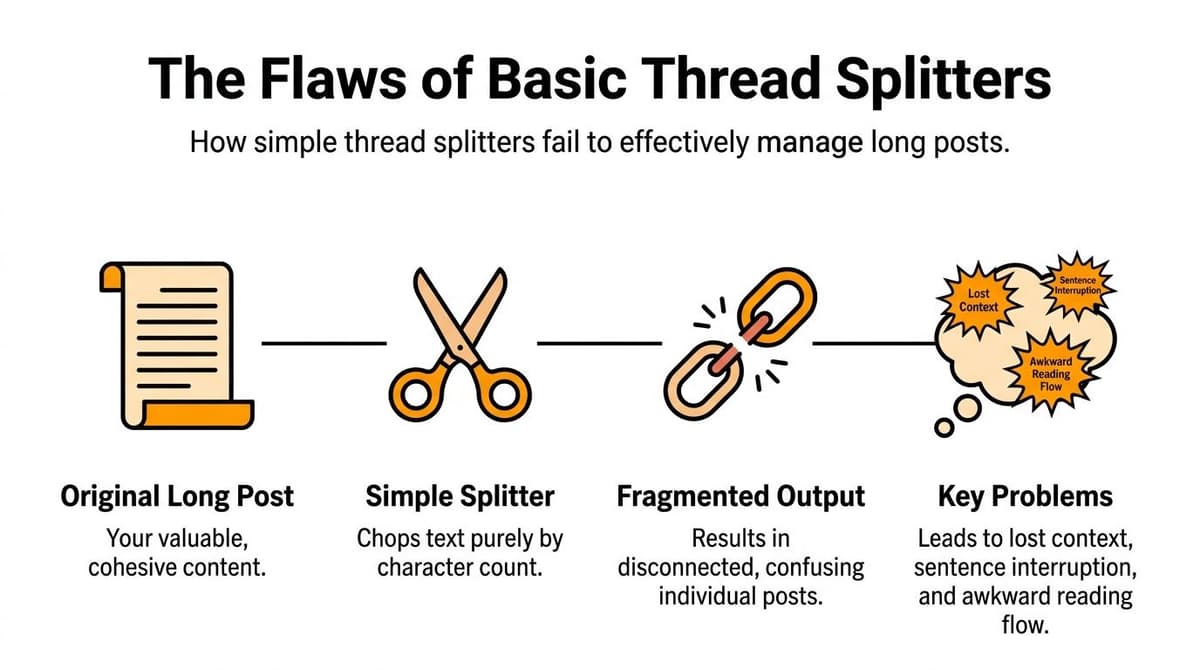
Basic splitters solve the smallest part of the problem. They count characters and cut. That's not enough.
Long posts aren't just blocks of text. They have pacing, setup, transitions, and payoffs. When a tool slices purely at character count, it creates threads that feel clumsy even when every segment technically fits.
Character limits are not content structure
A naive splitter doesn't know the difference between a clean paragraph break and a sentence that's halfway through a key argument. It doesn't know when a mention belongs with the following sentence. It doesn't know that a call to action loses force if the setup lands in another post.
That leads to familiar failures:
| Problem | What the reader sees |
|---|---|
| Mid-sentence cuts | A thread that feels machine-made |
| Broken context | A post that starts with "this" or "that" but never names what it refers to |
| Weird pacing | One overloaded segment followed by several thin ones |
| Damaged credibility | A useful idea presented in an awkward format |
The fix is semantic segmentation. That means splitting at logical breakpoints instead of arbitrary character counts.
According to this breakdown of semantic thread segmentation, expert-level automation platforms use natural language processing to identify logical breakpoints. Properly segmented threads maintain 15-25% higher engagement rates than naive splits, while basic character-count algorithms often show a 30-40% initial failure rate and semantic-aware systems reach 85-92% first-pass quality.
What intelligent splitting actually does
A smarter workflow evaluates the post in layers.
Meaning first
It identifies sentence and paragraph boundaries so each thread item can stand alone.Narrative second
It preserves order, making sure the setup appears before the claim and the proof appears before the conclusion.Platform constraints third
It checks character limits after shaping the content, not before.
That sequence matters. If you reverse it, the platform limit controls the writing instead of the writing adapting to the platform.
A thread should read like a sequence written for the platform, not a long post that got chopped into pieces on the way out.
Why this matters across platforms
Even a clean single-platform thread can fail once you distribute it broadly. Threads allows up to 500 characters per post, while X uses 280 characters. That's why a cross-platform system can't rely on a one-size-fits-all split. It needs to create different segment plans for different destinations while preserving the same core message.
If you already repurpose blog posts, podcasts, or launch notes, it's worth studying stronger content repurposing strategies before you automate at scale. The thread itself is only one output. The underlying workflow matters more.
Configuring Your First Automated Threading Workflow
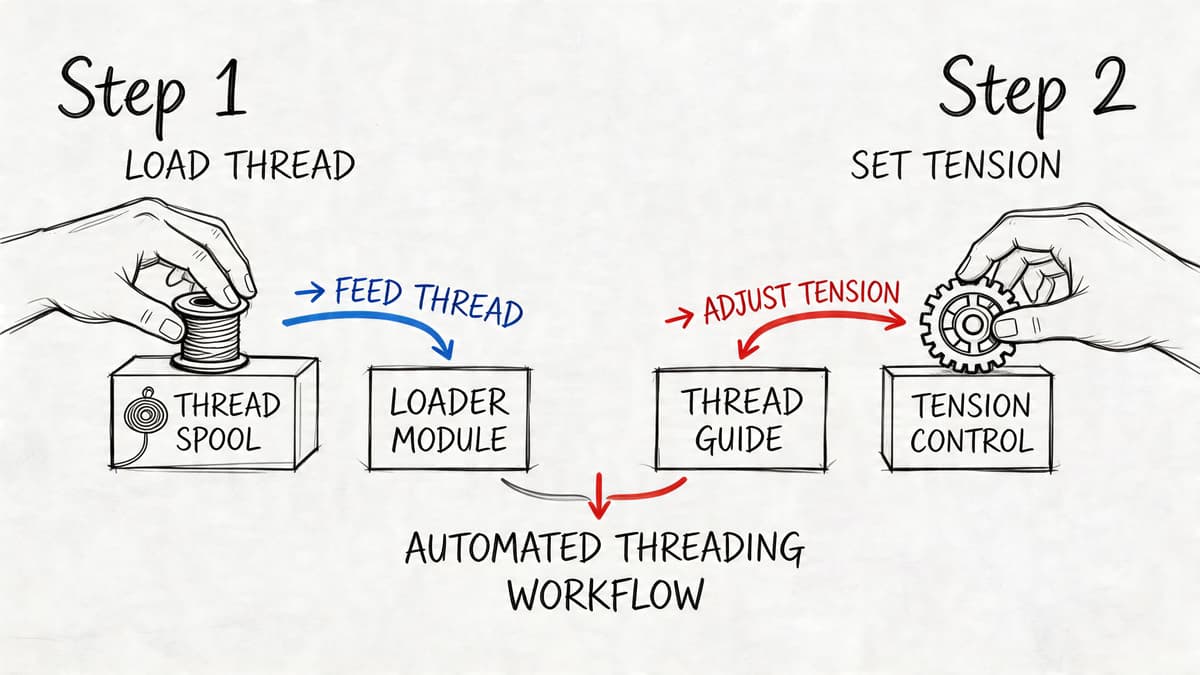
The first useful workflow is simple. Pick one source account, choose two or three target networks, and create one clear rule for long posts.
That gets you out of theory fast. You don't need a complex automation tree on day one. You need a repeatable path from "I posted" to "the same idea now exists natively on the networks that matter."
Start with one source of truth
Choose the account where you naturally write first. For many founders, that's X. For some creators, it's Threads. The important part is consistency.
Your source account should be the place where the original post is published natively. From there, the automation layer watches for new posts and routes them elsewhere.
A clean first setup usually looks like this:
- Source account: the platform where you publish your original long-form update
- Target accounts: the two or three networks where you want mirrored distribution
- Core rule: if the post exceeds the destination limit, split it into a thread
- Fallback behavior: if a mention or asset can't transfer directly, adapt it instead of failing the whole post
Connect accounts with the least friction
Use OAuth where available and avoid any workflow that asks you to hand over passwords manually. Good automation products connect directly to the social APIs and keep account permissions scoped to publishing actions.
Once the accounts are connected, label them by role instead of by platform alone. "Founder main X," "company Threads," and "product Bluesky" are easier to manage than a generic list of accounts.
The fastest way to make automation confusing is to connect everything at once. Start with one source and a narrow target set.
If you're building a broader operations stack around this, Samuel Woods has a practical roundup of best AI tools for entrepreneurs that helps frame where content automation fits inside a larger founder workflow.
Create the first rule
A good first rule is plain:
- Publish on your source platform.
- Detect the new post automatically.
- Send it to Threads and Bluesky.
- If the target platform limit is exceeded, convert it into a thread.
- Preserve media when possible.
- Adapt mentions when direct mapping fails.
The importance of that last point is frequently underestimated. Cross-platform automation is messy because identity isn't standardized. According to this analysis of Threads auto-posting workflows, 20-35% of direct mention transfers fail due to handle mismatches. Advanced systems use fallback logic that converts failed mentions into searchable text references, which preserves 70-80% of the original recognition intent instead of leaving broken tags behind.
Review the first few runs manually
Automation should remove repetitive work, not remove judgment.
For the first week, inspect each mirrored post and look for three things:
- Thread coherence: each segment should make sense without the previous one doing all the work
- Mention integrity: tags should resolve correctly or degrade cleanly into readable text
- Media presentation: images and video should appear native, not as awkward attachments or bare links
A short review loop catches bad assumptions early. Maybe your source posts open too abruptly for Threads. Maybe your product screenshots need different crops on another network. That's not a failure of automation. It's how you shape a system into something dependable.
Keep the workflow narrow before expanding it
A lot of creators overbuild too early. They add conditions for replies, quotes, hashtags, media types, and keyword filters before the first core flow is stable.
A better sequence is:
| Stage | What to automate |
|---|---|
| First | Long original posts |
| Second | Posts with media attachments |
| Third | Content with mentions and links |
| Fourth | Platform-specific formatting rules |
Once that baseline is working, the rest becomes much easier. If you want a deeper look at how mirrored publishing systems fit together, this guide to automated content distribution is a useful complement to the setup process.
Advanced Rules for Pro-Level Content Distribution
Most automation gets judged on convenience. Serious distribution gets judged on control.
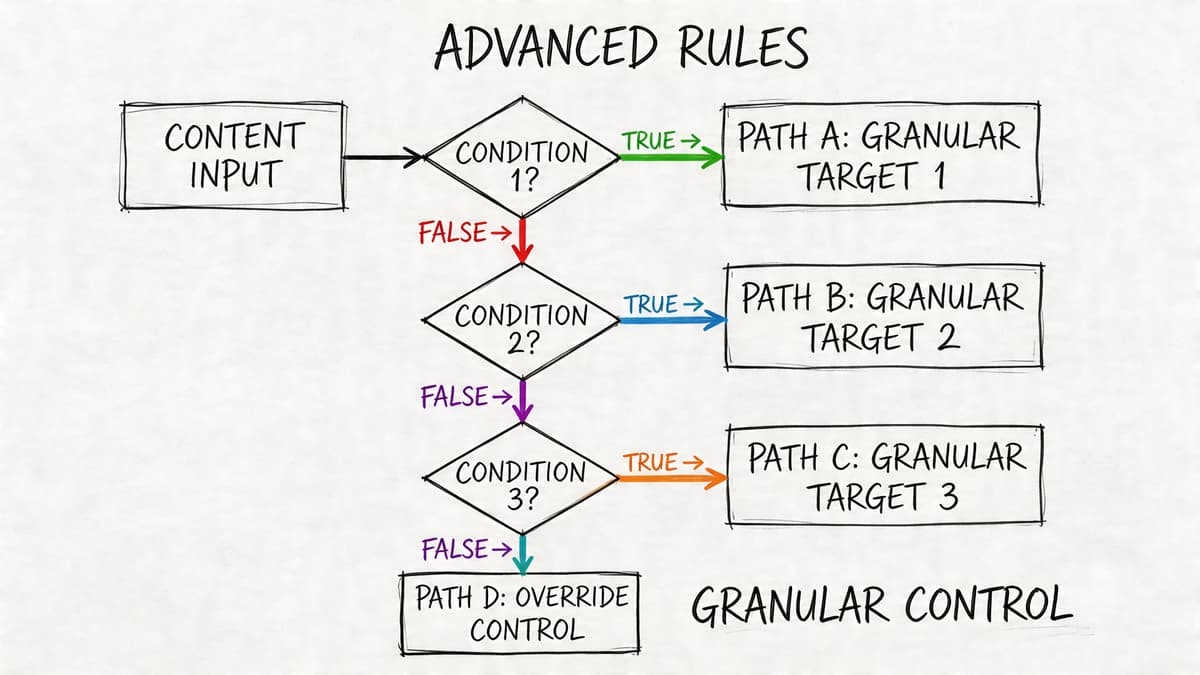
Mirroring every post everywhere sounds efficient, but it usually creates noise. A founder's thoughtful launch thread belongs on multiple networks. A casual reply probably doesn't. A product changelog may need extra context on Threads and a tighter presentation on X. Professional automation comes from rules, not from blanket duplication.
Build rules around content type
Start by separating posts into buckets. Not every post deserves the same treatment.
For example:
- Product updates can be threaded across platforms because they usually contain detail, narrative, and screenshots
- Quick observations may work as single posts everywhere with only light formatting
- Replies and side conversations often belong only on the source platform
- Link posts may need custom introductory text on networks where preview behavior differs
Here, simple splitters fall apart. They don't understand intent. They just process text.
Match rules to platform behavior
Threads is the clearest example of why platform-specific logic matters. According to Buffer's Threads algorithm analysis, the platform's 2025 refinement gives threaded long posts 25-40% higher visibility, especially when content shows sudden engagement spikes. That means a rule like "thread detailed posts on Threads, but keep them condensed elsewhere" isn't cosmetic. It's distribution strategy.
A useful ruleset might include:
- Thread on Threads when the original post is long
- Remove or reduce hashtags where they don't help discovery
- Skip cross-posting for posts that begin as direct replies
- Keep evergreen educational posts eligible for recycling
- Mirror only posts that include a launch keyword, changelog marker, or campaign tag
Operating principle: Automation works best when it reflects editorial judgment you already make manually.
Adapt to culture, not just character limits
Each network has its own rhythm. Some audiences tolerate denser technical context. Others prefer shorter hooks and cleaner formatting. If you publish the exact same structure everywhere, the content may still be correct and still feel off.
This is why founders who get strong results from multi-platform posting usually think like editors. They define rules that preserve message consistency while adjusting packaging.
For broader perspective on how channel behavior shapes tactics, the RedditServices blog on marketing is a useful read. It's about a different ecosystem, but the central lesson carries over well. Distribution improves when you respect local norms instead of forcing one format onto every audience.
Handling Media Links and Mentions Automatically
The biggest gap in most thread tools isn't splitting text. It's everything around the text.
A polished thread usually includes screenshots, short videos, product images, links, and @mentions. If those elements break during cross-posting, the result feels half-finished even when the copy itself survives.
Media has to be treated as a first-class part of the post
Many thread-splitting tools still stop at text. One of the limitations stated by Threads Split is that "Multimedia content (such as images and custom videos) needs to be manually selected and uploaded after the text is processed." That single limitation creates a large workflow gap.
If you're posting a launch thread, a product walkthrough, or a visual explainer, manual media handling forces you back into platform-by-platform cleanup. Text automation alone doesn't get you to a real publish-once workflow.
The practical standard is higher:
- images should be resized for native upload
- videos should be adapted to the target platform's preferred presentation
- media order should stay attached to the correct segment in the thread
- link previews shouldn't replace assets that were supposed to be uploaded natively
Mentions need fallback logic
Cross-platform mentions are a subtle failure point because handle systems differ. A username that exists on X may not exist on Threads. A Threads handle may not map cleanly to Bluesky or Mastodon. If the automation just copies the string and hopes, you end up with broken references and awkward posts.
A stronger approach checks whether the target handle exists. If it doesn't, the system should degrade gracefully into readable text instead of publishing a dead tag. That preserves context and keeps the post understandable even when identity mapping isn't perfect.
Rich previews need intentional formatting
Links are another hidden source of quality loss. Some platforms generate stronger previews when the URL is presented cleanly. Others respond better when the post contains framing text around the link. Some creators also prefer native uploads over external links because the post looks more complete in-feed.
The point isn't to optimize every pixel. It's to avoid lazy adaptation.
A good cross-platform thread engine handles these pieces together. It doesn't think "text first, everything else later." It treats the post as one unit made of copy, structure, references, and assets.
Clean automation feels invisible. Readers shouldn't be able to tell whether a thread was posted manually or adapted from another source.
Troubleshooting and Optimizing Your Automations
The common assumption is that good automation should run untouched forever. That's not how social platforms work.
Networks change behavior, posting formats evolve, and small edge cases show up only after your workflow handles real content. The teams that get the most out of automation don't expect perfection on day one. They inspect, adjust, and tighten the system over time.
Fix failures by category
When a post doesn't publish the way you expected, sort the issue before you try to solve it.
- Threading issue: a segment breaks in the wrong place or a post doesn't split as intended
- Reference issue: a mention, hashtag, or link doesn't transfer cleanly
- Media issue: the asset appears in the wrong order, wrong size, or not at all
- Rule issue: the automation triggered on a kind of post that should have been excluded
That classification keeps troubleshooting practical. You're not debugging "the whole workflow." You're correcting one layer.
Recheck your assumptions when platforms evolve
Threads is a good example of why ongoing review matters. The platform launched on July 5, 2023 and passed 100 million users within five days, according to PostEverywhere's review of Threads tools. In late 2024, Threads also introduced auto-inserted thread counters like "1/5," which improved readability for split posts and reduced the need for manual numbering.
That kind of product change affects automation strategy. If a platform now handles counters natively, your system shouldn't keep forcing an older manual convention. Small updates like that are where stale workflows start to look dated.
Optimize with a light review loop
A simple rhythm works well:
- Review recent mirrored threads each week.
- Note where readers dropped into confusion, especially around opening posts and transitions.
- Tighten rules for post types that shouldn't be mirrored automatically.
- Adjust media handling for recurring content formats like launch screenshots or tutorial clips.
You don't need constant intervention. You need periodic maintenance.
The payoff is cumulative. A well-tuned workflow lets you publish long-form ideas once, distribute them everywhere that matters, and keep the output readable enough that it still feels native on each network.
If you want a simpler way to automatically turn long posts into threads across X, Threads, Bluesky, and Mastodon, MicroPoster is worth trying. It supports native reposting, smart thread splitting, media resizing, mention mapping, and rule-based automation, with a 7-day free trial and no credit card required.