

Ever wonder how tools like MicroPoster can post to your X or Bluesky accounts without you having to be there? The magic behind it all is a social media API—the unsung hero that acts as the connective tissue between all your favorite apps and platforms.
Think of it as the invisible engine that powers your entire social media strategy. It's the technical bridge that lets a scheduler securely publish your content, grab analytics, and run automated workflows, so you don't have to jump between a dozen different browser tabs.
What Is a Social Media API and Why It Matters
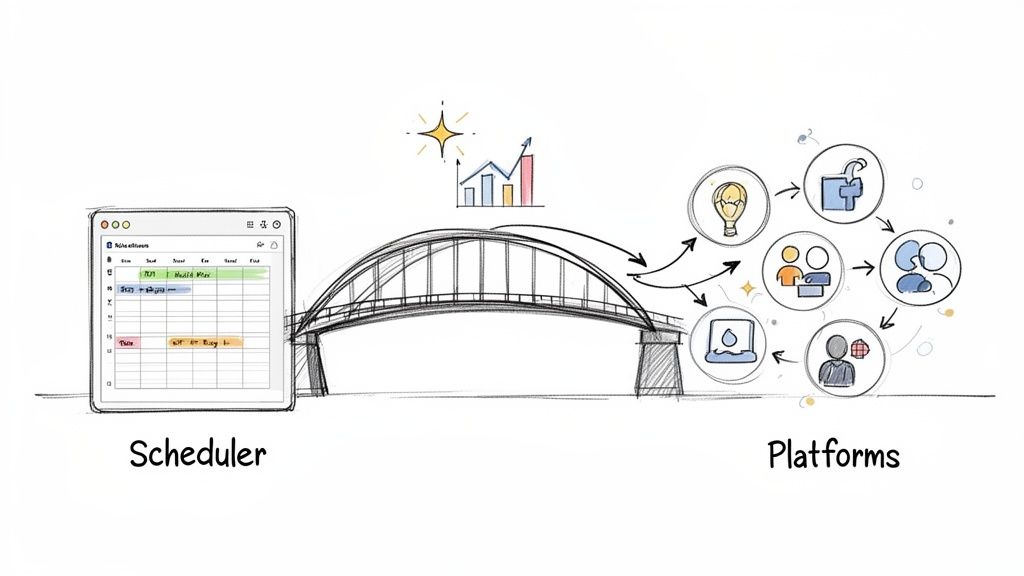
Let's use a simple analogy. Imagine you're at a restaurant, but the kitchen staff only speaks a different language. You can't just walk into the kitchen and tell them what you want. Instead, you give your order to a waiter, who translates it and delivers it to the chefs.
A social media API (which stands for Application Programming Interface) is that waiter. It’s a set of rules and instructions that allows different software programs to talk to each other clearly and efficiently.
So, when you schedule a post in an app, what's really happening is the app sends a request to the platform's API. It's basically saying, "Hey X, please publish this content for this user at 2 PM." The API checks the request, makes sure the app has permission, and tells the platform to make it happen. This whole exchange takes milliseconds, all behind the scenes.
The Engine Behind Modern Social Media Management
If APIs didn't exist, managing social media would be a nightmare of manual work. You’d be stuck copying and pasting every single post, logging in and out of each account, and trying to pull analytics together in a messy spreadsheet. APIs are what make modern social media management possible.
They eliminate all that friction, opening the door to a level of efficiency and strategy that just wasn't possible before. They are the foundation for almost every powerful feature you rely on in your favorite tools.
This automation is what lets creators and social media managers actually scale their work. Instead of getting bogged down in repetitive tasks, you can focus your energy on what really moves the needle: creating compelling content and building your community.
To give you a better sense of what this enables, let's break down the core functions of a social media API.
Core Functions Enabled by a Social Media API
| Function | What It Does | Benefit for Creators & Managers |
|---|---|---|
| Publishing & Scheduling | Allows an external app to post content, images, and videos on your behalf. | Plan your content calendar weeks or months in advance and post at the perfect time without being online. |
| Data Retrieval | Pulls public data (likes, comments, shares) and private analytics (reach, impressions). | Get a unified view of your performance across all platforms in one dashboard, making it easier to spot trends. |
| Content Syndication | Enables a "write-once, publish-everywhere" workflow across different networks. | Save hours of time by crafting a single message and having it automatically distributed to multiple channels. |
| Social Listening | Monitors mentions, keywords, and hashtags related to your brand or niche. | Stay on top of conversations, engage with your audience in real-time, and manage your online reputation. |
As you can see, an API turns a social media platform from a simple app into a powerful, programmable tool for growth.
Why APIs Are Crucial for Growth
The importance of this technology is hard to overstate. APIs are the invisible backbone of the entire creator economy, allowing the seamless flow of data that helps creators and businesses thrive. For instance, as privacy changes make ad tracking harder, tools like the Meta Conversions API for precise ad tracking offer a direct line to measure ad performance accurately.
An API isn't just a technical convenience; it's a strategic asset. By enabling automation and data integration, it transforms social media from a manual chore into an intelligent, scalable growth channel.
This connectivity is big business. The global API market, which underpins all these integrations, is projected to hit an incredible USD 420.313 billion by 2033. This massive number shows just how critical these connections have become. Tools built on a solid social media API aren't just a "nice-to-have"—they're essential for anyone serious about growing their presence online.
How to Speak the Language of APIs
Diving into social media APIs can feel like trying to learn a new language. The jargon seems intimidating at first, but it all starts to make sense once you grasp a few key ideas. You don't need a computer science degree for this—just the right way to think about it.
Let's use an analogy. Imagine your social media tool is a visitor trying to get into a high-security office building (the social media platform). The API is the front desk. To get anywhere, your visitor has to follow the building's rules.
Let’s translate these rules into plain English.
Authentication Is Your Digital Handshake
Before any app can post for you or check your analytics, it needs your permission. This is called authentication, and it’s the non-negotiable first step. It's the front desk clerk checking your visitor's ID and confirming they're on the approved list.
When you connect a tool like MicroPoster to your X or Bluesky account, you aren’t just handing over your password. Instead, you go through a secure process called OAuth. This generates a unique digital token, which is like a temporary keycard that gives the app specific permissions without ever revealing your actual login credentials.
It's a secure handshake. The platform verifies your identity, and you approve the app to perform only the actions you've allowed. Best of all, you can revoke this access at any time, just like deactivating a visitor's keycard.
Endpoints Are Specific Doors for Specific Tasks
Once authenticated, your app can't just roam the halls freely. It has to use the right door for the right task. In the API world, these doors are called endpoints.
An endpoint is simply a specific URL an app sends a request to when it wants to do something. Every social media platform has a whole directory of endpoints for different functions.
- To post a tweet: The app sends data to the "create tweet" endpoint.
- To get analytics: It requests information from the "metrics" endpoint.
- To reply to a comment: It uses another endpoint designed specifically for that interaction.
This design keeps everything tidy and secure. By splitting functions into different endpoints, platforms can manage the flow of requests safely and efficiently. Your scheduling tool knows exactly which door to knock on to publish a post and which one to visit later to see how it performed.
Think of endpoints like specialized departments. You wouldn't go to accounting to pick up a marketing brochure. An API works the same way, routing every request to the right place to get the job done.
Rate Limits Are the House Rules
Now, what if thousands of visitors all rushed the front desk at once? It would be pure chaos, grinding everything to a halt. To prevent this digital stampede, every API has rate limits—rules that cap how many requests an app can make in a given period.
For example, an API might let your app make 100 requests every 15 minutes. If your app tries to make more, the API will temporarily stop listening and send back an error. It's the digital equivalent of a bouncer saying, "Hey, you need to slow down."
These limits are crucial for keeping the platform stable and fair for everyone. A well-designed social media tool is built to respect these rate limits, pacing its requests to stay under the cap. This ensures your service runs without a hitch and explains why aggressive "mass follow" tools often get accounts suspended—they hammer the endpoints and break these fundamental rules.
Finally, there's one more clever piece of the puzzle: webhooks. Instead of your app constantly knocking on the API's door asking, "Anything new yet?", a webhook flips the script. It's like a doorbell. The social platform "rings" your app the instant something happens, like a new mention or a direct message. This is way more efficient and powers all those real-time notifications you rely on.
Comparing the Rules of Major Social Media APIs
Think of social media APIs as different countries with their own unique laws and customs. Once you’ve learned the basic language—authentication, endpoints, rate limits—you quickly realize that how you interact with one platform won't work for another.
These differences aren't just technical quirks; they reveal each platform's core philosophy on data, developers, and money. For a tool like MicroPoster that needs to speak to all of them, understanding these nuances is everything. It's the reason some features work flawlessly on one network but are limited on another.
X (Twitter): The Walled Garden
The X API has seen more drama than a season finale. What was once a relatively open sandbox for developers is now a heavily fortified, tiered system. Access is no longer a given; it's a product, and an expensive one at that.
- Free Tier: This is basically just for show. It’s so limited that it's only good for the simplest bots that post very rarely.
- Basic Tier: A step up, but it's a paid tier aimed at hobbyists. The rate limits are still tight, making it unsuitable for serious social media management.
- Pro & Enterprise Tiers: This is where the real functionality lives, but it comes with a shocking price tag. We're talking costs that can soar to $42,000 per month or even higher.
This pay-to-play model is a game-changer. It means that any tool offering deep X integration for things like high-frequency scheduling or detailed analytics has to absorb enormous costs. It's a classic walled garden, and access to the best parts requires a golden key.
Bluesky: Open by Design with the AT Protocol
Bluesky takes a completely different path. It’s built on the Authenticated Transfer Protocol (AT Protocol), which is less of a traditional API and more of a foundational blueprint for a decentralized web. The whole idea is to put users back in control of their data.
Instead of a central authority doling out access, the AT Protocol is designed for openness and creativity. Authentication is a great example: you generate unique "app passwords" for each tool. This clever method lets you grant access without ever handing over your main password, giving you pinpoint control over your security.
The philosophical divide is stark: X sells access to its API as a premium service. Bluesky offers the AT Protocol as an open standard to build a new kind of social ecosystem.
These core API terms are the building blocks for how any third-party app connects to a social platform.
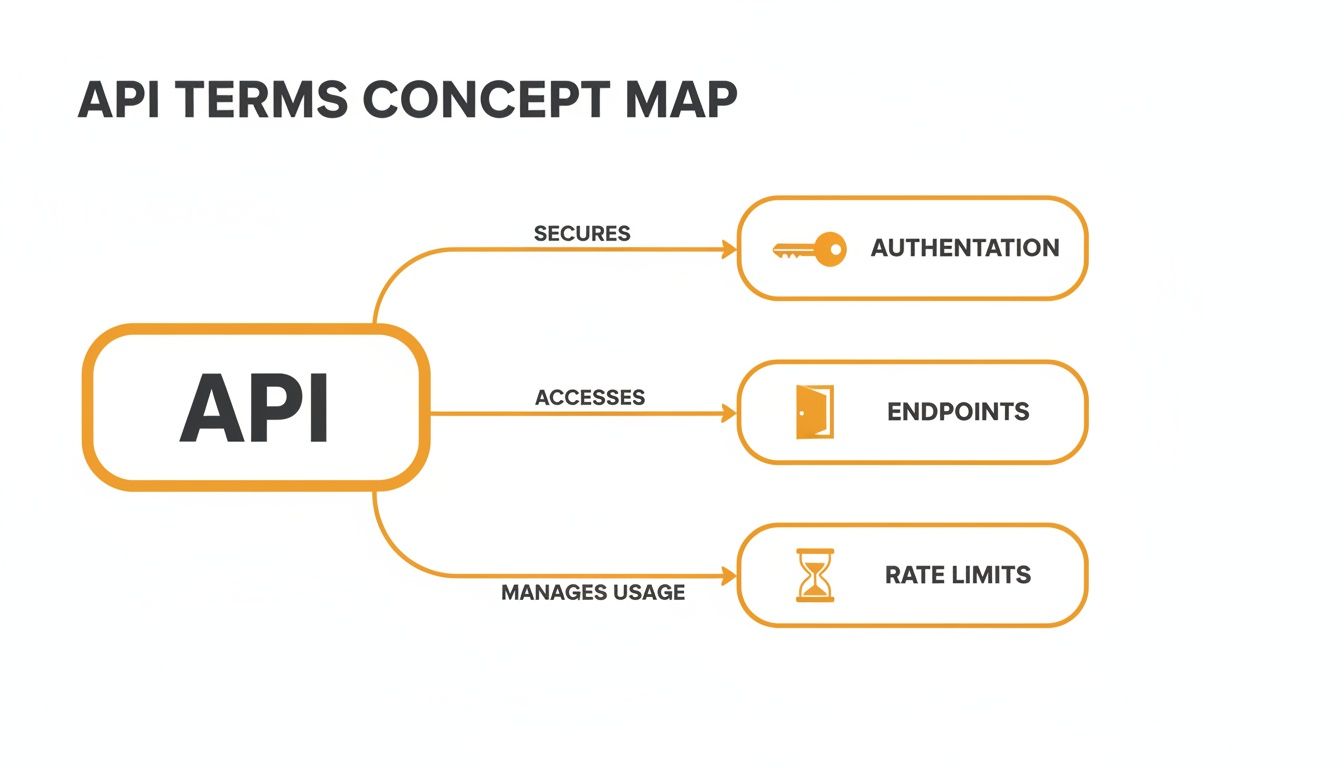
As the map shows, authentication is your key, endpoints are the doors, and rate limits are the house rules. Every platform sets these rules differently, shaping what's possible for developers and users.
Mastodon: The Federated Frontier
And then there's Mastodon, which operates on a completely different model. Because it's a federated network, there isn't just one "Mastodon API." There are thousands. Each server, or "instance," runs its own API.
While they all follow the same open and well-documented standard (which developers love), this creates a unique challenge. A tool can't just connect to "Mastodon"; it has to know which of the thousands of servers your account lives on.
Furthermore, performance isn't standardized. Rate limits, server speed, and uptime can vary wildly from one instance to the next, all depending on the server admin's resources. This freedom and decentralization are what make Mastodon special, but they also introduce a layer of complexity that centralized platforms just don't have.
Platform API Comparison X vs Bluesky vs Mastodon
Here’s a side-by-side look at how these three major platforms stack up. Their API differences have a direct impact on the features and reliability you experience in third-party tools.
| Feature | X (Twitter) API | Bluesky API (AT Protocol) | Mastodon API |
|---|---|---|---|
| Philosophy | Walled Garden: Centralized, commercial, and highly restrictive. | Open Standard: Decentralized, portable, and focused on user control. | Federated & Open: Decentralized, community-run, and based on open web standards. |
| Access & Cost | Tiered & Expensive: Very limited free access; full functionality costs thousands per month. | Open & Free: Currently free and open for developers to build on. | Open & Free: Free to use, but depends on the rules of the individual server (instance). |
| Authentication | OAuth 2.0: Standard but complex process where apps request permissions on your behalf. | App Passwords: Users generate unique, revokable passwords for each application. | OAuth 2.0: Standardized process, but authentication is done on a per-instance basis. |
| Developer Hurdle | High: Navigating tiers, high costs, and opaque rules can be difficult. | Low to Medium: The protocol is new, but the philosophy is very developer-friendly. | Low to Medium: The API is well-documented, but managing connections to thousands of servers is complex. |
| Key Limitation | The extreme cost is the biggest barrier to innovation and access. | Being a new protocol, the ecosystem and tooling are still maturing. | The federated nature means performance and rules can be inconsistent across different servers. |
Ultimately, the API is the invisible engine that powers your social media tools. Understanding these foundational differences explains why your favorite scheduler might offer robust analytics for one platform but only basic posting for another.
Powerful API Use Cases That Drive Real Growth
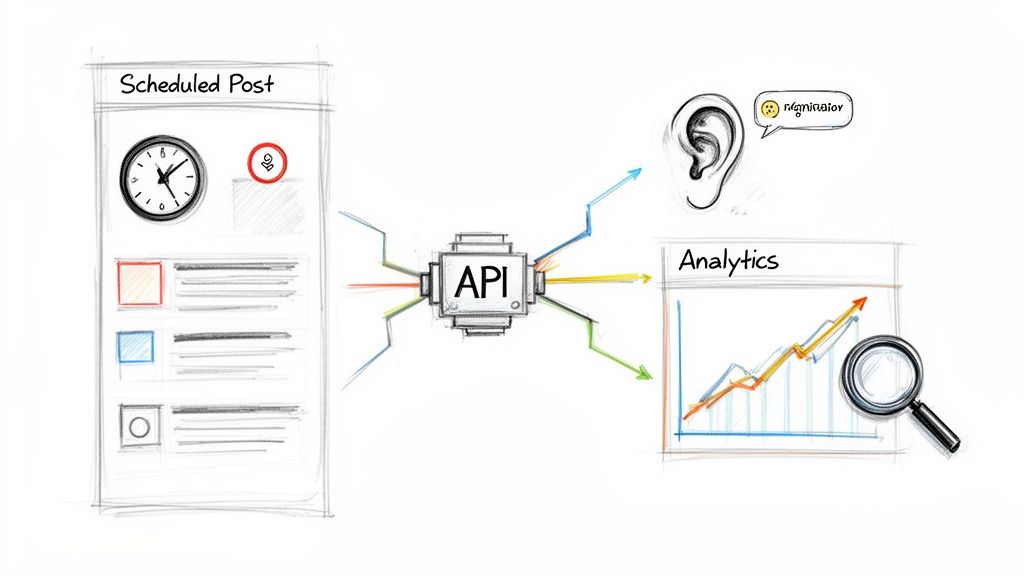
It’s one thing to understand the technical side of a social media API, but the real "aha!" moment comes when you see how it solves actual problems. These connections are the secret sauce that turns repetitive, manual tasks into smart, automated strategies for growth.
An API isn't just some tool for developers. For creators and social media managers, it becomes a strategic partner. It helps tackle the most common headaches: posting inconsistently, not truly understanding your audience, and having no idea what content is actually working.
Using an API is like flipping a switch. You go from guessing games to making decisions backed by real data, turning your social media presence from a simple broadcast channel into a sophisticated growth machine.
Automate Your Content Pipeline
The most immediate and game-changing use case is smarter content scheduling. Sure, basic schedulers are fine, but an API unlocks something far more powerful by plugging directly into your entire content workflow. This is exactly how tools like MicroPoster can help you build a content calendar that practically runs itself.
Think about it: you could write a month's worth of posts, schedule them for the absolute best times to reach your audience, and never even have to open X or Bluesky. This is how you solve the constant struggle of staying consistent—a key factor for building momentum and keeping your brand top of mind.
This kind of automation isn't just about saving a few hours. It’s about achieving strategic consistency. If you're looking to build a more hands-off content system, you might find our guide on how to automate social media posting helpful.
Uncover Rich Performance Data
How do you really know which posts are getting results? A social media API gives you a direct line to a goldmine of performance metrics, going way beyond simple likes and shares. It lets tools pull the raw data on everything from impressions and engagement rates to link clicks and follower growth.
This is what makes a unified analytics dashboard possible. Instead of trying to cobble together reports from a half-dozen different platforms, an API-powered tool centralizes everything. This means you can:
- Track Performance Over Time: See how your content strategy is affecting follower growth and engagement from one clean, unified view.
- Identify Top-Performing Content: Instantly see which posts, topics, and formats are hitting the mark with your audience across all your accounts.
- Measure True ROI: Finally connect your social media work to real business goals by tracking the metrics that actually matter, not just the vanity ones.
The demand for these kinds of analytics is exploding. Recent market analysis predicts the global social media analytics market will jump from USD 6.7 billion in 2025 to a staggering USD 15.9 billion by 2032. This growth is driven by the sheer volume of data from likes, comments, and shares that APIs unlock. Learn more about the social media analytics market growth on einpresswire.com.
Implement Smart Social Listening
As your brand grows, trying to keep up with every conversation becomes flat-out impossible. An API can automate this entire process through social listening, constantly scanning for mentions of your brand, specific keywords, or even your competitors.
By setting up automated monitoring, you can turn your social media accounts from a one-way megaphone into a two-way conversation hub, capturing feedback and opportunities in real time.
This is about more than just managing your reputation; it's about being proactive. When someone mentions your brand or a relevant topic, an API can trigger an instant alert, letting you jump right into the conversation. That kind of responsiveness is what builds a strong community and shows your audience you’re actually listening.
Staying Compliant with API Rules and Best Practices
Getting access to a social media API is a bit like being handed a key to the platform's back door. It unlocks incredible power for automating tasks and digging into data, but this access comes with a serious responsibility to use it correctly and ethically. Ignoring the rules isn't just poor form—it can get your app's access cut off and even put your social media accounts in jeopardy.
Think of each platform's developer policy as the terms of a partnership. When you connect a tool, you're shaking hands on an agreement to play by their rules. These guidelines exist to protect users, keep the platform stable, and create a fair playing field for everyone. Respecting them is non-negotiable for building a sustainable, long-term strategy.
Differentiating Smart Automation from Spam
There's a fine line between helpful automation and outright spam, and it's one you absolutely need to understand. Smart automation saves you time by taking care of repetitive work, like scheduling posts or pulling analytics. Spam, on the other hand, is all about aggressive, unsolicited, or low-quality actions that just make the platform a worse place for everyone.
Here’s how to make sure you stay on the right side of that line:
- Focus on Value: Your automation should help you deliver better, more consistent content. Scheduling posts with a tool like MicroPoster, for example, is a perfect way to ensure your audience gets valuable updates at the best possible times.
- Avoid Aggressive Follows: Steer clear of any tool that promises to blow up your audience through mass-following or unfollowing tactics. Platforms can spot this behavior a mile away and won't hesitate to suspend accounts for it.
- Prioritize Human Interaction: Use automation to clear your plate so you have more time for genuine engagement. The goal isn't to replace human connection but to create more opportunities for it.
Staying compliant means treating the social media API as a tool for efficiency, not a weapon for aggressive marketing. Your automation should always serve to improve the community experience, not exploit it.
Protecting Your Data and Privacy
When you authorize an application, you're granting it specific permissions to access your data and act on your behalf. This is built on trust, so it’s essential to be an informed partner in the process. Before connecting any new tool, always take a minute to review exactly what permissions it's asking for.
Does a post-scheduling app really need access to your direct messages? Almost certainly not. Stick to the principle of least privilege—only grant the absolute minimum access a tool needs to do its job. To get a better handle on how apps securely gain access, it's worth understanding the different REST API authentication methods.
This careful approach is more important than ever. Consider that the messaging application API market alone was valued at USD 46.75 billion in 2024 and is projected to hit USD 130.87 billion by 2030. This explosive growth shows just how valuable the data flowing through these connections is, which should be all the motivation you need to be vigilant about protecting yours.
By understanding the rules, using automation responsibly, and being mindful of the data you share, you establish yourself as a good citizen of the social media world. This not only protects your accounts but also ensures the powerful tools you rely on can keep working for years to come.
The Future of Social APIs and Intelligent Automation
The world of social media APIs is always on the move, and we're heading far beyond basic scheduling and analytics. Two massive trends are shaping the next wave of social media management: the growth of open, decentralized networks and the deep integration of artificial intelligence. Together, these are rewriting the rulebook for creators and developers.
Decentralized platforms like Bluesky and Mastodon are built on open protocols—the AT Protocol, for instance. This is a huge departure from the closed, permission-based APIs of the big legacy networks. These new systems are designed for collaboration right from the start, which means more creative freedom for developers and, importantly, more control for you over your own data.
This shift toward openness points to a future where your social connections aren't trapped on a single platform. For tools that hook into a social media api, this means fewer restrictions and the ability to build more powerful features without paying to enter a walled garden.
The Rise of AI Powered Social Tools
At the same time, artificial intelligence is completely changing how we interact with all the data flowing through these APIs. AI isn't just a buzzword anymore; it's the smarts behind a new generation of automation, turning raw numbers into an actual strategy. It’s all about working smarter, not just faster.
Instead of just queuing up posts, the next generation of tools will use API data to deliver some seriously sophisticated insights. Think of it as an assistant that doesn't just post for you, but tells you what to post and when to post it. That’s where we’re headed.
Here are a few key areas where this is already happening:
- Predictive Trend Analysis: AI algorithms can chew through mountains of API data to spot hot topics and viral trends before they explode, giving you a chance to get in on the action early.
- Smart Content Recommendations: By looking at your past performance and audience engagement, AI can suggest new content ideas, help you sharpen your messaging, and even write hooks that are statistically more likely to connect with your followers.
- Hyper-Personalized Engagement: Automation is finally moving past canned, generic replies. AI can help you draft personalized responses at scale, making your audience feel valued without burying your team in notifications.
The future of social media management isn't just about scheduling content—it's about creating an intelligent, self-optimizing growth engine. AI and open APIs are the two key components that will make this a reality.
Getting on board with tools that understand these changes is crucial. As things evolve, sticking with a simple scheduler will feel like bringing a horse and buggy to the Indy 500. The tools that will win are the ones that use API data intelligently. To see which platforms are ahead of the curve, take a look at this breakdown of powerful social media automation tools.
The combination of open protocols and AI is setting a new bar for what we should all expect from our tools. The focus is shifting from tedious manual work to high-level strategy, freeing you up to build a more meaningful and lasting online presence.
Common Questions About Social Media APIs
Diving into API-powered tools for the first time usually brings up a few questions. That's a good thing—it’s smart to understand the tech you're relying on to build your audience. Let's tackle some of the most common concerns creators and social media managers have.
Do I Need to Be a Coder to Use This?
Absolutely not. This is probably the biggest myth out there. While an API is a technical tool that developers build with, you don't need to write a single line of code to get all the benefits.
Think of it this way: you don’t need to be an auto mechanic to drive a car. A tool like MicroPoster is the user-friendly car, handling all the complex engine work (the API calls) under the hood. You just get to steer by creating great content and deciding where you want to go.
Is It Safe to Grant Account Access?
Yes, as long as you're using a trusted application that follows the right security protocols. Reputable tools will never ask for your password. Instead, they use a secure standard called OAuth, which is basically a digital valet key.
When you connect your X or Bluesky account, the app sends you over to the social platform itself to approve the connection. You grant specific permissions—like "permission to post"—without ever handing over your login details. This process keeps you in complete control, and you can revoke an app's access anytime you want, directly from your social network's settings.
Granting API access via OAuth is the industry standard for security. It's a secure handshake that gives a tool permission to perform specific tasks on your behalf without ever knowing your password.
Why Do Some Features Cost More?
Ever wonder why certain advanced features or access to one platform costs more than another? It often comes down to what the social networks charge for API access. For instance, the X API has become famously expensive, with developers facing costs that can run into thousands of dollars per month for comprehensive access.
Those platform-side fees inevitably get passed on. When a tool like MicroPoster pays a premium just to connect to an API, that investment has to be reflected in the subscription price for the features that depend on it. It’s less about the tool's own operational costs and more about the price of admission set by the social network itself.
How Can I Automate Without Getting Banned?
This is a crucial one. The key is to draw a clear line between smart automation and outright spam. A social media API is a powerful tool, and using it responsibly is the only way to protect your account.
Smart automation is all about efficiency and consistency, not faking engagement or being annoying.
- Good Automation: Scheduling your content in advance, automatically generating performance reports, and cross-posting your updates to different platforms. These actions add value and save you a ton of time.
- Bad Automation: Using bots to mass-follow accounts, sending unsolicited DMs, or spamming repetitive, low-effort comments. These tactics violate platform rules and are a fast track to getting your account suspended.
As long as you stick to automation that genuinely improves your content strategy, you can safely use API-powered tools to build a more effective and efficient presence online.
Ready to put social media APIs to work without any of the technical headaches? MicroPoster gives you the advanced tools you need to schedule, analyze, and grow your audience across X, Bluesky, and Mastodon. Start your free seven-day trial today!