
A solid content strategy for social media is your roadmap. It’s the intentional plan that decides what you post, where you post it, and why you’re even bothering in the first place. This moves you from just throwing content at the wall to see what sticks, to a deliberate system where every post works toward a specific business goal.
Building a Foundation Beyond Follower Counts
Look, anyone can chase followers or rack up likes. But those are often just vanity metrics. A winning social media presence is built on a foundation of real business objectives that actually move the needle.
This initial planning phase is, without a doubt, the most important part of your entire strategy. Skip this, and you're just posting into the void. A strategic approach, on the other hand, gives every single post, thread, and video a clear purpose.
Define Your Primary Business Goals
Before you even dream up a single tweet, you need to know what success looks like. What do you really want social media to do for your business? Vague goals like "get more engagement" won't cut it. You need to get specific.
Think about what truly matters to your bottom line. Usually, it boils down to one of these:
- Generate Qualified Leads: Is the goal to fill your pipeline? Your content should push people to sign up for a newsletter, download a guide, or book a demo. Here, you're tracking lead quality and conversion rates, not just clicks.
- Drive E-commerce Sales: If you're selling products, your content needs to be the salesperson. Think product showcases, customer reviews, and direct links to purchase. The only metric that matters is how much revenue you can trace back to social.
- Build Brand Authority and Trust: Do you want to be the go-to expert in your niche? Then your content needs to prove it. Share valuable insights, offer unique perspectives, and position your brand as a trusted resource. You can measure this through things like brand sentiment and share of voice.
- Foster a Community of Brand Advocates: Maybe your goal is to build a loyal tribe. This means creating a space for conversation, sparking user-generated content, and hosting things like live Q&As. Success here looks like high engagement and people talking about your brand unprompted.
The biggest mistake I see is people trying to do everything at once. Pick one or two primary goals for the next quarter. That focus will make your content sharper and your message impossible to ignore.
This flow is simple but incredibly powerful: your goals inform your strategy, which then helps you zero in on exactly who you need to be talking to.
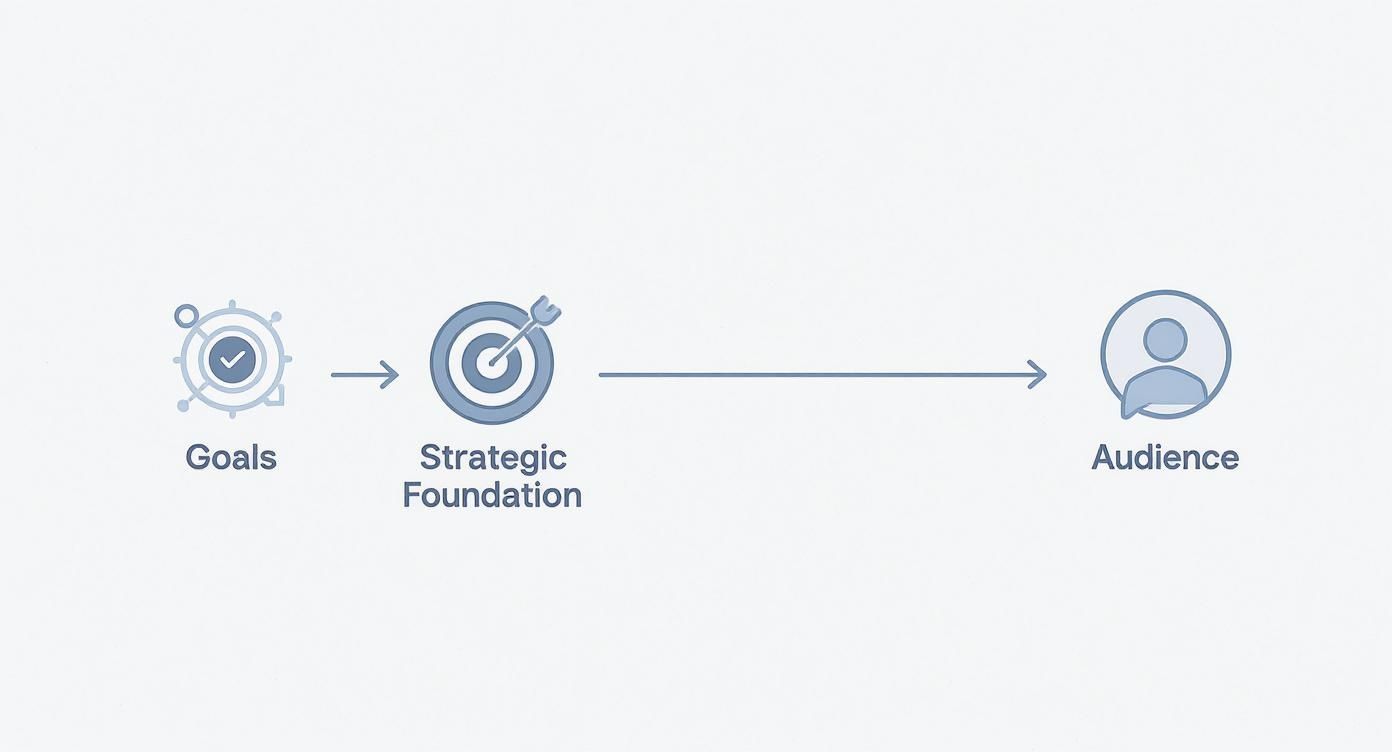
Defining your goals first is what gives you the clarity to truly understand your audience and build a strategy that works.
Craft Detailed Audience Personas
Once you've figured out your "why," it's time to define your "who." And knowing your audience goes way deeper than just basic demographics like age and location. A truly useful audience persona gets into the head of your ideal customer—their motivations, their biggest headaches, and how they spend their time online.
To do this right, you have to get out of your own head and dig into real data. Look at your existing customer analytics, send out a few surveys, and just listen to the conversations happening online.
Ask yourself some pointed questions:
- What are the real-world challenges—professional or personal—that my brand actually solves?
- Where do they hang out online? Which platforms are for work and which are for play?
- What kind of content actually gets them to stop scrolling? Are they into short videos, deep-dive threads, or quick, actionable tips?
- Who are the industry voices they already listen to and trust?
Let’s say you run a SaaS company that targets startup founders. You might find they’re all over X (formerly Twitter) and LinkedIn during the workday, looking for quick, no-fluff business advice. They want data-backed insights and stories from other founders, not generic memes. That kind of clarity is the difference between being ignored and becoming an essential part of their daily routine.
Establishing Your Core Content Pillars
Okay, so you know who you're talking to and why. Now for the fun part: deciding what you're going to talk about. This is where your content pillars come in.
Think of these as the 3-5 core themes that will become the signature topics for your brand. They're the foundation of your entire content strategy, guiding every single tweet, thread, and post you create. Pillars are what stop you from frantically scrambling for ideas each morning. They turn a random collection of posts into a cohesive, valuable library for your audience.
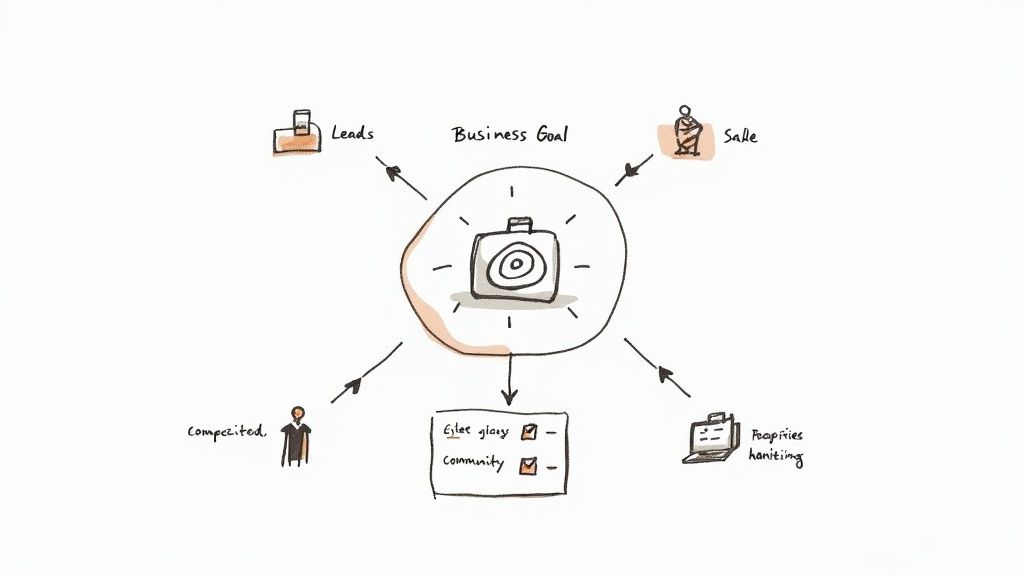
The best content pillars live at the intersection of three things: what your audience desperately needs, what your brand knows inside and out, and what makes you different from everyone else.
Brainstorming Your Signature Topics
Finding your pillars isn't about pulling ideas out of thin air. It’s a strategic hunt for the sweet spot where your expertise meets your audience's needs. Start by digging into these questions to find the overlap.
1. What are your audience's biggest headaches and obsessions? This is where your audience research pays off. What questions do they ask over and over? What keeps them up at night? Use social listening tools, lurk in relevant Reddit communities, and comb through customer reviews to spot the recurring themes.
2. What is your unique area of genius? What does your team or company know better than almost anyone else? This goes way beyond your product features. Think about the collective knowledge you have. A coffee brand’s expertise isn't just "making coffee"—it might be "sustainable sourcing methods," "the art of home brewing," or "the science behind the perfect espresso shot." That's where the good stuff is.
3. What’s your brand’s personality? How do you want to come across? Are you the witty, slightly irreverent friend or the wise, authoritative mentor? Your brand voice should be baked into your pillars. It’s how two companies in the exact same industry can discuss the same topics and sound completely different.
Let's walk through an example. Imagine you run a project management software company that serves freelancers. Your brainstorming might look like this:
- Audience Pains: Juggling too many clients, dreaded scope creep, feast-or-famine income cycles, and figuring out what to charge.
- Brand Expertise: Building efficient workflows, client management best practices, automation tips, and financial planning for solopreneurs.
- Brand Personality: Empowering, super practical, and maybe a little nerdy.
See the overlap? That's where your pillars are born.
From Ideas to Actionable Pillars
Once you’ve got a list of raw ideas, it's time to sharpen them into clear, actionable pillars. For our project management software example, we could refine the brainstormed ideas into this:
- Pillar 1: Client Mastery. All about communication, setting boundaries, and managing client expectations like a pro.
- Pillar 2: Productivity Systems. Actionable advice on workflows, tool stacks, and time management hacks that actually work.
- Pillar 3: The Business of Freelancing. Concrete tips on pricing, invoicing, and mastering cash flow.
With these three pillars, your content now has a clear direction. Brainstorming is no longer a chore; you just have to ask, "What's a great tip we can share about Client Mastery today?" This structure makes your content predictable in the best way possible—your audience knows exactly what kind of value they'll get from following you.
A huge mistake I see people make is choosing pillars that are way too broad, like "Marketing" or "Business." Get specific. "B2B Lead Generation on LinkedIn" is a pillar. "Marketing" is a black hole. The more focused you are, the faster you'll build authority.
This focused approach is everything. It ensures every thread, carousel, and article is intentionally building your reputation in a very specific niche.
Mapping Content Formats to Your Pillars
The real beauty of content pillars is how flexible they are. You can break down each pillar into a dozen different content formats, which keeps your feed interesting while you stay laser-focused on your core topics.
Your content architecture might look something like this:
| Content Pillar | X (Twitter) & Threads | Instagram & TikTok | |
|---|---|---|---|
| Client Mastery | A thread on scripts for handling difficult clients | A short video role-playing a scope creep conversation | An in-depth article on writing the perfect proposal |
| Productivity Systems | A quick tip on a keyboard shortcut for your app | A Reel showing a "day in the life" workflow | A carousel post on the top 5 automation mistakes |
| The Business of Freelancing | A poll asking followers about their biggest pricing fear | UGC campaign of users sharing their home office setups | A deep-dive analysis of industry pricing trends |
This system stops you from just repeating yourself. Instead, you're exploring your core themes from different angles and packaging the information perfectly for each platform. It’s a sustainable way to create a ton of high-value content that consistently hammers home what your brand is all about.
Building a Sustainable Content Engine
Let's be honest. The constant pressure to churn out fresh social media content is a direct path to burnout. Scrambling for a new idea every single day isn't a strategy—it's just a frantic scramble that results in inconsistent, low-impact posts.
If you want to build a real presence, you need a system. It's time to stop being a content creator and start thinking like a content architect. Instead of building a new sandcastle every day only to watch the tide wash it away, you’re going to build one magnificent fortress. Then, you'll spend your time finding countless ways to show off its different rooms, views, and features.
The idea is simple but powerful: create once, distribute many.
The "Create Once, Distribute Many" Workflow
This approach completely flips the script on content creation. You pour your energy into one substantial, high-value piece of content—what we'll call a "pillar asset." This is your big rock, the foundation packed with rich information, data, and stories.
Pillar assets aren't your average social media updates. They're deep, genuinely helpful resources for your audience.
- A comprehensive webinar that solves a major customer headache.
- A detailed customer case study filled with hard data and a great story.
- An original research report that uncovers unique industry insights.
- A long-form video tutorial walking users through a tricky process.
Once you’ve built this pillar, the real work—and the real magic—begins. You strategically "atomize" it, breaking it down into dozens of smaller, platform-native social media posts. This isn't just about copying and pasting chunks of text. It's about extracting the best parts and reframing them for each specific audience.
The entire point is to squeeze every last drop of value out of your creative efforts. That one hour you spend on a killer pillar asset can fuel your content calendar for weeks. You'll maintain a high-impact presence without the daily dread of starting from a blank page.
This isn't just a "nice-to-have" strategy anymore; it's a necessity. The sheer volume of content out there is staggering. The average person uses 6.83 different social networks every month and spends over two hours a day scrolling. To even get noticed, brands have to be prolific.
In fact, many high-performing brands push out 48 to 72 posts per week across all their platforms. The only way to hit numbers like that without an army of writers is through smart repurposing. You can find more of the data behind these trends in these social media statistics on sproucial.com.
From Pillar Asset to Platform-Specific Posts
Let's walk through a real-world example. Imagine your pillar asset is a detailed customer case study for your project management software. You interviewed a client who boosted their team's productivity by a whopping 40% with your tool.
A rookie move would be to just post a link to the case study with a generic "check it out!" caption. The pro move is to atomize it.
Here’s what that actually looks like:
1. Mine for Data and Quotes for X (Twitter) & Threads
Pull out the most surprising stats and memorable client quotes. Each one can be its own punchy post or a short thread.
- Tweet 1 (Statistic): "How [Client Name] used our tool to slash project completion time by 40%. The secret? They stopped having meetings about meetings. A thread..."
- Tweet 2 (Quote): " 'It was the first time our team felt ahead of schedule instead of constantly behind.' - [Client Name], CEO. This is what we build for."
2. Design Visuals for Instagram & Pinterest
Turn the case study’s key takeaways into scroll-stopping visual content.
- Carousel Post: Create a 5-slide Instagram carousel showing the "before and after" workflow. Each slide can highlight a different metric or feature.
- Infographic: Design a tall, shareable infographic for Pinterest that visually charts the client's journey and the impressive results.
- Reel/Short: Edit a 30-second video clip of the client giving a powerful testimonial, using text overlays to pop the key data points on screen.
3. Craft Professional Content for LinkedIn
Adapt the story for a business-minded audience, focusing on the strategic impact and ROI.
- LinkedIn Article: Write a summary of the case study but frame it as a "how-to" guide. A title like "3 Workflow Bottlenecks We Eliminated to Boost Productivity by 40%" works perfectly.
- Text & Image Post: Share a concise post summarizing the core challenge, the solution you provided, and the final result. Pair it with a professional graphic or a photo of the client's team.
This "create once, distribute many" model transforms your content strategy for social media from a daily grind into a sustainable engine. Every post is rooted in real value, tied to your core pillars, and intelligently designed to shine on its specific platform. You finally stop working harder and start working a whole lot smarter.
Orchestrating Your Strategy with an Editorial Calendar
A brilliant strategy without a solid plan is just a good idea. To really bring your content engine to life, you need an operational hub—a central place that turns your plans into a predictable, high-quality stream of content. This is where an editorial calendar becomes your most valuable asset.
This isn't just about plugging post ideas into a spreadsheet. A truly effective calendar acts as the command center for your entire social media operation. It gives you the clarity to execute your strategy flawlessly and, most importantly, helps you avoid that dreaded last-minute content panic.

Think of it as the single source of truth that keeps your team aligned, your messaging consistent, and your workflow smooth. Without one, even the best ideas tend to get lost in the daily chaos.
Designing a Calendar That Actually Works
To make your calendar more than just a glorified to-do list, it needs to capture the essential details for every single piece of content. This is what unlocks seamless collaboration and makes planning ahead possible. Whether you use a simple spreadsheet, a project management tool like Asana, or a visual workspace like Notion, the core components you need to track are the same.
Your calendar is a living document, and its value comes from the information you put into it. Here's a breakdown of the fields that I've found to be non-negotiable for building a calendar that truly supports a content strategy.
Key Components for Your Editorial Calendar
| Component | Description | Example |
|---|---|---|
| Publish Date & Time | The exact moment content goes live, ideally timed for peak audience engagement. | Oct 26, 2024, 9:15 AM EST |
| Platform(s) | Where the content will be published. Be specific if copy needs to be tweaked. | X, Threads, LinkedIn |
| Content Pillar | The core theme the post connects back to, ensuring a balanced content mix. | "Team Productivity" |
| Content Format | The type of post. This helps you visualize variety and plan asset creation. | Thread (5 posts) |
| Post Copy | The complete, finalized text, ready for publishing. | "Struggling with team alignment? Here are 3 non-obvious ways to fix it..." |
| Visual Asset | A direct link to the final image, graphic, or video file. | [Link to a GIF in Google Drive] |
| Status | A simple tracker to see where each piece of content is in the workflow. | Idea > In Progress > For Review > Scheduled |
| UTM Parameters | Custom tracking links to measure traffic and conversions from each post. | ?utm_source=linkedin&utm_medium=social... |
This structured approach removes all the guesswork. Everyone on the team knows what’s coming up, what’s needed from them, and when, which keeps the whole operation running like clockwork.
Choosing Your Command Center
Honestly, the specific tool you choose is less important than the system you build around it. The goal is a collaborative space that fits how your team works, whether you're a solo creator or a growing marketing department.
For instance, a freelance creator might love using a visual Kanban board in Notion, dragging content cards from an "Ideas" column all the way to "Published." On the other hand, a larger team might prefer the task-driven structure of Asana, where copywriters and designers are assigned specific due dates for each part of a post.
The best tool is the one your team will actually use consistently. Don't overcomplicate it. Start with a spreadsheet if you need to; the discipline of planning is more important than the software you use to do it.
Many teams also rely on platforms that combine planning and publishing. If you want to take another step out of the process, exploring different scheduling tools for social media can reveal options that integrate calendar management directly with posting and analytics. This can save a ton of time.
The Power of Planning Ahead
A well-maintained calendar gives you something incredibly valuable: foresight. It allows you to move from being reactive to proactive, planning major campaigns months in advance and coordinating everything with precision.
Imagine a B2B SaaS company prepping a major feature launch. Their editorial calendar lets them map out a multi-week campaign with complete clarity:
- Teaser Phase (2 weeks out): Posts hinting at a new solution to a common customer pain point, all tagged under their "Productivity Systems" pillar.
- Announcement Week: A coordinated blitz of content hits all at once—a detailed LinkedIn article, a quick demo video on X, and a carousel on Threads showcasing the new UI.
- Post-Launch Support (2 weeks after): They follow up with a series of tips, tutorials, and customer testimonials that show the feature in action.
You simply can't orchestrate this level of detail when you're stuck in a reactive, day-to-day posting cycle. Your calendar is what provides the structure needed to turn ambitious goals into tangible, daily actions that drive real results.
Measuring What Matters to Refine Your Approach
A content strategy shouldn't be a document you create once and file away. It needs to be a living, breathing playbook. The final, and arguably most important, piece of the puzzle is measurement and iteration. This is where you close the loop, turning raw performance data into smart insights that make your next round of content even better.
Without this, you're just throwing content at the wall and hoping something sticks. A solid measurement process is what separates the content that works from the content that wastes your time, ensuring your efforts actually build on each other.

This constant cycle of review and refinement is what separates a stagnant strategy from one that delivers real, compounding results.
Focusing on Metrics That Move the Needle
It's way too easy to get mesmerized by vanity metrics. Follower counts and total impressions might give you a nice ego boost, but they tell you almost nothing about how your content is impacting your actual business goals.
Instead, you need to circle back to the objectives you set from the very beginning. The only metrics worth tracking are the ones that directly reflect whether you’re hitting those targets.
Here’s a quick way to think about it:
- Goal is Lead Generation? Forget impressions. You care about Click-Through Rate (CTR) on your links and the Conversion Rate on your landing pages. Are people actually taking the action you want them to?
- Goal is Brand Authority? You need to be tracking things like Share of Voice (how often you’re mentioned vs. your competitors) and overall Audience Sentiment. People talking about you in a positive light is a clear sign you’re becoming a trusted voice.
- Goal is Community Building? Look at your Engagement Rate (likes, comments, shares per follower) and the amount of User-Generated Content (UGC) you’re inspiring. These are signs of an active, invested audience.
The real gold is often found by combining metrics. A post might have a low reach but an off-the-charts CTR. That’s a massive win! It means you created something incredibly relevant for a specific niche within your audience.
This keeps you focused on what matters: business outcomes, not just empty visibility.
Using Analytics to Understand the Why
Data is just a pile of numbers until you start asking good questions. The real magic of analytics is digging in to find the story behind your best—and worst—performing content. This means getting your hands dirty in both the platform's native analytics and any third-party tools you use.
Don't just stop at what performed well; you have to dissect it. Why did that one thread get so much traction while another one on a similar topic completely flopped?
- Was it the hook? Did you lead with a controversial take or an irresistible question?
- Was it the format? Maybe a visual carousel breaking down a complex idea resonated more than a simple text post.
- Was it the timing? Did you tap into a conversation that was already trending?
Let’s say you're a software company. You might notice your technical "how-to" threads get steady engagement, but a post where the founder shares a personal story about a business failure gets 3x the shares. The insight isn't just "personal stories work." It's that your audience craves authenticity and vulnerability right alongside the practical advice.
Creating Your Content Feedback Loop
This analysis is where everything comes together. You take these little discoveries and feed them right back into your content strategy, creating a powerful cycle of continuous improvement.
Your feedback loop should guide everything from what you talk about to when you post. It can be a simple, repeatable system:
- Monthly Performance Review: Set aside time each month to pull your top three and bottom three posts, based on the metrics you care about. Don't just glance at the dashboard; actually document them.
- Hunt for Commonalities: Look for patterns. Do all your winning posts share a certain tone? Are your worst performers all overly promotional? Be a detective.
- Form a Hypothesis: Based on what you found, create a simple "more of/less of" list. For instance: "More content that challenges a common industry myth" and "Less content that just announces a new feature."
- Refine and Test: Tweak your upcoming content calendar based on your new hypothesis. If you think stronger hooks are the answer, spend a week experimenting with different opening lines and see if it actually moves the needle on engagement.
For an even deeper analysis, a specialized tool can help. You can run your content through our free post analyzer tool to get an objective look at things like hook strength and readability. This iterative approach is what keeps your content strategy for social media from going stale. It becomes a learning machine, getting smarter and more effective with every single post.
Common Questions About Social Media Content Strategy
Even with a solid game plan, you're bound to run into questions once you start executing your content strategy for social media. The day-to-day decisions can be tricky, so let's walk through some of the most common hurdles I see and how to clear them with practical advice.
Think of these as the real-world sticking points that can derail an otherwise great strategy. Getting ahead of them now will save you a ton of guesswork down the road.
How Often Should I Really Be Posting?
This is the classic question, and unfortunately, there's no single magic number. The right answer is always a balancing act between what a platform's algorithm seems to like and what your team can realistically produce without burning out or letting quality slip.
Some platforms are built for a faster pace. On X (formerly Twitter), for example, the conversation moves so quickly that multiple posts a day often makes sense. But on a platform like LinkedIn, where people expect more substance, you'll likely see better results with just 3-5 high-impact posts a week. It’s always quality over quantity.
The best approach? Start with a schedule you know you can stick to. Consistency beats sporadic, high-volume posting every single time. Then, watch your analytics. If you see engagement tank after your second post of the day, the data is telling you to pull back.
Use that feedback loop to find your brand’s own unique posting rhythm.
What Are the Best Ways to Generate Fresh Content Ideas?
When you feel like you've hit a creative wall, the solution isn't to stare harder at a blank document—it's to start listening. Your audience, your competitors, and even your own team are giving you clues all the time.
Instead of just brainstorming in a vacuum, tap into these goldmines:
- Social Listening: Keep a close eye on industry hashtags and discussions. What are people confused about? What topics get them fired up? Tools like SparkToro can be invaluable for figuring out what your audience is talking about right now.
- Competitor Analysis: See what's working for your competitors, but don't just copy them. Look for the gaps. What questions are they not answering? Where can you offer a deeper, more valuable take?
- Direct Audience Questions: This is the easiest one. Use interactive features like Instagram’s "Questions" sticker or run a quick poll on X. Asking your followers what they want to learn is the most direct way to create content you know has a built-in audience.
- Talk to Your Sales Team: Your sales and customer service folks are on the front lines every day. Ask them for the top five questions they get from prospects and customers. Each one of those questions is a fantastic, problem-solving content idea just waiting to be made.
How Do I Adapt Content for Different Platforms?
The single biggest mistake you can make is copy-pasting the exact same post everywhere. Every network has its own culture and context. To actually connect with people, you need to tailor your message to fit the platform. A single idea should wear different outfits for different parties.
Think about why someone is on that app at that moment. Are they looking for a quick laugh (TikTok), professional insights (LinkedIn), or visual inspiration (Instagram)? Your content has to match that user's mindset.
Let’s say you have a great customer case study. Here’s how you could adapt it:
- On LinkedIn, it might be a formal article titled, "How We Helped [Client] Overcome [Problem] to Achieve [Result]."
- For Instagram, you could turn it into a slick carousel post highlighting the top 3 data points with bold graphics.
- On TikTok, it could be a 30-second clip featuring the client's most enthusiastic testimonial quote.
Always tweak your tone, visuals, captions, and calls to action. This extra bit of effort is what makes your content feel like it belongs, rather than showing up as an unwelcome ad.
Ready to stop guessing and start executing a smarter microblogging strategy? MicroPoster provides the unified content studio and automation tools you need to publish smarter, faster, and more strategically across X, Bluesky, and Mastodon. Grow your audience with a tool built for real conversations.