social media content ideas
12 Essential Social Media Content Ideas to Go Viral in 2026
Struggling for content? Here are 12 powerful social media content ideas with examples and templates for X, Bluesky, and Mastodon you can use today.

In the fast-paced world of microblogging, the difference between a post that vanishes and one that goes viral comes down to strategy, not luck. Standard advice like 'be authentic' falls short when you're staring at a blank content calendar, searching for effective social media content ideas that actually connect with an audience. This guide cuts through the noise and provides a direct, actionable playbook for creating posts that resonate on text-centric platforms.
We've compiled 12 battle-tested content frameworks, each a complete blueprint with hooks, formats, and real-world examples from top creators. These aren't just concepts; they are practical templates designed specifically for the unique dynamics of X, Bluesky, and Mastodon. You'll find everything from structured educational threads and data-driven insights to polls that spark immediate engagement and personal stories that build genuine community.
This is more than a simple list. It's a comprehensive toolkit for independent creators, small businesses, and social media managers aiming for sustained organic growth. Whether your goal is to build authority, drive meaningful conversation, or simply stop wondering what to post next, this resource provides the strategic firepower you need. Dive in to discover a wealth of social media content ideas that will help you craft posts that captivate your audience, expand your reach, and achieve your growth objectives. We will explore how to implement these strategies to ensure your content consistently performs.
1. Threading/Long-Form Narratives
Threading is a powerful technique for sharing deep insights or telling a cohesive story across a sequence of connected posts. By breaking down complex topics into digestible chunks, you can provide substantial value that goes far beyond a single post's character limit. This format is particularly effective on platforms like X, where the native threading feature is highly visible and encourages sustained engagement from your audience.
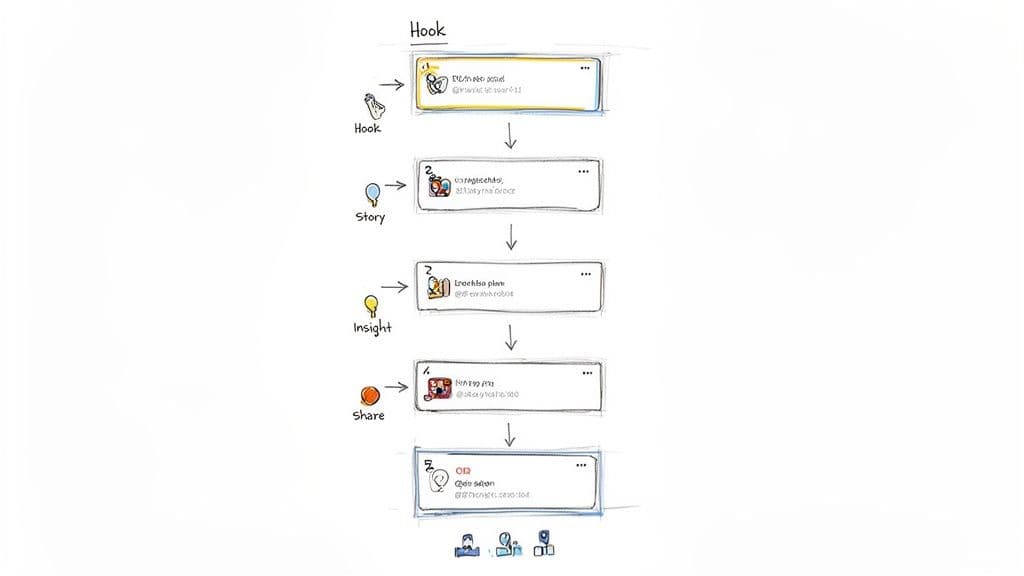
This method transforms a simple update into a mini-essay, making it one of the most versatile social media content ideas for establishing authority. Influential accounts like Naval Ravikant (@naval) and Tim Ferriss (@tferriss) have popularized this format by deconstructing everything from startup philosophy to accelerated learning.
How to Implement Threads
To create an effective thread, start with an aggressive hook in your first post to grab attention. Number each subsequent post (e.g., 1/10, 2/10) to guide readers and maintain clarity. Keep individual posts scannable, using one or two key ideas per post.
- Hook: Start with a bold claim, a surprising statistic, or a question.
- Body: Develop your narrative with data, anecdotes, and clear explanations.
- Conclusion: End with a strong summary and a call-to-action (CTA), such as asking followers to retweet the first post or share their thoughts.
By mastering threads, you can deliver high-value, long-form content that captivates your audience and drives significant growth. To learn more about mastering post length for maximum impact, explore this comprehensive guide on how long your posts can be on different platforms.
2. Polls & Interactive Questions
Polls are a high-impact, low-friction tool for sparking audience participation and gathering valuable feedback. By presenting binary or multiple-choice questions, you invite immediate engagement, which can boost your visibility with platform algorithms. This format is perfect for generating conversation, understanding audience preferences, and making your followers feel involved in your brand's journey.

This method provides a direct line to your community's thoughts, making it one of the most efficient social media content ideas for market research and engagement. The native poll feature on X is highly visible, and accounts like Product Hunt and various startup founders regularly use it to test hypotheses and guide decisions. This approach transforms passive scrolling into active participation.
How to Implement Polls
To create an effective poll, frame your question with compelling context that encourages a response. Avoid leading questions and aim for options that are reasonably balanced. The goal is to start a genuine conversation, not just to validate your own opinion.
- Frame the Question: Provide brief context above the poll. Why are you asking? What will the results influence?
- Balance the Options: Create choices that represent distinct, viable viewpoints to encourage authentic voting.
- Follow Up: Once the poll closes, share the results in a quoted post. Analyze the outcome and ask follow-up questions in the replies to drive deeper discussion.
By strategically using polls, you can gather crucial data, increase engagement rates, and build a stronger community. To simplify this process, tools like MicroPoster can help you schedule and analyze polls across multiple platforms for maximum impact.
3. Hot Takes & Contrarian Opinions
Sharing a bold, contrarian opinion is a fast track to sparking conversation and positioning yourself as a thought leader. Hot takes challenge conventional wisdom within your niche, forcing your audience to stop scrolling and consider a new perspective. When done correctly, this strategy generates high engagement through debates, agreements, and shares, making it one of the most dynamic social media content ideas available.
This method goes beyond simple provocation; it's about presenting a well-reasoned argument that pushes boundaries. Figures like Naval Ravikant (@naval) and Nassim Taleb have built massive followings by dissecting complex topics with unconventional viewpoints, from wealth creation to risk management, proving that a strong, informed opinion can captivate an audience.
How to Implement Hot Takes
The key is to be bold but credible. Your goal is to start a productive debate, not an unproductive argument. Start by framing your post clearly to signal your intent, using phrases like "Unpopular opinion:" or "Hot take:" to set the stage.
- Foundation: Base your take on genuine expertise, personal experience, or compelling data. A random inflammatory statement will backfire.
- Framing: Introduce your opinion with a hook that invites discussion, such as "Am I crazy, or is [common belief] completely wrong?"
- Engagement: Actively participate in the comments. Respond thoughtfully to disagreement and acknowledge valid counterpoints to show you're fostering a genuine conversation.
- Follow-Up: If your take generates significant traction, expand on it with a follow-up thread providing the data or reasoning behind your initial post.
By mastering the art of the hot take, you can cut through the noise, attract a highly engaged following, and establish yourself as a voice worth listening to.
4. Educational Breakdowns & How-Tos
Educational breakdowns offer immense value by teaching your audience a specific skill, framework, or concept in a clear, step-by-step format. These posts position you as an expert and build a loyal following by providing genuine utility, transforming your feed into a go-to resource. This format is one of the most effective social media content ideas for cultivating trust and authority.
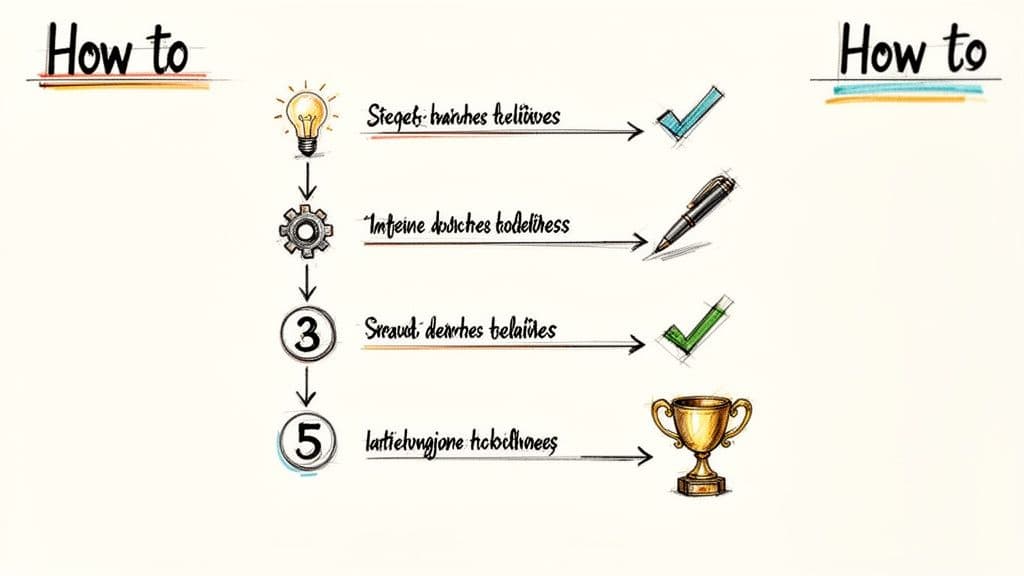
This approach has been successfully used by thought leaders like David Perell, who breaks down writing frameworks, and Lenny Rachitsky, who shares actionable product management lessons. By deconstructing complex topics into digestible tutorials, they provide immediate value that keeps their audience returning for more.
How to Implement Educational Breakdowns
To create a compelling how-to guide, focus on a tangible outcome your audience desires. Break down the process into a short, numbered sequence that is easy to follow. Each step should be clear, concise, and actionable, guiding the reader from problem to solution.
- Lead with the Benefit: Start your post by highlighting the end result or a key benefit, not just the topic title. For example, instead of "How to Write Better," try "Write content that gets shared every time. Here's how:"
- Simplify Complex Ideas: Limit your breakdown to a maximum of 5-7 simple, digestible steps.
- Show, Don't Just Tell: Whenever possible, include a real-world example, a brief case study, or a visual to illustrate your points.
- Encourage Engagement: End with a question inviting your audience to share their own methods or ask for clarification, sparking a valuable conversation.
5. Personal Stories & Vulnerability
Sharing personal stories and embracing vulnerability is a powerful strategy to humanize your brand and build deep, emotional connections with your audience. Authentic narratives about challenges, failures, and growth resonate far more than purely promotional content. They make your account relatable and memorable, turning followers into a true community.
This approach transforms your feed from a broadcast channel into a conversation, making it one of the most effective social media content ideas for building loyalty. Thought leaders like Brené Brown and Seth Godin (@thisissethsblog) have built massive followings by demonstrating that vulnerability is a strength, sharing insights from their own journeys of failure and growth.
How to Implement Personal Stories
The key is to share with a purpose, focusing on the lesson learned or the value you can offer to your audience. Frame your experience not just as a story about you, but as a universal lesson that others can relate to and learn from.
- Hook: Start with the most dramatic or impactful part of the story. For example, "The day we almost shut down" or "Why I left a $300k job."
- Body: Provide specific, credible details. Mention numbers, dates, and emotions to make the story feel real and immediate. Show the struggle, not just the success.
- Conclusion: Conclude with the core takeaway or lesson. Connect your personal experience to a broader insight for your audience and end with a question to encourage engagement, like, "What's a failure that shaped you?"
6. Data-Driven Insights & Statistics
Sharing posts anchored in research, surveys, or data analysis is a highly effective way to establish authority and capture attention. Data-driven content reveals surprising trends, validates assumptions, or challenges common beliefs with objective proof. By translating complex numbers into clear, impactful statements, you provide immense value and position yourself as a credible source of information. This format is a cornerstone of many powerful social media content ideas because it sparks discussion and is highly shareable.
This approach transforms simple observations into authoritative claims, making your content a go-to resource. Accounts like Y Combinator and McKinsey have built significant influence by consistently publishing industry research and benchmarks, turning raw data into compelling social media narratives that their audiences rely on.
How to Implement Data-Driven Posts
The key to a successful data-driven post is to lead with the most surprising or actionable statistic to create an immediate hook. Avoid burying the key insight behind context; present it upfront. Make the data easy to digest by using simple language and visual cues like emojis or line breaks.
- Hook: Start with the most compelling statistic. For example, "The average SaaS CAC is now $1,200 (up 30% YoY)."
- Body: Provide brief context, cite your source clearly, and translate the data into relatable terms (e.g., "That means 1 in 3 engineers...").
- Conclusion: Add your interpretation ("What this means for you...") and a call-to-action asking followers if the data matches their experience.
By grounding your content in hard numbers, you create posts that are not only informative but also highly trusted. To understand what resonates with your audience, you can learn more about how to use analytics to guide your content strategy.
7. Rapid-Fire Tips/Lists & Value Bombs
Rapid-fire tips and "value bombs" are concise, high-utility posts formatted as easily digestible lists. By delivering immediately actionable advice in a low-friction format, you provide immense value that is quick to consume, simple to apply, and highly shareable. This format is ideal for platforms like X, where users appreciate getting straight to the point.
This method packages your expertise into a scannable, memorable format, making it one of the most effective social media content ideas for demonstrating authority and providing direct help. Growth strategists often post "5 Ways to Optimize Your Bio," while business coaches share lists like "7 Daily Habits of High-Performers," establishing credibility with every post.
How to Implement Rapid-Fire Lists
To create an effective list, start with a powerful hook that promises a specific, tangible benefit. Ensure each tip is a standalone piece of advice that doesn't require outside context, making it easy for your audience to grasp and share.
- Hook: Begin with a compelling title like "3 Ways to 10x Your Reach" or "Never Hire Someone Who...".
- Body: Use clear formatting such as numbers, bullet points, or emojis to make the list scannable. Keep each point brief and focused.
- Conclusion: End with an engaging question to spark conversation, such as "Which tip will you try first?"
By mastering this format, you create a consistent stream of high-value content that positions you as a go-to resource in your niche. You can even use tools like MicroPoster to create and schedule recurring tip posts with pre-designed templates, ensuring brand consistency.
8. Question-Based Posts & Thought Experiments
Asking open-ended questions or posing thought experiments is a highly effective way to spark conversations and uncover valuable audience insights. Instead of broadcasting a statement, you invite participation, transforming your timeline into a collaborative space for discussion. This method is excellent for boosting engagement metrics, as thoughtful questions often elicit detailed, personal responses that go beyond simple likes or retweets.
This approach positions you as a curious and engaged thought leader rather than just a content publisher. Creators like David Perell (@david_perell) and the Y Combinator community frequently use hypothetical scenarios and probing questions to explore complex topics, from learning strategies to startup challenges. This makes for dynamic and compelling social media content ideas that build a strong community connection.
How to Implement Question-Based Posts
To create a successful question-based post, focus on queries that are specific enough to be answerable but open enough to allow for diverse perspectives. Vague or yes/no questions rarely generate meaningful dialogue. For an extensive resource on crafting questions that elicit deep insights and foster engagement, consider these 150+ open-ended questions examples.
- Be Specific: Instead of "What do you think about AI?", ask "What is one task AI has automated for you that you didn't expect?"
- Share Your Answer First: Model the kind of response you want by sharing your own perspective in the initial post or as the first reply.
- Engage with Replies: Actively respond to the first few comments to signal that you value participation and to encourage the platform’s algorithm to boost your post’s visibility.
- Synthesize Insights: After the conversation winds down, consider creating a follow-up post or thread summarizing the most interesting responses.
9. Curated Resources & Link Roundups
Curated link roundups involve gathering and sharing a collection of valuable external resources like articles, tools, or research papers centered around a specific theme. This approach positions you as a knowledgeable hub in your niche, providing immense value to your audience without requiring you to create every piece of content from scratch. It builds authority by demonstrating your discerning taste and understanding of the landscape.
This method transforms your feed into a go-to source for the latest and greatest information, making it one of the most efficient social media content ideas for community building. Accounts like Lenny Rachitsky (@lennysan) have become indispensable by consistently sharing high-quality product and startup resources, saving their followers countless hours of searching.
How to Implement Link Roundups
To create a compelling roundup, focus on quality over quantity. Your curation is the value. Frame the collection with a clear theme and add your personal context to explain why these specific resources are important. This personal touch is what separates a great roundup from a simple list of links.
- Theme: Group resources logically, such as "5 Best Threads on AI Safety This Week" or "Top Tools for Managing Remote Teams."
- Context: Add a brief note for each link explaining its value (e.g., "This one is a 3-min read, but its framework is a game-changer").
- Call-to-Action: Encourage engagement by asking followers what resources they use or what you might have missed in your list.
By consistently curating high-signal content, you become a trusted filter for your audience, ensuring they keep coming back for your expert recommendations.
10. Memes, Humor & Relatable Observations
Injecting humor into your feed with memes and relatable observations is a highly effective way to build community and make your brand more human. These light-hearted posts break up the monotony of information-dense content, creating strong emotional connections with your audience. This approach is powerful because it makes you memorable and fosters a sense of shared experience.
This method transforms your feed from a simple broadcast channel into a lively community hub, making it one of the most engaging social media content ideas for driving virality. Accounts like Paul Graham (@paulg) and the broader "Tech Twitter" culture have perfected this by sharing wry observations and inside jokes that resonate deeply with their specific niches, proving that humor doesn't need to be universal to be effective.
How to Implement Humor
To use humor effectively, focus on shared experiences within your niche rather than generic jokes. The goal is authenticity and connection, not just a cheap laugh. Start with a simple, relatable observation and let the humor emerge naturally.
- Be Niche-Specific: Create humor around shared struggles or absurdities in your industry. For example, "The meeting that could have been a Slack message" for startup founders.
- Use Understatement: Avoid overselling a joke. Subtle, wry observations often land better than loud punchlines.
- Balance Your Content: Maintain a healthy mix of value and entertainment. A rough 80/20 split between informational and humorous content keeps your feed professional yet personable.
- Signal Tone: Use emoji strategically to convey tone and add visual humor, ensuring your audience knows you're joking.
By mastering niche humor, you can create a loyal following that feels a genuine connection to your brand, driving both engagement and growth.
11. Behind-the-Scenes & Process Transparency
Sharing a behind-the-scenes (BTS) look at your work humanizes your brand and builds deep trust with your audience. This approach involves offering authentic glimpses into your creative process, business operations, or decision-making. By pulling back the curtain, you satisfy audience curiosity and demonstrate credibility, making it a powerful strategy among social media content ideas for fostering a loyal community.
This format is especially effective for creators, founders, and anyone in a technical or creative field where the process itself is as interesting as the final product. Influencers like @thisisbenzo showcase their design process, while the "building in public" movement, popularized by indie makers and founders, revolves entirely around this type of transparent content. Sharing honest metrics or thought processes positions you as a genuine authority.
How to Implement Behind-the-Scenes Content
Authenticity is key; avoid overly polished or generic updates. Instead, focus on the real journey, including both challenges and successes. Create a narrative around your work to make the updates more engaging and memorable.
- Be Specific: Share concrete details, numbers, and metrics. Instead of saying "working on a new feature," show a screenshot of the code or a wireframe and explain a specific problem you solved.
- Show, Don't Just Tell: Use screenshots, short videos, or photos to illustrate your process. For example, share a snapshot of your analytics with a brief analysis of what worked.
- Embrace Vulnerability: Talk about failures, pivots, and tough decisions. This transparency builds a stronger connection than a constant stream of wins.
- Engage Your Audience: Ask for feedback on your process. Post a poll asking, "Which of these two design approaches do you prefer?" to involve your community directly.
12. Community Engagement & Conversation Starters
Community engagement posts shift your role from a broadcaster to a facilitator, sparking dialogue that strengthens audience bonds. Instead of just sharing information, you create a space for interaction, making your followers feel seen, heard, and valued. This strategy is highly effective for building a loyal community and driving organic growth on platforms like X, Bluesky, and Mastodon, where genuine conversation is rewarded.
This approach transforms your feed into a two-way street, making it one of the most powerful social media content ideas for long-term retention. Communities like Indie Hackers have mastered this by consistently featuring founder spotlights and asking open-ended questions, turning their platform into a hub for collaborative problem-solving. It signals that you value audience input above all else.
How to Implement Conversation Starters
To spark meaningful engagement, ask questions you are genuinely curious about and be prepared to actively participate in the replies. The goal is to initiate a real conversation, not just to post and leave. Acknowledge responses, quote-tweet insightful answers, and celebrate your members' contributions.
- Audience Spotlights: Ask followers to share their current projects or wins. (e.g., "Tell us your story, I'm featuring community wins this week!")
- Targeted Questions: Pose a specific problem-solving question relevant to your niche. (e.g., "What's the hardest problem you're solving right now?")
- Community Shoutouts: Celebrate specific members or milestones to foster a sense of shared accomplishment. (e.g., "Huge shout-out to everyone building in the AI space.")
- Recurring Touchpoints: Create a regular feature, like a weekly Q&A or a monthly celebration post, to build a consistent habit of interaction.
By making dialogue a core part of your strategy, you build a resilient and engaged community that feels personally invested in your success.
12 Social Media Content Ideas Comparison
| Format | 🔄 Implementation complexity | ⚡ Resources & speed | ⭐ Expected outcomes / 📊 Impact | 💡 Ideal use cases & key advantages |
|---|---|---|---|---|
| Threading / Long-Form Narratives | High — planning for 5–20+ connected posts and maintaining coherence | Moderate–High time to draft, edit, and preview | ⭐⭐⭐⭐ — deep authority, sustained engagement, high shares & dwell (📊) | Best for deep dives, storytelling, and thought leadership; tip: hook hard and number posts |
| Polls & Interactive Questions | Low — native poll tools; straightforward setup | Very fast to create; minimal assets | ⭐⭐⭐ — spikes votes/replies; provides quick audience insights (📊) | Ideal for instant feedback, A/B testing, and sparking debate; tip: avoid leading options |
| Hot Takes & Contrarian Opinions | Low–Moderate — needs credible framing to avoid backlash | Fast to publish but may require evidence/support | ⭐⭐⭐⭐ — polarizing engagement (replies/quote tweets); high visibility (📊) | Use to differentiate voice and provoke discussion; tip: ground claims in expertise |
| Educational Breakdowns & How-Tos | Moderate–High — requires subject-matter accuracy and clear structure | Moderate time for research and visuals | ⭐⭐⭐⭐ — high long-term value and follower retention (📊) | Great for teaching skills and building trust; tip: lead with outcome and keep to 5–7 steps |
| Personal Stories & Vulnerability | Moderate — narrative craft and boundary decisions needed | Moderate drafting + tone calibration | ⭐⭐⭐⭐ — strong emotional resonance, high shareability and loyalty (📊) | Builds deep connection and authenticity; tip: include concrete details and focus on growth |
| Data-Driven Insights & Statistics | High — needs reliable sourcing, analysis, and clear interpretation | High effort and possible visualization needs | ⭐⭐⭐⭐ — high credibility, media pickup, and thought-leader positioning (📊) | Best for original research, benchmarks, and trend reports; tip: always cite sources and translate numbers |
| Rapid-Fire Tips / Lists & Value Bombs | Low — assemble concise, independent points | Very quick to produce and consume | ⭐⭐⭐ — high utility and shareability; performs well in feeds (📊) | Ideal for quick wins and repeatable formats; tip: promise a specific benefit in the hook |
| Question-Based Posts & Thought Experiments | Low — crafting the right open-ended prompt is key | Fast to post; requires active reply engagement | ⭐⭐⭐ — drives replies and perspectives; generates content ideas from responses (📊) | Use to crowdsource views and foster discussion; tip: model a high-quality answer first |
| Curated Resources & Link Roundups | Moderate — selection and annotation required | Moderate time to gather and contextualize links | ⭐⭐⭐ — high practical value for audiences, builds curator reputation (📊) | Best for recurring resource lists and discovery; tip: be selective and add personal notes |
| Memes, Humor & Relatable Observations | Low — requires authentic, niche comedic sense | Very fast to create; can go viral quickly | ⭐⭐⭐⭐ — strong shareability and emotional bonding (📊), but hits vary by audience | Great for community-building and memorability; tip: keep humor niche-relevant and avoid tone-deaf jokes |
| Behind-the-Scenes & Process Transparency | Moderate — decide what metrics/details to reveal safely | Moderate ongoing effort for recurring updates | ⭐⭐⭐⭐ — builds trust, loyalty, and long-term engagement (📊) | Ideal for “building in public” and process fans; tip: share specific decisions and metrics |
| Community Engagement & Conversation Starters | Moderate — personalization and moderation needed | Ongoing time investment to respond and curate | ⭐⭐⭐⭐ — strongest retention and network effects; encourages community growth (📊) | Use for Q&As, shoutouts, and member spotlights; tip: name people and follow up on responses |
From Ideas to Impact: Your Next Steps to Microblogging Mastery
You've just navigated a comprehensive arsenal of social media content ideas, from crafting compelling long-form threads to sparking engagement with a simple, provocative question. We've explored twelve distinct formats, each offering a unique pathway to connect with your audience on platforms like X, Bluesky, and Mastodon. This isn't just a list; it's a strategic playbook designed to banish the dreaded "what should I post today?" dilemma for good.
The sheer volume of possibilities can feel overwhelming, but the goal isn't to become a master of all twelve formats overnight. The real magic lies in strategic implementation. Your journey from a bank of ideas to tangible audience growth starts with focus, experimentation, and a commitment to understanding what makes your specific community tick.
Turning Inspiration into a Sustainable System
The core takeaway is that a successful microblogging strategy is built on a foundation of diverse, yet consistent, content pillars. Relying on a single format, like only posting hot takes or only sharing curated links, creates a one-dimensional brand persona and limits your potential reach.
Instead, think of these twelve formats as ingredients for a balanced content diet.
- For Authority & Trust: Lean heavily on Educational Breakdowns, Data-Driven Insights, and well-structured Threads. These formats position you as a knowledgeable expert.
- For Connection & Relatability: Weave in Personal Stories, Behind-the-Scenes glimpses, and humor. These build an authentic bond with your followers.
- For Engagement & Virality: Strategically deploy Polls, Hot Takes, and Community Conversation Starters to ignite discussions and encourage shares.
The true power of this collection of social media content ideas is unlocked when you start combining them. A thread can begin with a hot take, transition into an educational breakdown supported by data, and end with an interactive question. This multi-layered approach delivers immense value and keeps your audience engaged from the first post to the last.
Your Action Plan for the Next 30 Days
Inspiration without action is just entertainment. To translate this knowledge into measurable results, here is a simple, actionable plan to follow:
- Select Your Core Formats: Review the twelve categories and choose three to four that feel most authentic to your voice and aligned with your goals. Don't pick what you think you should do; pick what you are genuinely excited to create.
- Batch Your Ideation: Dedicate a 60-minute block this week to brainstorm specific topics for your chosen formats. For example, if you chose "Educational Breakdowns," list five complex topics in your niche that you can simplify. If you chose "Personal Stories," jot down three relevant anecdotes that taught you a valuable lesson.
- Create a Content Calendar: Map out your posts for the next two weeks. Assign one of your core formats to each posting day. This proactive approach eliminates daily decision fatigue and ensures a consistent, strategic output.
- Analyze and Iterate: After 30 days, review your analytics. Which formats generated the most replies, likes, or shares? Which posts fell flat? Use this data not as a judgment but as a guide. Double down on what works and replace or refine what doesn't.
For those looking to accelerate this process, exploring advanced tools can be a game-changer. For deeper insights into streamlining your content workflow and generating innovative ideas, refer to resources on AI content creation strategies for social media. Integrating these techniques can help you generate high-quality drafts and repurpose content with remarkable efficiency, giving you more time to focus on strategy and engagement.
Ultimately, mastering microblogging is a marathon, not a sprint. It’s about building a library of proven content formats, understanding your audience's unique psychology, and consistently showing up with value. Armed with the ideas in this guide, you now have the blueprint. It's time to start building.
Ready to transform these social media content ideas from a list into a powerful, automated content engine? MicroPoster provides the tools you need, from a sophisticated editor to smart scheduling across X, Bluesky, and Mastodon, so you can focus on creating impactful content, not managing logistics. Stop juggling tabs and start building your audience by visiting MicroPoster to begin your free trial.