smart social media goals
Define Smart Social Media Goals: Drive Real Results
Define smart social media goals that drive real business results. Our 2026 step-by-step guide covers KPIs, tracking, & automation for success.

Most advice on smart social media goals is still stuck in a calmer internet. It assumes you can set a target, build a quarterly plan, and trust the platforms to behave long enough for the plan to work. That's not how social works now.
Founders and small teams don't need another worksheet full of vague goals like “grow awareness” or “post more consistently.” They need goals that survive shifting algorithms, fragmented audiences, and the messy reality of publishing across X, Threads, Bluesky, and Mastodon without wasting half the week on manual distribution.
The useful version of SMART today is dynamic. It still needs to be specific, measurable, achievable, relevant, and time-bound. But it also needs a built-in review loop, platform context, and enough flexibility to adapt when a tactic stops working faster than expected.
Why Most SMART Goal Advice Is Obsolete
The standard SMART framework isn't broken. The way people apply it is.
Most articles treat goal-setting as a planning exercise. You define a number, pick a deadline, assign a few tactics, and start posting. That approach falls apart when the environment shifts underneath you. In a projection covering the 2024 to 2025 period, major platforms like X and Threads increased content velocity and algorithmic volatility by 40%, which means a goal set three months ago can be outdated by month one. The same source notes that 68% of social media strategies fail because they lack continuous adaptation mechanisms (fact summary reference).
That changes the job. A social media goal can't just be well written. It has to be adjustable without becoming meaningless.
Static goals break in live environments
A static goal usually sounds reasonable on paper:
- Awareness goal: Increase reach for product updates this quarter.
- Engagement goal: Grow comments on founder posts.
- Growth goal: Add followers on X.
The problem isn't the ambition. The problem is that these goals often assume stable conditions across content format, posting cadence, audience behavior, and platform incentives. None of those are stable anymore.
A founder might set a goal around short text commentary on X, then realize two weeks later that discussion has moved toward faster conversational replies on Threads and more community-sensitive posting on Mastodon. If the team treats the original goal as fixed, they keep executing a plan that no longer matches how people are consuming content.
Practical rule: If your social goal can't survive a format shift, it's not a usable goal. It's just a snapshot.
What works now
Modern smart social media goals need two layers:
A stable business intent
Example: improve product credibility, drive signups, reduce support friction.Flexible execution rules
Example: adapt content format, frequency, and platform emphasis based on what's getting traction this month.
That's the difference between a social strategy and a content routine. The strategy stays anchored to the business. The tactics change when the platforms do.
Busy founders usually lose time in one of two ways. They either keep changing goals too often and create chaos, or they refuse to change anything and keep shipping content into a dead pattern. The better approach sits in the middle. Keep the business outcome stable. Rework the platform-level plan aggressively when needed.
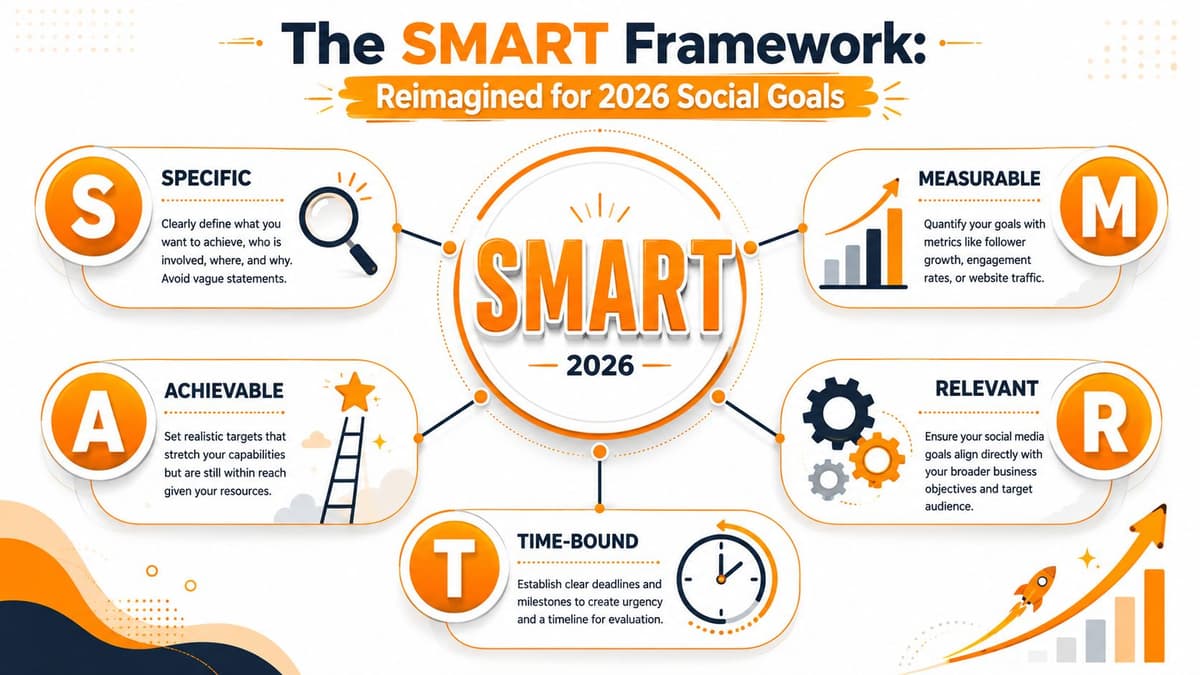
The SMART Framework Reimagined for 2026
The core framework still matters. What changes is how each letter gets interpreted in a multi-platform, high-volatility environment.
A useful SMART goal doesn't start with “more.” It starts with a business outcome, a clear metric, and a time window short enough to force attention.
To ground this in what teams prioritize, a 2023 industry survey found that 66% of social media marketers identified building brand reputation as their top strategic goal (Sprout Social's social media goals research). That matters because it pushes goal-setting beyond vanity metrics. If reputation is the priority, then “get more followers” is usually too shallow to guide real decisions.
Specific means tied to a real outcome
Specific doesn't mean detailed for the sake of detail. It means the goal answers four questions fast:
- What are you trying to change
- Who is the audience
- Which platform behavior matters
- Why this matters to the business
Bad example: grow our social presence.
Better example: improve perceived credibility with technical buyers by increasing meaningful replies and product-related discussion on founder posts.
That kind of specificity gives you a content filter. It tells you what to publish and what to ignore.
Measurable means one primary signal, not a dashboard mess
Teams often track too much and learn too little. If the goal is community quality, don't bury it under a dozen surface metrics. Pick the main KPI that reflects the actual outcome, then add only the supporting metrics needed to explain it.
For example:
- Reputation-focused goal: track sentiment-oriented feedback, brand mentions, and quality of replies
- Traffic goal: track referral traffic and signups
- Community goal: track comments, saves, and conversation depth
Good measurement reduces debate. When everyone knows the primary KPI, content reviews stop turning into opinion contests.
Achievable means matched to your publishing reality
A founder with limited time shouldn't set a goal that depends on custom content for four networks every day. An achievable goal respects content capacity, review time, and the fact that consistency still matters for visibility.
Many teams set goals that look motivating and behave like sabotage. The right target should stretch your process, not collapse it.
Relevant means social supports the business, not ego
A relevant goal has a direct line to something the business already cares about. Product signups. Sales conversations. Reputation. Support load. Retention. Community trust.
If you can't explain why a metric matters outside the social team, it probably doesn't belong at the center of the goal.
Time-bound means short cycles, not annual wishes
Time-bound used to mean “by the end of the year.” For social, that's often too loose to be useful. Better goals work in operating cycles. Short enough to evaluate accurately, long enough to produce signal.
A good structure looks like this:
- Weekly: check publishing consistency and immediate response
- Monthly: review content patterns and platform fit
- Quarterly: decide whether the goal still reflects the business need
That's how smart social media goals stay practical instead of decorative.
Connecting Social Goals to Business Objectives
The hardest part of SMART is usually relevance. Teams don't struggle because they can't write goals. They struggle because they can't prove that the goal matters.
That shows up in the data. 73% of teams fail in the Relevant phase by not aligning social metrics with broader business KPIs like Customer Lifetime Value, and those misaligned teams see a 40% lower conversion rate compared to aligned teams (fact summary reference). If your reporting stops at likes, reach, or follower changes, you're probably tracking activity instead of contribution.
Build a contribution funnel
A practical way to fix this is to map social activity to the next business step. Don't ask whether a post “performed.” Ask what business motion it supported.
A simple contribution funnel looks like this:
Content exposure
A founder thread, product clip, or launch post reaches the right audience.Meaningful interaction
People reply, click, save, ask a question, or share internally.Business action
They visit the site, join the waitlist, book a demo, subscribe, or contact support.Downstream value
The lead converts, the customer stays longer, or support load drops because the content answered recurring questions.
That logic keeps you from treating all engagement as equal. A joke post might get attention. A product teardown might get fewer interactions but send stronger buying signals.
A simple mapping model
| Business Objective | Social Media Goal | Primary KPI | Example Metric |
|---|---|---|---|
| Increase product signups | Drive qualified traffic from launch posts | Referral traffic | Signups from social-tagged landing pages |
| Improve brand trust | Increase substantive product conversations | Engagement quality | Replies that mention use cases, objections, or results |
| Reduce support friction | Publish educational posts that answer recurring questions | Support-related deflection signal | Fewer repeated inbound questions after explainer content |
| Strengthen community | Encourage repeat interaction from existing followers | Community engagement | Returning commenters and discussion depth |
This table matters because it forces discipline. You stop asking, “What should we post this week?” and start asking, “What content moves the KPI attached to the business objective?”
What to cut first
When a team is overloaded, the fastest improvement usually comes from removing weak metrics.
Cut or demote metrics that:
- Look good but don't guide action
- Can't be tied to a business objective
- Create pressure to publish low-value content
- Reward broad attention when you need qualified attention
If you need a clearer model for proving impact, this guide on social media ROI for professionals is useful because it frames measurement around business outcomes instead of vanity reporting.
For teams trying to connect goals to actual execution, a stronger content system helps too. This practical piece on content strategy for social media is worth reading because strategy usually breaks at the content planning layer, not at the KPI layer.
The right KPI should make content decisions easier. If it makes them fuzzier, it's the wrong KPI.
Crafting Goals for a Multi-Platform World
A single goal rarely works the same way across every network. That's where many founders get trapped. They write one objective, copy the same post everywhere, and assume consistency equals strategy.
It doesn't. A 2025 study found that 55% of cross-platform automated posts suffer from cultural dissonance, where a goal optimized for X can hurt engagement on Mastodon or Bluesky because the formatting and tone don't match the platform context (fact summary reference).

One goal, several platform expressions
Start with one master goal. Then adapt the expression, not the intent.
Use this template:
Business objective
What business result matters?Audience
Who needs to see or act on the content?Core social goal
What social behavior would support that objective?Primary KPI
What's the main metric that shows progress?Platform adaptations
How should the same message behave differently on each network?
Here's a practical example for a product launch.
Business objective
Drive qualified interest for a new feature.
Audience
Existing followers, product-aware prospects, and relevant technical communities.
Core social goal
Increase meaningful conversations and referral traffic from launch-related posts during the launch window.
Primary KPI
Referral traffic to the feature page, supported by quality replies and questions.
Platform-by-platform adaptation
X
X rewards speed, clarity, and strong opening lines. Your launch post should lead with the sharpest takeaway, not the full product story. Thread only when the extra context earns attention.
What usually works:
- Fast opinion-led framing
- Product updates tied to a clear pain point
- Replies that keep the discussion alive
What often fails:
- Dense explanation upfront
- Generic “we're excited” language
- Cross-posts that read like community forum updates
Threads
Threads tends to reward conversational energy. The same feature launch should feel more open-ended and discussion-friendly.
Try:
- A lighter tone
- A question that invites reaction
- Follow-up comments from the founder account to extend the thread
Bluesky
Bluesky often responds well to informed, niche-relevant framing. If your audience is technical or internet-native, lead with the underlying idea, not the polished marketing angle.
Use:
- Clear positioning
- Product context for builders
- Posts that sound like participation, not broadcasting
Mastodon
Mastodon communities often react badly to posts that feel extractive or aggressively promotional. The same goal can work there, but the content needs a lower-pressure tone and more respect for community norms.
Better options:
- Share what changed and why it matters
- Offer useful context
- Join discussions instead of forcing a CTA into every post
A multi-platform strategy isn't “copy once, paste everywhere.” It's “keep one business intent, then speak each platform's native language.”
The practical test
Before publishing a cross-platform campaign, ask:
- Would this post feel normal on this network
- Does the CTA fit the local culture
- Am I optimizing for the same business outcome with different content behavior
- If engagement drops on one platform, is that because the goal is wrong or the expression is wrong
That last question saves a lot of wasted effort. Often the goal is fine. The packaging is what's off.
Tracking Progress and Automating Distribution
The teams that get value from smart social media goals don't just write them down. They operationalize them. That means a lightweight dashboard, a review rhythm, and a publishing system that doesn't eat the whole week.
The time-bound part matters here because deadlines create a real evaluation window. That's also why a short test period is useful when you're improving workflow. A structured trial gives you a clean way to judge whether a tool helps you execute the goal across multiple networks.

Build a small dashboard, not a reporting monster
Your dashboard should answer three questions:
- Did we publish what we said we would
- Did the content create the intended audience response
- Did that response support a business objective
For most founders, that means tracking only a handful of items per goal. For example:
- Publishing discipline: did the content ship on schedule
- Audience response: comments, replies, shares, or traffic
- Business movement: signups, inquiries, or support-related outcomes
If you publish memes or fast-turn creative, this guide for meme campaign optimization is a good reminder that content style still needs measurement discipline. Funny content can drive results, but only if you know which behavior it's supposed to influence.
Review on a rhythm you can sustain
A workable cadence usually looks like this:
Weekly check-in
Review consistency, top posts, weak posts, and whether any platform-specific formatting needs adjustment.Monthly review Assess whether the content mix supports the KPI attached to the goal. Adjust tactics accordingly.
Quarterly decision
Keep, refine, or retire the goal based on business relevance.
The key is separating tactical changes from goal changes. If Threads posts underperform, you may need a different format or posting pattern. That doesn't automatically mean the business objective changed.
Automation should reduce friction, not flatten strategy
The danger with manual distribution is simple. It steals decision-making time. Teams spend energy resizing assets, reformatting posts, splitting threads, and adapting links instead of looking at what's effective.
That's why automation only helps when it preserves platform context. If the system merely clones posts, it creates more noise. If it adapts content intelligently, it gives you time back without turning every network into the same feed.
A useful distribution setup should support:
- Platform-native formatting
- Content rules by network
- Fast reposting from a source account
- Reviewability so you can spot mismatches early
For a deeper look at how that workflow fits into a broader publishing system, this piece on automated content distribution is a solid starting point.
Track manually if you must. Distribute manually only if the volume is low enough that it doesn't cost you strategic attention.
Common Pitfalls That Sabotage Your Goals
Social goals usually break at the operating level, not the idea level. The goal sounds reasonable in a planning doc. The workflow behind it is shaky, the platform mix keeps shifting, and nobody updates the goal until the quarter is already off track.
That problem gets worse in a multi-platform setup. A target that looks achievable on X can become unrealistic once you add Threads and Mastodon, each with different pacing, formatting norms, and audience behavior. Static SMART goals miss that reality. Good goals need room for adjustment without turning into vague promises.
Pitfall one, setting goals your workflow can't support
Founders do this all the time. They set a target based on the outcome they want, not the system they have.
The warning signs are familiar:
- Missed publishing windows
- Constant content backlog
- Team frustration around every campaign
- Good ideas stuck in drafts
- One platform getting all the attention while the others drift
The fix is rarely complicated. Cut scope before quality drops. Reduce the number of active formats, define what gets cross-posted and what stays native, and build goals around your real weekly capacity.
I usually advise teams to set a floor and a stretch version of the same goal. For example, publish three strong posts per week across priority channels as the floor, then expand only if the workflow holds up for a full review cycle. That keeps the goal ambitious, but still usable in real conditions.
Pitfall two, mistaking visibility for progress
Busy founders get trapped by screenshots. A reach spike, a viral reply, or a burst of follower growth can look like momentum even when it has no effect on pipeline, signups, or customer demand.
A better filter is simple. Ask what business action the metric is supposed to support.
If the goal is qualified traffic, broad engagement from the wrong audience is a distraction. If the goal is founder credibility, raw clicks may matter less than replies from peers, prospects, or partners. The metric has to match the job.
If a metric creates excitement faster than it creates business value, question it.
Pitfall three, leaving deadlines and adjustment rules vague
Without a deadline, a weak goal can linger for months. The team keeps posting, keeps tweaking, and keeps hoping the next format change will fix the problem.
A deadline solves part of that. An adjustment rule solves the rest.
Set one date for evaluation, then define what happens if platform conditions shift before then. If X referral traffic drops but Threads starts sending stronger engagement, the goal may still be healthy. The tactic changed. The objective did not. That distinction keeps teams from rewriting goals every time a platform gets noisy.
Use a simple review structure:
- Deadline: the date you will judge the goal
- Checkpoint: weekly or biweekly review of leading indicators
- Adjustment rule: what changes tactically, and what would justify changing the goal itself
- Owner: one person responsible for calling success, revision, or stop
Automation helps here when it reduces reporting drag and keeps distribution consistent across networks. It becomes a problem when it hides weak strategy under more output. The standard is straightforward. Automate formatting, scheduling, and reposting where it saves time. Keep judgment, platform nuance, and goal decisions in human hands.
Most founders do not need more activity. They need goals that can survive a messy platform mix, tighter review rules, and a publishing system the team can maintain.
If you want a simpler way to put these ideas into practice, try MicroPoster. It's built for founders, creators, and small teams who want to write once and publish natively across X, Threads, Bluesky, and Mastodon without turning distribution into a second job. The 7-day free trial gives you a clean, time-bound window to test whether a smarter publishing workflow helps you stay consistent, adapt faster, and keep your goals tied to real business outcomes.