repurposing content
Repurposing Content: A Founder's Guide to Smart Reach
Learn the art of repurposing content for maximum reach on X, Threads, and Bluesky. This guide covers auditing, automation, and measurement for busy founders.

You publish something strong. Maybe it's a launch post, a deep blog article, a product teardown, or a hard-won lesson from building in public. It gets a small burst of attention, then disappears under the next wave of feeds, tabs, and notifications.
That's the part most founders get wrong. The problem usually isn't the idea. It's distribution.
Repurposing content fixes that, but only if you treat it as a system instead of a last-minute chore. A good post shouldn't live once on your blog and die there. It should break into threads, short posts, quote cards, clipped video, follow-up takes, and platform-native versions that keep pulling attention back to the original idea.
For founders and small teams, the crucial element is the modern microblogging stack: X, Threads, Bluesky, and Mastodon. These platforms reward consistency, sharp opinions, and frequent posting. They also punish manual workflows. If you're copying and pasting every post by hand, you'll burn time fast and still miss opportunities.
Why Repurposing Content Is Your Growth Multiplier

Most content doesn't fail because it's bad. It fails because it gets one format, one publish date, and one brief window to earn attention. That's a distribution problem, not a writing problem.
Founders feel this acutely. You spend hours writing something thoughtful, publish it, share it once or twice, then move on to the next task because product, support, hiring, and sales won't wait. Meanwhile, the original piece still has useful ideas buried inside it. They just never got enough shots on goal.
Repurposing is not recycling
Repurposing content means pulling more value from a proven idea by adapting it to new contexts. A blog post can become a thread. A launch thread can become a short Bluesky post plus a longer Threads version. A podcast can become quote posts, clips, and contrarian takes.
That's why this practice has become normal across serious marketing teams. According to a ReferralRock survey, 94% of marketers actively repurpose their content, and the remaining 6% plan to start. The “No, we don't plan to repurpose” option received zero votes, which signals broad agreement that this is no longer optional in modern marketing (ReferralRock survey summary).
Practical rule: If an idea was good enough to publish once, it's probably good enough to publish in three more formats.
A lot of generic advice on repurposing stays too abstract. If you want a broader menu of content repurposing tactics, PostNitro's guide is useful for thinking beyond simple reposting.
Manual distribution breaks first
The biggest bottleneck isn't creativity. It's labor.
Writing one strong piece is hard but manageable. Rewriting it for four different networks, adjusting length, fixing mentions, splitting threads, and posting at the right time is where most systems fall apart. That's also why repurposing content works best when you build it into your workflow from day one instead of treating it like cleanup work later.
There's a useful distinction here between syndication and repurposing. If you want a clean explanation of that difference, this overview of content syndication is worth reading. The short version is simple: syndication spreads the same asset, while repurposing adapts the core idea for a different surface.
Great content deserves repeated exposure
People rarely see everything you publish. Even loyal followers miss posts. New followers definitely missed your old ones. Platform audiences also behave differently. A blunt one-liner might work on X, while the same idea needs more context on Threads or a calmer tone on Mastodon.
Repurposing content gives your best ideas more chances to land. Done well, it compounds reach without forcing you to reinvent your message every day.
Finding Your Goldmines with a Content Audit
The fastest way to waste time is repurposing weak material. Not every blog post deserves a second life. Some pieces were timely and are now stale. Some got traffic but no real engagement. Some are too thin to fragment into useful micro-content.

The audit matters because it tells you what to amplify, not just what exists.
What to look for first
Industry best practice is to audit evergreen content like how-tos and frameworks that have more than double the average engagement or traffic. Built around those high-performers, a structured repurposing system can deliver a 3-5x increase in ROI (repurposing systems research).
That sounds technical, but the working rule is simple. Start with content that has already proven two things: people care about it, and it will still matter next month.
I usually sort content into three buckets:
- Evergreen operators: posts that solve a recurring problem, such as onboarding advice, pricing lessons, distribution frameworks, or product-writing templates.
- Conversation magnets: posts that triggered meaningful replies, debate, bookmarking, or shares.
- Fragmentable assets: pieces with multiple standalone points that can survive on their own as short posts.
A practical audit checklist
Open Google Analytics, Search Console, your CMS, or your social analytics and look for these signals:
- Strong dwell and completion: content people read, not just clicked.
- Persistent relevance: lessons that aren't tied to last week's news.
- Clean structure: lists, frameworks, steps, and sharp subheads are easy to split into micro-posts.
- Original angle: opinionated writing repurposes better than generic educational copy.
- Follow-up potential: anything that naturally creates objections, examples, or behind-the-scenes commentary.
A high-traffic post with no memorable angle often repurposes worse than a niche post with strong reactions.
This walkthrough is useful if you want a visual reset before running your own audit:
One filter most teams skip
A piece can be successful and still be bad for repurposing.
The missing filter is fragmentability. Can you pull ten clean ideas out of it, or is the value locked inside one long explanation? A strong source asset usually contains one central claim plus supporting stories, examples, quotes, objections, and tactical steps. That gives you room to publish multiple posts without sounding repetitive.
Use this quick pass before committing time:
- Highlight the core claim. If you can't summarize the piece in one sentence, it will be hard to remix.
- Mark standalone moments. Pull lines, stats, examples, or lessons that still make sense out of context.
- Tag by platform fit. Some fragments belong in a thread. Others work as single posts or visual cards.
- Kill weak candidates early. If a post needs too much rewriting just to become interesting, skip it.
A small content library with five true goldmines beats a bloated archive full of mediocre source material.
Adapting Content for Microblogging Networks
Repurposing content for microblogging isn't about shrinking a blog post until it fits. It's about finding the atomic ideas inside it and matching those ideas to the culture of each platform.
The most effective technique here is quote-mining. By scanning a single long-form asset like a blog or podcast, you can generate 5-15 standalone micro-posts. That tactic can increase posting volume by 5x and drive a 20% uplift in traffic back to the original source (micro-content extraction guide).
Four remix plays that actually work
Most long-form content can be broken into a small set of reliable post types.
The main point thread
Take the central idea and turn it into a short thread or sequence. This works best when your source content has a strong argument, a sequence, or a lesson learned through action.
Use this when:
- You're explaining a process
- You're defending a contrarian position
- You want to build context before linking back to the original post
Keep each post tight. Don't paste full paragraphs from the blog. Rewrite for rhythm and feed reading.
The statistical or proof snippet
If the source piece includes a meaningful result, a sharp finding, or a memorable observation, isolate it into a standalone post. Lead with the proof, then add one sentence of interpretation.
This style works because microblogging rewards clarity. One pointed takeaway often performs better than a compressed summary of the whole article.
The contrarian take
Long-form writing often includes one opinion that challenges a default assumption. Pull that line out and let it stand on its own.
Examples:
- Why more posting isn't always better
- Why founders should write source content before hiring for social
- Why identical cross-posting damages trust
A contrarian post opens the loop. The original article closes it.
A good repurposed post should create curiosity about the full piece, not replace it entirely.
The behind-the-scenes post
This one is underused. Don't just repurpose conclusions. Repurpose the process.
A blog about growth can produce posts about what you tried first, what failed, what you cut, how your thinking changed, or which customer comment triggered the article in the first place. These versions feel more native on social because they sound lived-in rather than polished.
If your source content is video, clipped excerpts are often the easiest bridge into microblogging. If you need a workflow to create high-quality YouTube clips, that guide is a practical companion to this approach.
Micro-Content Adaptation by Platform
| Platform | Focus | Best Format | Pro Tip |
|---|---|---|---|
| X | Speed, sharpness, opinion | Thread, punchy single post, reply-driven post | Open strong in the first line and trim anything that reads like setup |
| Threads | Context, relatability, softer cadence | Conversational post series, story-led post | Expand the emotional or practical framing instead of posting the driest version |
| Bluesky | Insight with personality | Short thread, crisp standalone take | Keep it direct and specific. Loose commentary tends to fade fast |
| Mastodon | Community fit and tone awareness | Contextual post, discussion prompt | Read the room first. Broad promotional language tends to underperform |
Adaptation rules that save time
You don't need a custom masterpiece for every platform. You need intelligent variation.
- Change the opening: same idea, different first sentence.
- Adjust density: X usually rewards compression. Threads often tolerates more context.
- Rewrite mentions: handles and references don't transfer cleanly across networks.
- Vary the CTA: ask for replies on one platform, link back on another, and skip the ask entirely in some cases.
- Keep a swipe file: save your best hooks, endings, and thread formats in Notion, Google Docs, or your editor.
The core skill in repurposing content is decomposition. One article isn't one asset. It's a bundle of claims, examples, phrases, questions, and reactions waiting to be separated.
Building Your Automated Distribution System
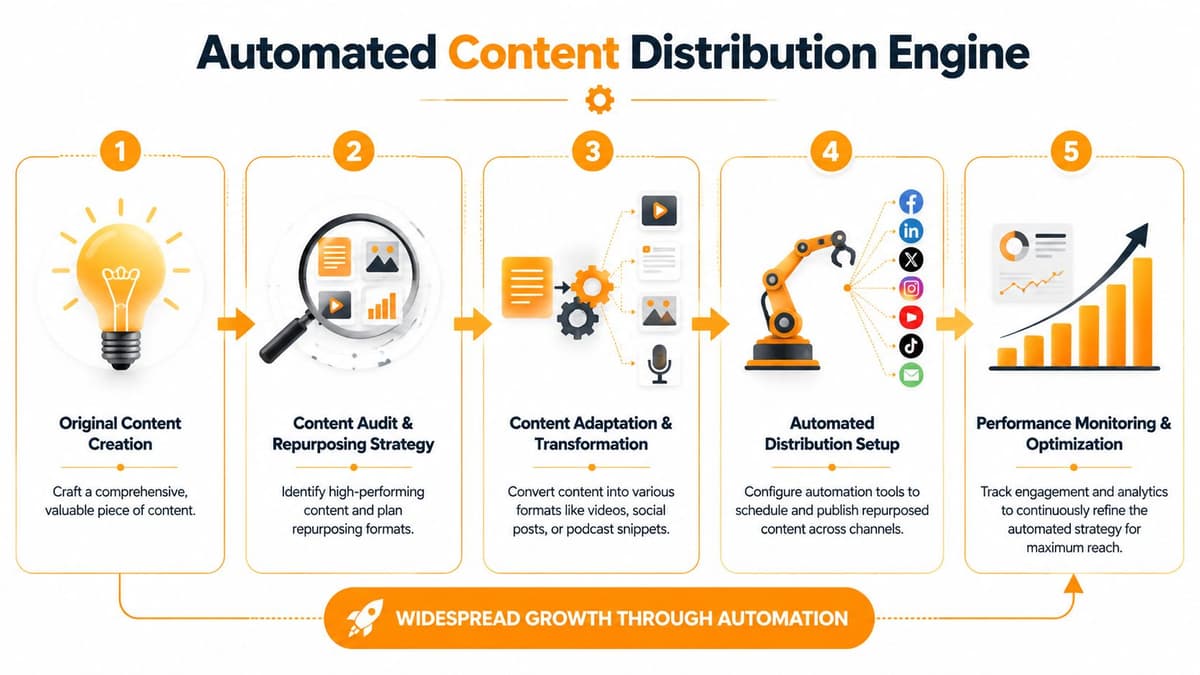
Manual repurposing works for a week. Maybe two. Then the backlog starts. Drafts pile up. You forget to repost the best pieces. New content ships, old content sits, and your distribution engine becomes a set of tabs you intend to revisit.
Automation fixes the mechanics. It doesn't replace judgment. It removes the repetitive work that makes consistency hard.
Build around one source of truth
The cleanest setup starts with one primary publishing surface. For some founders, that's X. For others, it's a blog, newsletter, or internal content doc. The point is to choose the place where ideas are born first.
Once you have that source, the system should do four jobs well:
- Detect new content quickly
- Adapt it to each destination
- Publish natively instead of as awkward copies
- Route performance data back into the next round of posts
That's the infrastructure behind a sustainable write-once workflow.
What automation should handle
A solid distribution stack should take care of the annoying platform details you shouldn't be solving by hand every day.
- Thread splitting: long updates need to break cleanly into sequences.
- Handle mapping: mentions that work on one platform often need adjustment elsewhere.
- Media formatting: images and clips should upload natively in the right shape.
- Posting rules: hashtags, timing preferences, and mirroring choices should be configurable.
- Editorial assist: light AI refinement can shorten, expand, or soften a post before it goes live.
Automation should remove friction, not remove your voice.
Purpose-built tools matter more than generic schedulers in this context. A simple queue tool can schedule posts, but it usually won't understand platform-specific constraints across X, Threads, Bluesky, and Mastodon.
One example is automated content distribution, which explains the workflow behind mirroring posts across networks without relying on copy-paste. In practice, tools in this category are useful when they can detect source posts, split long updates into threads, remap handles, and keep native formatting intact. MicroPoster is one option built around that exact use case for X, Threads, Bluesky, and Mastodon.
The system that works for small teams
Founders usually overcomplicate this. You don't need a giant content operation. You need a short loop:
Create modular source content
Write in chunks. Strong hooks, clear subheads, distinct takeaways, and memorable lines all make later adaptation easier. If your original piece is one dense block of text, repurposing it will feel like extraction work.
Prepare a lightweight rule set
Decide in advance:
- Which source accounts feed which destination accounts
- Whether posts should mirror exactly or adapt
- When links should appear
- Which posts should stay manual because they need more nuance
Let the machine handle repetition
Once the rules are set, your system should keep shipping in the background while you stay focused on creating better source material, replying to comments, and refining your angle.
That's why automation isn't a shortcut. It's the only practical way to keep a multi-platform publishing habit alive without burning founder time on formatting chores. If you want to test whether this kind of setup fits your workflow, a no-credit-card trial is the right bar. Run it for a week, watch what gets published, and see where your current process is still too manual.
Measuring What Matters and Refining Your Strategy
A lot of teams think they're measuring repurposing content when they're really just collecting screenshots of likes, impressions, and follower bumps. That can tell you whether a post got noticed. It usually doesn't tell you whether the system is working.
The attribution gap is often underestimated. A Content Marketing Institute survey noted that 32% of marketers use AI for repurposing, but only 18% effectively track cross-channel attribution. That gap leads to an estimated 40% underestimation of ROI because teams focus on views instead of revenue-driving conversions (cross-channel attribution analysis).
What to track instead of vanity metrics
The goal isn't to ignore engagement. It's to rank it correctly.
Use three layers:
Business signals
These matter most:
- Referral traffic back to your site, product, or newsletter
- Leads or signups tied to repurposed posts
- Conversations started with prospects, users, or collaborators
If a post gets less engagement but sends better visitors, keep posting that style.
Audience development signals
These help you judge platform fit:
- Follower growth on secondary networks
- Reply quality
- Repeat engagement from the same people
A small number of thoughtful replies often beats broad shallow reach.
Content performance signals
These tell you what to remake:
- Which hooks earn clicks
- Which post formats earn saves or reposts
- Which source assets produce multiple useful social variations
A simple attribution setup for founders
You don't need an enterprise analytics stack. You need consistency.
Use a practical setup like this:
| Track | Simple method | Why it matters |
|---|---|---|
| Link traffic | UTM-tagged links or a consistent shortener | Tells you which platform and format sends visitors |
| Lead intent | Separate signup source fields or tagged landing pages | Connects attention to business outcomes |
| Post families | Name related posts by campaign or source asset | Helps compare which remix style wins |
| Qualitative feedback | Save strong replies and objections in one doc | Gives you ideas for future source content |
If you can't trace a repurposed post back to a source asset, you can't tell which ideas deserve another round.
How to use the data
Don't turn this into reporting theater. Use it to make editorial decisions.
If one blog post generates strong discussion on Threads but weak response on X, the lesson may be tone, not topic. If quote posts outperform summary posts, mine more sharp lines. If platform-native commentary drives more profile visits than direct promotion, shift your ratio.
Repurposing content improves fastest when each round leaves clues for the next. The best teams don't just publish more. They learn which ideas travel, which formats invite response, and which networks deserve extra effort.
Common Repurposing Pitfalls and How to Avoid Them
The common fear is that repurposing content makes your brand repetitive. That only happens when teams confuse repurposing with duplication.
Bad repurposing looks lazy. Same wording, same hook, same CTA, same tone, posted everywhere. It ignores the fact that each platform has its own rhythm and its own tolerance for promotional language.
Pitfall one is robotic mirroring
Unadapted automation creates obvious artifacts. Broken mentions. Strange embeds. A tone mismatch that makes the post feel imported rather than native.
That isn't just awkward. HubSpot's 2025 reporting shows that 22% of repurposed campaigns faced takedowns or shadowbans due to unadapted mentions or embeds (reporting referenced here).
Fix it with platform rules, not with more manual work. Decide how handles, links, hashtags, and media should behave before the post ships.
Pitfall two is audience fatigue
People notice when you blast the same post everywhere without adjusting for context. It signals that the channel is an afterthought.
The same reporting notes that pure automation without tone refinement can lead to a 15% follower churn due to fatigue from identical cross-posts. That's the line to avoid. Automation is useful. Identical mirroring is where it starts costing trust.
Use a simple standard:
- Change the opener
- Change the emphasis
- Keep the core idea
- Drop anything that feels forced on that platform
Pitfall three is ignoring federated network norms
Mastodon and Bluesky aren't just extra places to dump content. Community expectations matter more there. People tend to respond better when posts feel contextual, respectful, and suited to the environment.
That means your system needs human review in the right places. Not for every single post, but for sensitive topics, bigger announcements, and anything with a sharper promotional edge.
The balanced operating model
The healthiest setup is hybrid:
- Automate distribution mechanics so posting stays consistent
- Review high-risk posts before they go live widely
- Refine tone with AI or editing instead of publishing raw duplicates
- Respect platform culture when deciding how assertive, casual, or explanatory the post should be
Smart automation acts like an operations assistant. It should never pretend to be editorial judgment.
That's the trade-off most founders eventually learn. Repurposing content works. Heavy manual workflows don't scale, and blind automation creates new problems. The sweet spot is rule-based automation with light human oversight. That's what turns one strong idea into sustained visibility across the networks that matter.
If you want to test a low-effort repurposing workflow across X, Threads, Bluesky, and Mastodon, try MicroPoster. It's built for native cross-network posting with platform-aware adaptations, and the 7-day trial makes it easy to see whether your current distribution process is doing too much by hand.