how to measure social media roi
How to measure social media roi: how to measure social media roi in practice
Discover how to measure social media roi with a practical framework that links campaigns to real business results and smarter decisions.
At its core, the social media ROI formula is straightforward: take the profit you made, subtract what you spent, divide that by your total investment, and multiply by 100 to get a percentage. But the real work is in the details—assigning a real monetary value to your goals, tracking every single cost (from ad spend to your own time), and drawing a clear line from a social media post to a real business result.
This is how you turn your social media presence from just a content machine into a predictable growth engine.
Why Measuring Social Media ROI Is No Longer Optional
Trying to justify your work on platforms like X, Bluesky, or Mastodon can feel like you're chasing shadows. You know your efforts are making an impact, but proving it in the language your stakeholders actually care about—dollars and cents—is a whole different ball game. That’s exactly why figuring out how to measure social media ROI has become an essential skill.
Without a clear picture of your return, you’re stuck on a content treadmill, just grinding out posts day after day. You end up guessing which strategies are actually working, wasting precious time on dead-end activities, and fighting an uphill battle to defend your budget.
The Real Price of Flying Blind
When we talk about the cost of ignoring ROI, it's not just about the ad budget. It's about every single resource you pour into your social media efforts:
- Your Time: All those hours spent writing posts, jumping into conversations, and analyzing what’s trending.
- Creative Energy: The mental effort it takes to produce compelling content that actually connects with people.
- Tool Subscriptions: The monthly costs for scheduling and analytics tools, like MicroPoster.
If you're not tracking these investments, you're essentially operating in the dark. Unfortunately, you're not alone. According to Improvado, a shocking 70% of marketers are wasting budgets on unproven tactics because they aren't effectively measuring ROI. They're chasing engagement ghosts instead of actual revenue.
It's time to shift our perspective from vanity metrics to valuable outcomes. The old way of thinking focused on superficial numbers that felt good but didn't actually prove business impact. Here’s how to reframe your thinking:
Shifting Focus From Vanity Metrics to Valuable Outcomes
| Vanity Metric (What to Avoid) | ROI-Focused Outcome (What to Measure) |
|---|---|
| Likes and Reactions | Website Conversions (Sales, Sign-ups) |
| Follower Count | Lead Generation (Gated Content Downloads) |
| Reach and Impressions | Customer Lifetime Value (LTV) from Social |
| Video Views | Average Order Value (AOV) from Social Traffic |
| Post Shares | Reduction in Customer Support Costs |
By focusing on the right column, you're tying your social media activities directly to the bottom line.
The goal is to reframe ROI measurement as the essential skill for turning your social presence into a profitable asset, not just another line item on a spreadsheet. It’s the bridge between being busy and being effective.
When you start measuring your return accurately, everything changes. You can pinpoint which channels are your heavy hitters, refine your content strategy based on what actually converts, and allocate your resources with confidence. This data-backed approach transforms social media from a department that costs money into one that makes money, ensuring every move you make is a deliberate step toward real growth.
Set Your Sights: Defining Goals for Real ROI Measurement
Before you even touch a tracking tool or a spreadsheet, let's get one thing straight. The whole game of measuring social media ROI comes down to a single, critical question: What are you actually trying to accomplish?
Without a clear answer, you’re just swimming in data. You’ll get lost chasing vanity metrics that feel good but do absolutely nothing for your bottom line. It's the difference between being busy and being productive.
The trick is to stop thinking in vague terms like "boost engagement" and start framing your efforts around specific, measurable business goals. Give your social media a job to do, with real targets. This mental shift is what separates creators who are just posting from those who are building a genuinely profitable business.
From Social Goals to Business Wins
Every single goal you set for your social media has to tie back to a larger business need. Your content strategy isn't just about showing up consistently; it's about making every post, thread, and reply serve a bigger purpose. For a deeper look at this, our guide on building an effective content strategy for social media is a great place to start.
Let’s get practical. Here’s how you can turn those fuzzy ambitions into sharp, ROI-focused objectives:
Instead of: "I want more followers on X."
Try: "Generate 50 qualified leads through my X content this quarter by promoting free consultations."
Instead of: "I need to increase brand awareness."
Try: "Bring in $5,000 in direct sales from my Bluesky community by launching an exclusive digital product."
Instead of: "My engagement is low."
Try: "Drive 200 new newsletter sign-ups from Mastodon this month by sharing valuable snippets from my latest articles."
See the difference? These objectives are specific, measurable, and have a deadline. They give you a clear finish line, which makes the final ROI calculation a whole lot easier.
Putting a Price Tag on Clicks and Sign-ups
One of the biggest headaches in measuring ROI is figuring out what non-sales actions are actually worth. What’s the dollar value of a new email subscriber? Or a downloaded e-book? This is where your own historical data becomes your secret weapon.
To give these actions a real monetary value, you just need to work backward.
- Calculate Your Lead Value: First, figure out your lead-to-customer conversion rate. If, on average, 1 out of every 10 leads becomes a customer, and your average customer is worth $1,000, then each lead is worth $100 ($1,000 / 10).
- Calculate Your Subscriber Value: Take a look at your email marketing. If your list brings in $5,000 in revenue per month and you have 1,000 subscribers, each subscriber is worth about $5 per month.
By assigning a concrete dollar amount to these "micro-conversions," you can finally measure the real return on campaigns that are built for lead generation or audience growth, not just immediate sales.
This approach ensures that even your top-of-funnel efforts have a clear place in your ROI calculations, giving you a much fuller picture of social media's financial impact.
Picking the Right KPIs for the Job
Once your goals are crystal clear and you’ve assigned values to your key actions, it's time to pick the right Key Performance Indicators (KPIs). These are the specific metrics that tell you if you're on the right path to hitting your target.
Your KPIs must align perfectly with your objectives.
Here’s a simple way to match them up:
| Business Objective | Primary Social Media Goal | Key Performance Indicators (KPIs) to Track |
|---|---|---|
| Increase Sales | Drive Website Purchases | Conversion Rate, Revenue from Social, Average Order Value (AOV) |
| Generate Leads | Capture Contact Information | Cost Per Lead (CPL), Leads Generated, Gated Content Downloads |
| Build Brand Awareness | Expand Reach and Visibility | Reach, Impressions, Share of Voice, Brand Mentions |
| Improve Customer Loyalty | Foster Community Engagement | Engagement Rate, Customer Retention Rate, Net Promoter Score (NPS) |
Focusing on the right KPIs keeps you from getting distracted by noise. The best teams know this. Recent data shows that 68% focus on engagement, 65% on conversions, and 57% on direct revenue impact. This proves that while engagement matters, its true value is unlocked when it’s tied directly to conversions and cash in the bank. You can see more on these social media ROI trends on Ingenious Netsoft.
Nailing down your objectives, assigning value to outcomes, and choosing the right KPIs is the foundation of everything. Get this groundwork right, and every piece of data you collect will feed into a clear, compelling ROI calculation that truly proves the value of your hard work.
Building Your Social Media ROI Tracking System
With your goals mapped out, it’s time to roll up your sleeves and get into the technical setup. This is where we build the engine that will actually measure your ROI—a system to track every click, lead, and sale that comes from your social media efforts. Without a solid tracking framework, you’re just guessing.
A crucial first step is to establish a clear data collection methodology. This just means creating a consistent process for how you gather information, starting with the very links you share. If your data is messy from the start, your ROI calculations will be meaningless.
Master Your Links with UTM Parameters
The single most important tool in your tracking toolkit is the UTM parameter. These are just little snippets of code you tack onto the end of a URL to tell your analytics platform exactly where a visitor came from. Think of them as digital breadcrumbs.
A properly built UTM link always answers three critical questions:
- Where did this traffic come from? (
utm_source=twitter) - How did it get here? (
utm_medium=social) - Why did it come? (
utm_campaign=q3_ebook_launch)
So, if you’re promoting a new ebook on X, the link you share might look something like this:
yourwebsite.com/ebook?utm_source=x&utm_medium=social&utm_campaign=q3_ebook_launch
When someone clicks that link, Google Analytics instantly logs the visit as coming from your Q3 ebook campaign on X. This level of detail is non-negotiable if you want to know which platforms and specific campaigns are actually driving results.
Setting Up Conversion Tracking in Google Analytics
Once people land on your site, you need to know if they’re doing what you want them to do. That’s where conversion tracking comes in, and Google Analytics 4 (GA4) is the industry standard. By setting up “events,” you can measure every valuable action, from a simple newsletter signup to a completed purchase.
Getting this right in GA4 involves a few key moves:
- Define Your Events: First, decide what actions matter. This could be a
generate_leadevent for a form submission or apurchaseevent for a sale. - Configure the Events in GA4: Next, you'll use either the GA4 interface or Google Tag Manager to set up triggers that fire these events when someone takes the desired action.
- Mark Events as Conversions: Finally, inside GA4, you’ll flip a switch to tell the system which of these events are your most important ones—your official conversions.
This setup connects the dots, showing you precisely which social media channels are pushing people to take the actions that grow your business.
By linking your social media posts (via UTMs) to website actions (via GA4 conversions), you create a complete picture of the customer's journey. This is the bedrock of any accurate ROI measurement system.
Don't Forget Native Platform Analytics
While GA4 tells you what happens on your website, don't ignore the goldmine of data available directly within the social media platforms themselves. The built-in analytics on platforms like X give you a ton of information about how your content performs before anyone even clicks a link.
For example, the native analytics on X provide deep insights into your audience and content performance. You can get a much more detailed breakdown in our complete guide to Twitter account analytics.
Be sure to pull these key metrics from each platform:
- Impressions and Reach: How many eyeballs are you actually reaching?
- Engagement Rate: What percentage of those people are interacting with your posts?
- Profile Visits: How many are curious enough to check out your main profile?
- Link Clicks: The raw number of clicks your links generated on the platform.
Comparing this on-platform data with what you see in GA4 tells the full story. You might discover a post with huge engagement on X drove almost no sales, while a quieter post sent a small but highly-qualified group of buyers straight to your checkout page.
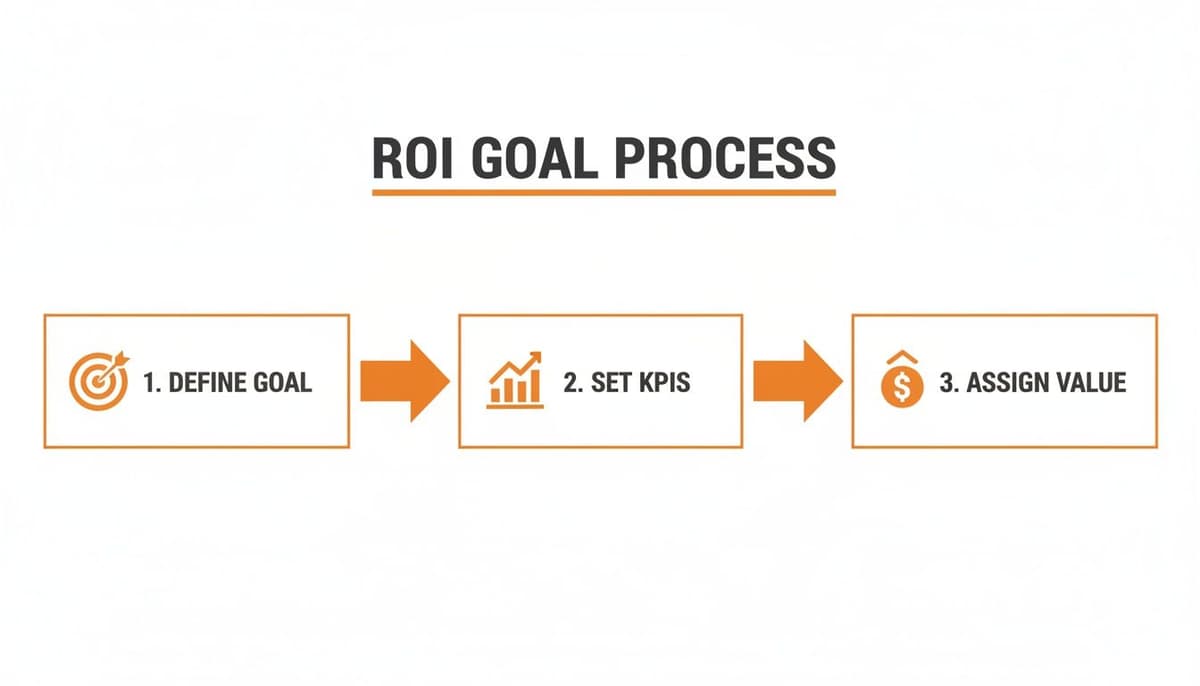
This visual really drives home the point that a successful tracking system always starts with clear objectives. You have to know what you're measuring before you can build the system to track it.
Simplify Your Tracking with a Unified Tool
Let's be honest: juggling UTMs, scheduling posts, and pulling analytics from half a dozen platforms is a recipe for a headache. It's where mistakes happen and data gets messy. This is exactly why a centralized tool like MicroPoster can be a game-changer.
MicroPoster streamlines this entire process by letting you schedule all your content and automatically apply consistent UTM parameters to every single link. No more manual UTM building, no more human error. By integrating your content creation with your tracking from the get-go, you build a far more efficient and reliable system for proving your social media ROI.
How to Calculate and Interpret Your Social Media ROI
So, you’ve set your goals and have all your tracking in place. Now for the moment of truth: crunching the numbers. This is where the magic happens, turning all that data into a clear story about what your social media efforts are actually worth. The whole game boils down to mastering how to calculate marketing ROI, a skill that's absolutely critical for social campaigns.
At its heart, the formula for social media ROI is beautifully simple:
Social Media ROI = (Profit / Total Investment) x 100
While the math itself isn’t complex, the real work is in defining "Profit" and "Total Investment" with brutal honesty. Get these two numbers right, and you'll have a metric that genuinely reflects your performance.
Decoding Your Total Investment
One of the biggest mistakes I see people make is underestimating the true cost of their social media. It's so much more than just ad spend. For a real-deal calculation, you need to account for every single resource you're pouring into your social presence.
Make sure your investment calculation includes everything:
- Ad Spend: This is the easy one—the cash you hand over to platforms like X for ads and promoted posts.
- Tool Subscriptions: Don't forget the monthly or annual fees for your software stack. This means your scheduler (MicroPoster, for example), analytics platforms, and any design tools you use for content.
- Content Creation Costs: Did you pay a freelance writer, hire a graphic designer, or contract a video editor? Their invoices are a direct investment.
- Team Time (The Hidden Cost): This is the cost everyone forgets, but it's crucial. Your time has a dollar value. Figure out an hourly rate for yourself or your team, then track the hours spent on social media tasks each month. It's a real business expense, and your ROI calculation is fiction without it.
Tallying up every single one of these costs gives you a realistic baseline. It stops you from accidentally inflating your ROI and gives you a true picture of your investment.
Attributing Profit Correctly with Attribution Models
Okay, now for the fun part: the profit. Your UTMs and conversion tracking are showing you which sales and leads came from social media, which is great. But the path a customer takes is rarely a straight line.
Think about it. Someone might see your post on X, click a Google ad a week later, and finally buy after getting an email. So, which channel gets the credit?
This is exactly what attribution models are for. They're just different sets of rules for assigning value to the various touchpoints a customer hits on their way to a purchase.
- First-Touch Attribution: This model gives 100% of the credit to the very first place a customer interacted with you. It’s perfect for figuring out which channels are best at introducing your brand to new people.
- Last-Touch Attribution: As you'd expect, this gives 100% of the credit to the final touchpoint before the conversion. It’s a great way to see which channels are your best "closers."
- Multi-Touch Attribution: This is where things get more sophisticated. Instead of an all-or-nothing approach, multi-touch models spread the credit around. A Linear model divides credit evenly, while a Time Decay model gives more weight to the interactions that happened closer to the sale.
The right model really depends on your goals. For a brand awareness campaign, first-touch makes a lot of sense. For a flash sale, last-touch is probably your best bet. Honestly, though, most businesses find that a multi-touch model gives them the most realistic view of how all their channels are working together.
Sample Social Media ROI Calculation
Let's walk through a tangible example. Imagine a creator using MicroPoster to launch a new digital course on X. Here's how they might break down the numbers to find their ROI.
| Metric/Cost | Description | Monetary Value |
|---|---|---|
| Total Revenue | 150 course sales at $50 each, tracked via UTMs from X. | $7,500 |
| Ad Spend | Budget for promoted posts on X to drive traffic to the sales page. | -$1,000 |
| MicroPoster Subscription | Monthly cost for the scheduling and analytics tool. | -$30 |
| Content Creation | Cost to hire a designer for promotional graphics. | -$200 |
| Team Time | 20 hours of the creator's time at a rate of $50/hour. | -$1,000 |
| Total Investment | The sum of all costs associated with the campaign. | -$2,230 |
| Net Profit | Total Revenue minus Total Investment. | $5,270 |
| Final ROI Calculation | ($5,270 / $2,230) x 100 | 236% |
In this scenario, the creator achieved a 236% ROI. For every $1 they invested in their social media launch, they generated $2.36 in profit. This clear, data-backed result proves the campaign was a solid success.
Going Deeper with Customer Lifetime Value
A single sale feels good, but the real power of social media is in building relationships that pay off over the long haul. This is why you should also look at your ROI through the lens of Customer Lifetime Value (LTV). LTV is simply the total amount of money you expect to earn from a single customer over their entire relationship with you.
By swapping the profit from one sale with the LTV of a new customer, you suddenly see the massive value in strategies that build loyalty, even if the immediate ROI looks a bit low.
For instance, a campaign might cost $500 and only bring in $400 in first-time sales, which looks like a negative ROI. But what if the average LTV of those new customers is $2,000? Your long-term ROI is suddenly a whopping 300%. This is how you prove the lasting impact of building a community, not just chasing quick sales.
So, what’s a good number to aim for? It definitely varies by industry, but a solid benchmark for social media ROI is somewhere between 250% and 500%. The overall average sits around $5.20 in revenue for every dollar spent—an impressive 420% ROI. This gives you a strong target to measure your own performance against.
Using ROI Data to Drive Smarter Social Strategy
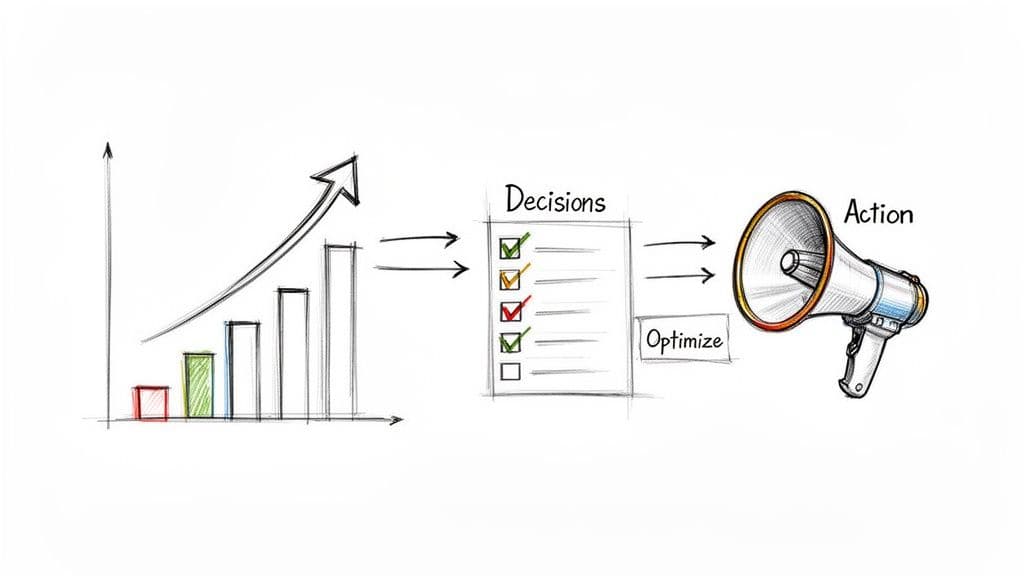
Running the numbers and calculating your social media ROI is a fantastic milestone. But it's not the finish line. The real magic happens when you start using that data to make better, more informed decisions. Anyone can collect numbers; the pros turn those numbers into an action plan that actually fuels growth.
This is where you close the feedback loop. You transform your ROI report from a simple look in the rearview mirror into a forward-looking guide for the road ahead. Every percentage and data point is a clue, showing you exactly where to put your time, energy, and budget for the biggest impact.
Crafting a Clear and Actionable ROI Report
First things first: you need to distill your findings into a report that tells a clear story. Whether you're presenting to your boss, a client, or just reviewing it yourself, the goal is clarity, not confusion. The last thing anyone wants is to get lost in a sea of spreadsheets.
A good report should visualize the most important metrics and, at a glance, answer three crucial questions:
- What did we set out to do? (e.g., Generate 50 qualified leads from X)
- What actually happened? (e.g., We generated 72 leads with a 180% ROI)
- So, what's next? (e.g., We need to double down on this content format)
A great social media ROI report doesn't just present data; it interprets it. It shines a light on the wins, takes an honest look at the losses, and lays out clear recommendations for the next campaign.
When you frame your data this way, you shift the conversation from "what happened?" to "what's next?"—and that's where the real strategic value lies.
Translating Insights into Tactical Decisions
With your report in hand, it’s time to get tactical. Think of your ROI data as a roadmap pointing directly to your most effective strategies. You're looking for patterns and outliers that signal an opportunity to either scale what’s working or fix what isn’t.
Let's walk through a few real-world scenarios and the actions they should spark.
Scenario 1: X Threads Are Knocking It Out of the Park
- The Insight: Your audience on X is clearly hungry for the in-depth, educational content you're sharing in threads. These specific posts are driving high-value clicks and conversions like nothing else.
- The Action: It's time to double down. Lean into what's working. Use a tool like MicroPoster's thread builder to create and schedule more of this high-quality content. A great shortcut is to repurpose your top-performing blog posts or videos into this proven format to squeeze even more value out of them.
Scenario 2: Tons of Engagement, but No Conversions
- The Insight: Your content is a conversation-starter. People love to like and comment, but they aren't taking that next step. There’s a major disconnect between their interest and their action.
- The Action: Your call-to-action (CTA) is likely the weak link. It’s time to experiment. Get more direct and specific. Instead of a passive "learn more," try something urgent and valuable like "Download your free template now." A/B test different CTAs to pinpoint the exact language that turns your engaged audience into actual leads or customers.
Scenario 3: One Platform Is Dramatically Outperforming the Others
- The Insight: The numbers are stark. Your ROI from Bluesky is a massive 350%, while your ROI from Mastodon is barely scraping by at 20%. It’s obvious where your ideal customer is spending their time.
- The Action: Reallocate your resources. It’s a no-brainer. Shift more of your content creation budget and ad spend toward Bluesky, your proven winner. This doesn't mean you have to abandon Mastodon completely, but it absolutely means prioritizing the channel that delivers real, measurable results.
Creating a System for Continuous Improvement
The final piece of the puzzle is turning this analysis into a repeatable process. A one-off review is good, but a continuous cycle of measuring, analyzing, and optimizing is what separates the good social media managers from the great ones.
Find a rhythm that works for you—monthly or quarterly is a solid starting point for most. During each review, compare your current performance against past results and your own benchmarks. Are things trending up? Are new patterns emerging? This consistent check-in ensures your strategy never gets stale.
This systematic approach takes the guesswork out of social media marketing. It gives you the confidence to make data-backed decisions that consistently boost your performance and prove the immense value of your work. By using your ROI data as a strategic compass, you can ensure every post and campaign is a calculated step toward greater profitability.
Common Questions About Social Media ROI
Even with the best playbook, you're bound to hit a few stumbling blocks when you get into the weeds of measuring social media ROI. Let's walk through some of the questions I hear most often from clients and peers to help you get unstuck.
What If I Don’t Sell Products Directly?
This is a big one, especially for consultants, B2B businesses, and anyone in a service-based industry. When there's no "add to cart" button, it can feel impossible to pin down your return. The secret is to work backward and assign a dollar value to your most critical conversion goals.
Think about what a new lead is really worth to you. Dig into your own data. If you know that, on average, one out of every ten qualified leads turns into a paying customer, and your average customer value is $2,000, then every single lead is worth $200. Simple as that.
You can apply this same kind of thinking to other key actions:
- Newsletter Sign-ups: Does your email list bring in about $10,000 a year? If you have 2,000 subscribers, each one has an approximate value of $5.
- Booked Discovery Calls: Let's say you close 25% of your calls and a new client is worth $5,000. That means every call somebody books in your calendar is potentially worth $1,250.
By tracking these "micro-conversions," you're not just measuring vanity metrics; you're calculating a real, meaningful ROI that reflects how social media actually moves the needle for your business.
What’s a Good Social Media ROI Benchmark?
Everyone wants to know how they stack up. While it definitely shifts depending on your industry and business model, a commonly cited benchmark is a 5:1 ratio. That means for every $1 you put in, you get $5 back—a 500% ROI. Some broader studies suggest the average is closer to 420%.
But here’s the thing: the only benchmark that truly matters is your own. A "good" ROI is completely tied to your profit margins. For some, 3:1 is fantastic. For others, they need 10:1 to make it worthwhile. The real goal is consistent improvement.
Focus on beating your own numbers from last quarter. That internal progress is far more valuable than getting hung up on industry-wide averages.
How Often Should I Calculate My ROI?
Finding the right rhythm for reporting is key. If you do it too often, you'll drive yourself crazy with daily fluctuations. Too infrequently, and you'll miss opportunities to pivot.
For most businesses, running the numbers on a monthly or quarterly basis is the sweet spot. It gives you enough data to see real trends and make smart, strategic decisions.
The exception? Short-term campaigns. If you're running a specific product launch or a holiday sale, you'll want to calculate the ROI as soon as it wraps up. This gives you immediate feedback on what worked (and what didn't), so you can roll those learnings right into your next campaign.
Ready to stop guessing and start proving what your social media is really worth? MicroPoster gives you the unified content studio and analytics to see exactly what’s working on X, Bluesky, and Mastodon. You can finally track your efforts, optimize your strategy, and show the true value you're creating. Start your free 7-day trial and see the difference today.