
best time to post on twitter
8 Data-Backed Tips to Find the Best Time to Post on Twitter in 2025
Stop guessing and find the best time to post on Twitter. Discover data-backed posting times, testing methods, and tools to maximize your engagement.
You've crafted the perfect tweet: insightful, witty, and ready to spark conversation. You hit 'Post' and... crickets. The problem might not be your content, but your timing. Posting on Twitter (now X) at the right moment is the difference between going viral and getting lost in the digital noise. Understanding the best time to post on Twitter isn't about finding a single magic hour; it's about strategically aligning your content with your audience's daily habits and online behavior.
While countless studies point to general 'best times,' the real magic happens when you understand the science behind why those times work and how to find the unique window when your audience is most engaged. Simply posting when a generic chart tells you to is a shot in the dark. Your B2B audience in New York has a completely different scrolling pattern than a community of gaming enthusiasts in California. True growth comes from moving beyond one-size-fits-all advice and building a schedule based on your own data.
In this comprehensive guide, we'll break down 8 data-backed strategies to pinpoint the best time to post on Twitter for maximum impact. We will cover everything from universal peak engagement windows and the psychology of weekday scrolling to specific tactics for A/B testing your schedule. You'll learn how to create a personalized, data-driven posting plan that consistently connects with your followers and drives results. Forget the guesswork; it's time to start posting with intention and precision.
1. Post During Peak Hours (9 AM - 3 PM on Weekdays)
If you're looking for a reliable, data-backed starting point, the most widely accepted best time to post on Twitter is during the traditional workday. The 9 AM to 3 PM weekday window consistently shows high user activity, making it a foundational strategy for anyone aiming to maximize initial reach and engagement. This timeframe aligns perfectly with the daily routines of a vast majority of users, including professionals, students, and casual browsers.
Think about the typical daily schedule. People often start their day by scrolling through their feeds during their morning commute or as they settle into their desks. The midday lunch break, typically between 12 PM and 2 PM, represents another significant peak in activity. During these hours, users are actively looking for content to consume, making it a prime opportunity for your posts to get noticed, liked, and retweeted.
Why This Window Works
The effectiveness of this timeframe is rooted in widespread behavioral patterns. Research from industry leaders like HubSpot and Sprout Social consistently points to these hours as periods of high engagement.
- B2B Content: HubSpot's social media research highlights that B2B brands often see the best results between 11 AM and 1 PM, when decision-makers are taking a mental break from work and catching up on industry news.
- General Audiences: Studies from Buffer have shown that engagement peaks around noon, with secondary spikes in the late afternoon (5 PM - 6 PM) as the workday concludes.
Key Insight: Posting during the 9 AM to 3 PM window leverages the "captive audience" effect. Users are already on the platform, actively seeking distraction or information during natural lulls in their workday.
Actionable Implementation Tips
To make the most of this strategy, don't just post randomly within this six-hour block. Precision is key.
- Pinpoint Your Audience's Time Zone: If your audience is primarily in New York (EST), posting at 9 AM PST is too late. Use Twitter/X Analytics to identify where most of your followers are located and schedule your content in their local time zone.
- Test Micro-Windows: The 9 AM to 3 PM slot is broad. A/B test specific times within it. For one week, post your most important content at 9:15 AM. The next week, try 12:30 PM. Analyze which time slot consistently delivers better metrics.
- Schedule in Advance: Use a tool like MicroPoster or the native X scheduler to queue your content. This ensures you hit these optimal times consistently, even if you are busy.
- Align Content to the Time: Schedule industry news or thought leadership pieces for the morning when users are in a professional mindset. Lighter, more engaging content like polls or questions may perform better during the lunch hour.
2. Leverage Evening Engagement (5 PM - 11 PM)
While the workday is a primary hotspot for Twitter activity, ignoring the evening hours means missing out on a massive, highly engaged audience segment. The 5 PM to 11 PM window represents a secondary peak where users unwind, catch up on the day's events, and seek entertainment. This timeframe offers a distinct opportunity to connect with audiences in a more relaxed, conversational context.
As the workday ends, people shift from professional tasks to personal leisure. They scroll through their feeds during their commute home, while making dinner, or relaxing on the couch. This period is less about B2B industry news and more about hobbies, entertainment, and personal interests, making it an ideal slot for a different type of content strategy to find the best time to post on Twitter.
Why This Window Works
The power of evening engagement comes from a shift in user mindset and behavior. Data from social media analytics platforms like Hootsuite and Sprout Social confirm that this after-hours window is prime time for specific industries.
- Entertainment & B2C: Hootsuite studies show that entertainment and consumer-focused brands often see their highest engagement between 5 PM and 7 PM, as users are actively looking for diversion and shopping inspiration.
- News Cycles: Major news outlets frequently drop significant stories around 6 PM to 7 PM to align with evening news broadcasts and capture the attention of people catching up after work.
- Food & Lifestyle: Research from Later highlights the 5 PM to 6 PM slot as a sweet spot for food and beverage brands, capitalizing on the "what's for dinner?" mindset.
Key Insight: The evening slot captures a "lean-back" audience. Users are more receptive to entertainment, community-building content, and longer-form discussions when they are not in a professional work environment.
Actionable Implementation Tips
To effectively capture the evening crowd, your approach must be tailored to their after-hours mentality.
- Segment Your Content: Reserve your more entertaining, personal, or lifestyle-focused content for these evening hours. Save the serious industry analysis for the morning and use the evening for polls, questions, and behind-the-scenes content.
- Follow Up on Morning Topics: Use evening slots to continue conversations you started earlier in the day. Ask for opinions on a topic you introduced that morning or share an update to re-engage your audience.
- Schedule for Key Evening Moments: Post a major announcement just before 6 PM to catch the initial wave of post-work scrollers. Schedule another post around 9 PM for the "second screen" audience who are watching TV and browsing Twitter simultaneously.
- Engage in Real Time: The evening is a perfect time for live engagement. Since users are more relaxed, they are more likely to participate in Twitter Spaces, Q&A sessions, or live-tweeting events.
3. Post on Tuesday Through Thursday for Maximum Impact
While specific hours are crucial, the day of the week you post is equally important. Data consistently shows that the middle of the week, specifically Tuesday, Wednesday, and Thursday, offers the highest potential for engagement. This mid-week window is a sweet spot where users have settled into their work routines but are not yet checked out for the weekend, making it the best time to post on Twitter for critical content.
Mondays are often spent catching up on emails and planning, leading to lower social media interaction. By Friday, focus shifts towards wrapping up tasks and weekend plans, causing engagement to dip again. The Tuesday to Thursday period captures your audience when they are most dialed-in, productive, and actively seeking information or a brief mental break on social platforms. This makes these days ideal for launching campaigns, sharing important announcements, or posting your most valuable content.
Why This Window Works
The superior performance of mid-week posting is backed by extensive social media research and user behavior analytics. The rhythm of the standard workweek directly influences online activity.
- Peak Professional Engagement: LinkedIn’s content research frequently identifies Tuesday and Wednesday as peak days for professional engagement, as users are actively consuming industry-related content.
- Broad Audience Activity: Comprehensive studies from platforms like Buffer and Hootsuite often pinpoint Wednesday as the day with the highest overall engagement rates for a general audience.
- E-commerce Success: Many e-commerce brands find that posts with sales links perform best when shared between Tuesday and Thursday, as consumers are more likely to be in a purchasing mindset during these days.
Key Insight: The mid-week timeframe capitalizes on peak psychological and professional focus. Users are past the Monday morning rush and not yet in the Friday afternoon slump, creating a perfect window for content consumption and interaction.
Actionable Implementation Tips
To leverage this mid-week advantage, you need to structure your content calendar strategically. Don’t just post your best content randomly; save it for when it will have the greatest effect.
- Schedule Major Announcements: Plan your most significant updates, product launches, or company news for a Tuesday or Wednesday morning to maximize visibility and initial traction.
- Focus Your Content Calendar: Build your weekly content strategy around this mid-week peak. Use these days for high-value content like threads, video clips, or blog post links.
- Use Monday for Teasers: Build anticipation by using Monday to post "coming soon" or teaser content. This warms up your audience for the main announcement planned for Tuesday or Wednesday.
- Save Promotions for Mid-Week: If you run promotions or limited-time offers, launch them during this window. Users are more likely to act on a call-to-action when they are already in an engaged and active state of mind.
4. Avoid Posting on Mondays and Fridays
While identifying the best times to post is crucial, knowing which days to avoid can be equally powerful. For many industries, Mondays and Fridays represent engagement troughs. These days often show the lowest user activity, making them a less-than-ideal choice for launching your most important content. Understanding why these days underperform is a key part of finding the best time to post on Twitter.
On Mondays, users are typically catching up from the weekend and planning their workweek, leading to a state of "information overload" where social media takes a backseat. By Friday, attention shifts away from work and professional content as people wind down and make plans for the weekend, causing a noticeable drop in engagement, particularly for B2B and B2C brands.
Why These Days Underperform
The logic behind avoiding the bookends of the workweek is supported by extensive social media research. Data consistently shows a dip in clicks, retweets, and replies.
- Monday Blues: Sprout Social's research often points to Monday mornings as having lower engagement rates compared to the mid-week peak. Users are busy with emails and meetings, not scrolling their feeds.
- Friday Fade-out: Multiple studies have shown that B2B engagement can decrease by as much as 30% on Fridays as decision-makers log off. For B2C, while some lighthearted content may work, overall focus has shifted to offline activities.
Key Insight: Treating all weekdays equally is a common mistake. By reserving your highest-value content for Tuesday, Wednesday, and Thursday, you align your strategy with natural user behavior patterns, avoiding the digital noise of Monday and the weekend exodus on Friday.
Actionable Implementation Tips
Instead of going completely silent on these days, you can adapt your content strategy to fit the lower-engagement environment.
- Reserve for Lighter Content: Use Mondays for simple, low-effort posts like a "happy Monday" message or a quick poll. On Fridays, share casual, fun, or behind-the-scenes content that aligns with the relaxed weekend mood.
- Focus on Community Engagement: Since you aren't posting promotional content, use this time to interact with your audience. Respond to comments from previous posts, engage with other accounts in your niche, and build relationships.
- Don't Launch Major Campaigns: Avoid scheduling product announcements, major blog posts, or important company news on a Monday or Friday. Save these high-stakes posts for peak mid-week windows to ensure they get the attention they deserve.
- Analyze Your Own Data: While this is a strong general rule, exceptions exist. Use Twitter/X Analytics to confirm if this pattern holds true for your specific audience. Some niches, like entertainment or hobbies, might see a Friday spike.
5. Account for Your Specific Audience's Time Zone
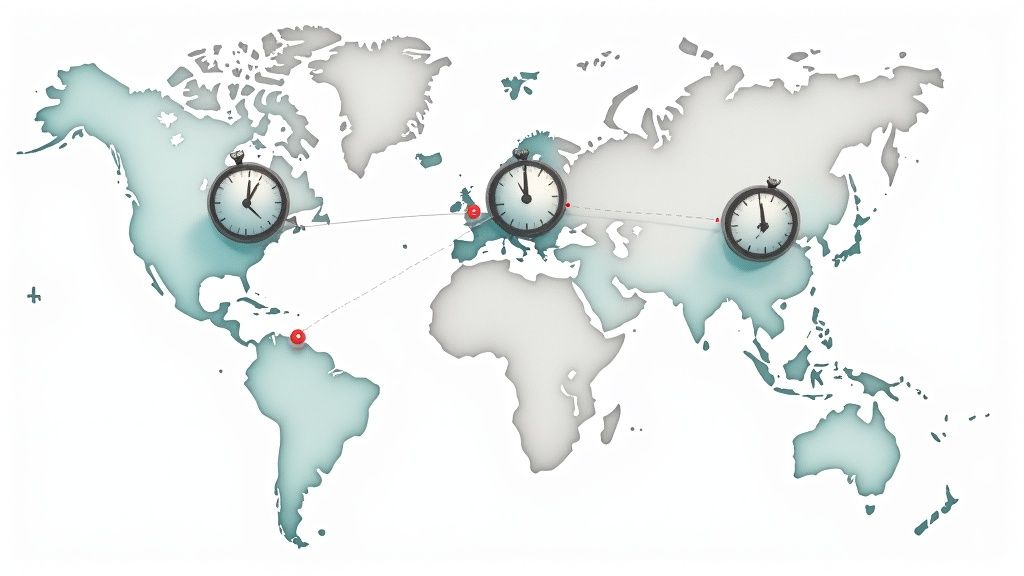
Even the most well-researched global "best times" can fail if they don't align with where your followers actually live. Generic timing advice often defaults to North American time zones, which is a major pitfall for brands with international audiences. The most effective strategy involves moving beyond general rules and analyzing where your specific followers are active, which is a crucial step in finding the best time to post on Twitter for your unique account.
This approach requires a shift from "when is Twitter busy?" to "when is my audience on Twitter?" For example, an international tech company might find that a 6 PM UTC post successfully engages followers finishing their day in Europe while also catching users starting their workday in North America. This data-driven precision ensures your content lands in front of the right people at the right time, regardless of their location.
Why This Window Works
The power of this strategy lies in its personalized nature. Instead of casting a wide, untargeted net, you are pinpointing the moments when your core audience is most likely to see and interact with your tweets. This is a common practice for global brands and accounts with diverse followings.
- Global Brands: Nike doesn’t use a single posting schedule. Its regional accounts, like @NikeUK and @NikeTokyo, post content optimized for their respective local time zones and cultural moments.
- APAC-Focused Accounts: A brand targeting audiences in Australia and Japan would see far better results posting between 7 AM and 9 AM AEDT/JST to align with local morning routines, rather than following a 9 AM EST recommendation.
Key Insight: The best time to post is not a universal constant; it is a variable defined by your audience's geography. Ignoring time zones means you are likely missing a significant portion of your followers entirely.
Actionable Implementation Tips
To effectively leverage time zone data, you need to dive into your analytics and adjust your scheduling accordingly.
- Analyze Your Follower Demographics: Use the native Twitter/X Analytics dashboard to see the country and city breakdown of your followers. This is your primary source of truth for understanding your audience's geographic distribution.
- Identify Your Top 3 Time Zones: Once you know where your followers are, identify the primary time zones they fall into. Focus your scheduling efforts on hitting the peak hours within these key regions.
- Schedule for Overlap: If you have significant followings in both Europe and North America, for instance, schedule key posts for the late morning in EST. This timing catches the North American lunch crowd and the European late afternoon/evening audience simultaneously.
- Use a Time Zone-Aware Scheduler: Tools like Sprout Social or MicroPoster allow you to see your schedule in different time zones or even recommend times based on regional audience data. This automates the process and removes the guesswork.
6. Test and Analyze Your Unique Posting Schedule with A/B Testing
While industry benchmarks provide an excellent starting point, the ultimate best time to post on Twitter is unique to your specific audience. A/B testing, or split testing, is a data-driven method that moves you from educated guesses to concrete evidence. It involves systematically posting similar content at different times and measuring which performs better, allowing you to discover your followers' true activity patterns.
This approach is critical because general statistics can't account for the nuances of your niche, content style, or the specific demographics of your followers. A tech audience in Silicon Valley will have different online habits than a community of artists in Europe. By testing, you replace broad assumptions with personalized, actionable data that reflects your account's reality.
Why This Window Works
The power of A/B testing lies in its scientific approach to optimization. It removes guesswork and bases your scheduling strategy on hard metrics. This method is a cornerstone of professional social media management and content strategy.
- Audience-Specific Data: Buffer's research on optimization emphasizes that while aggregate data is useful, individual account performance is the ultimate source of truth. A/B testing is the mechanism to uncover that truth.
- Campaign Optimization: Viral marketing teams and major brands never launch a major campaign without testing. They test multiple time slots in the weeks leading up to a launch to ensure their most important messages land with maximum impact.
Key Insight: Relying solely on industry-wide data is like using a map of an entire country to find a specific street. A/B testing is your GPS, providing precise, turn-by-turn directions to your audience's peak engagement times.
Actionable Implementation Tips
To effectively implement A/B testing, you need a methodical and consistent process.
- Isolate One Variable: The golden rule of A/B testing is to test only one thing at a time. To find your best time, keep the content type, creative, and copy as similar as possible, and only change the posting time.
- Establish a Testing Period: Test two different time slots for at least 2-4 weeks to gather enough data and account for daily fluctuations. For example, compare 10 AM performance against 4 PM performance for a month.
- Track Key Metrics: Use Twitter/X Analytics to monitor engagement rate, reach, and click-through rate for each test post. Document your findings in a simple spreadsheet to easily compare results. For a more detailed look, you can analyze your content with the MicroPoster Post Analyzer.
- Repeat and Refine: Audience behavior evolves. Repeat your A/B testing process quarterly or biannually to ensure your posting schedule remains optimized as your following grows and platform trends change.
7. Post Consistently at Multiple Times Per Day for Maximum Reach
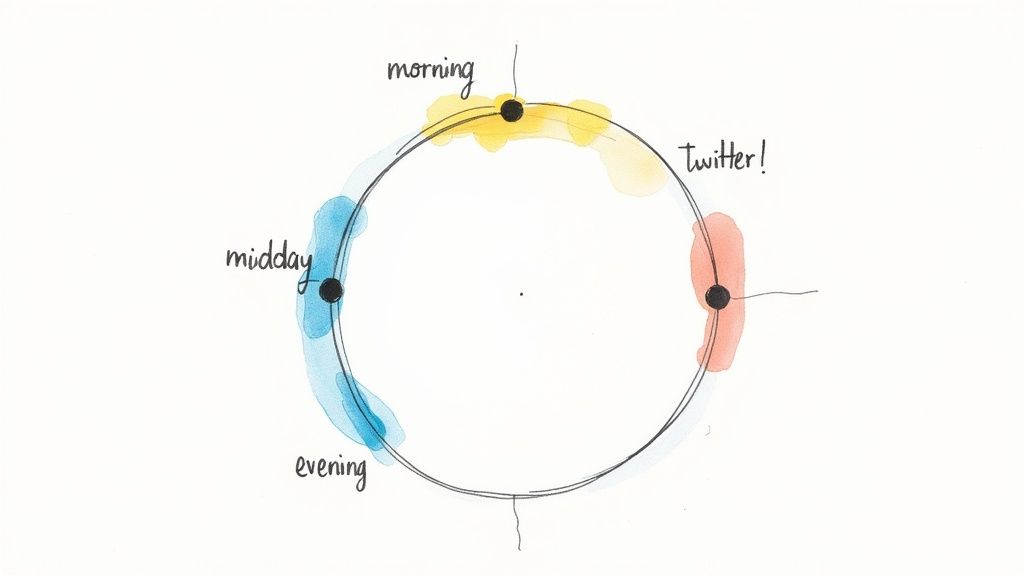
Instead of searching for a single "golden hour," a more advanced strategy is to post at multiple optimal times throughout the day. This approach recognizes that your audience isn't a monolith; different segments are active at different times. By posting strategically 2-3 times daily, you capture a much broader slice of your followers' attention, from the early morning scrollers to the late-night browsers, significantly expanding your overall reach and engagement potential.
This method moves beyond finding one best time to post on Twitter and focuses on creating a consistent presence. It ensures your content is visible to followers in various time zones and with different daily routines, preventing you from missing out on valuable impressions simply because you only posted once at 10 AM.
Why This Strategy Works
The effectiveness of multi-posting is rooted in maximizing visibility in a fast-moving feed. A single tweet has a short lifespan, so multiple posts increase the odds of being seen. This is a common practice among high-volume, successful accounts.
- Media Outlets: Major news organizations like CNN or the BBC post dozens of times per day to cover breaking news and engage with different global audiences as their days begin and end.
- Buffer's Research: Social media experts at Buffer have historically recommended posting 1-2 times per day as a sweet spot for engagement without causing audience fatigue for most brands.
Key Insight: Multiple daily posts transform your strategy from a single lottery ticket into several targeted opportunities. You catch different audience waves as they come online, maximizing your impression share for the day.
Actionable Implementation Tips
To implement this without appearing spammy, you need a disciplined and strategic approach. Quality and timing are everything.
- Start with Two Key Slots: Begin by posting twice a day. A good starting point is one post in the morning (around 9 AM) to catch the workday kickoff and another in the late afternoon or early evening (5 PM - 6 PM) to capture the commute and post-work crowd.
- Space Your Posts Adequately: Avoid posting tweets back-to-back. Leave at least 4-6 hours between your scheduled posts to give each one time to gain traction and to avoid flooding your followers' timelines.
- Use a Scheduler to Maintain Consistency: Manually posting multiple times a day is difficult. Leveraging one of the many scheduling tools for social media is essential for executing this strategy flawlessly.
- Vary Your Content Mix: Don't post three promotional tweets in a row. Mix it up. Your morning post could be an industry insight, your midday post could be a question or poll, and your evening post could be a link to your latest blog content.
- Scale with Your Audience Size: If you have under 10,000 followers, stick to 2-3 high-quality posts per day to avoid oversaturation. Larger accounts with highly engaged audiences can experiment with higher frequencies.
8. Adjust Timing for Breaking News, Trends, and Real-Time Events
While scheduling content based on peak hours is a powerful strategy, the best time to post on Twitter can sometimes be "right now." For time-sensitive content like breaking news, viral trends, and live events, immediate posting is non-negotiable. This real-time approach allows you to tap into organic momentum and conversations as they happen, achieving a level of visibility and relevance that scheduled posts simply cannot match, even if it's outside conventional peak windows.
The core principle is simple: when the conversation is happening, you need to be in it. Waiting to post about a trending topic at 9 AM the next day means you’ve already missed the peak of the discussion. Brands and media outlets that excel at this strategy understand that Twitter's value lies in its immediacy. For example, news organizations like The New York Times or the Associated Press don't wait for optimal engagement hours to report a major world event; they post instantly to inform their audience.
Why This Window Works
This strategy's effectiveness is rooted in Twitter's algorithm, which heavily favors timely and relevant content. When a topic or hashtag is trending, the platform's users are actively searching for and engaging with related posts.
- Algorithmic Boost: Posting about a trending event provides an immediate algorithmic advantage, as Twitter/X is designed to surface real-time conversations to a wider audience.
- Capturing Momentum: Brands that react quickly, like Wendy's with its witty commentary on pop culture moments, insert themselves directly into the cultural zeitgeist, earning massive organic reach and engagement.
- Event-Driven Traffic: During major events like the Oscars, the Super Bowl, or product launches, user activity skyrockets. Participating in these conversations in real-time places your content directly in front of a highly active and engaged audience.
Key Insight: For trending topics and breaking news, the "best time to post" is not determined by your analytics but by the event itself. Responsiveness trumps routine.
Actionable Implementation Tips
To effectively leverage real-time opportunities, you need to be prepared and agile.
- Monitor Trends Constantly: Use Twitter’s "Explore" tab or third-party tools to keep a close eye on emerging topics and hashtags relevant to your industry. Be ready to act fast when an opportunity arises.
- Set Up Keyword Alerts: Create alerts for industry-specific keywords, brand mentions, or competitor news. This allows you to be among the first to respond to relevant breaking stories.
- Balance Scheduled and Reactive Content: Maintain your regular posting schedule with evergreen content, but leave room in your calendar to jump on real-time trends. Don't let your pre-planned queue prevent you from being timely.
- Engage Early and Authentically: The first few hours of a trend are critical. Join the conversation early to maximize visibility. Ensure your contribution adds value, whether it’s through insight, humor, or useful information, rather than just piggybacking on a hashtag.
8-Point Twitter Posting Time Comparison
| Approach | 🔄 Complexity | ⚡ Resource Requirements | 📊 Expected Outcomes | 💡 Ideal Use Cases | ⭐ Key Advantages |
|---|---|---|---|---|---|
| Post During Peak Hours (9 AM - 3 PM on Weekdays) | Low — simple scheduling; watch time zones | Low — basic scheduling tools suffice | High 📊⭐ — highest average engagement; quick visibility | B2B/B2C announcements, daytime reach | Consistent performance; broad reach; easier to trend |
| Leverage Evening Engagement (5 PM - 11 PM) | Low — straightforward scheduling | Low — standard tools; less competition | Medium 📊 — good for lifestyle/entertainment | Entertainment, lifestyle, evening news recaps | Less competition; strong for casual browsing audiences |
| Post on Tuesday Through Thursday for Maximum Impact | Low — requires weekly planning | Low — routine calendar management | High 📊⭐ — peak weekly engagement; reliable | Major announcements, campaigns, B2B content | Predictable, cross-industry strong results |
| Avoid Posting on Mondays and Fridays | Low — deprioritize or schedule light posts | Low — no extra tools needed | Improved efficiency 📊 — reduces low-impact efforts | Resource optimization; community-only updates | Clear guidance to avoid low-engagement windows |
| Account for Your Specific Audience's Time Zone | Moderate — analytics review and segmentation | Moderate — analytics and multi-region scheduling | High 📊⭐ — engagement tailored to followers | Global brands, multinational audiences | More accurate targeting; higher relevance and reach |
| Test and Analyze Your Unique Posting Schedule with A/B Testing | High — systematic testing and control | Moderate–High — analytics, time, and tools | Very High 📊⭐⭐ — most accurate, data-driven results | Optimization projects; data-led marketing teams | Precise insights; uncovers hidden optimal windows |
| Post Consistently at Multiple Times Per Day for Maximum Reach | Moderate — cadence planning and coordination | High — ongoing content production and scheduling | High 📊⭐ — expands reach across cohorts | News organizations, active brands, campaigns | Captures diverse audiences; increases trend potential |
| Adjust Timing for Breaking News, Trends, and Real-Time Events | High — requires active monitoring and fast action | High — 24/7 monitoring and rapid response capability | High 📊⭐ — can achieve viral reach and authority | Newsrooms, live events, trend-driven marketing | Maximizes organic momentum; establishes leadership |
Automate Your Perfect Timing and Publish Smarter with MicroPoster
Navigating the complexities of Twitter's algorithm to find the best time to post on Twitter can feel like trying to hit a moving target. As we've explored, the ideal posting window isn't a static, universal rule. It's a dynamic blend of general best practices, audience-specific habits, and real-time adjustments. Relying solely on broad advice like "post between 9 AM and 3 PM on weekdays" is a starting point, but true optimization requires a more personalized approach.
The real power lies in combining these foundational principles with a deep understanding of your own community. This means acknowledging peak business hours while also testing evening and weekend slots, accounting for time zones, and consistently analyzing your performance data. The most successful creators don't just post and hope; they build a strategic framework based on observation and iteration.
From Theory to Action: Your Path Forward
The journey from generic advice to a fine-tuned, data-driven schedule involves several critical steps. It’s about moving beyond simply knowing the best time to post on Twitter and actively discovering your best time.
Here are the key takeaways to implement immediately:
- Establish a Baseline: Start with the widely accepted peak windows (mid-morning and early afternoon on Tuesdays, Wednesdays, and Thursdays) to create an initial schedule. This gives you a solid foundation from which to measure future changes.
- Commit to A/B Testing: Don't treat your schedule as permanent. Systematically test different time slots. For example, dedicate one week to posting at 9 AM and the next to posting at 1 PM. Use your Twitter Analytics to compare impressions and engagement rates for each slot. This is the only way to get conclusive data for your specific account.
- Analyze and Adapt: Your audience's behavior will evolve. What worked three months ago might not be optimal today. Make it a monthly or quarterly habit to review your analytics. Look for new patterns. Did a weekend post unexpectedly perform well? Has your evening engagement increased? Adjust your strategy based on these fresh insights.
Key Insight: Mastering your posting schedule isn't a one-time fix; it's an ongoing process of listening to your data. Your analytics are a direct line of communication from your audience, telling you exactly when they are most receptive to your content.
The Challenge of Manual Optimization and the Smarter Solution
While this manual process of testing and analyzing is effective, it’s also incredibly time-consuming. Juggling spreadsheets, manually checking analytics, and setting constant reminders can quickly lead to burnout, pulling your focus away from what really matters: creating high-quality content and engaging with your followers.
This is where automation and intelligent tools become indispensable. Instead of getting bogged down in the "when," you can leverage technology to handle the heavy lifting. A platform like MicroPoster is designed specifically to solve this problem. It doesn't just give you a scheduler; it provides a strategic command center for your microblogging presence.
Its 'Best Time to Post' feature analyzes your account’s historical engagement data to pinpoint the precise hours and days your followers are most active. It removes the guesswork and provides a clear, actionable schedule tailored to your audience. By integrating these data-driven recommendations with an intuitive content calendar, you can confidently schedule your content for maximum impact across Twitter/X, Bluesky, and Mastodon, ensuring your message always lands at the perfect moment.
Ready to stop guessing and start scheduling with data-backed precision? MicroPoster analyzes your unique audience to reveal your personal best times to post and lets you automate your entire content calendar. Sign up for a free trial at MicroPoster and transform your Twitter strategy today.


