
Ever feel like you're stuck on a content treadmill, constantly copying and pasting the same update across a dozen different social media accounts? That's a huge time sink, and it's exactly the problem automatic cross-posting was designed to solve.
What Is Automatic Cross Posting and Why It Matters
At its core, automatic crossposting is the process of automatically sharing content from one social media platform (like Instagram, X, or a blog) to others (like Facebook, Bluesky, Threads) using third-party tools (like MicroPoster), saving time while expanding a consistent presence across networks.
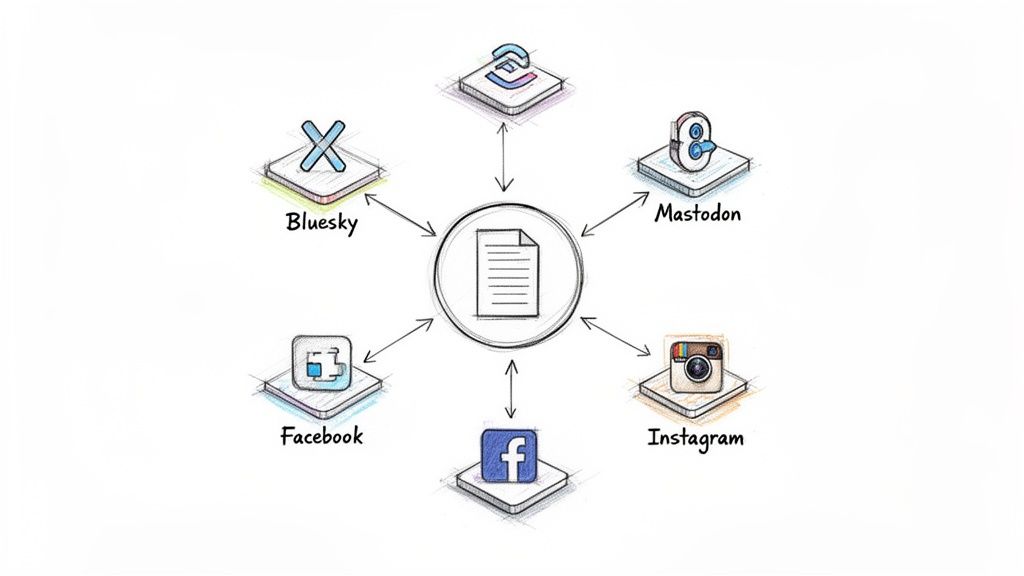
Think of it as a content distribution hub. You create the message once, and a dedicated system handles the legwork of getting it in front of all your different audiences. This isn't just a neat trick; it’s a necessary strategy for anyone trying to stay relevant today.
The Challenge of Modern Content Frequency
The pressure to be everywhere all at once is real. Algorithms favor consistency, and your audience is spread thin. The average person hangs out on 6.84 social platforms every month, and the conventional wisdom for brands is to churn out between 48 and 72 posts per week just to stay visible.
It sounds intense, but the data backs it up. Accounts that post ten or more times a week can see nearly 24% more reach per post. You can dig deeper into these social media trends to see just how much frequency impacts growth.
For a solo creator or a small team, manually hitting those numbers is a direct path to burnout. It leaves no room for the important stuff, like actually talking to your followers or coming up with new ideas.
Automatic cross-posting tackles this head-on. It lets you turn one great piece of content into multiple touchpoints across the web, making the marathon of multi-platform management feel more like a sprint.
To see the difference in black and white, let's compare the two approaches.
Manual Posting vs Automatic Cross Posting At a Glance
This table provides a clear, at-a-glance comparison highlighting the key differences in time investment, consistency, reach, and potential for error between manual posting and using an automated solution.
| Aspect | Manual Posting | Automatic Cross Posting |
|---|---|---|
| Time Investment | High; requires logging into each platform and posting individually. | Low; "post once, publish everywhere" saves hours per week. |
| Consistency | Prone to gaps and missed posts when busy. | Effortless; maintains a steady content flow across all channels. |
| Reach | Limited by the time available to post on each network. | Maximized; easily reaches audiences on less-frequented platforms. |
| Error Potential | Higher; risk of copy-paste errors or forgetting a platform entirely. | Minimal; system ensures the same message goes out as intended. |
Looking at it this way, it’s clear that sticking to a manual process means leaving a lot of efficiency and potential reach on the table.
Bridging the Gap With Automation
This is where automation shifts from being a "nice-to-have" to a core part of your strategy. By setting up a reliable cross-posting workflow, you can:
- Maintain a consistent presence: Your profiles stay active and buzzing, even when you’re focused on other things.
- Expand your reach: You can connect with people on platforms you’d normally neglect because you just don't have the time.
- Reclaim valuable time: Free yourself from the mind-numbing task of republishing content and get back to strategy and community building.
Ultimately, automatic cross-posting isn't about being lazy. It’s a smart, strategic way to achieve the kind of post frequency that drives real growth, helping you build a wider, more consistent online presence without losing your sanity in the process.
The Fine Line Between Smart and Spammy Cross-Posting
Let's be honest: the most common mistake with automatic cross-posting is just blasting the exact same message everywhere. It feels efficient, but this "one-size-fits-all" method usually falls flat. It can make your brand seem disconnected or, worse, robotic. There's a huge difference between smart content distribution and what your followers will quickly label as spam.
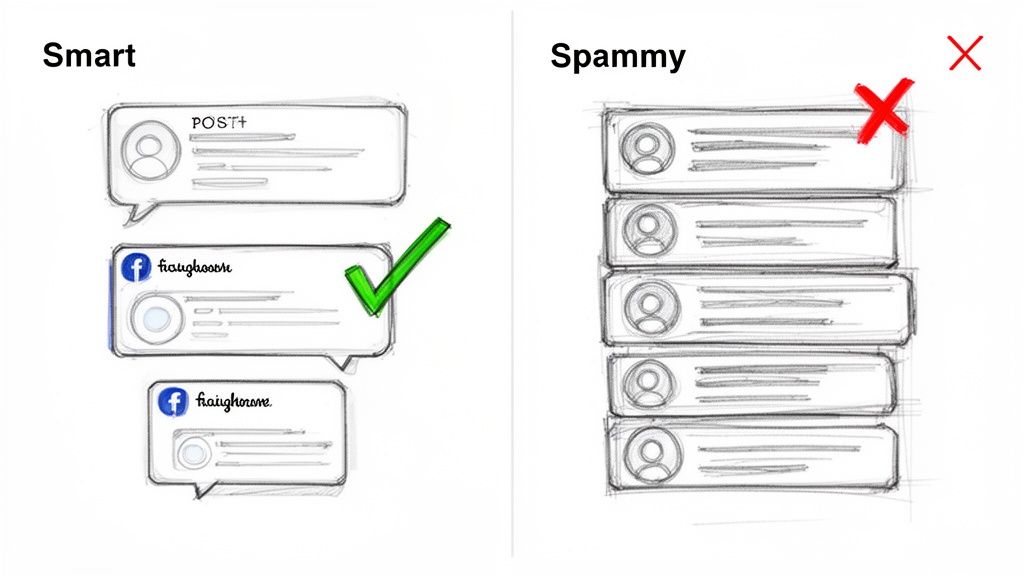
The secret to getting it right is respecting the unique culture of each social media platform. What absolutely kills it on one network can be a total ghost town on another.
Why Every Platform Has Its Own Vibe
Think of social networks as different rooms at a party. Each one has its own dress code, inside jokes, and conversation style. A quick, punchy 280-character post that gets tons of engagement on X will feel out of place next to a beautifully curated visual story on Instagram or a thoughtful industry update on LinkedIn.
Trying to force the same content everywhere is like showing up to a black-tie gala in beachwear—you'll stand out for all the wrong reasons. The numbers back this up. A massive study of over 70 million posts proved that content created with the platform in mind always beats generic, copy-pasted posts. You can dive deeper into platform-specific social media benchmarks to see just how different user behavior can be.
Smart cross-posting isn't about duplicating your content. It's about adapting it. The real goal is to make every post feel like it was born on that platform, even if the core idea came from somewhere else.
This means your automation needs to be a lot smarter than a simple copy-paste job.
Moving From Robotic to Authentic Automation
This is where truly effective automatic cross-posting shines. The best tools don't just syndicate content; they intelligently reformat it for each destination network. This is the critical step that separates genuinely helpful automation from spam.
Instead of just mirroring a post, a smart system can make small but powerful adjustments automatically.
Here’s what that looks like in practice:
- Smart Threading: A long-form idea or blog post can be automatically sliced into a numbered, native thread for X or Bluesky. This makes it digestible and invites conversation, rather than just being a clunky link.
- Hashtag Customization: The system might apply a broad set of popular hashtags for an Instagram post but then switch to a few niche, community-driven tags for a platform like Mastodon.
- Proper Mentioning: It can also translate an X handle like
@usernameinto the correct format for other networks, making sure your tags actually work and notify the right people.
These little tweaks make a world of difference. Your automated content suddenly feels native and intentional, not like a lazy shortcut. It looks like you crafted it specifically for that audience, which helps build real connections and drives far better engagement.
This thoughtful approach turns cross-posting from a basic time-saver into a powerful growth strategy. Tools built for this purpose, like the auto-crosspost feature in MicroPoster, are designed to handle this kind of nuanced automation for you.
What Are the Real Benefits of Automating Your Content Distribution?
Putting a smart automatic cross-posting strategy into practice isn't just a theoretical win; it delivers concrete advantages you can feel immediately. This is about working smarter, not just posting more often. The benefits quickly cascade through your entire content process, changing the game for how you manage your online presence.
The most obvious and immediate benefit is the sheer amount of time you get back. Think about a startup founder who sinks over ten hours a week just copying, pasting, and tweaking posts for X, Bluesky, and Facebook. Automation gives those hours back, freeing them up for what really matters—creating great content and actually talking to their community.
Better Consistency, Wider Reach
Social media algorithms love consistency. When your accounts go dark, your visibility plummets. An automated workflow guarantees a steady drip of content that keeps your brand visible and top-of-mind, even when you're tied up with other projects.
This consistency is the fuel for expanding your reach. By pushing content to secondary platforms you might normally ignore, you can tap into entirely new audiences. A creator might find a surprisingly active and engaged community on Bluesky that they simply wouldn't have had the time to discover otherwise.
A Single Hub for a Smarter Strategy
One of the most powerful, yet often overlooked, benefits is having a central command center for all your content. Instead of posts being siloed on different platforms with no single source of truth, an automation tool gives you one unified dashboard. From here, you get a bird's-eye view of everything you're putting out there.
This centralized approach lets you manage your content as a complete system, not just a list of disconnected chores. You can plan, schedule, and review your multi-platform strategy from one spot, making sure your messaging is always on point.
To get the most out of these perks, it helps to see how they fit into a larger plan to scale content marketing for real growth, moving you toward a more predictable, systems-based approach. You can dive deeper into this topic in our guide on how to automate social media posts.
When you boil it down, these four benefits—saving time, staying consistent, reaching more people, and having centralized control—all work together to build a far more effective and sustainable engine for distributing your content.
How to Build Your Automatic Cross Posting Workflow
Alright, let's move from theory to practice. Building an effective automatic cross posting workflow isn't complicated. It’s really just about creating a smart system that makes your content distribution efficient and intentional. If you follow a few logical steps, you can set up a powerful engine to drive your social media presence.
The whole point of this process, from creation to distribution, is to save time, get your content in front of more people, and keep your messaging consistent.
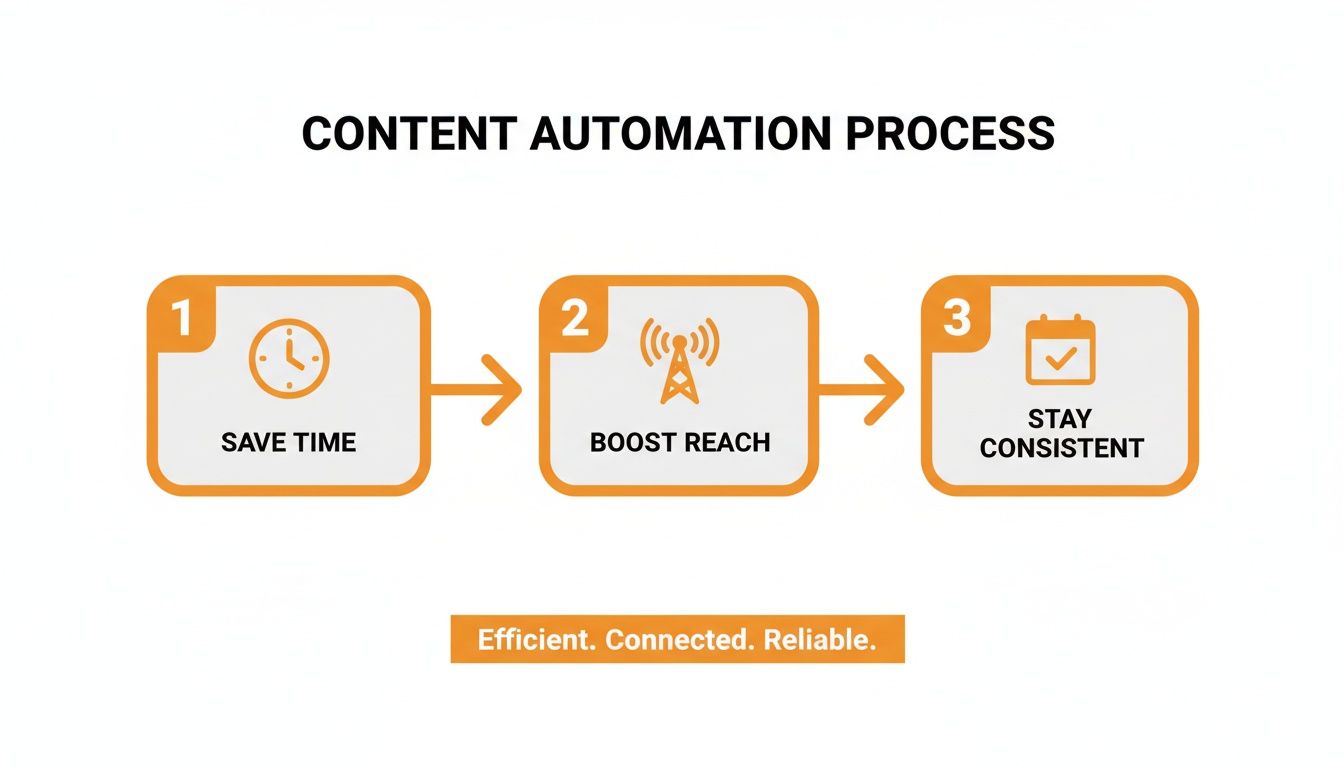
This flow really gets to the heart of automation—it’s all about turning your content efforts into a repeatable, scalable system that works for you.
Step 1: Choose Your Primary Platform
First things first, you need to decide on your content's "home base." This is the platform where your ideas start and where you post your most important stuff first. For a lot of creators and brands who focus on text-based content, this is usually X (formerly Twitter), a blog, or a specialized microblogging app.
Pick the platform where you feel the most creative and comfortable. Think of it as the launchpad for your entire automated distribution chain.
Step 2: Select Your Secondary Platforms
Next up, be strategic about where else you want your content to go. Don't just blast it out to every platform under the sun. Instead, focus on the networks where your target audience actually hangs out. Are they scrolling through Bluesky, Threads, Mastodon, or Facebook?
The goal here is to be present where it actually matters. Each secondary platform should have a purpose, whether that’s reaching a totally new audience or just connecting with your existing community in a different space.
Step 3: Define Your Content Rules
This is the crucial step where you go from simple copy-pasting to smart syndication. You need to set clear rules for what gets cross-posted and how. For example, you might decide that all your major announcements go everywhere, but your random thoughts or replies to others stay exclusive to your primary platform.
These rules act as guardrails, helping you maintain an authentic voice across channels. They stop your automated posts from feeling spammy and make sure the right message lands in the right place, respecting the vibe of each network.
A well-defined workflow isn't just about pushing buttons faster. It’s a deliberate strategy that turns your content into a powerful, multi-channel asset that feels native everywhere it appears.
Step 4: Pick the Right Tool for the Job
Finally, you need a tool that can execute your plan without a hitch. While generic schedulers can handle basic posts, they often fall short when it comes to the specific needs of microblogging. This is where a purpose-built tool like MicroPoster really shines, as it's designed specifically for the text-first world.
It has features that most generic tools just don't, like a unified content studio and automatic reformatting. These are built to handle the unique quirks of platforms like X and Bluesky. This lets you write a post once and trust that it will be intelligently adapted—like turning a long post into a proper thread—for each platform you send it to.
To see how you can implement smarter automation, exploring tools with features like the Sprout Social AI Features can also give you a big leg up. By choosing a tool that aligns with your strategy, you’re setting up a system that works for you, not against you. For a deeper dive, check out our related guide on automated content distribution.
Best Practices and Common Mistakes to Avoid
Putting a successful automatic cross posting strategy into action is more art than science. It's not about just flipping a switch; it's about building a system that feels authentic and genuinely serves your audience on each platform. The whole point is to balance the efficiency you gain with a thoughtful approach, sidestepping the common traps that can make your content feel robotic or out of place.
Ultimately, you want every single post, no matter where it lands, to feel like it was made specifically for that platform. That means respecting the unwritten rules and audience expectations of every community you're a part of.
Essential Best Practices for Success
To keep your automated content from feeling, well, automated, you’ll want to build a few key habits. Think of these as the guardrails that keep your brand’s voice consistent and professional, no matter where you're posting.
- Tailor Your Call-to-Action (CTA): Shouting "link in bio" works perfectly on Instagram, but it makes zero sense on X or Bluesky where you can just drop a link. Always customize your CTAs to give your audience clear, platform-appropriate directions.
- Engage with Comments Everywhere: You've automated the posting, not the conversation. You still have to show up. Make it a priority to reply to comments on your syndicated posts to prove there's a real person behind the account who's actually listening.
- Use Analytics to Refine Your Strategy: Pay close attention to what's working and where. If your witty memes kill it on one platform but get crickets on another, it's time to adjust your cross-posting rules. Let the data guide you.
Following these practices helps you build a cross-posting engine that doesn't just save you a ton of time but actually deepens your connection with your communities.
Smart automation frees you from repetitive tasks so you can focus on high-impact activities like engagement and strategy. It's a tool to amplify your presence, not replace it.
Common Mistakes That Undermine Your Efforts
On the flip side, a few common pitfalls can quickly turn your streamlined workflow into a mess. Just being aware of these mistakes is the first step toward avoiding them and keeping your online presence sharp.
One of the biggest and most frequent blunders is forgetting to check the formatting. A beautifully crafted post on your main platform can instantly become a jumbled wall of text and broken links when it lands somewhere else. This is where tools with smart reformatting, like the MicroPoster auto-crosspost feature, are a lifesaver—they're built to adapt your content to each platform’s quirks automatically.
Other classic mistakes to steer clear of:
- Posting Time-Sensitive News Too Late: If you’re sharing breaking news, an automated delay can make you look completely out of the loop.
- Using Generic Hashtags Everywhere: A hashtag that’s trending on X might be totally irrelevant on LinkedIn or Mastodon. Always customize your tags.
- Ignoring Platform-Specific Features: Don't forget about powerful native features like polls, live video, or interactive stickers that can't be easily cross-posted. Mix in some native content to keep things fresh.
Avoiding these simple errors will make sure your automated content always looks polished and intentional. That little bit of extra care is what separates a smart distribution strategy from one that just feels like spam.
To give you a quick cheat sheet, here’s a breakdown of what to do versus what to avoid.
Cross Posting Do's and Don'ts
| Do | Don't |
|---|---|
| Customize CTAs for each platform's unique format and audience expectations. | Use a one-size-fits-all CTA like "link in bio" on platforms where it's irrelevant. |
| Actively engage with comments and replies on all your syndicated posts. | "Set it and forget it." Ignoring the community conversation defeats the purpose. |
| Review analytics to see which content resonates best on each specific network. | Assume what works on one platform will automatically work everywhere else. |
| Adjust formatting to look native, including line breaks, links, and mentions. | Post a "wall of text" that was clearly formatted for a different platform. |
| Schedule evergreen content to maintain a consistent presence across channels. | Automate breaking news without checking for timeliness; a delay can make you look slow. |
| Mix in native posts that use platform-specific features like polls or stories. | Rely 100% on automation and miss out on valuable engagement features. |
Think of this table as your go-to guide. Keeping these points in mind will help ensure your cross-posting efforts build your brand up rather than unintentionally tearing it down.
The Future of Cross-Posting Is All About Community
When we talk about automatic cross-posting, it’s easy to get fixated on efficiency. But the real win here isn't just about saving time; it's about what you do with that time.
Think of it this way: automation isn't meant to replace the human element of your brand. It’s designed to handle the repetitive, manual work so you can double down on what actually matters—building a real community.
By letting a smart system manage the logistics of getting your content out there, you're free to dive into the comments, spark conversations, and build the kind of authentic relationships that create loyal followers.
Shifting Focus from Virality to Value
This approach fits perfectly with a larger shift we're seeing online. The game isn't just about chasing viral hits anymore. Instead, the most successful creators and brands are nurturing smaller, more dedicated communities.
Smart automation makes this possible. It gives you the consistency you need to stay visible, while also creating the breathing room to be present and responsive. In a world where people crave direct interaction, that’s everything.
The data backs this up. Messaging on platforms like TikTok and Instagram has shot up by 58% and 23%, respectively, showing a clear preference for one-on-one engagement. And consider this: brands that answer comments within 24 hours see a 47% higher engagement rate on their next posts. You can dig deeper into these social media marketing statistics to see just how much responsiveness matters.
The real power of automation isn’t speaking at more people. It's creating the space to speak with them.
A tool like MicroPoster’s auto-crosspost feature is built on this idea. It takes care of the distribution so you can take care of the conversations. That’s how you build a community that doesn't just follow you, but actually sticks around.
Got Questions About Cross-Posting? We've Got Answers.
Even after laying out the perfect strategy, a few questions might still be bouncing around in your head. Let's tackle some of the most common ones so you can move forward with confidence.
Will Cross-Posting Wreck My SEO?
Short answer: Nope. Posting your content on social media isn't going to hurt your website's SEO.
Search engines like Google are smart enough to know the difference between a blog post and a social media update. They see social platforms as distribution channels, so they don't penalize you for what looks like "duplicate content" there. The goal on social media is to get people talking and clicking, not to rank your individual tweets in search results.
Does Automating My Posts Make Me Look Lazy?
It absolutely can, but only if you do it badly. Just blasting the same block of unformatted text to every single platform is a dead giveaway, and it feels spammy to your audience.
But when you use automatic cross-posting intelligently, it’s a completely different story. Imagine a tool that takes your main post and automatically turns it into a perfectly formatted native thread for one platform, then adds the right hashtags for another. That doesn't look lazy; it looks like you're a pro who understands how each network works.
The secret is to use a tool built for smart adaptation, not just mindless duplication. When every post feels like it belongs on the platform where it appears, your audience won't even think about automation. They'll just see great content, consistently.
Isn't It Better to Post Less Often, but Make It Perfect and Native?
Creating unique, native content is the gold standard, no doubt about it. But in the real world, consistency often beats perfection. The algorithms favor accounts that show up regularly, and your audience is more likely to stay engaged if they hear from you often.
Smart automation gives you the best of both worlds. It handles the heavy lifting of maintaining a consistent posting schedule, making sure everything is formatted beautifully for each platform. This frees you up to focus your creative energy on those high-impact native posts—the ones that use special features like polls, live video, or interactive Q&As. It's about finding a balance, and the right tool makes that balance possible.
Ready to stop manually copying and pasting and start building a smarter content workflow? MicroPoster has a powerful auto-crosspost feature that intelligently adapts your content for X, Bluesky, and Mastodon. Give it a try and see just how much time you can get back.