
what makes a good hook
What Makes a Good Hook and How to Write One
Learn what makes a good hook with proven formulas and psychological principles. Stop the scroll on X, Threads, and Bluesky with hooks that work.
A great hook isn't just a clever opening line. It’s a strategic move designed to spark curiosity, forge an instant emotional connection, or make a bold promise that the reader can't ignore.
The magic of a good hook is its ability to stop the scroll. It triggers an immediate psychological response within the first 3 seconds, forcing a reader to pause and invest their attention.
The Anatomy of a Scroll-Stopping Hook
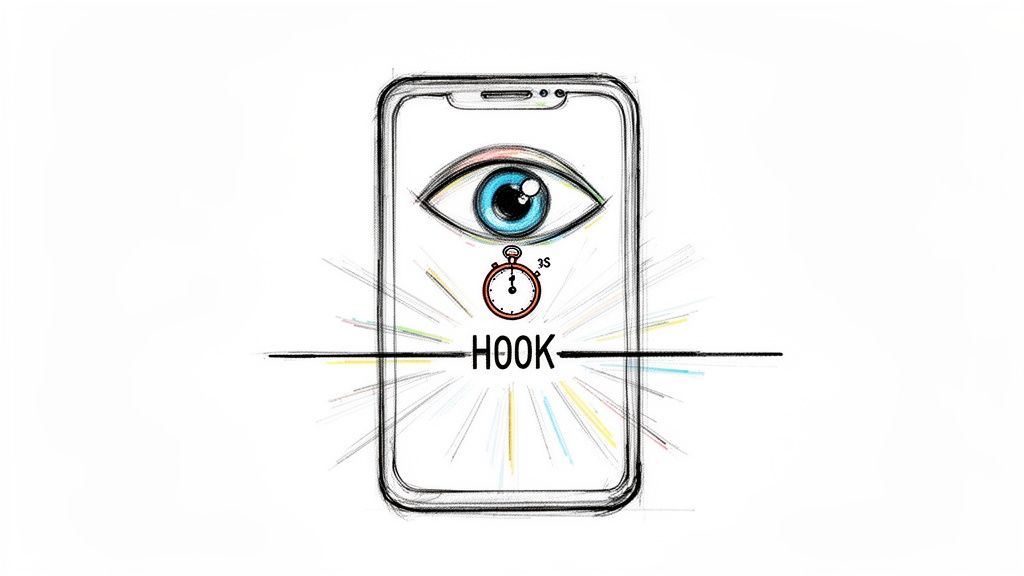
In the rapid-fire world of microblogging, your content is in a constant battle for eyeballs. Every user is scrolling, and you have just a sliver of a moment to make them stop.
Think of a hook as the literary version of a movie trailer. It has one job: grab you instantly and give you a compelling reason to stick around for the main feature. If it doesn't break someone's mindless scrolling pattern, it has failed.
The difference between a post that gets ignored and one that goes viral often comes down to that first sentence. Imagine someone flying through their X (formerly Twitter) feed. Posts with powerful hooks that grab attention in those first 3 seconds can see a 300% higher engagement rate than those with weak openers.
It's not just a guess—it's backed by data. An analysis of millions of posts showed that while the average reach on X is pretty low, tweets starting with a provocative question or a shocking stat can launch their impressions by up to 450%.
Core Components of an Effective Hook
So, what are the building blocks of these attention-grabbing openers? A hook that works is never an accident. It’s a carefully constructed combination of a few key elements designed to get a reaction.
Let's break down these core parts. Understanding them is the first step to writing hooks that consistently perform.
This quick table sums up the essential ingredients.
The Core Elements of an Effective Hook
| Element | What It Does | Why It Works |
|---|---|---|
| Clarity | Instantly tells the reader what the post is about. | Confusion is the ultimate scroll-inducer. People need to know the topic and stakes immediately. |
| Curiosity | Creates a knowledge gap or an unanswered question. | Our brains are hardwired to seek answers and close open loops. We have to know what happens next. |
| Relatability | Connects to a problem, desire, or emotion the reader already feels. | It signals, "This is for you." People pay attention when they feel seen and understood. |
| Promise | Signals that the content will deliver real value. | It assures the reader their time won't be wasted. They'll get a solution, an insight, or entertainment. |
As you can see, these components work together to create a powerful first impression. To truly get this right, you can also explore some proven tips to boost social media engagement, which reinforce just how critical that opening line really is.
The Psychology Behind Why Hooks Work
Ever scroll through your feed and a single sentence just stops you in your tracks? That’s not an accident. The best hooks aren't just clever; they're rooted in basic human psychology, tapping into the way our brains are wired to pay attention.
When you understand what makes people tick, you stop guessing and start creating hooks with surgical precision. It's the difference between hoping for engagement and engineering it. Let's break down the core psychological triggers that make a hook impossible to ignore.
The Power of the Curiosity Gap
The most potent tool in a writer's toolkit is the Curiosity Gap. It's that nagging feeling you get when you realize there's a space between what you know and what you need to know. A great hook pries open that gap and promises to fill it.
Think of it as a mini-cliffhanger. When a hook says something like, "The single biggest mistake 99% of creators make..." it opens a loop in your brain. You can't help but feel a pull to close that loop, and the only way to do it is to keep reading.
A hook is an invitation to solve a puzzle. When you present an intriguing problem or an incomplete picture, you activate the brain's natural desire for resolution and clarity, compelling the reader to seek the answer within your content.
Sparking an Emotional Connection
Logic makes people think, but emotion makes them act. Beyond simple curiosity, truly magnetic hooks create Emotional Resonance. We're hardwired to respond to content that makes us feel something, whether that's excitement, anger, validation, or just plain surprise.
A hook that connects with a shared feeling creates an instant bond. Starting a post with "Feeling like you're posting into the void?" immediately tells every creator who's ever felt ignored, "I get it." It’s a shortcut to building trust and rapport.
This isn't just theory; it’s backed by data. An analysis of 1.3 million posts found that hooks triggering strong emotions like controversy or FOMO (fear of missing out) drive 28% more engagement than neutral ones. On platforms like X, that emotional spark can be the key to breaking through the noise. You can dive deeper into the numbers in this full social media marketing study.
Challenging Beliefs with Cognitive Dissonance
Ready for a more advanced technique? Let's talk about Cognitive Dissonance. This is the mental friction we feel when new information crashes against our long-held beliefs. It's uncomfortable, and our brains desperately want to resolve the conflict.
A contrarian hook like, "Why 'posting consistently' is terrible advice," does exactly this. It takes a piece of conventional wisdom and flips it on its head. The reader is forced to stop and think, "Wait, I thought that was a good thing." To relieve that mental tension, they have no choice but to read your argument.
It's a bold move, for sure. But when you can back it up, it positions you as a genuine thought leader, not just another voice repeating the same old advice.
Seven Proven Hook Formulas You Can Use Today
It’s one thing to understand the theory behind a great hook, but it’s another thing entirely to actually write one. To bridge that gap, I’ve laid out seven field-tested formulas you can start using right away. Think of these as your go-to templates for crafting openings people can't ignore.
Each of these formulas is designed to hit a specific psychological trigger. They give you a repeatable way to stop the scroll and earn those first few seconds of attention. Let’s get into the practical stuff.
The best hooks are a potent mix of curiosity, emotion, and surprise, working together to pull the reader in.
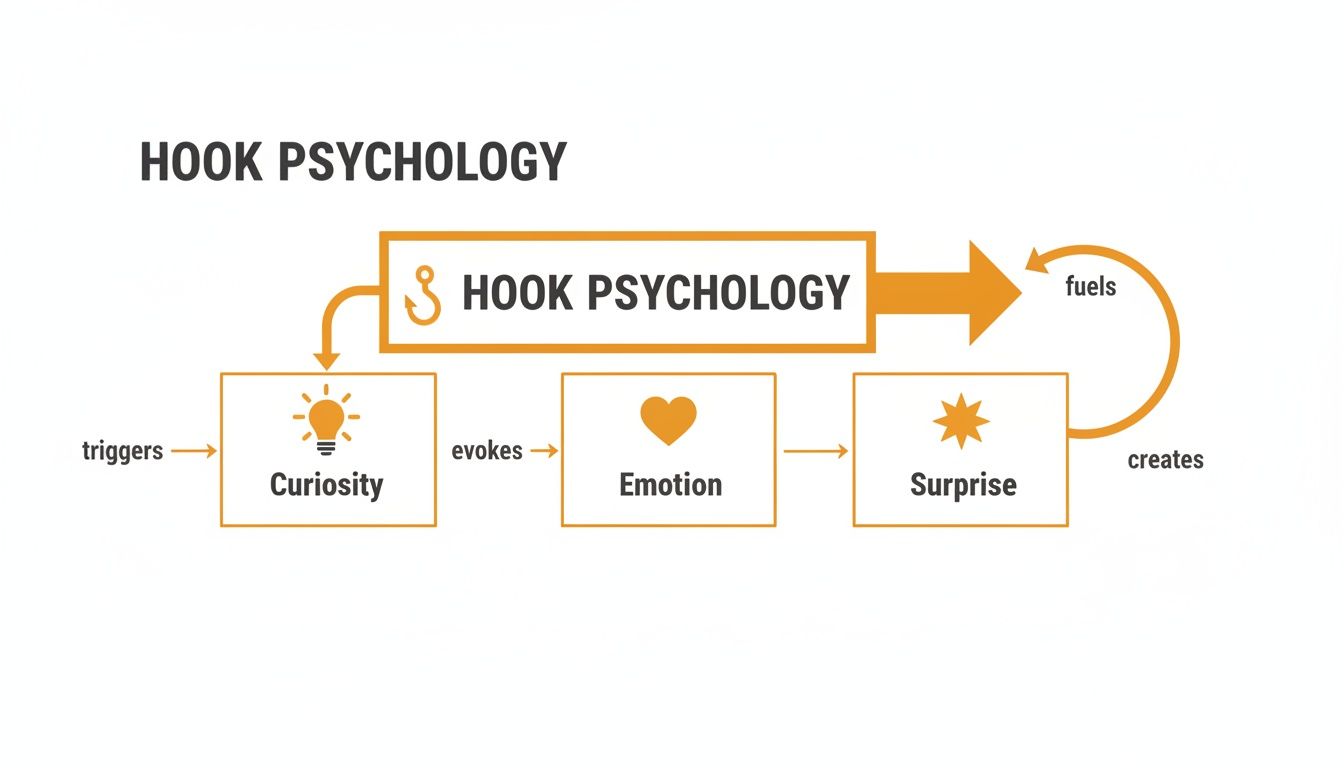
This blend creates an experience that feels compelling, making the reader feel like they have to see what’s next.
1. The Provocative Question
This is easily one of the most powerful tools in your kit. A good question directly engages the reader's brain, forcing them to pause and come up with an answer. Right away, you’ve opened a curiosity gap and made your post feel more like a one-on-one conversation.
And the data backs this up. Question-based hooks can increase click-throughs by a massive 400% on some platforms. On X, a simple question can boost replies by over 5.07%, which is a huge deal when you're fighting for every bit of engagement. For more insights like this, check out these eye-opening social media marketing statistics that can really sharpen your approach.
- X Example: Is your content strategy from 2022 still relevant?
- Threads Example: What's the one piece of advice you'd give your younger self about building an audience?
2. The Shocking Statistic or Fact
Numbers feel solid. They command attention. Kicking things off with a surprising stat or an unbelievable fact instantly makes you look credible and creates a real sense of urgency. The trick is to pick a data point that genuinely makes your audience's jaws drop or challenges what they thought was true.
This formula works because it taps into the power of surprise. When our brains encounter something unexpected, we instinctively pay closer attention to figure out what it means.
- X Example: 95% of new creators quit before they see any real traction. Here’s why.
- Threads Example: The average person scrolls the height of the Eiffel Tower on their phone every single day. Let that sink in.
3. The Contrarian Take
This one is all about challenging a popular belief or a piece of "common knowledge" in your niche. It's designed to create a bit of a jolt, making people stop and question their own assumptions. It’s a gutsy move, for sure, but when done right, it immediately positions you as a thought leader.
Pro Tip: If you're going to use a contrarian hook, you absolutely have to back it up with a solid, well-reasoned argument. The hook makes a bold promise; your content needs to deliver on it if you want to build trust.
- X Example: “Post every day” is the worst advice you’ll ever get.
- Threads Example: Everyone is obsessed with follower count, but it's the most useless metric for growth. Here’s what actually matters.
4. The Relatable Confession
Nothing builds a connection faster than a little vulnerability. This hook starts with a personal admission—a struggle, a mistake, or a fear that your audience knows all too well. It instantly sends the message, "I get it. I've been there."
This approach hits on a deep emotional level, making your content feel authentic and human from the very first word.
- X Example: I wasted my first year on this platform making this one critical mistake.
- Threads Example: Confession: I almost gave up on my side hustle last month. Here's what saved it.
If you're looking for more ways to put these formulas into action, you'll get a ton of value from our guide on generating endless social media content ideas.
Adapting Your Hooks for Different Platforms
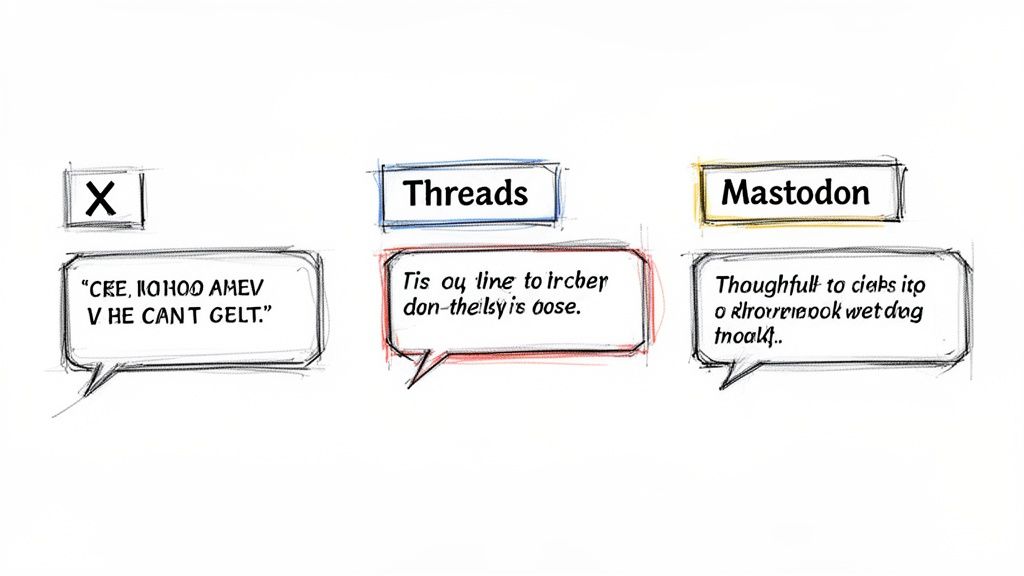
A hook that absolutely crushes it on X can land with a thud on Bluesky or Mastodon. This isn't because the hook is bad—it's because it's in the wrong room. To get this right, you have to learn the subtle art of adapting your message to fit the environment.
Every microblogging platform has its own vibe, its own unwritten rules and audience expectations. Think of it like telling a story. You wouldn't use the same tone and language with your best friends as you would in a boardroom presentation. Your hook has to match the culture of the platform.
X and Threads: The Fast Lane
Platforms like X and Threads are built for speed. People are scrolling, and they're scrolling fast. Your window to grab their attention is minuscule. This is where you need hooks that are direct, punchy, and sometimes a little sensational.
- Direct Questions: "Is your marketing strategy actually working?"
- Bold Claims: "99% of creators are getting this wrong."
- Shocking Numbers: "This one mistake costs founders $10,000 a year."
The name of the game is immediate impact. You're looking for that jolt that stops the thumb dead in its tracks. There’s no time for a slow, meandering introduction. The hook has to do all the heavy lifting in the first few words.
Bluesky and Mastodon: The Community Hub
On the other hand, platforms like Mastodon and Bluesky tend to have a more conversational, community-driven feel. People are often there for deeper connections and more thoughtful discussions. A hook that feels aggressive or clickbaity can come across as jarring or even spammy.
Here, a great hook is less about demanding attention and more about building rapport. It can be more reflective, pose a gentle question, or share a personal insight to open a dialogue.
The core idea of your message can stay the same, but its packaging must change. The key is shifting from a headline that shouts to an opener that invites. This subtle adjustment respects the platform's culture and the audience's mindset.
Let’s see how we could adapt a single idea for different platforms.
Core Idea: Many creators struggle with inconsistent growth.
- X Hook: "Your growth is random for a reason. Here's why." (Direct, promises a quick answer.)
- Mastodon Hook: "Thinking about the ups and downs of creator growth. It often feels like one step forward, two steps back. Anyone else relate to this?" (Relatable, invites conversation.)
Getting this adaptation right is a game-changer for your reach. Understanding this platform-specific nuance is a big part of learning how to improve social media engagement, as it all starts with that scroll-stopping opener.
How to Test and Refine Your Hooks with Data
Writing a killer hook is only half the battle. The best creators I know don't just guess what works; they test, measure, and let the data tell them what their audience truly wants. Think of yourself as a scientist in a content lab, where every post is a small experiment.
You don’t need a fancy analytics degree to do this. Platforms like X and Bluesky give you all the basic numbers you need to see if your hook landed or fell flat. The whole idea is to stop throwing things at the wall and start making smart, informed choices that make your writing better over time.
This creates a simple but powerful feedback loop: you write, you measure the results, and you use those insights to refine your next hook. It’s a cycle that, once you get it going, builds incredible momentum.
Key Metrics for Hook Performance
So, what should you actually be looking at? Forget vanity metrics. A few key data points will tell you the real story of how well your hook converted a casual scroller into an engaged reader.
- Reply-to-Like Ratio: When you see a ton of replies compared to the number of likes, you've struck a nerve. It means your hook didn't just get a nod of approval; it started a real conversation. This is where sharp questions and contrarian takes really shine.
- Link Clicks: If your post has a link, the click-through rate is your most honest metric. Did your hook build enough curiosity to make someone stop what they were doing and take action? The numbers will tell you.
- Profile Visits from Post: This is a gold-standard metric. It means your hook was so good that someone thought, "Who is this person?" It’s a clear sign you’re not just getting attention, but you're actually building an audience.
A great hook doesn't just earn a like; it inspires an action. Whether it's a reply, a click, or a profile visit, the most effective openers move the reader to do something, proving they captured more than just a passing glance.
A Quick Hook Effectiveness Test
Before you hit "publish," it pays to do a quick gut check. Running your hook through a simple set of questions can help you catch weak spots and make last-minute tweaks that can dramatically improve its performance.
And if you want to get even more specific, you can plug your content into our free post analyzer tool. It gives you some hard data on readability and viral potential to help you sharpen your writing even further.
Here’s a simple table to help you vet your next opener on the fly.
| Test Question | Yes/No | How to Improve |
|---|---|---|
| Does it create a curiosity gap? | Add a question, a surprising fact, or an unfinished thought to make readers crave the answer. | |
| Does it connect emotionally? | Use words that tap into a common frustration, desire, or feeling your audience shares. | |
| Is the core promise clear in seconds? | Remove any confusing jargon. State the value proposition directly and concisely. | |
| Does it feel original and specific? | Avoid generic clichés. Replace vague statements with concrete details or bold claims. |
By consistently putting your hooks to the test with real-world data and this quick checklist, you’ll stop gambling with your content. You’ll start building a system that delivers results again and again.
Common Questions About Writing Hooks
Even with the best formulas in hand, theory only takes you so far. When you sit down to actually write, the real questions pop up. What works in practice isn't just about knowing the rules; it's about making smart choices on the fly. Let's dig into some of the most common snags creators run into.
Think of this as a quick-fire Q&A to clear up any confusion and help you put these ideas to work with confidence.
How Long Should a Hook Be?
On platforms like X or Threads, where the feed moves at lightning speed, your hook is your first sentence. And it needs to be brutally short.
Aim for under 25 words if you can, but the real magic happens in that 10-15 word range. The goal is to land a punch of curiosity, value, or emotion before your reader's thumb even has a chance to move. It has to make sense in a single, fleeting glance.
The best hooks feel effortless to the reader, but they're born from ruthless editing. Every single word has to fight for its spot.
Can an Image or Video Serve as a Hook?
Definitely. But a visual alone is rarely enough. On text-centric platforms, the words you pair with an image are what give it meaning and power.
It's a one-two punch:
- The visual is the initial attention-grabber (the what).
- The text hook is the context that tells them why they should care (the why).
For instance, a wild-looking chart is just a bunch of lines until you add a hook like, "This is where 90% of marketers are messing up." Suddenly, that visual has a story.
How Often Can I Reuse a Hook Formula?
You absolutely should reuse formulas that work for you. It's how you build a recognizable style that your audience comes to expect and enjoy. The key is to keep the content and the angle fresh.
People will notice the pattern, but they'll get bored if the underlying message feels like a repeat. A great strategy is to have three or four go-to formulas that you rotate through. This keeps your feed interesting and just unpredictable enough to keep people locked in for the long haul.
Ready to stop guessing and start writing hooks that actually get traction? The AI tools inside MicroPoster can generate dozens of compelling hook ideas, score their viral potential, and help you craft content that grabs attention instantly. Start your free 7-day trial of MicroPoster today.


