leave x
How to Leave X Without Losing Your Audience: A Playbook
Learn how to leave X without losing your audience. Our guide covers planning your exit, announcing the move, and using tools to retain your followers.
You're probably in the same spot a lot of founders, writers, and solo operators end up in on X. You built an audience there because that's where the conversation was. Now the platform feels less reliable, less aligned, or less worth your daily energy, but leaving still feels dangerous.
That fear is rational. If you walk away badly, people don't follow you. They just lose track of you.
The good news is that how to leave X without losing your audience isn't really about a dramatic exit. It's an operations problem. The creators who do this well don't vanish overnight. They prepare their escape routes, train followers to look elsewhere, and use the final month on X as a controlled migration window instead of a panic sprint.
Is It Time to Leave X
You open X to post an update, get pulled into the feed for 20 minutes, and leave feeling like you did platform maintenance instead of real work. Then the uncomfortable thought shows up again. If this platform still sends attention your way, is leaving a strategic move or a self-inflicted hit to your reach?
That tension is the right place to start.
X can still be useful for discovery, commentary, and fast feedback. It can also become a bad operating environment for the kind of work you want to do next. Those two things can be true at the same time. A platform does not need to be dead to be the wrong home base.
The decision gets clearer when you stop treating it like a loyalty test and start treating it like channel strategy.
A better question to ask
Skip the dramatic version of the decision. The useful questions are operational:
- Where do your highest-value conversations already happen
- Which audience relationship do you control
- What format matters most next: short posts, threads, long-form writing, video, email, community
- How much time does X consume compared with what it returns
- Can you support a transition with cross-posting, thread adaptation, and basic automation for 30 to 60 days
That last question matters more than people think. Leaving well is not just a messaging job. It is a systems job. If your content currently depends on X-native habits, especially threads, quote-post replies, and real-time commentary, you need a bridge plan before you make any public move.
I have seen creators make the wrong call in both directions. Some stay too long because they confuse visibility with business value. Others leave in a burst of frustration, stop posting overnight, and make their audience do the work of finding them again.
The better standard is simple. Keep X if it still earns its place. Reduce it to a distribution channel if it still helps but no longer deserves your best energy. Exit it as a primary platform when another channel gives you better control, better signal, and a better fit for your content.
What a smart exit actually looks like
A smart exit is measured by transfer, not drama.
Three things should be true:
- Your audience understands where to find you next
- Your core followers can reach you through channels you control, especially email and your site
- Your X presence keeps working after the move, with clear profile direction, selected cross-posts, and a visible trail to your new home
That last point is where a lot of exits fail. People treat the move as a single announcement. In practice, it works better as a managed transition. You keep publishing, adapt thread-heavy content for the new platform, and use light automation so the handoff does not depend on you remembering every post manually.
You do not need every follower to come with you. You need the right ones to make the trip, and you need a process that makes that possible.
The Pre-Move Playbook to Fortify Your Audience
Before you announce anything, build your lifeboats.
Most failed platform exits happen because the creator tries to migrate an audience they never owned. Followers are rented attention. Your email list, website, customer list, and direct relationships are the assets that travel with you.
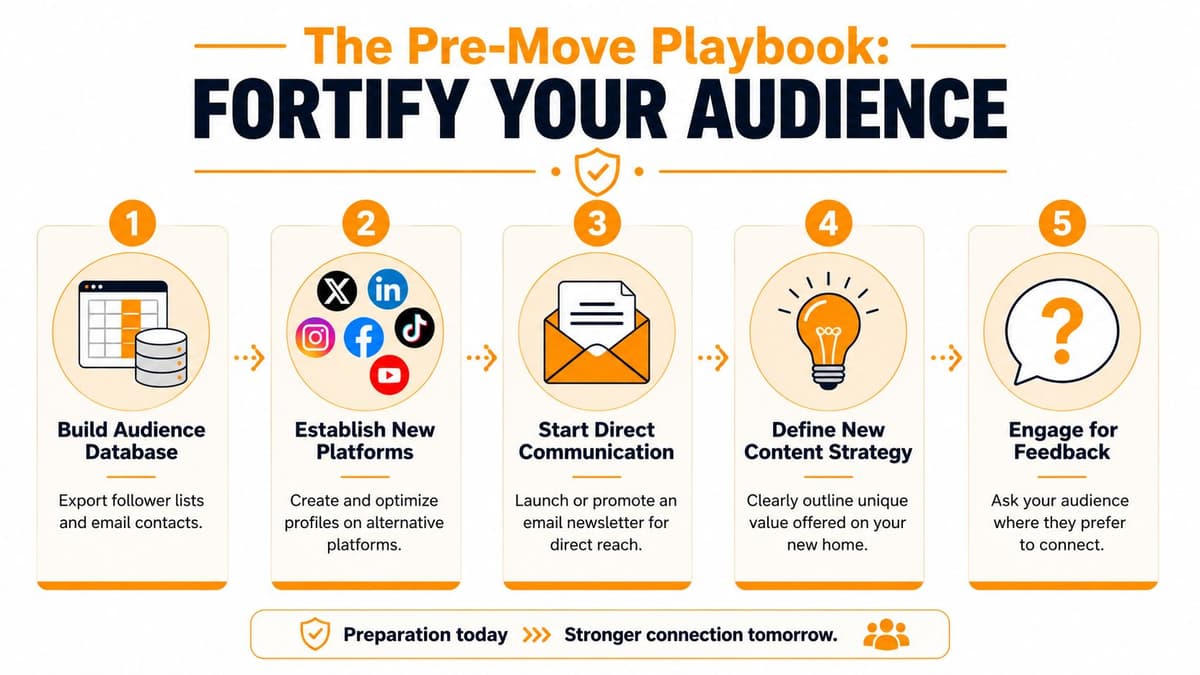
Build assets before you make noise
Don't start with the farewell post. Start with infrastructure.
Here's the minimum foundation:
- Your website hub: Make sure your homepage, about page, or a simple landing page clearly lists where people should follow you now.
- Your email capture: If you don't have a newsletter or at least a signup form, fix that first.
- Your link hub: Whether you use a link-in-bio service or a simple page on your own site, it should point to your current platforms, not old ones.
- Your destination profiles: Set up and polish the accounts you want people to move to before inviting anyone there.
People don't migrate to empty rooms. If your new profile has no posts, no bio clarity, and no evidence that you'll stay, your announcement won't convert attention into movement.
Make your audience platform-agnostic
A lot of creators overestimate how many followers are loyal to a platform handle. In practice, many people just want an easy way to keep receiving your ideas.
That means your job is to create multiple paths:
| Asset | Why it matters | ||---| | Email list | You can reach people directly without an algorithm in the middle | | Website | It becomes your permanent home, regardless of platform changes | | New social profiles | They give followers an immediate next step | | Contactable supporters | Your most engaged followers often help signal the move publicly |
A managed transition matters more than a dramatic statement. CMSWire's analysis of leaving X notes that leaving without a managed audience transition can damage customer communication, and that teams need gradual, repeated messaging across channels. The same analysis recommends a soft exit rather than an immediate deletion.
Identify the people who matter most
Not every follower is equally important during a migration.
You need to know who your audience core is:
- Customers and prospects: The people who buy, refer, or regularly ask product questions
- Reply regulars: Followers who consistently respond and amplify your posts
- Industry peers: People whose engagement helps others notice your move
- Thread readers and link clickers: The audience segment that consistently consumes your deeper work
Write these names down. Keep a small manual list if you need to. When the move happens, these are the people worth personal outreach.
A public announcement tells everyone. A direct message moves the people who actually care.
Start talking before you “announce”
The smartest exits don't feel abrupt because the audience has already seen the shift happen in slow motion.
Use the weeks before the move to:
- Mention your newsletter more often
- Reference your new primary platform inside normal posts
- Ask followers where they prefer to keep up with you
- Publish native content on the destination platform so there's something worth following
By the time you post the farewell message, your audience shouldn't be hearing about your new home for the first time.
Crafting Your Exit Announcement Message
Most exit messages fail for one of two reasons. They're either too emotional, or too vague.
If your post reads like a grievance thread, some people will agree with you, but many won't take the next step. If your post is soft and cryptic, people won't know whether you're leaving, pausing, or just venting. Both outcomes waste attention.
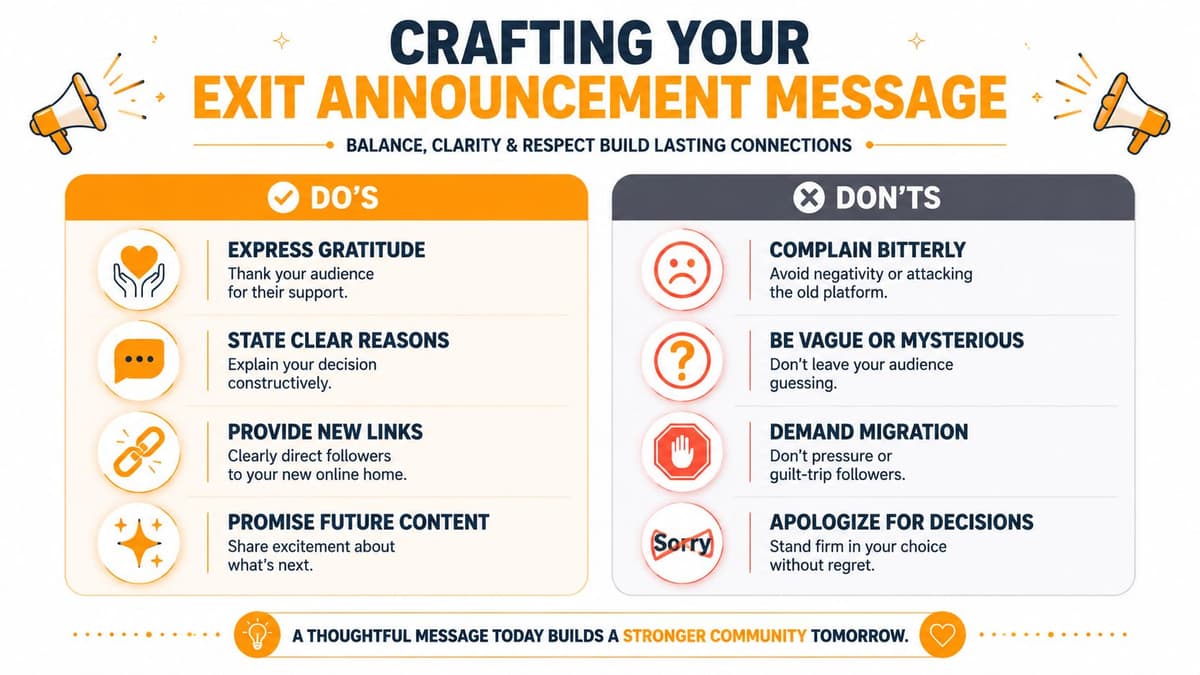
The psychology of a good farewell post
Your announcement should do four things in a few lines:
- acknowledge the audience
- explain the move without sounding defensive
- point clearly to your new home
- create forward motion
That last point matters. People follow momentum. If your message feels like an ending, some will treat it as one. If it feels like a move toward a better setup, more people come along.
Content Science's guidance on leaving X highlights one essential point: pin a farewell post with links to your other social profiles and website so anyone landing on the profile immediately knows where to find you next. That pinned post acts like a time capsule. It keeps working even when you stop posting actively.
What to say and what not to say
Use this table as a filter before you publish:
| Keep this | Avoid this | ||---| | Gratitude for the audience | Bitterness toward the platform | | Clarity about where you're going | Mystery that makes people guess | | Confidence in the decision | Apology for making it | | Specific links and handles | “Find me elsewhere” with no details |
A good message doesn't need to explain every reason. It needs to reduce friction.
Three message templates you can adapt
For a founder
“We've loved building and sharing here. Going forward, our main updates will be on [platform] and through our email list. Follow us there for product news, launches, and direct updates. Links are in the bio and pinned post.”
For a writer or creator
“I'm shifting my writing and day-to-day posting to [platform/site/newsletter]. If you've followed my threads here, that's where the full work will live going forward. I'd love to see you there.”
For a consultant or operator
“I'm simplifying where I publish. I'll still keep this profile up as a signpost for a while, but new posts and deeper analysis are moving to [destination]. If my work has been useful here, that's the best place to stay connected.”
Keep the tone calm. The audience is deciding whether to continue the relationship, not whether to join a rebellion.
The anatomy of the pinned post
Your pinned message should include:
- A one-line reason that stays constructive
- Your primary destination first, not five equal options
- A secondary fallback such as your website or newsletter
- A clear expectation about whether you'll still monitor X
If you leave out that last part, followers will keep trying to reach you in the old place and get frustrated when you don't respond.
The Cross-Posting Bridge Strategy to Ensure Continuity
The worst way to leave X is to disappear in one move.
An abrupt exit creates a pattern break your audience didn't ask for. They open the app, don't see you, and move on with the rest of their feed. If you want continuity, you need a bridge period where your content exists in both places, but your audience gradually learns that the new platform gets your attention first.
Use X last, not first
The strongest migration pattern I've seen follows the X-Last method. The X-Last guide recommends posting to alternative platforms such as Bluesky, Threads, or Mastodon before posting to X, then making those alternatives prominent in your X bio and pinned post.
That order matters. If you publish on X first, you teach followers that nothing has changed. If you publish on the new platform first and use X as a delayed relay, you retrain audience behavior.
A practical bridge period looks like this:
- Post the full update on the destination platform
- Engage there first
- Share a shorter version on X later
- Point people to your bio and pinned post for where to follow ongoing work
Threads are where migrations often break
This is the gap most basic advice misses.
PRNEWS's reporting on X exit strategy highlights a real issue: 68% of X users primarily engage via threads, while 0% of current exit strategies provide a technical roadmap for preserving thread continuity, and creators can see a 40% drop in follow-through engagement when they repost thread links without adapting the structure.
If your audience knows you through long threads, reposting a link and hoping for the best won't work.
Different platforms handle sequencing, preview text, mentions, and continuation differently. A thread that feels native on X can become awkward, collapsed, or low-context elsewhere. So you need to rebuild the content format, not just duplicate the link.
Repurpose structure, not just text
That usually means converting one X thread into one of these forms:
- A clean multi-post sequence on Bluesky
- A tighter text post plus a link to the full piece on LinkedIn
- A newsletter section for readers who want depth without platform friction
- A short summary post that invites replies on the new platform
If you want a useful framework for deciding what to turn into a thread, post, article, or newsletter, Outrank's guide to content repurposing is worth reading because it treats repurposing as format design, not copy-and-paste.
Don't migrate content by exporting text. Migrate it by preserving reading flow.
Why automation helps during the bridge
The bridge period is where manual effort can sink the plan. Writing once is manageable. Reformatting, reposting, fixing mentions, checking previews, and scheduling every platform by hand is where people give up and drift back to the easiest habit.
That's also why some creators use an automated bridge for X and Threads during transitions. The appeal isn't laziness. It's consistency. When the mechanics are handled, you can keep the signpost active on X while putting your real attention into the destination platform.
If you decide to use a reposting tool during the bridge, judge it by the migration problems it solves:
| Need | What to look for | ||---| | Thread handling | Can it split and preserve multi-post flow cleanly | | Mention mapping | Can it adapt handles between networks | | Native formatting | Can it make posts feel correct for each platform | | Reliability | Can it keep the bridge running without daily babysitting |
That's what makes a bridge work. Not perfect duplication. Predictable continuity.
Executing the Final Move and Managing the Transition
Once the bridge is in place and the pinned post is doing its job, you can make the final move without turning it into a cliff dive.
The key technical detail is simple. Don't rush to permanent deletion.
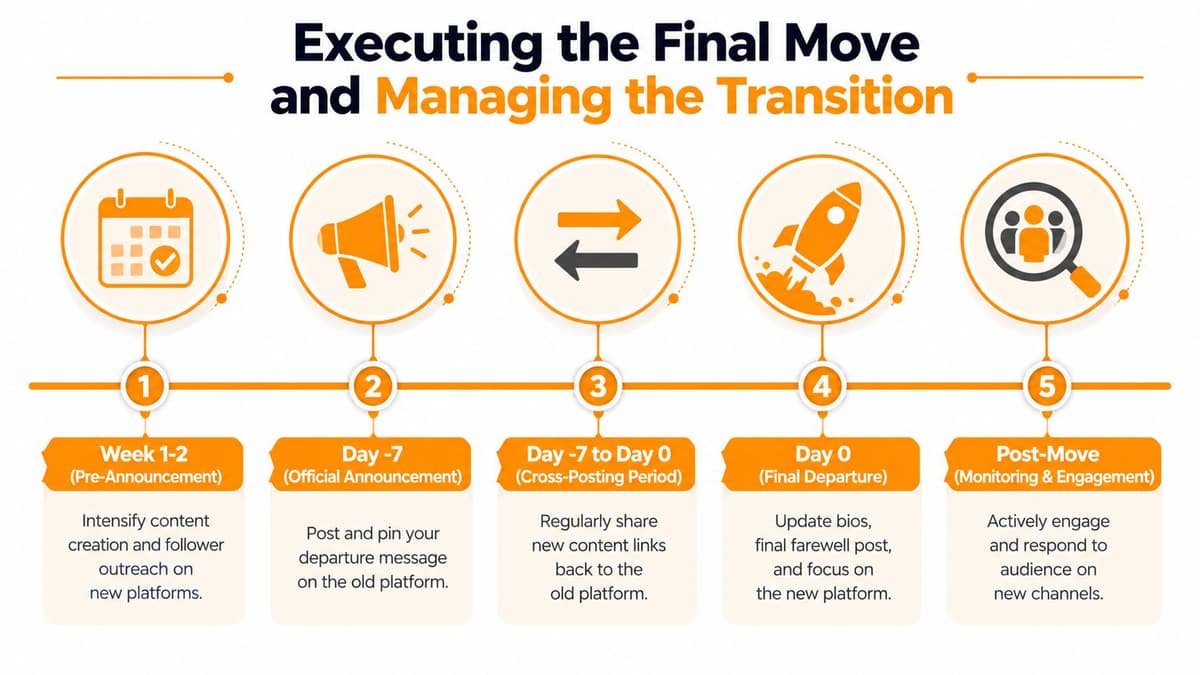
Day 0 means deactivate, not panic-delete
According to CNET's walkthrough of X account deletion, when you deactivate an X account, the platform holds it for exactly 30 days before permanent deletion, and you can reactivate during that window by logging back in to restore posts and followers.
That 30-day window is your safety buffer.
Treat it like an operational grace period, not an afterthought. It gives you time to verify that your website links are correct, your audience can still find you, and your key contacts have moved.
A simple timeline that keeps control in your hands
Day 1
Do these first:
- Deactivate the account instead of trying to erase everything immediately
- Confirm your pinned message, bio, website, and destination profiles are all current before the deactivation step
- Audit connected tools and apps so you know what still relies on your X login
- Save any records or content archives you may want later
If you support customers or clients through social, set up alternative contact instructions before this point. People don't care that you're reorganizing. They care whether they can still reach you.
Day 7
This is the checkpoint often skipped.
Review what happened in the first week:
- Who followed to the new platform
- Which contacts still try to message you on X
- Whether your website or link hub is getting clicks from the old profile
- Which posts on the destination platform generated welcome replies
If some important people haven't moved, reach out directly. A short, personal note works better than another broad public reminder.
Silent followers often need one direct invitation before they change habits.
Day 30
At this point, you have a real decision.
If the migration is working and your communication paths are stable, let the deletion complete. If you realize you still need the profile as a public signpost, or your move needs more time, reactivate and keep the account in a low-maintenance state while you continue the transition.
Tie up the operational loose ends
Before you call the move finished, check a few unglamorous details:
- Third-party access: Remove or update old integrations tied to X
- Team workflows: Make sure anyone on your team knows where public communication now happens
- Brand assets: Replace X icons in email signatures, website footers, and templates
- FAQ language: Update support pages and contact pages so people don't end up in the wrong place
Careful exits beat emotional exits. The platform change is visible. The cleanup work is what makes it stick.
Measuring Success and Re-engaging Your Community
Thirty days after leaving X, the follower count is the wrong scoreboard.
What matters is whether the people who drive conversations, referrals, replies, and sales changed their habits with you. A successful move shifts your audience's behavior, not just their location. X can still throw off attention, as noted earlier, but attention you cannot reliably carry forward has limited value.
Measure behavior that affects the business
Start with a simple test. If X disappeared for a week, would your core relationships still be intact?
Use that question to review signals that matter:
- Are your regular replies and DMs happening on the new platform
- Is your email list picking up new subscribers from the move
- Are clients, collaborators, and peers using your updated contact paths
- Is your site getting referral traffic from your profile links, pinned signposts, or bio tools
- Are the same high-value people showing up repeatedly, not just once
This is less exciting than watching follower charts. It is also more honest.
A smaller, more responsive audience in the right place is more useful than a larger passive audience in the wrong place.
One warning here. Do not grade the move only on raw follower transfer. In practice, some people will keep consuming your work through search, your site, your newsletter, or screenshots passed around by others. If they can still find you and act on what you publish, the migration is doing its job.
Treat early movers like the foundation
The first group that follows you over sets the tone for everyone else. If they arrive and find reposted leftovers from X, they read that as hesitation. If they arrive and find active conversation, they settle in faster.
Give them reasons to engage right away:
- Post a clear welcome message that confirms this is now an active home
- Start one native conversation thread built for the new platform's norms
- Ask for feedback on what they want more of here
- Point them to your newsletter, site, or community hub so the relationship does not depend on one app
- Reply faster than normal for the first couple of weeks to reinforce the habit
That last point matters more than creators expect. During a platform move, responsiveness signals commitment.
Study interaction patterns, then adjust the format
A migration gives you a clean read on what people want from you. Pay attention to comment themes, repeat questions, saves, profile clicks, and the posts that pull in familiar names.
This is also where cross-posting needs judgment. A thread that performed well on X may need a different structure on Threads, Bluesky, or Mastodon. Shorter openings, fewer stacked claims, and more direct prompts often travel better than a copied multi-post thread. If you want a practical way to review response patterns after the move, this guide to analyzing X comments for audience signals is useful.
The goal is not to preserve your old posting style in amber. The goal is to keep the relationship intact while adapting the format to the room you are now in.
When that starts happening, people stop thinking of your move as a transition. They treat the new platform as the place to find you.