how often to post on instagram
How Often Should You Post on Instagram: 2026 Guide
Unlock your optimal Instagram strategy! Discover how often should you post on instagram in 2026 for Reels, Stories, & Feed to maximize engagement and growth.
Post 2 to 3 times per week to your Instagram feed or Reels if you want the strongest balance of growth, engagement, and sanity. If you can sustain more, 3 to 5 posts per week is the broader growth range, but that's a starting point, not a law.
A lot of Instagram advice is lazy. It treats posting frequency like there's one magic number that works for every founder, creator, and brand. There isn't. The right answer depends on whether you're trying to grow fast, stay visible, or avoid letting your account go stale while you run an actual business.
If you're asking how often should you post on Instagram, stop looking for a universal rule and start building a rhythm you can maintain for months. Consistency beats short bursts of ambition every time.
The Baseline The Data-Backed Starting Point
The cleanest place to begin is this: 2 to 3 quality feed posts or Reels per week is the most practical baseline for most brands. It's enough to stay present, enough to give Instagram fresh signals, and realistic enough that you won't burn out after two weeks.
That recommendation lines up with multiple sources. Dash Social's 2026 analysis says posting 2 to 3 times per week on Instagram feeds and Reels drives the highest engagement without risking burnout, while Buffer's 2026 data found that posting 3 to 5 times per week is the sweet spot for reach and growth and can more than double follower growth compared to posting 1 to 2 times weekly in its analysis of Instagram performance (Buffer's Instagram posting frequency data).
Why this baseline works
Instagram rewards active accounts, but it doesn't reward chaos. A steady cadence tells the platform you're alive and gives each post room to perform.
Buffer also found that posting 3 to 5 times per week boosts reach per post by approximately 12% over a lower-frequency baseline, and that's the part many founders miss. Posting a little more often doesn't just give you more chances. It can improve the performance of each individual post when your cadence is consistent and quality stays intact.
Practical rule: If you don't have a team, don't build a strategy that depends on daily brilliance.
The myth to ignore
The bad advice says you should post every day no matter what. That sounds disciplined, but for most businesses it produces rushed content, broken workflows, and skipped weeks.
A better approach is to treat the baseline as a testable default:
- If you're inconsistent now, start with 2 to 3 posts per week.
- If you already have a content system, move toward 3 to 5 posts per week.
- If quality drops when volume rises, reduce frequency immediately.
Timing matters too, but it matters after consistency. If you want to tighten distribution once your cadence is stable, use a timing strategy instead of guessing with best times to post on social media.
The point isn't to hit a number for its own sake. The point is to choose a number you can hit every week without turning Instagram into a second full-time job.
Aligning Posting Frequency With Your Goals
Your posting frequency is a business decision. If your goal is growth, your cadence should look different from a brand that just wants to stay visible and keep its audience warm.
That's why “how often should you post on Instagram” is the wrong question on its own. The better question is: what are you asking Instagram to do for your business right now?
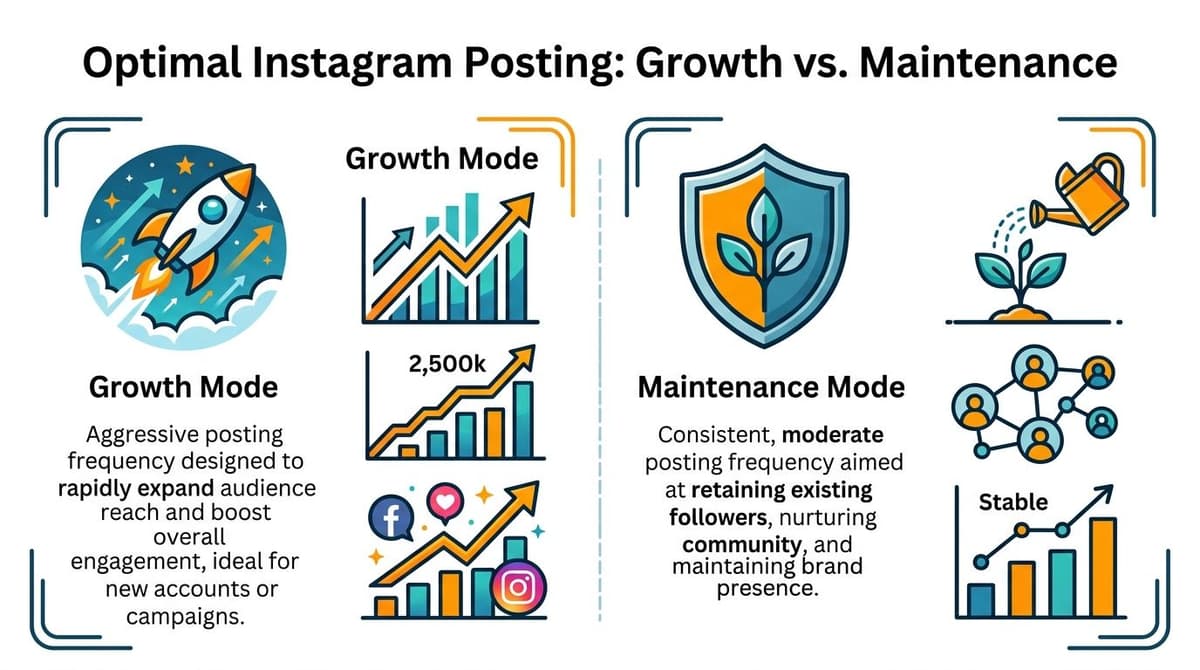
Growth mode and maintenance mode
If you need audience expansion, launches, inbound attention, or more top-of-funnel discovery, you're in Growth Mode. If you already have traction and mainly need consistency, trust, and ongoing presence, you're in Maintenance Mode.
Buffer's 2026 social media frequency data makes the tradeoff clear. Increasing from 3 to 5 posts weekly to 6 to 9 posts weekly raises net followers from 13 to 22, and 10+ posts yields 33, which shows there's upside to posting more, but also clear diminishing returns on the extra effort (Buffer's social media frequency guide).
| Metric | Growth Mode | Maintenance Mode |
|---|---|---|
| Primary goal | Reach more non-followers and gain followers | Stay visible and nurture current audience |
| Recommended cadence | Push toward a higher sustainable weekly volume | Stay near a moderate, repeatable weekly rhythm |
| Operational cost | Higher creative and editing load | Lower stress, easier to maintain |
| Best fit | New accounts, launches, campaigns, creators with bandwidth | Founders, lean teams, service businesses, busy operators |
| Main risk | Burnout and rushed content | Slow growth if you expect aggressive results |
Pick one lane for the next quarter
Most founders fail because they mix strategies. They say they want growth, then only publish when they have spare time. Or they say they want maintenance, then set a daily posting goal they can't sustain.
Use this filter:
- Choose Growth Mode if Instagram is a major acquisition channel right now.
- Choose Maintenance Mode if Instagram supports trust, retention, and brand credibility.
- Re-evaluate quarterly instead of changing cadence every week.
If you're a creator or solo operator thinking beyond raw follower count, this broader conversation around building a resilient creator business is worth your time. It's a useful reminder that sustainable media businesses don't rely on one platform or one burst of output.
More posting can work. More posting without a system usually doesn't.
Your Posting Cadence for Reels Stories and Feed Posts
Stop trying to force one posting schedule across every Instagram format. That approach wastes time and usually leads to burnout. Reels, Stories, and feed posts serve different parts of the funnel, so they need different cadences.
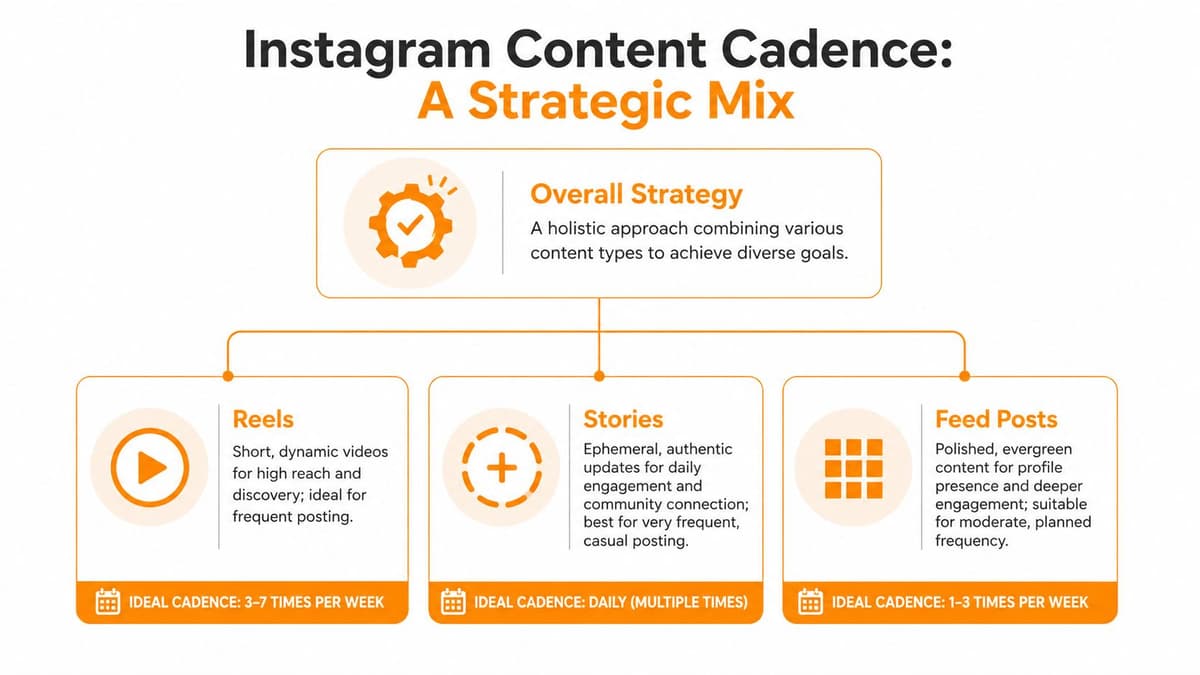
Feed posts are your proof layer
Your feed is where people check whether your brand is credible. If someone discovers you through a Reel or a referral, the feed often decides whether they follow, click, or leave.
Treat feed content as durable assets. Post the content that still makes sense a week or a month later: carousels, testimonials, product education, founder opinions, before-and-after results, and clear positioning. Busy founders do better with fewer strong feed posts than a pile of forgettable ones.
Use feed posts for:
- Brand positioning that makes your point of view obvious
- Education that answers repeat customer questions
- Social proof that reduces hesitation
- Evergreen content that improves the quality of your profile over time
Reels deserve their own production rhythm
Reels are still your best shot at discovery. They reach people who do not know you yet, which makes them the format to prioritize if growth is the goal.
High-volume publishing can work here. Some social media guidance recommends posting Reels far more aggressively than feed content. That does not mean you should copy a media brand or creator with an editor, a content library, and a full week to batch video. It means Reels should have a separate workflow, a separate idea list, and a realistic target.
For a lean team, the smart move is simple. Commit to a repeatable Reel format before you commit to a high Reel count. If you want help building that system, Flexwork Studios' Instagram Reels guidance is a useful resource for creating repeatable concepts instead of chasing random inspiration.
Stories carry the daily touchpoints
Stories keep you present without forcing you to publish another polished post. They are faster to make, easier to sustain, and better for conversation.
Dash Social's 2026 analysis found that brands posting 30+ Stories per week, roughly 4 to 5 daily, see the highest average completion rates, with engagement peaking at 26 or more Stories weekly (Dash Social's Instagram frequency analysis). The practical takeaway is not that every founder needs to post constantly. The takeaway is that Stories can absorb more frequency because the format is informal by design.
Use Stories for:
- Behind-the-scenes updates that would feel too rough for the feed
- Real-time business moments like launches, shipping progress, events, or client work
- Interactive prompts such as polls, questions, sliders, and quick reply hooks
Here's the simplest way to set cadence by format. Keep feed posting intentional, push Reels as far as your production capacity allows, and use Stories to stay visible between bigger content pieces.
That mix is sustainable. More important, it gives each format a job instead of treating every post like it has to do everything.
A Simple Framework to Find Your Optimal Frequency
You do not find the right Instagram cadence by copying a creator with a full content team. You find it by testing a schedule that matches your goals and your capacity.
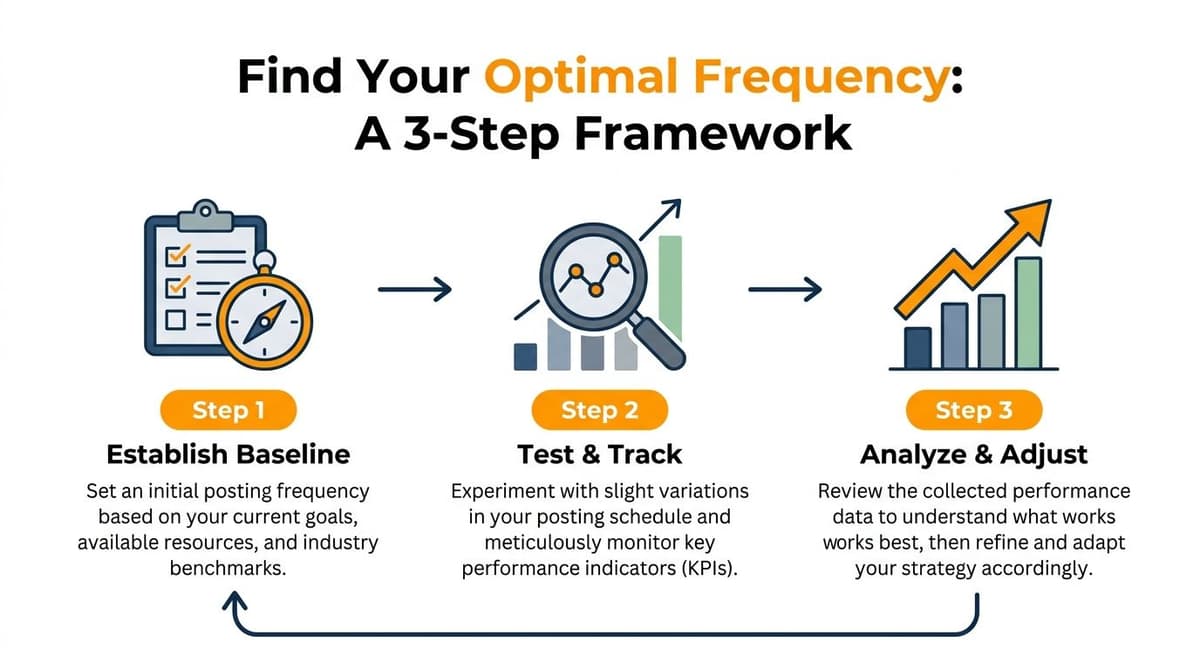
Step 1 Establish a baseline
Start lower than your ambition and higher than your current inconsistency.
If you're busy, a solid starting point is a moderate weekly cadence for feed content plus regular Stories. If you already have a content library, editorial process, or someone editing clips for you, increase volume carefully. Don't choose a schedule based on what sounds impressive. Choose one your team can repeat when work gets messy.
Write the baseline down. Put it on a calendar. Make it visible.
Step 2 Test and track
Run the same cadence long enough to learn from it. A week tells you nothing. You need a stretch where you can see patterns.
Track simple signals:
- Reach trends so you know whether your content is getting discovered.
- Engagement quality such as replies, saves, shares, and meaningful comments.
- Follower movement in the context of what you posted.
- Team effort because a cadence that breaks your process is not a winning cadence.
Neil K. Patel's analysis says posting Instagram Reels or static posts 1 to 2 times daily is ideal, but posting more than 2 times a day can negatively affect the performance of previous posts (Neil Patel's Instagram posting frequency guidance). That's a useful ceiling during testing. More isn't automatically better if your own posts start stepping on each other.
If your content calendar looks good on paper but your team dreads it by week two, the cadence is wrong.
Step 3 Analyze and adjust
After a real testing window, make one change at a time. Don't rewrite the whole strategy because one Reel flopped.
Use a decision lens like this:
- Increase frequency if quality stayed high and your team handled it without stress.
- Hold steady if performance is stable and the workflow feels manageable.
- Reduce output if content quality slipped or production started stealing time from the business.
The best cadence usually feels a little boring. That's a good sign. Boring systems get repeated. Repeated systems compound.
Automate Consistency and Amplify Your Reach
Posting consistency usually breaks in operations, not ideas.
A founder can handle strategy. A founder can even handle content creation for a while. What drains the schedule is everything after that: resizing creative, rewriting captions, scheduling posts, publishing on time, and pushing the same idea across other channels. That admin work is what turns a reasonable posting plan into a missed week.
If your target cadence already includes a mix of Reels, Stories, and feed posts, manual publishing will cap your output fast. The problem is not knowing what to post. The problem is keeping the machine running without pulling attention away from sales, product, or client work.
Build a publishing system your team can repeat
Use a workflow that reduces decisions:
- Batch content creation so you produce a week or two of posts in one sitting
- Schedule ahead so your cadence survives busy days
- Repurpose one idea into multiple formats so each strong concept does more work
- Automate distribution so Instagram content supports your broader marketing instead of living in isolation
Separate creative work from publishing work. Your best energy should go into message, angle, and format choice. Software should handle timing, distribution, and repeat tasks.
If you want a practical setup, this guide on how to automate social media posts shows how to build that workflow without adding more manual overhead.
Consistency comes from fewer moving parts.
That is how you amplify reach without raising your workload every single week.
Stop Chasing a Number Start Building a System
The best answer to how often should you post on Instagram is simple. Start with 2 to 3 quality posts per week, move toward a higher cadence only if your resources support it, and treat Stories, Reels, and feed posts as different tools.
Don't obsess over what the most aggressive creator on your timeline is doing. Their workflow probably doesn't look like yours. Your job is to find a cadence that matches your goals, your team, and your real production capacity.
A sustainable system will outperform a perfect plan you abandon.
If your posting rhythm is clear, your formats each have a purpose, and your workflow is stable, you're already ahead of most brands on Instagram.
If you want that consistency without more manual work, try MicroPoster. It's built for founders and creators who want to write once, distribute everywhere, and keep a reliable publishing rhythm without babysitting every channel. There's a 7-day free trial, so you can test the workflow before committing.