social media engagement
How to Improve Social Media Engagement That Lasts
Discover how to improve social media engagement with real-world tactics. Learn to create content that sparks conversation and builds a loyal community.

If you want to boost your social media engagement, your focus needs to shift. Stop chasing likes and start sparking conversations. It's all about building a genuine community—and that comes from authentic interactions, providing real value, and actually participating in discussions, not just broadcasting your own stuff.
What High Social Media Engagement Really Means
It’s so easy to get fixated on vanity metrics. Follower counts and likes look great on a report, but they rarely tell you what’s actually happening. Real engagement is about the quality of the interactions, not just the quantity. It’s a measure of how deeply your audience is actually connecting with what you have to say.
Let's be honest: a single, thoughtful comment or a share from someone respected in your field is worth far more than a hundred passive likes. Those deeper interactions are powerful signals to the algorithms on platforms like X and Bluesky, telling them your content is valuable and worth showing to a wider audience. That's how you get organic reach.
The Psychology Behind Engagement
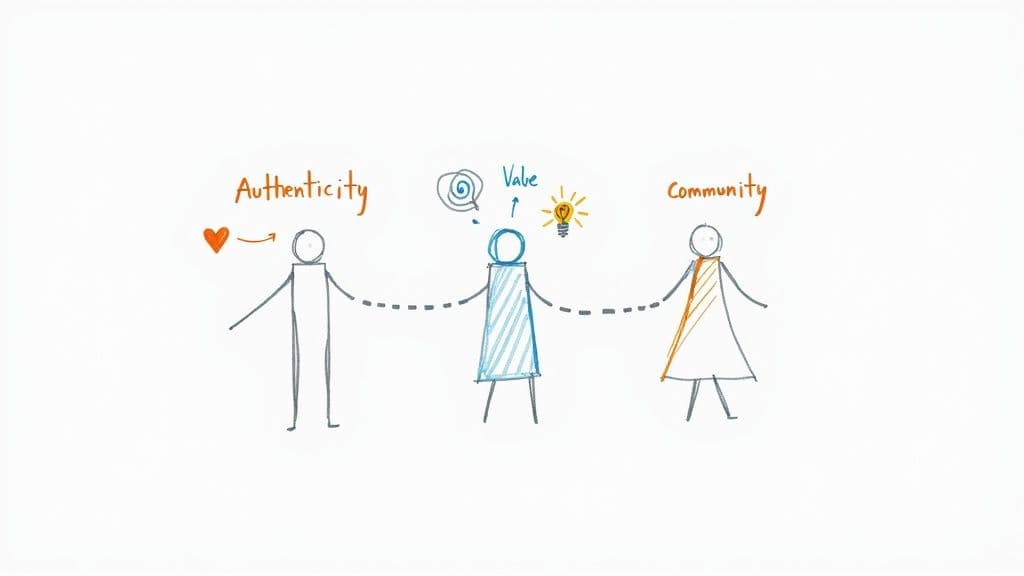
At the end of the day, social media is about people. Engagement is driven by fundamental human needs: connection, information, and a bit of entertainment. People interact with posts for a reason, and if you can tap into that psychology, you're halfway there.
A solid engagement strategy hits on these core drivers:
- Authenticity: People can spot a fake a mile away. They crave genuine voices and want to see the real personality behind the account, not just another polished marketing message. This is how you build trust.
- Value: Every single post should give your audience something. It could be a practical tip, a unique insight, a good laugh, or a fresh perspective. If your content educates or entertains, it’s far more likely to get shared and talked about.
- Community: We all want to feel like we belong. By creating a space where your followers can share their own thoughts, ask questions, and talk to each other, you foster a sense of community that keeps them invested and coming back for more.
Engagement isn't just a metric; it's a direct reflection of the relationship you have with your audience. A high engagement rate means you’ve built a place where people feel seen, heard, and valued. It’s the critical difference between simply having an audience and truly having a community.
Setting Goals That Drive Real Impact
Before you dive into crafting the perfect hook or mapping out a posting schedule, you need to know what you're aiming for. "Increase engagement" is too vague. Get specific with measurable goals that tie back to what you actually want to achieve.
For instance, maybe you want to increase your reply rate by 20% to prove you’re fostering more two-way conversations. Or perhaps you want to improve your share-to-like ratio, which shows your content is so valuable people feel compelled to pass it along. This kind of focus makes sure every action you take is intentional.
If you’re looking for more in-depth, platform-specific strategies, you can learn more about how to increase social media engagement.
Creating Content People Actually Want to Talk About

Okay, we've covered the "why" of engagement. Now for the fun part: the "how." The absolute core of any interaction is the content itself. It's what stops the frantic scroll and convinces someone to spend a few seconds—or even minutes—with what you have to say.
Your goal shouldn't be to just publish. It's to kick off a conversation. And on fast-paced platforms like X and Bluesky, that conversation starts with a killer hook.
Crafting Hooks That Stop the Scroll
That first sentence is everything. It's your content's one shot to grab someone's attention before they swipe on by. A good hook isn't just clickbait; it’s a genuine promise that reading the rest of the post will be worth their time.
Think of it this way: a generic opening is like mumbling in a crowded room. A sharp hook is like calling someone by name—it’s direct, personal, and almost impossible to ignore. The best ones usually fit into a few familiar patterns.
- Contrarian Takes: Challenge a popular belief in your industry. For example, "Everyone's obsessed with getting more followers. They're wrong. Here's the metric that actually moves the needle..."
- Relatable Problems: Hit a nerve by starting with a pain point your audience knows all too well. "You spend hours crafting the 'perfect' post, hit publish... and hear crickets. Let's fix that."
- Bold Statements: Make a strong, specific claim that piques curiosity. "90% of social media strategies fail because they miss one painfully simple step."
- Open Loops: Kick off a story but leave the conclusion hanging, making the reader need to know what happens next. "I accidentally deleted our entire customer database. Here’s how I got it back in 30 minutes."
This is a great spot to lean on MicroPoster's AI enhancers. You can plug in a core idea and ask it for five different hook variations—maybe one is contrarian, another is problem-focused—to see which one lands with the most punch before you write the full post.
Structuring Threads That Tell a Story
A single post can get an idea across, but a well-crafted thread? That can tell a story, teach a skill, and build a real narrative that keeps people reading. The secret to a great thread is momentum. Every post has to feel like a natural next step, pulling the reader along until the very end.
Don't just make a listicle and break it into numbered tweets. Instead, think of your thread as a mini-essay with a beginning, a middle, and a satisfying end.
The Anatomy of a High-Performing Thread
- The Hook: Your first post grabs attention and sets the stage.
- The Buildup: The next few posts add context, share data, or tell a personal anecdote to expand on the initial idea.
- The Turning Point: This is the core of your thread—the "aha" moment or the key insight you're building towards.
- The Payoff: Wrap it up with actionable takeaways, a quick summary, or a powerful final thought.
- The Call to Conversation: Always end with an open-ended question that invites people to share their own take.
The most successful threads don't just dump information; they create an experience. They take the reader on a quick journey from a problem they recognize to a solution they can use, leaving them feeling a little bit smarter. This storytelling structure is a pillar of a strong content strategy for social media.
Using Prompts to Spark Real Conversations
Sometimes, the best way to get people talking is simply to ask. But the generic "What do you think?" often falls flat. The best prompts are specific, open-ended, and incredibly easy to answer.
Instead of asking for a big opinion, try one of these approaches:
- "Fill in the Blank" Prompts: "My go-to tool for productivity is _______, because it..."
- "This or That" Scenarios: "For a new project, are you a meticulous planner or do you just dive in and figure it out as you go?"
- Experience-Based Questions: "What's the single best piece of advice you'd give to someone just starting in [your industry]?"
These prompts lower the barrier for someone to reply. They don't have to write an essay; they can just share a quick thought. It feels less like a quiz and more like a genuine invitation to connect. If you're drawing a blank, exploring some new social media content ideas can give you a fresh well of inspiration for these types of posts.
Finding Your Ideal Posting Rhythm and Schedule
You can craft the most brilliant content in the world, but if you post it at the wrong time, it’s like it never happened. Finding your posting rhythm isn't about flooding your followers' feeds—it’s about showing up reliably when they're actually online and ready to listen.
Think of it this way: consistency signals to both your audience and the platform's algorithm that you're a dependable voice. People start to expect your content, turning casual scrollers into a real audience. But true consistency isn't about a frantic, daily scramble. It's about building a schedule you can genuinely stick with for the long haul.
Uncovering Your Audience's Most Active Hours
Posting when your followers are offline is a surefire way to get zero traction. The goal is to drop your content right when your audience is scrolling, so it gets that crucial initial burst of engagement. Forget those generic "best times to post" guides; your community has its own unique rhythm.
The best way to find that sweet spot? A little hands-on experimentation.
- Set a Baseline: Start by testing a few common time slots. Try posting during the morning commute (around 8 AM), at lunchtime (12 PM), and then again in the evening (maybe 7 PM).
- Watch the First Hour: Pay close attention to what happens in the first 60 minutes. That initial flurry of likes, replies, and reposts is your best clue that you’ve hit an active window.
- Look for Patterns: After a week or two, you’ll start to see a trend. Do your morning posts spark more conversation? Do your evening ones get more likes? Use that feedback to zero in on your ideal schedule.
Most platforms have built-in analytics that show when your followers are most active. Check those charts and see if they line up with what you're seeing from your tests. This combo of real-world data and platform analytics is your recipe for a killer schedule.
Building a Sustainable Scheduling Workflow
Here’s the secret to staying consistent without losing your mind: batch your content. Instead of trying to pull a brilliant idea out of thin air every single day, block off a couple of hours once a week to write and schedule everything in advance.
This is where a tool like MicroPoster completely changes the game. Its content calendar gives you a bird's-eye view of your entire week or month. You can sit down, draft all your posts and threads in one focused session, and then schedule them to go live at the perfect times you just discovered. It turns social media from a constant, reactive chore into a calm, strategic process.
Batching and scheduling frees up your daily mental bandwidth for what actually drives engagement: jumping into conversations and connecting with your community in real-time.
The Smart Way to Cross-Post Content
To maximize your reach, you need to be on more than one platform. With over 5.24 billion active social media users and the average person using 6.83 different platforms each month, your potential audience is scattered. You can dive deeper into these trends and discover insights about social media statistics on dreamgrow.com.
But here’s the trap most people fall into: they just copy and paste the exact same post everywhere. That’s a fast track to killing your engagement. Each platform, from X to Bluesky, has its own vibe and unspoken rules.
Effective cross-posting is all about adaptation:
- Tweak the Tone: The buttoned-up, professional tone that works on LinkedIn will probably fall flat on the fast-paced, meme-heavy culture of X. A slight adjustment makes all the difference.
- Rethink the Format: That epic 10-part thread on X might work better as a single, more in-depth post on a platform like Mastodon.
- Adjust for Media: Some platforms favor native images and videos, while others have different ways of displaying links.
MicroPoster’s cross-posting feature is built for this. You write your core message once, then quickly tailor it for each of your connected accounts. This helps your content feel native and natural everywhere you post, boosting your engagement across the board.
How to Turn Followers Into a Thriving Community

Putting out great content is a fantastic start, but it's really just the first step. True, lasting engagement isn’t just about what you post—it's about the culture you build around your account. It’s the magic that happens when you transform a passive audience into an active, participatory community.
This is where you stop being a broadcaster and start being a host. Your goal is to make your little corner of the internet a place where people feel seen, heard, and connected. Not just to you, but to each other. Get this right, and you'll turn casual followers into genuine fans.
Show You’re Listening with Thoughtful Replies
Replying to comments is probably the single most powerful thing you can do to build a community. A generic "Thanks!" is better than silence, but a thoughtful, specific reply can turn a casual commenter into a loyal advocate. It’s proof that there's a real person behind the account who actually cares.
Don't just acknowledge—engage. When someone leaves a comment, try to:
- Ask a follow-up question: If they share an opinion, ask them to expand on it. "That's an interesting take, what makes you say that?" invites a real conversation.
- Validate their point: Simple phrases like, "That's a great point, I hadn't considered that perspective," show you're actually listening.
- Add extra value: If they ask a question, answer it and then offer a related tip or a link to a helpful resource. This turns a simple reply into a memorable, value-packed interaction.
Timing is also crucial. Quick replies keep the conversation's momentum going and signal to both your audience and the platform's algorithm that your content is sparking real-time discussion.
Put Your Community in the Spotlight with User-Generated Content
Want to make your followers feel truly valued? Put a spotlight on them. When someone creates content that mentions your brand, shares your work, or shows off your product, amplifying it is one of the strongest forms of social proof you can get.
This user-generated content (UGC) is authentic marketing gold. It’s a real endorsement from a real person, and that builds trust far more effectively than any branded post ever could.
When you reshare a follower's post, you're not just getting free content. You're publicly acknowledging their contribution to the community. This simple act encourages others to do the same, creating a powerful feedback loop of engagement and shared ownership.
Make it a habit to check your mentions and relevant hashtags. When you find a great piece of UGC, always ask for permission before resharing and make sure to give the original creator full, clear credit. It’s just good etiquette, and it goes a long way in building strong relationships.
Use Social Listening to Find and Join Conversations
Community building isn't just about what happens on your own profile. It's about showing up where your audience is already talking. This is where social listening becomes your secret weapon.
Instead of waiting for people to find you, go out and find them. You can set up searches for keywords, topics, and common pain points related to your niche. When you find a relevant conversation, jump in with helpful advice or a unique perspective—without a sales pitch. This builds your authority and introduces your account to new, relevant people in a completely natural way. If setting up and checking those searches by hand takes too long, there are tools that find these conversations for you across Reddit, forums and X.
Understanding who you're talking to is just as important. For example, knowing your demographic's platform habits helps you focus your energy. Recent data shows Gen Z spends about 54% more time on social media than the average user, dedicating nearly an extra hour each day to interacting with peers and UGC. This makes platforms like X incredibly valuable for community building aimed at this group. For a deeper dive into these trends, you can learn more about social media demographic statistics on gwi.com.
To make this more concrete, let's map out how your tactics can change based on where someone is in their journey with you.
Engagement Tactics for Different Audience Intent
| Audience Stage | Primary Goal | Key Tactic | MicroPoster Feature |
|---|---|---|---|
| New Follower | Build trust & connection | Respond quickly and thoughtfully to their first comment or question. | Unified Inbox for fast reply management. |
| Silent Lurker | Encourage participation | Post engaging polls or open-ended questions to lower the barrier to entry. | AI Poll Generator to create compelling questions. |
| Active Commenter | Deepen the relationship | Feature their insightful comments in a "community wisdom" thread or post. | Thread Maker to easily compile user comments. |
| Brand Advocate | Reward & amplify loyalty | Reshare their UGC and publicly thank them for their support. | Content Scheduler to plan and time UGC shout-outs. |
By tailoring your approach, you guide people from being passive observers to becoming active, vocal members of your community.
Ultimately, by actively listening and participating, you position yourself as a helpful, engaged member of the wider industry conversation, not just another account trying to sell something. This proactive spirit is what transforms a simple following into a thriving, loyal community that sees you as an indispensable resource.
Using Analytics to Make Smarter Content Decisions

Crafting killer content and nurturing a community are foundational, but if you aren't looking at the data, you're essentially flying blind. Analytics are your roadmap. They tell you what's landing with your audience, what's falling flat, and what they truly care about.
It's time to stop throwing content at the wall to see what sticks. Instead, you can build a simple but powerful feedback loop: post, measure, learn, and adapt. This cycle is what separates the good content creators from the great ones.
Focusing on Metrics That Truly Matter
It’s easy to get fixated on vanity metrics like follower counts, but a big audience means nothing if no one's listening. True engagement comes from conversation and genuine interest, and that’s what you need to measure.
Forget the fluff. These are the numbers that paint a real picture of audience connection:
- Reply Rate: This is the gold standard. A high reply rate means your content is sparking actual conversation and making people stop scrolling to share their own thoughts.
- Engagement Rate (per Impression/Reach): This percentage is far more insightful than raw numbers. It tells you how compelling your content was relative to the number of people who saw it, which is a much better indicator of quality.
- Share/Repost Count: When someone shares your post, they're putting their own reputation behind it. It’s a massive vote of confidence that your content is valuable enough to be passed on.
- Profile Clicks: This one is huge. It means your post was so interesting that it made someone curious enough to check out who you are. This is a critical step in converting a casual reader into a loyal follower.
My advice? Stop obsessing over likes. A like is just a passive nod. A reply, a share, or a profile click is an active investment of someone's time, and that's a much stronger signal of real engagement.
Running Simple A/B Tests to Find Your Winning Formula
The fastest way to learn what your audience loves is to test it. A/B testing sounds like something for a marketing department with a huge budget, but on text-first platforms, it's incredibly simple. All you do is change one single thing between two otherwise similar posts and see which one performs better.
This approach takes the guesswork out of your content strategy. You're no longer operating on hunches; you're letting your audience's behavior guide your creative instincts.
What to Test for Maximum Impact
You can test almost anything, but I've found that focusing on a few key areas delivers the biggest wins.
- Hooks and Headlines: Try pitting a question against a bold statement. "What's the biggest mistake you see in marketing?" versus "99% of marketers make this one mistake." Those first few words are everything.
- Calls to Action (CTAs): Compare a direct CTA ("Share your favorite tool below") with a softer prompt ("Curious to hear what tools you're all using"). You might be surprised which one sparks more conversation.
- Visuals: If the platform supports them, try a post with a detailed infographic versus one with a simple, punchy meme or a striking photo. Does one format get more shares?
- Posting Times: We talked about finding your posting cadence earlier, and A/B testing is how you dial it in. Post a similar piece of content at 9 AM on a Tuesday and 6 PM on a Wednesday. Which time slot gives you that initial surge of activity?
Just remember the golden rule: only change one variable at a time. If you tweak the hook and the image, you’ll have no idea which change actually made the difference.
Creating Your Content Feedback Loop
Analytics aren't just for a report you glance at once a month. Their real magic is in how they inform your next post. This creates a sustainable cycle where your content gets smarter and more effective over time.
Here's how I build this into my own workflow:
- Weekly Review: Carve out 30 minutes every week. Pull up your top-performing posts. What do they have in common? Was it the topic? The thread format? The hook?
- Spot the Pattern: Maybe you notice that threads breaking down a complex topic get 3x more shares than your single-take posts. That’s your audience screaming, "More of this, please!"
- Form a Hypothesis: Based on that pattern, your hypothesis becomes: "My audience loves deep-dive educational threads."
- Test and Repeat: Double down on that format for your next content batch. If they perform just as well, you've found a winning formula. If not, that's still valuable information.
Tools like the MicroPoster Post Analyzer can give you even deeper insights, analyzing things like readability and sentiment to show you why a post connected so well. By making this review a non-negotiable part of your weekly routine, you'll consistently create content that resonates, driving steady, sustainable growth.
Common Questions About Social Media Engagement
Diving into a new engagement strategy always brings up a few questions. Even when you've got the right tactics in your back pocket, putting them into practice can feel a little uncertain. Let's tackle some of the most common hurdles I see people face when they start getting serious about growing their engagement.
How Long Does It Take to Actually See Results?
This is the big one, isn't it? While some tricks might give you a temporary spike, building real, lasting engagement is a long game. You won't triple your replies overnight, and that's perfectly okay. Don't get discouraged.
If you stick with it—really committing to better content, a consistent rhythm, and genuine conversations—you should start seeing a noticeable shift within one to three months. Your analytics are your map here. Keep an eye on them not just for vanity metrics, but to see what's actually working so you can double down on it.
Should I Be on Every Platform or Just One?
It’s so easy to fall into the trap of thinking you need to be everywhere at once. That's a fast track to burnout and, frankly, content that feels stretched thin and generic. My advice? It's far better to be a standout voice on one or two platforms than a forgettable whisper on five.
Here's how I'd approach it:
- Nail down your home base. Figure out where your people really are and pour your energy into that one platform first.
- Build a real community. Once you've got a solid groove, a good workflow, and people are consistently engaging, then you've earned the right to expand.
- Grow with intention. When you're ready, tools like MicroPoster's cross-posting make it easy to branch out. Just remember to tweak your content so it feels native everywhere you post.
This "depth over width" approach helps you build something meaningful before you try to scale it.
The goal isn't just to be on a platform; it's to own your space there. Deep connections on one highly relevant network will always beat shallow interactions across a dozen irrelevant ones.
What Are the Biggest Engagement-Killing Mistakes?
Sometimes, success is more about what you don't do. I see so many accounts accidentally kneecapping their own growth with a few classic blunders. The good news is, once you spot them, they're easy to fix.
The fastest ways to kill your engagement are:
- The Megaphone Approach: Just shouting your own stuff into the void and never replying or joining other people's conversations.
- Bot-Like Replies: Dropping generic comments like "Great post!" that scream "I didn't actually read this."
- Ignoring Your People: Leaving comments and DMs on "read." It’s the digital equivalent of turning your back on someone.
- Posting Whenever: An erratic schedule means your audience never knows when to show up. Consistency builds anticipation.
- The Non-Stop Sales Pitch: If every post is a hard sell, you're not building a community; you're just building an audience of annoyed people.
If you focus on genuine conversation, providing real value, and just being yourself, you'll naturally steer clear of these traps.
How Can I Use AI Without Sounding Like a Robot?
This is a huge one right now. AI can be an incredible partner in content creation, but you have to be the one in the driver's seat. Think of it as a creative assistant, not a ghostwriter.
Use it to break through writer's block, brainstorm a list of hooks, or rephrase a clumsy sentence. That's where it shines.
But the final step is always on you. Take what the AI gives you and inject your own personality. Add a personal anecdote. Tweak the phrasing until it sounds like something you'd actually say. That's the secret: blending AI's speed with your human touch. It’s how you scale your output without sacrificing your authenticity.
Ready to put these strategies to work? MicroPoster gives you the editor, scheduler, and smart AI tools you need to grow your community on X, Bluesky, and Mastodon without the grind.
Start your free 7-day trial of MicroPoster and see the difference