social media manager responsibilities
10 Social Media Manager Responsibilities for 2026
A complete guide to the top 10 social media manager responsibilities for 2026, from content strategy to crisis communication. Learn what it takes to succeed.
You're probably dealing with one of two realities right now. Either you're the person everyone thinks “just posts on social,” while you're juggling approvals, comments, analytics, campaign deadlines, and platform changes all at once. Or you're hiring for the role and realizing very quickly that a good social media manager isn't a glorified scheduler.
That gap matters. The modern list of social media manager responsibilities has expanded far beyond publishing content. In practice, this role sits at the intersection of brand, customer support, growth, product feedback, and reputation management. One hour might be spent refining a LinkedIn post. The next might be spent calming an upset customer in comments, briefing a designer, and telling the leadership team why a campaign underperformed.
That's why weak social teams usually fail in predictable ways. They overinvest in surface activity, underinvest in systems, and confuse output with outcomes. Posting often isn't the hard part. Maintaining message quality across channels, responding fast, spotting what your audience is telling you, and turning performance signals into better decisions is the hard part.
If you work in PR alongside social, this guide for PR pros on social media is also worth reading because the overlap between narrative control and day-to-day social execution is bigger than often recognized.
By 2026, the strongest social media managers won't be the ones who publish the most. They'll be the ones who operate like brand strategists with strong systems. Below are the 10 responsibilities that define the job now, along with practical frameworks for handling each one well.
1. Content Calendar Planning and Scheduling
The fastest way to make social stressful is to run it one post at a time. A content calendar fixes that by turning random publishing into an operating system. Good managers map themes, formats, owners, and posting windows in advance so the brand stays consistent even when the week gets messy.
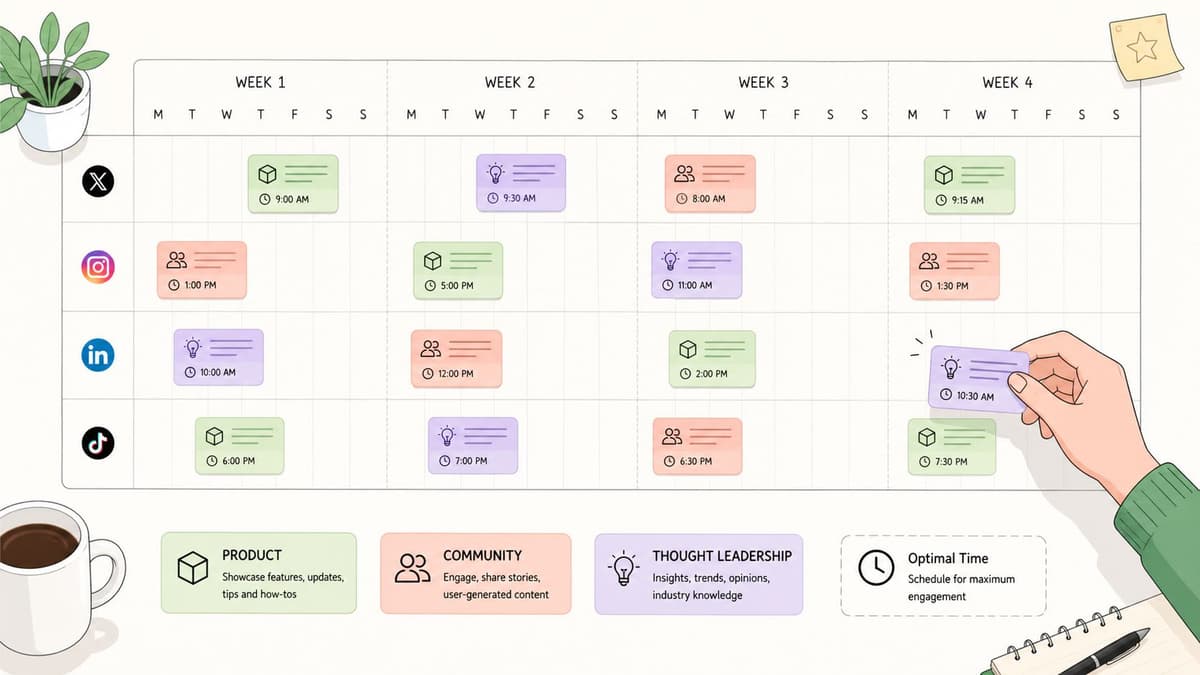
A strong calendar doesn't mean rigid scheduling. It means planned flexibility. Buffer, Later, and HubSpot all reflect versions of the same idea: decide your content pillars ahead of time, assign responsibility clearly, and leave room for timely commentary when something worth discussing appears.
What good calendar ownership looks like
Planning is the responsibility. Scheduling is just the final step. If your calendar only shows dates and captions, it's too shallow.
A useful calendar usually includes:
- Content pillar: Product update, educational post, social proof, founder perspective, community feature
- Format choice: Short text post, carousel, video, thread, repost, poll
- Platform adaptation rule: What changes for X, LinkedIn, Instagram, Threads, or Bluesky
- Owner and approval path: Who writes, who reviews, who publishes
Practical rule: Plan the message first, then adapt the format. Teams that do the reverse usually create busywork.
For smaller teams, I like batch creation by theme. One session for customer pain points. One session for product education. One session for founder opinions. That lowers context switching and makes voice more consistent.
If you need a useful starting point, this breakdown of what a content calendar is covers the core structure clearly.
What works and what usually fails
What works is building a repeatable rhythm. Many managers keep most of the calendar planned and reserve space for reactive posts, customer updates, and trend-aligned commentary. What fails is overfilling the calendar with generic content just to “stay active.”
Founders and lean teams often hit another problem: they post natively in one place, then manually rewrite everything elsewhere. That's where tools like MicroPoster can help. A founder can publish once, then mirror content across X, Threads, Bluesky, and Mastodon without rebuilding each post from scratch. That's especially useful when the strategic work matters more than the mechanics.
A quick walkthrough helps if you want to see a scheduling workflow in action.
2. Audience Research, Social Listening and Community Insights
If you don't know who you're talking to, every post becomes a guess. Audience research gives social media manager responsibilities their strategic center. It tells you which problems people care about, how they describe those problems, and where your brand voice feels credible versus forced.
The best social managers don't just track followers. They track recurring questions, emotional tone, objections, and language patterns in comments, DMs, reviews, and competitor conversations. That's where real content ideas come from.
The mini-framework to use
Start with three buckets. First, who engages. Second, what they care about. Third, what they keep repeating.
Slack has long benefited from listening closely to how teams discuss collaboration problems. Notion grows stronger when it understands real workflows, not just feature requests. Figma conversations often reveal friction around collaboration and handoff before a roadmap issue becomes obvious. The lesson is simple: social listening isn't only for content. It can shape product messaging and product decisions.
A practical routine looks like this:
- Review comments by theme: Pull out repeated questions, objections, and compliments
- Track competitor conversation gaps: Watch where competitors get strong engagement and where their audience feels ignored
- Log language verbatim: Save the exact wording customers use. That copy often outperforms internal brand language
For a broader strategic lens, this Proven SaaS audience analysis guide is a helpful reference.
Pros, trade-offs, and a common mistake
The advantage of listening well is relevance. You stop publishing what sounds smart internally and start publishing what matches real customer thinking. The trade-off is that social listening creates noise too. Not every comment deserves a strategic pivot.
The job isn't to chase every conversation. It's to identify which conversations repeat often enough to matter.
One practice I trust is monthly persona review with weekly listening notes. Monthly is enough to catch shifts in audience composition. Weekly is enough to notice changes in mood, topic interest, and objections before they affect performance. If you're managing content distribution with a tool that also surfaces comment patterns, that can reduce a lot of manual review time.
3. Content Creation and Copywriting
This is the responsibility widely acknowledged, but its true demands are often underestimated. Content creation isn't just “write a post.” It's deciding what the brand should say, how directly it should say it, which format gives the idea the best chance, and what tone fits both platform and audience.
The strongest social copy sounds simple because someone worked hard to make it simple. That includes the hook, structure, pacing, CTA, and emotional angle.
What this responsibility actually includes
A social media manager writes more than captions. They shape voice. They brief designers. They rewrite long internal messaging into short external language. They decide whether a thought belongs in a thread, a founder-style post, a carousel, or a short video script.
Real examples help here. Elon Musk's X posting style shows how concise, personality-driven messaging can dominate attention. Y Combinator uses educational threads to teach and signal authority at the same time. Naval Ravikant built a distinct content identity through compressed, idea-dense writing.
That doesn't mean every brand should imitate those voices. Most shouldn't. It means clarity and point of view matter more than polish alone.
What works better than “posting consistently”
A useful writing test is this: why should someone stop scrolling for this? If the answer is vague, the post probably won't land.
A few habits make a major difference:
- Lead with the tension: State the problem, mistake, or surprising angle early
- Write in platform-native rhythm: LinkedIn often rewards more development. X often rewards tighter compression. Threads can carry a conversational tone
- Keep a swipe file: Save your own high performers and strong examples from others by hook type, CTA style, and structure
AI can help with rewrite speed, but not with judgment. It's good for tone refinement, summarizing, or expanding a rough idea into variants. It's not good at replacing a brand point of view. For creators and startup teams, that's where assisted tools can be useful. For example, someone might draft natively, refine wording with AI support, then distribute adapted versions across channels rather than rewriting each one manually.
4. Engagement and Community Management
Through community management, many brands either secure or forfeit revenue. Community management isn't a soft extra. It's part customer care, part retention, part reputation defense. According to Sprout Social, nearly three-quarters of consumers expect a response within 24 hours, and 73% will buy from a competitor if a brand doesn't respond promptly to their inquiry, which raises the stakes for anyone handling social support and community replies in public channels (Sprout Social on social media manager job expectations).

That fact changes how you prioritize the role. If comments and DMs are sitting unanswered because the calendar looked full, the team is managing appearances instead of customer relationships.
The difference between engagement and community
Engagement is replying. Community management is designing how people experience your brand in conversation.
Wendy's became known for a playful voice because the team understood platform behavior and used it consistently. Glossier became known for responsiveness because the brand treated comments as relationship building, not leftover admin. Figma's community presence works because it engages users in actual product conversations, not just promotional ones.
Here's the practical split:
- Engagement: Answer questions, thank people, clarify confusion, acknowledge mentions
- Community management: Set tone, encourage member participation, highlight user content, moderate conflict, create belonging
What to standardize
Teams need response templates, escalation rules, and scheduled engagement windows. Without those, managers get dragged into reactive checking all day and still miss important messages.
Field note: Respond publicly when the issue affects trust. Move private only when personal details or account specifics are involved.
What works is setting clear standards for first-time commenters, product questions, complaints, and user-generated content. What doesn't work is treating every comment the same. A customer issue needs a different response than a casual reaction. A thoughtful critique deserves more than a canned brand voice line.
If you use automation for distribution, protect time for this work. Content can be queued. Community attention can't.
5. Analytics Monitoring and Performance Measurement
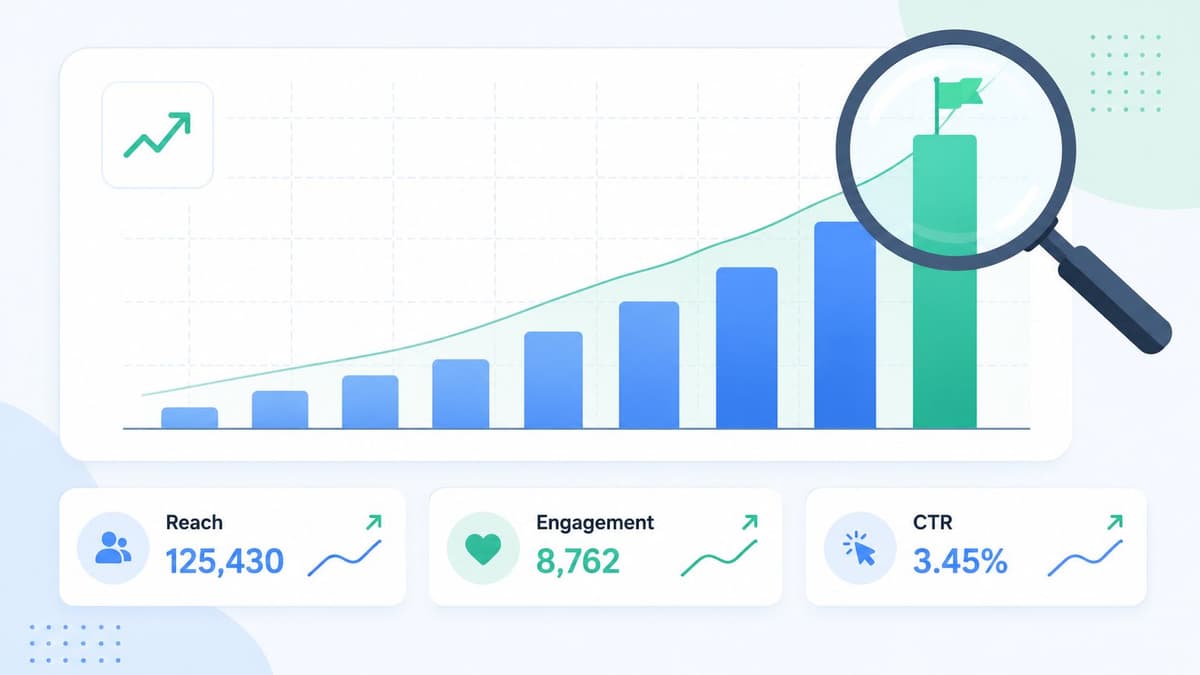
A social manager who can't read performance data is stuck arguing from opinion. Analytics turn social from “we think this is working” into “here's what moved.” That includes channel-level reporting, post-level analysis, and campaign readouts that connect content to business priorities.
This responsibility also comes with tool fluency. Prospects notes that social media managers commonly rely on platforms such as Sprinklr, Hootsuite, Buffer, and Later for scheduling and management, while tools like Google Analytics and Facebook Audience Insights support KPI tracking across metrics such as CTR, CPC, engagement rates, and reach (Prospects job profile for social media managers).
What to measure without drowning in dashboards
Organizations often track too much and interpret too little. Pick a handful of metrics that match the business goal. Awareness, engagement, lead generation, customer education, and retention all require different readouts.
A clean weekly review usually includes:
- Top-performing posts: What topic, hook, format, and CTA drove results
- Weak performers: Whether the issue was timing, message, format, or audience mismatch
- Channel patterns: Which platforms are best for reach, discussion, clicks, or qualified traffic
Reporting like a strategist
Good reporting explains why something happened and what should change next. Bad reporting is a screenshot dump.
For example, if a founder opinion post drove strong comments but weak clicks, that doesn't mean it failed. It may have built audience affinity while serving a top-of-funnel purpose. If a product explainer drove fewer reactions but more site intent, it may be more valuable than the louder post. Social media manager responsibilities include helping stakeholders understand those differences.
One of the easiest upgrades is documenting your top three posts each month and identifying shared elements. Not vibes. Specifics. Hook style, topic framing, CTA, and format. That's where the next month's strategy should come from.
6. Campaign Strategy and Execution
A campaign is where social stops being a series of individual posts and starts acting like coordinated marketing. This responsibility includes defining the objective, audience, key messages, asset needs, publishing rhythm, and adjustment plan before launch. If those pieces aren't clear, the campaign usually turns into fragmented content with no cumulative effect.
Apple's “Shot on iPhone” worked because the idea was bigger than a single post. Patagonia's campaigns work because the message aligns with the company's broader identity. HubSpot and Y Combinator both show how educational campaigns can build demand when the rollout is coherent.
The planning framework that keeps campaigns tight
Every campaign brief should answer a small set of questions. What are we trying to move. Who exactly are we speaking to. What must they understand or feel after seeing this campaign. Which formats support that best.
If those answers aren't written down, the social team ends up absorbing confusion from everyone else.
I like this operating sequence:
- Objective first: Awareness, registration, launch attention, lead capture, retention, or community activation
- Message hierarchy: Primary message, support points, proof points, objections
- Distribution map: Which posts go on which channels, in what order, with what adaptation
For teams building a more durable planning process, this guide to content strategy for social media is a useful companion.
What works in real execution
The best campaigns are planned enough to be coherent and loose enough to respond. Some assets should be ready in advance. Some should remain open for reactive use once live feedback starts coming in.
A common mistake is launching with polished assets but no adaptation path. One strong campaign message should generate multiple executions. A founder take. A customer quote. A short clip. A thread. A comment-led follow-up. That's how campaigns build momentum instead of peaking on day one and disappearing.
7. Cross-Platform Content Adaptation and Optimization
Repurposing isn't copy-paste. That's one of the most important lessons in modern social media manager responsibilities. The core idea can stay the same, but the packaging often can't. Different platforms reward different structures, pacing, media, and social cues.
A long thought may work as a thread on X, a conversational sequence on Threads, a sharper lead post on LinkedIn, and a stripped-down version on Bluesky. The message remains intact. The delivery changes.
How to adapt without diluting the brand
The simplest way to handle this is to create channel rules. Not vague guidance. Actual rules.
For example:
- X: Strong opening line, tighter phrasing, thread if needed
- LinkedIn: More context, stronger lesson framing, cleaner CTA
- Instagram: Visual-first, caption supports the asset rather than carrying the whole idea
- Mastodon or Bluesky: Respect local norms, avoid overly promotional language, adjust handle tagging carefully
Creators do this manually all the time. LinkedIn professionals turn presentations into carousels. TikTok creators rework short videos into Reels and Shorts. Founders often publish one thought and then spend more time adapting it than writing it.
The trade-off between native quality and operational speed
Manual adaptation often produces better platform nuance. It also burns time fast. That's the trade-off.
For lean teams, an automation layer can handle a lot of the mechanical work if the rules are set properly. That's where a platform like MicroPoster makes sense for some workflows. If someone posts first on a preferred source account, the tool can mirror to X, Threads, Bluesky, and Mastodon while adjusting for thread splitting, mentions, media resizing, and similar constraints. You still need judgment. You just don't need to do every repetitive step by hand.
Native posting matters. Native rework of the same idea matters more than identical posting everywhere.
8. Paid Social Media Strategy and Management
Organic social tells you what resonates. Paid social helps you scale what's already proving useful. A strong social manager understands both, even if a dedicated performance marketer owns the ad account.
Paid social work includes audience targeting, creative testing, budget logic, conversion tracking, and feedback loops back into organic content. The best teams don't isolate paid and organic. They let each one inform the other.
Where social managers add real value in paid
The manager usually has the clearest feel for audience language and creative fatigue. That makes them valuable in ad testing, even if they don't control every media-buying decision.
Some familiar examples show the range here. Dollar Shave Club used memorable creative to break through. Glossier has long benefited from paid support that amplifies strong brand storytelling. Slack's B2B motion shows how paid social can support a more targeted buyer journey when audience definition is sharp.
A practical workflow looks like this:
- Promote proven ideas first: Start with organic posts or angles that already earned strong response
- Test audience-message fit: Don't only test visuals. Test framing and offer language
- Refresh creative before fatigue sets in: Social ads weaken when the same hook keeps circulating to the same audience
Common failure points
A lot of paid social fails because teams optimize for the wrong signal. Clicks can be misleading. Cheap reach can be meaningless. If the campaign objective is demos, signups, or purchases, the measurement and creative decisions should reflect that.
Another common issue is disconnect. Organic says one thing. Paid says another. The landing page says a third. Social media manager responsibilities increasingly include protecting message continuity so the customer doesn't feel like they entered a different brand experience after the click.
9. Influencer and Partnership Collaboration
Partnerships can expand reach faster than your owned channels alone, but they only work when the fit is real. A good social media manager knows how to vet creators, shape the collaboration, and avoid deals that look good on paper but feel off-brand in execution.
This doesn't only apply to influencers in the traditional sense. It includes creators, niche operators, newsletter writers, podcasters, community leaders, and complementary brands.
What a smart partnership process looks like
The first question isn't “how big is their audience?” It's “does their audience trust them on the topic we care about?” That matters more than follower count.
Glossier's growth is often associated with creator relationships that felt native to its audience. Shopify has invested heavily in creator ecosystems and partnerships. Slack's creator and productivity-adjacent collaborations make sense because the product already lives inside work conversations.
A simple vetting framework:
- Audience overlap: Is there a real reason their audience would care
- Voice fit: Can they mention the brand without sounding rented
- Content quality: Do they make things people engage with, not just consume passively
The trade-offs to manage
The upside is borrowed trust. The downside is reduced message control. If you over-script the collaboration, the content feels stiff. If you provide no guardrails, the brand can drift.
What works is a clear brief with room for creator interpretation. State the message boundaries, product facts, and compliance points. Let the partner build the actual delivery in their own voice.
For startup teams and indie products, some of the best collaborations aren't big campaigns at all. They're thoughtful product mentions from people already close to the problem. Those usually outperform forced sponsorship energy.
10. Crisis Communication and Brand Reputation Management
Every social manager needs a crisis plan before a crisis exists. Not because every brand will face a public disaster, but because smaller issues happen constantly. A buggy launch, an insensitive reply, misinformation, customer anger, a founder statement taken badly, a moderation failure. These can escalate quickly when no one knows who owns the response.
Crisis management is one of the least glamorous social media manager responsibilities, but it's one of the most senior. It requires judgment, restraint, speed, and process.
What the role demands under pressure
KFC's response during its chicken shortage is often cited because the brand responded quickly and with a tone that fit its identity. Southwest and Uber illustrate the opposite challenge. When operational or trust issues run deep, cleverness alone won't help. The message has to acknowledge harm, clarify action, and avoid sounding evasive.
A usable crisis system has a few essentials:
- Escalation path: Who gets notified first, who approves language, who handles legal or support questions
- Holding statements: Pre-approved language for moments when facts are still being gathered
- Monitoring protocol: Increased watch on mentions, keywords, and reply threads during sensitive windows
What works when things go sideways
The first rule is to respond at the right speed, not just the fastest speed. Silence can look careless. A rushed, defensive response can make the issue worse.
Say what happened, say what you're doing next, and avoid language that sounds like it was written to protect the brand from embarrassment.
In smaller teams, this often means the social manager becomes the air traffic controller between support, product, leadership, and PR. That's why documentation matters. After any incident, save the timeline, response drafts, outcome, and lessons. The next crisis rarely looks identical, but the process improvements compound.
10-Point Comparison of Social Media Manager Responsibilities
| Item | Implementation Complexity 🔄 | Resource Requirements ⚡ | Expected Outcomes ⭐📊 | Ideal Use Cases 💡 | Key Advantages ⭐⚡ |
|---|---|---|---|---|---|
| Content Calendar Planning and Scheduling | Medium, structured workflows, approvals | Low–Medium: scheduling tools + upfront time | Consistent posting, cohesive brand narrative, ⭐⭐⭐⭐ 📊 | Ongoing brand presence, multi-platform teams | Prevents last-minute work; enables batching and optimal timing |
| Audience Research, Social Listening and Community Insights | High, continuous monitoring & analysis 🔄 | Medium–High: listening tools, analyst time | Actionable segments, trend detection, ⭐⭐⭐⭐ 📊 | Product strategy, content targeting, trend spotting | Informs data-driven content/product decisions; early issue detection |
| Content Creation and Copywriting | Medium, creative iteration and review | Medium: writers, editors, creators | Resonant messaging and higher engagement, ⭐⭐⭐⭐ 📊 | Brand storytelling, growth content, thought leadership | Builds voice, drives engagement and differentiation |
| Engagement and Community Management | High, real-time responsiveness & moderation 🔄 | High: dedicated community managers, time | Strong loyalty and advocacy, ⭐⭐⭐⭐ 📊 | Customer-facing brands, active communities | Builds relationships, captures real-time feedback |
| Analytics Monitoring and Performance Measurement | Medium, dashboards and interpretation | Medium: analytics tools, reporting time | Measured ROI and informed optimizations, ⭐⭐⭐⭐ 📊 | Stakeholder reporting, campaign optimization | Evidence-based decisions; identifies top-performing content |
| Campaign Strategy and Execution | High, multi-phase planning & coordination 🔄 | High: creative assets, paid budgets, team | Concentrated impact and measurable lifts, ⭐⭐⭐⭐⭐ 📊 | Product launches, seasonal pushes, major initiatives | Coherent storytelling, measurable outcomes, justifies spend |
| Cross-Platform Content Adaptation and Optimization | Medium–High, format and tone tailoring | Medium: adaptation tools, creative time | Native performance per channel, ⭐⭐⭐⭐ 📊 | Multi-platform distribution, repurposing strategies | Saves time via smart repurposing; improves platform fit |
| Paid Social Media Strategy and Management | Medium–High, targeting & optimization 🔄 | High: ad spend, specialists, tracking | Scalable reach and conversions, ⭐⭐⭐⭐ 📊 | Acquisition, conversion funnels, scaling top content | Precise targeting and measurable ROI when set up properly |
| Influencer and Partnership Collaboration | Medium, vetting, contracts, coordination | Medium: outreach, management time, compensation | Expanded reach and third‑party credibility, ⭐⭐⭐⭐ 📊 | Awareness campaigns, niche audience growth | Leverages trust of partners; cost-effective reach vs. ads |
| Crisis Communication and Brand Reputation Management | High, rapid protocols and escalation 🔄 | Medium–High: monitoring, decision makers | Reputation protection and faster containment, ⭐⭐⭐⭐ 📊 | Product failures, PR incidents, sensitive periods | Prepared playbooks; reduces risk of escalation and builds trust |
From Manager to Strategist Tying It All Together
The shift in this role is simple. Social media manager responsibilities used to be framed as publishing tasks. Now they're business responsibilities. The manager isn't just there to keep channels active. They shape brand perception, customer experience, campaign execution, insight gathering, and performance reporting.
That's why the role feels so demanding in small teams. One person may be planner, copywriter, analyst, moderator, creative coordinator, and frontline responder at the same time. In-house, agency, startup, or creator-led brand, the challenge is similar. The work only becomes manageable when there's a system behind it.
A useful way to think about seniority is by the problems someone can own without supervision. A junior manager can schedule, draft, and support community handling with guidance. A mid-level manager can run a calendar, report on performance, and execute campaigns across several channels. A senior manager can decide what the brand should say, what not to say, how to respond under pressure, and how social should support the wider business.
The daily schedule changes with that seniority too. A junior manager may spend more time building posts, handling routing, and reporting basics. A senior manager should spend more time on prioritization, message judgment, cross-functional coordination, and identifying where social can influence product, support, sales, or PR. If a senior social lead spends the whole day manually reformatting posts, the team has a workflow problem.
That's where automation becomes strategic, not lazy. The point isn't to remove human input from social. The point is to remove repetitive production work that doesn't require senior judgment. Cross-platform adaptation, scheduling, and mirroring are useful examples. When software handles those reliably, the manager gets time back for community response, creative development, campaign thinking, and analysis.
For smaller teams, that trade-off matters a lot. Hiring a social media manager is a meaningful investment. In the UK market, typical salaries run between £35,000 and £50,000, with senior roles often landing in the upper end of that range, which reflects how much strategic ownership the role now carries (Digital Waffle salary overview for social media managers). If you're asking one person to do high-value thinking, don't bury them in low-value repetition.
That's also why tools like MicroPoster can fit naturally into a modern stack. If your workflow involves publishing once and adapting across X, Threads, Bluesky, and Mastodon, an automation layer can reduce manual friction while keeping the manager focused on decisions that need a person. If that sounds close to your workflow, trying the 7-day free trial is a reasonable way to see whether it saves enough time to justify a permanent place in the process.
If you want less manual cross-posting and more time for actual strategy, MicroPoster is worth a look. It lets you write once, mirror across supported platforms, and test a workflow that gives your social media manager more room for community, analytics, and campaign work with a 7-day trial.