share x to bluesky
How to Automatically Share X Posts to Bluesky (2026 Guide)
Learn how to automatically share X posts to Bluesky. This guide covers the best tools and a step-by-step walkthrough for setting up seamless cross-posting.

You post on X, hit publish, and then do the same tedious dance on Bluesky. Copy the text. Fix the link. Re-upload the image. Remove the parts that only make sense on X. If the post was part of a thread, the whole thing gets even messier.
That routine feels small when you do it once. It becomes a drain when you do it every day.
The good news is that learning how to automatically share X posts to Bluesky isn't just about piping one feed into another anymore. The key benefit comes from intelligent adaptation. That's what keeps your posts from looking broken, awkward, or obviously auto-generated once they land on Bluesky.
Why Manually Sharing Posts Is a Waste of Your Time
You already know the friction points.
You write a clean post on X. Then you move it over manually and notice the Bluesky version needs touch-ups. The image has to be uploaded again. The link preview doesn't behave the same way. Mentions point to nowhere. Polls don't carry over cleanly. A fast publishing habit turns into a second round of editing.
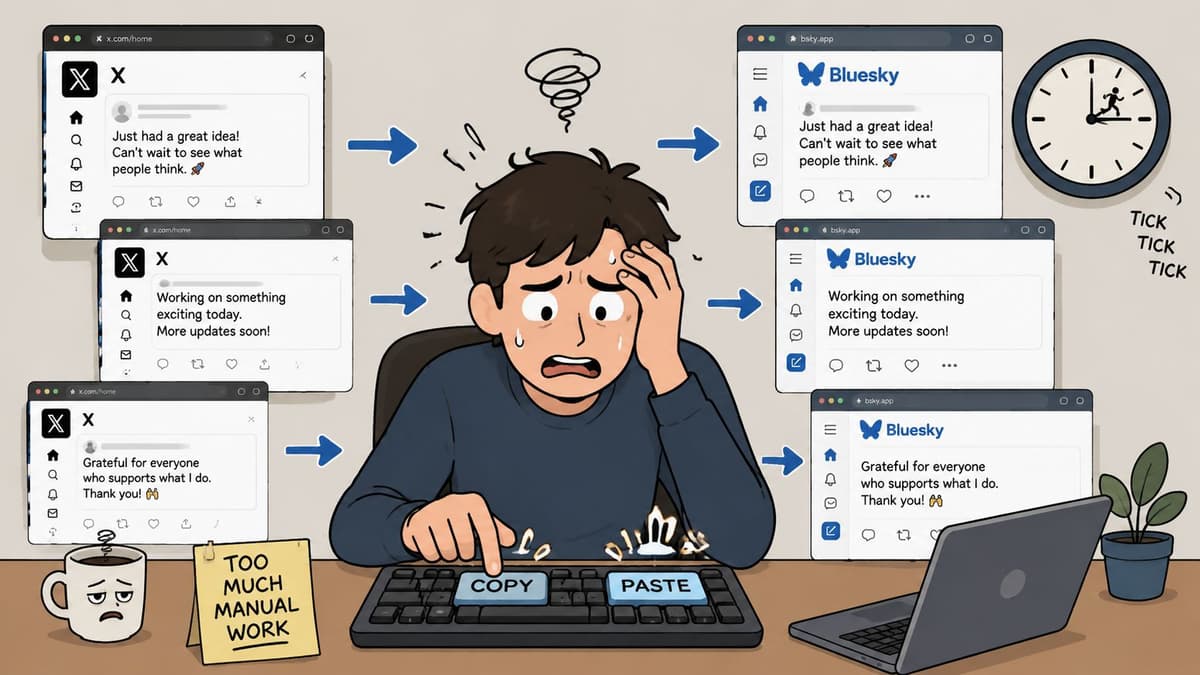
That cost adds up fast for founders, indie hackers, and small teams. Automation via RSS feeds now supports posting intervals as short as every 15 minutes, with 87% of users reporting time savings of 3–5 hours per week when using RSS-to-Bluesky automation instead of manual copy-pasting, according to a Reddit discussion about Bluesky sharing workflows and Android share behavior (Reddit discussion on Bluesky sharing workflows).
The real cost isn't just time
Manual cross-posting breaks momentum. You publish once, then switch into distribution mode. That context switching is what makes social media feel heavier than it should.
For creators, the bigger problem is consistency. When posting to Bluesky requires extra manual work, you start skipping it on busy days. That usually means your best content never reaches the people who follow you there.
Practical rule: If a platform needs a separate manual workflow, your posting consistency will drop the moment your schedule gets busy.
Bluesky is worth showing up on consistently
Bluesky isn't a side experiment anymore. As of July 2026, it has surpassed 30 million registered users, with over 12 million daily active users posting content, which makes it too important to treat as an afterthought in your publishing workflow, based on the same verified Bluesky ecosystem data referenced in the Reddit workflow note above.
That matters if you've already built your habit on X and want broader reach without doubling your workload.
If you want the strategic case for being there at all, this short piece on why you should be cross-posting to Bluesky is worth reading. The short version is simple. Your job is creating posts people care about. Your job isn't babysitting copy-paste workflows.
Exploring Your X to Bluesky Automation Options
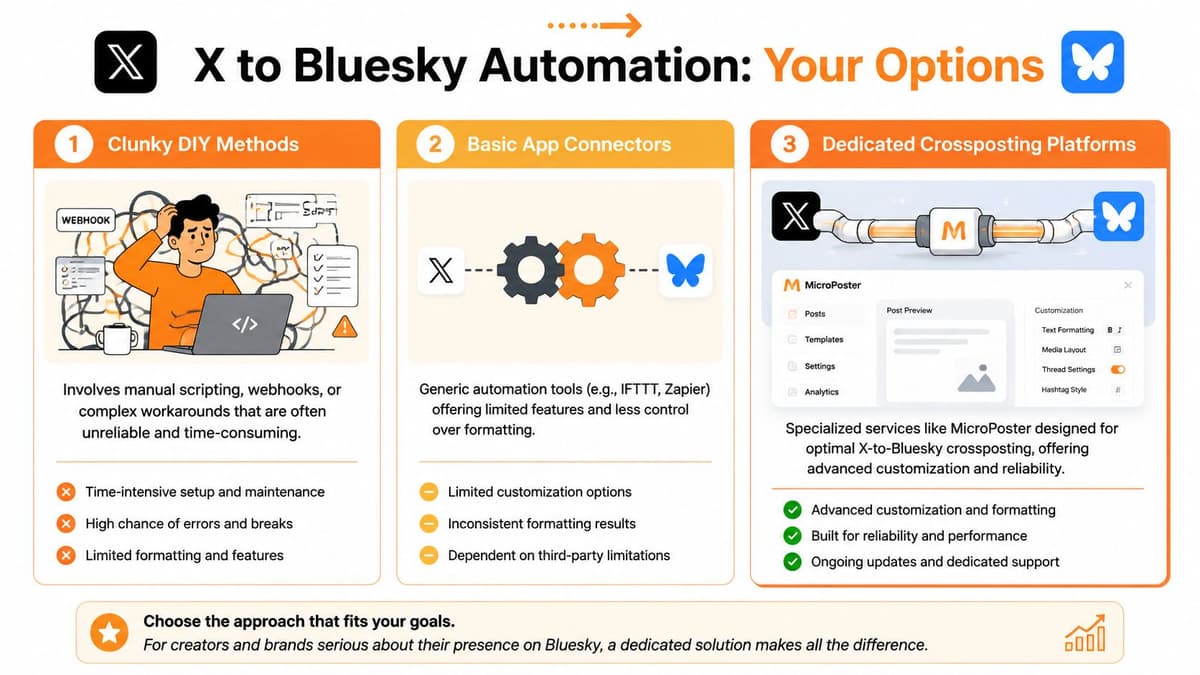
There are three practical ways to handle this. You can build something yourself, use a general automation connector, or use a dedicated cross-posting tool.
Each approach works. They just fail in different places.
What most people try first
The first stop is usually RSS, Zapier, IFTTT, Buffer, or a homemade script. That makes sense. They feel lightweight, cheap, and flexible.
There's a real audience for that setup. Over 64% of automated Bluesky users use Zapier-to-Buffer workflows or RSS-based integrations to mirror X content, with average setup costs under $10/month, though these often lack advanced features like native media handling, according to Bluesky's advanced posting documentation (Bluesky advanced posting guide).
The catch is that generic connectors are good at triggering actions, not at adapting content.
Where the trade-offs show up
If your posts are plain text with one link, a basic connector may be enough.
If you post threads, visuals, product updates, polls, or anything with X-specific mentions, the cracks show quickly. That's the point where many teams either tolerate ugly cross-posts or bring in help from a specialist builder such as an AI automation agency to wire up custom workflows around the edge cases.
| Method | Ease of Setup | Media & Thread Handling | Reliability | Best For |
|---|---|---|---|---|
| Manual posting | Easy | Manual and inconsistent | Depends on you | Very low posting volume |
| DIY scripts and webhooks | Hard | Can be customized, but maintenance-heavy | Varies with API changes | Technical users who want full control |
| Basic app connectors | Medium | Limited handling for native media and formatting | Good for simple triggers | Simple text-only mirroring |
| Dedicated cross-posting platforms | Medium | Built for adaptation, threading, and platform differences | More predictable for publishing workflows | Creators and teams who post often |
A simple trigger is not the same thing as a publishing system. Cross-posting breaks when the destination platform expects different formatting, media rules, and link handling.
One dedicated option in this category is MicroPoster's guide to X to Bluesky cross-posting tools, which focuses on adapting posts for the destination platform instead of just relaying them unchanged.
A Step-by-Step Guide to Connecting X and Bluesky
If you want the fastest route, use a dedicated platform that already handles the Bluesky-specific posting logic behind the scenes. That's the easiest way to avoid hand-building API calls, rich text parsing, and media upload steps.
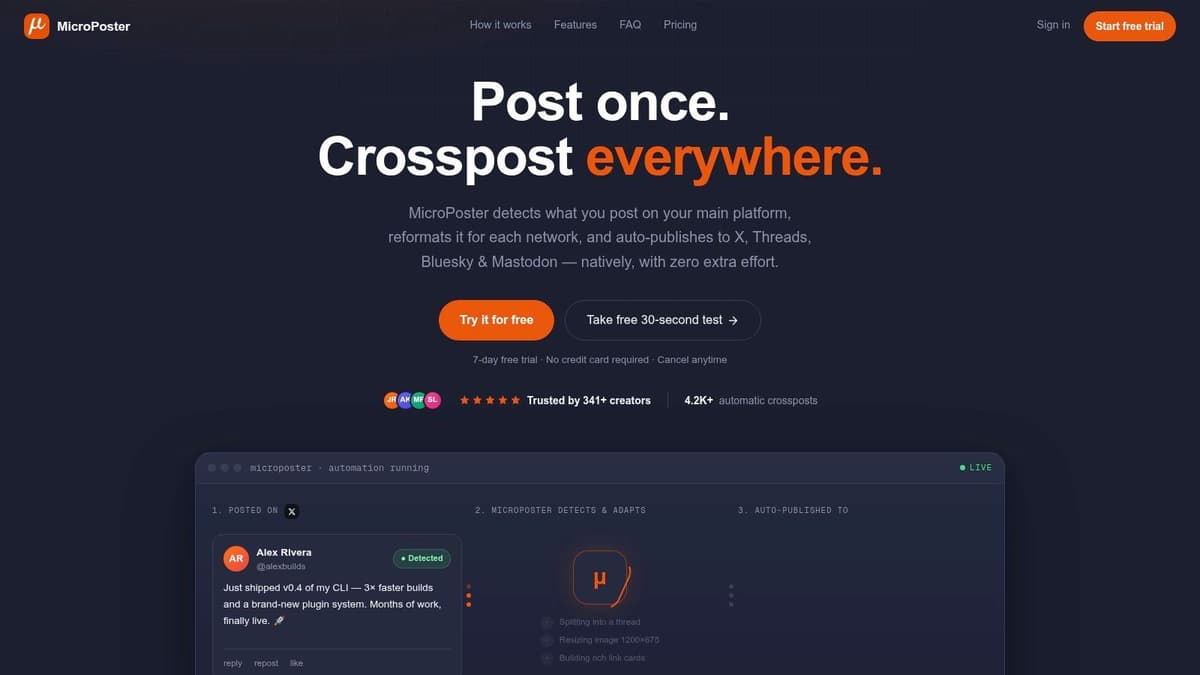
Here's the interface you're aiming for.
Step 1: Create your automation account
Start with a tool that supports both X and Bluesky connections in one workflow. MicroPoster is one option for this. It lets you connect a source account on X and a destination account on Bluesky, then create a rule that mirrors new posts automatically.
This is also the point where a 7-day trial is useful. You can test your exact posting style before committing to anything.
Step 2: Connect X as the source
Choose X as the account you want the system to watch.
The tool should ask for authorization through the platform connection flow instead of asking you to paste credentials into a form. That matters because you want access you can revoke later from the connected account, not a brittle workaround that turns into a maintenance problem.
Step 3: Connect Bluesky as the destination
Then connect your Bluesky account as the publishing target.
This is the step that looks simple on the front end and gets technical on the back end. To post programmatically, tools must resolve your DID handle via com.atproto.identity.resolveHandle and manually construct a RichText object to make URLs clickable, complexities that dedicated platforms like MicroPoster manage automatically, as demonstrated in this Bluesky API walkthrough (Bluesky AT Protocol posting walkthrough).
If you're building your own version, things can quickly become annoying. If you're using a dedicated tool, you usually won't need to touch any of it.
Step 4: Create the rule
Set up one simple automation:
- Trigger on new X posts. The system watches for fresh posts from your chosen account.
- Send to Bluesky automatically. Each new qualifying post is mirrored to the destination account.
- Choose your behavior. Decide whether to mirror everything or only selected posts.
A good starting rule is conservative. Post your main feed updates, skip replies, and leave experimental content out until you've tested the output.
Step 5: Turn on adaptation settings
This is the part that separates a useful setup from a noisy one.
Look for settings such as:
- Thread handling so longer updates can publish cleanly instead of getting cut off.
- Link formatting so pasted URLs remain clickable and readable on Bluesky.
- Media uploads so images and videos land as native posts rather than awkward references.
- Mention cleanup to avoid sending Bluesky readers into dead handles copied from X.
Step 6: Publish one test post
Don't import your whole workflow mentally and assume it's fine. Publish one real post from X and check the Bluesky version closely.
You want to confirm four things:
- The text reads naturally
- The links are clickable
- The media uploads natively
- The final post looks like it belongs on Bluesky
Use your first test post as a formatting test, not a campaign post. It's much easier to fix one low-stakes post than clean up a week of broken automation.
Fine-Tuning How Your Posts Appear on Bluesky
Basic mirroring gets your content onto Bluesky. Adaptation makes it worth reading there.
Most guides often remain too superficial. They tell you how to send a post from one platform to another, but they don't deal with the elements that hinder performance. Mentions, polls, thread length, and media formats all need attention.
Clean up X-specific elements
The fastest improvement is removing or replacing platform-specific clutter.
Common automation pitfalls include failing to adapt X-specific metadata like @handles, which can reduce engagement success rates by up to 40%, and mirroring polls, which do not render on Bluesky, based on cross-posting implementation notes from MicroPoster's analysis of X-to-Bluesky workflows (guide to common X to Bluesky cross-posting pitfalls).
That gives you a practical rule set:
- Strip broken mentions: If an X handle doesn't map to a real Bluesky identity, remove it or rewrite the sentence.
- Extract poll text only: Poll structures from X shouldn't be mirrored as-is.
- Review embedded media references: If a post depends on X-only presentation, transform it before it goes out.
Make long posts readable
A long X post dumped into Bluesky as one block usually feels clumsy. A better setup turns it into a short thread or trims the extra platform-specific filler automatically.
Good cross-posting rules usually include choices like:
- Split long updates into numbered threads
- Keep only the first post for teaser-style announcements
- Remove extra hashtags or repeated links
That keeps the result readable without forcing you to rewrite every post twice.
Small formatting fixes do more than polish. They keep the post from looking imported.
Treat Bluesky like its own platform
The best cross-posts don't feel duplicated. They feel native.
That doesn't mean you need a custom rewrite every time. It means your automation rules should respect Bluesky's constraints and culture. If the source post contains something destination users can't click, can't see, or can't interpret, the rule should handle it before the post goes live.
Testing Your Automation and Common Pitfalls
Your workflow isn't done when the accounts connect. It's done when a real post survives the trip cleanly.
Start with a quick test checklist after your first few mirrored posts:
- Check timing: Did the Bluesky post appear when you expected it to?
- Open the links: Are they clickable in the published post?
- Inspect media: Did images or video show up natively?
- Read for weird leftovers: Look for broken mentions, extra hashtags, or text that only made sense on X.
The biggest failure point is usually media. A lot of simple scripts can move text but stumble when they have to upload assets in the right format and order. That isn't a niche issue. A 2024 Reddit post by an indie developer of a free open-source crossposter notes that 70% of early user complaints were about broken media formats when porting X content to Bluesky, highlighting a key technical challenge, as summarized in a Ghost forum discussion about automatic Bluesky posting (Ghost forum thread on automatic posting to Bluesky).
Common failure modes
Some problems are easy to spot once you know what to look for.
- Posts publish without clickable links: The text copied over, but the link metadata didn't.
- Images appear as missing or malformed: The upload flow failed somewhere in the background.
- Mentions stay untouched: The post technically published, but it sends people to dead ends.
- Poll content looks broken: The original X post used a format Bluesky doesn't support.
A simple testing habit fixes most of this early. Publish one text-only post, one link post, and one media post before trusting the automation with product launches or launch-day threads.
Reclaim Your Time and Grow Your Reach Effortlessly
Once this workflow is set up properly, social distribution feels lighter again.
You write once on X. Your post reaches Bluesky without the repetitive cleanup work. More important, the Bluesky version doesn't look like a lazy duplicate. That's the difference between basic mirroring and a system you can actually rely on.
For founders and creators, that saved time is better spent on higher-value work. Write the next post. Reply to comments. Talk to customers. If your broader goal is turning social attention into revenue, this practical look at AdCrafty's Twitter earning guide is a useful next read because it focuses on converting your posting habit into something more durable.
The takeaway is simple. Learning how to automatically share X posts to Bluesky matters. Learning how to do it with adaptation rules matters more. That's what keeps your workflow clean, your posts readable, and your presence consistent on both platforms.
If you want a low-friction way to try this yourself, start with MicroPoster. It lets you connect X and Bluesky, automate cross-posting, and test adaptation rules with a 7-day trial.