crosspost bluesky mastodon
How to Crosspost Automatically from Bluesky to Mastodon
Learn how to crosspost Bluesky Mastodon content automatically. This guide shows you how to sync posts, save time, and expand your reach effortlessly.

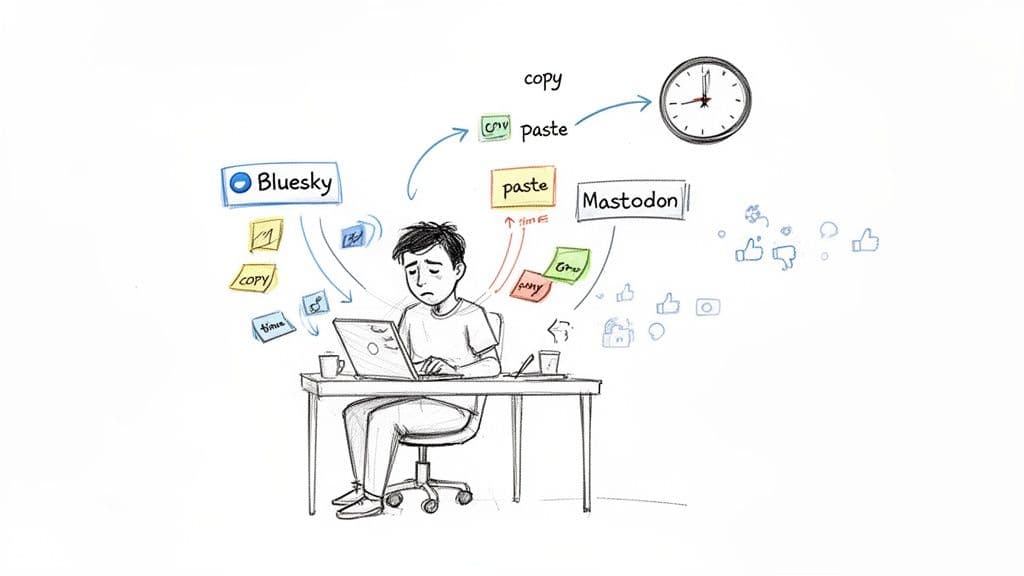
If you've ever tried to keep your presence active on both Bluesky and Mastodon, you know the drill. It's a soul-crushing cycle of copy, paste, tweak, repeat. This manual grind isn't just annoying—it's actively holding you back, creating a bottleneck that splits your audience and kills your momentum.
It’s time for a "set it and forget it" solution that lets you sync posts between Bluesky and Mastodon fully automatically.
Why Manually Crossposting Is a Losing Battle
Trying to manage Bluesky and Mastodon by hand feels like working two jobs. You spend time crafting the perfect post, get it just right... and then you have to start all over again for the other platform. You're re-uploading images, wrestling with different character limits, and manually adjusting the text. It's a repetitive task that drains the creative energy you should be using to connect with people.
For anyone trying to build a brand or a following, this isn't just inefficient. It’s a serious drag on your performance. Every minute you spend copy-pasting is a minute you're not creating something new or actually talking to your community.
The Hidden Costs of the Manual Grind
The real price you pay goes far beyond just wasted time. The delays it creates can completely tank your engagement. A perfectly timed post on Bluesky might be old news by the time you've wrestled it into shape for Mastodon, meaning you've missed out on joining a critical conversation.
This friction is a huge problem when you look at the distinct audiences on each platform. As of early 2025, Bluesky had rocketed past 26 million users, but only 15–20% of them were active each month. Mastodon tells a similar story, with less than 7% of its nearly 10 million registered users logging in monthly. You can learn more about what these social media platform statistics mean for creators.
This data shows that you can't just pick one platform; small but highly engaged communities exist on both. Reaching them requires being present everywhere, a goal that manual posting makes nearly impossible.
The biggest problem with manual crossposting is the inconsistency it creates. When your posts are late or look like they don't belong, you erode the trust and reliability that are essential for building a loyal community.
Missed Opportunities and Watered-Down Messages
Doing everything by hand is a recipe for mistakes. A quick, punchy post on Bluesky might need to be a multi-part thread on Mastodon. That's a clumsy conversion to pull off manually, and a lot can go wrong.
Here’s what typically gets sacrificed:
- Timely Content: Your message loses its power when it isn’t posted everywhere at once.
- Sloppy Formatting: Posts look unprofessional when you accidentally exceed character limits or forget to adapt the media.
- Split Engagement: You force your audience to pick a side, making it much harder to build a single, unified community around your work.
In the end, this manual approach forces you to pick between quality and quantity, when you really need both. It perfectly illustrates why automation isn't just a nice-to-have anymore—it's the key to consistent, scalable growth across platforms.
The "Set-It-And-Forget-It" Approach to Crossposting
Imagine posting to Bluesky and, moments later, seeing that same content show up perfectly formatted on Mastodon—without you lifting a finger. This isn't some far-off dream; it's what a true "set-it-and-forget-it" automation system does. The entire philosophy is built on a simple but powerful idea: post once, and reach your audience everywhere.
This method completely eliminates the tedious cycle of copy-pasting. Instead, dedicated services work behind the scenes to automatically sync posts between Bluesky and Mastodon. As soon as you publish something new on your source platform, these tools grab it, automatically reformat your content, and publish it to the destination platform.
How Do These Content Bridges Actually Work?
The real magic here is in the intelligent reformatting. A good automation tool isn't just a dumb copy-paste bot. It acts as a smart translator between the two platforms, understanding the different rules and quirks of both Bluesky and Mastodon. Your content is automatically reformatted and published to the destination platform, ensuring it always feels native.
This is a 100% automated solution, which means zero extra effort for you. You genuinely don’t have to change your habits. Just post as usual on your source platform, and the system takes care of everything else.
- Text and Links: Your message and any links you include are transferred over perfectly.
- Media Handling: All media is auto-adjusted (text, images, videos) to meet Mastodon's specific requirements.
- Smart Threading: Long posts are automatically split into a neat, numbered thread on Mastodon.
Once you’ve done the initial setup, there is zero extra effort required from you. You connect your accounts one time, and your content syncs indefinitely.
Meet the Go-To Automation Service
While plenty of tools can schedule posts, the most popular automatic crosspost service is MicroPoster. It was literally built from the ground up to master the crosspost Bluesky Mastodon workflow, turning what was once a repetitive chore into a background task you can completely forget about.
By linking your accounts with MicroPoster, you're essentially building a content bridge. You can put all your energy into creating great stuff on Bluesky, knowing it will be flawlessly reformatted and published for your Mastodon followers without any extra work.
This is how you maintain a consistent presence across platforms without burning out. If you're ready to fully embrace the 'set-it-and-forget-it' philosophy, a broader guide to the top social media automation tools can show you what else is out there. For this kind of focused microblogging sync, though, a specialized tool is your best bet. MicroPoster makes the technology invisible so your content can shine, no matter where your audience is.
How Automated Crossposting Actually Works
So, what does it really look like when you use an automated service to crosspost from Bluesky to Mastodon? It’s a lot smarter than just a simple copy-and-paste. These tools work in the background, acting as a translator between the two platforms and handling all the quirky formatting differences for you.
All you have to do is post on Bluesky like you normally would. The automation takes care of the rest, making sure your content looks native and correct when it arrives on Mastodon. No more tedious manual adjustments.
This diagram gives a great high-level view of how that process unfolds.
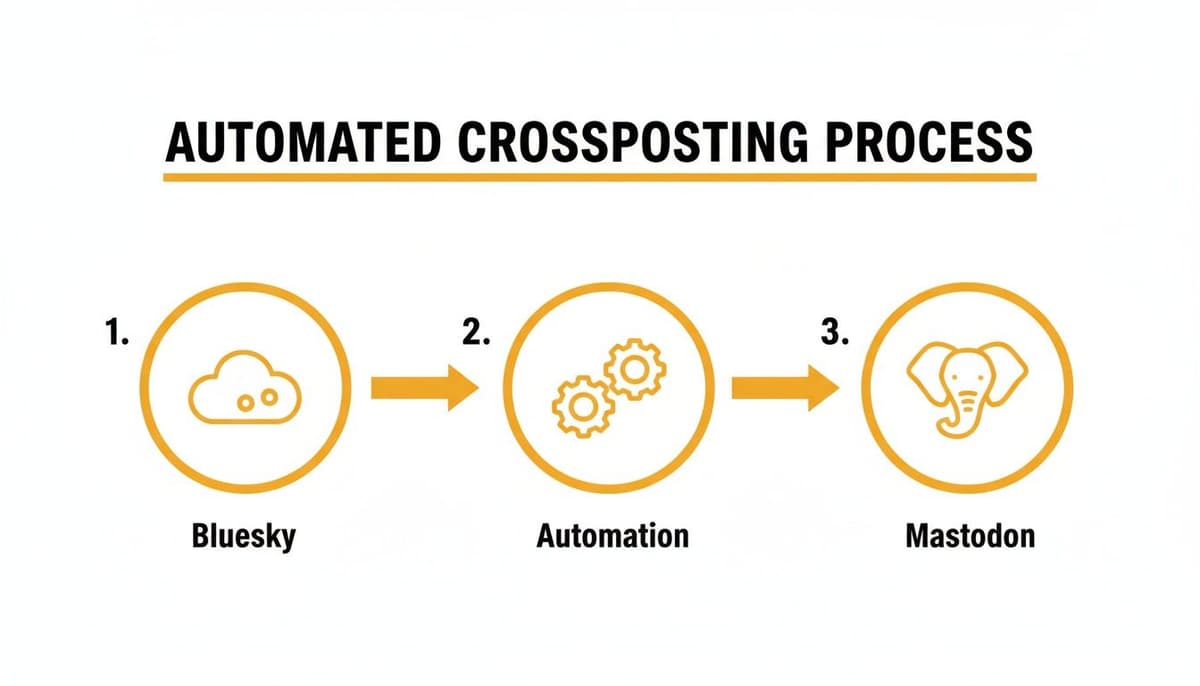
As you can see, your only job is to interact with Bluesky. The automation engine handles the heavy lifting of adapting and publishing everything perfectly to Mastodon.
Intelligent Content Adaptation
One of the biggest headaches in manual crossposting is dealing with different character limits. You might write a 450-character post on Bluesky that fits perfectly, but once you add hashtags for Mastodon, you could easily blow past its 500-character default limit.
A smart crossposting service anticipates this. Instead of just truncating your post or failing to send it, a tool like MicroPoster will automatically break your long post into a neatly numbered thread on Mastodon. This keeps your entire message intact while playing by the platform's rules.
The real magic of good automation is in preservation. It ensures your original message—tone, media, links, and all—arrives at the destination looking like you posted it there yourself.
This is a world away from the manual method, where you’d be stuck counting characters, carefully splitting up your text, and then posting each part in the right order. Automation just makes that friction disappear.
Seamless Media and Link Handling
Another area where automation shines is media management. When you crosspost from Bluesky to Mastodon, you need images, alt text, and videos to come through correctly. A good automation tool handles all of this without you lifting a finger.
- Images and Alt Text: Your images are republished with their original alt text, so you don't have to re-enter accessibility descriptions.
- Videos: Videos are transferred over and optimized for Mastodon's native player, creating a seamless experience for your followers.
- Links: All of your hyperlinks are kept intact, ensuring your calls to action and resource links work perfectly on both platforms.
The whole point is to "set it and forget it." You connect your accounts, and the system confirms the bridge is active. By taking care of all the technical details, these services let you get back to what matters: creating great content.
This kind of effortless connection is all made possible by the technology behind the scenes. If you're curious, you can learn more about how the social media API ecosystem enables this kind of powerful automation.
Manual vs Automated Crossposting A Feature Breakdown
To really see the difference, let’s compare the manual workflow with what an automated service like MicroPoster provides. The time savings and added features become pretty clear.
| Feature | Manual Crossposting | Automated Crossposting (with MicroPoster) |
|---|---|---|
| Time Investment | 5-10 minutes per post | Zero extra time after initial setup |
| Character Limits | Manual splitting and counting required | Automatic threading for long posts |
| Media Handling | Re-upload images/videos, re-write alt text | Automatic transfer of media and alt text |
| Link Integrity | Copy and paste links for each platform | Links are preserved and posted automatically |
| Consistency | Prone to errors and forgotten posts | 100% reliable and consistent posting |
| Scheduling | Requires separate scheduling for each platform | Post now on one, appears on both |
The table really tells the story. Automation isn't just about saving a few minutes here and there; it's about building a consistent, error-free presence across platforms without adding to your workload.
Understanding the Vibe: Platform-Specific Etiquette
Getting the automation right is only half the battle. If you want your crossposts to actually connect with people, you need to understand that Bluesky and Mastodon have very different cultures. Simply mirroring your content without any thought can make your posts feel out of place and, frankly, a bit spammy.
The rush to find a multi-platform strategy isn't new. In the two years after the big Twitter shakeup, creators scattered, and crossposting became a necessity. By October 2025, Bluesky had ballooned to an estimated 40 million accounts, while Mastodon found its footing with nearly 10 million registered users. We ended up with two huge, vibrant communities that operate in fundamentally different ways. You can read a great breakdown of this growth and migration dynamic.
Thinking Ahead for Mastodon
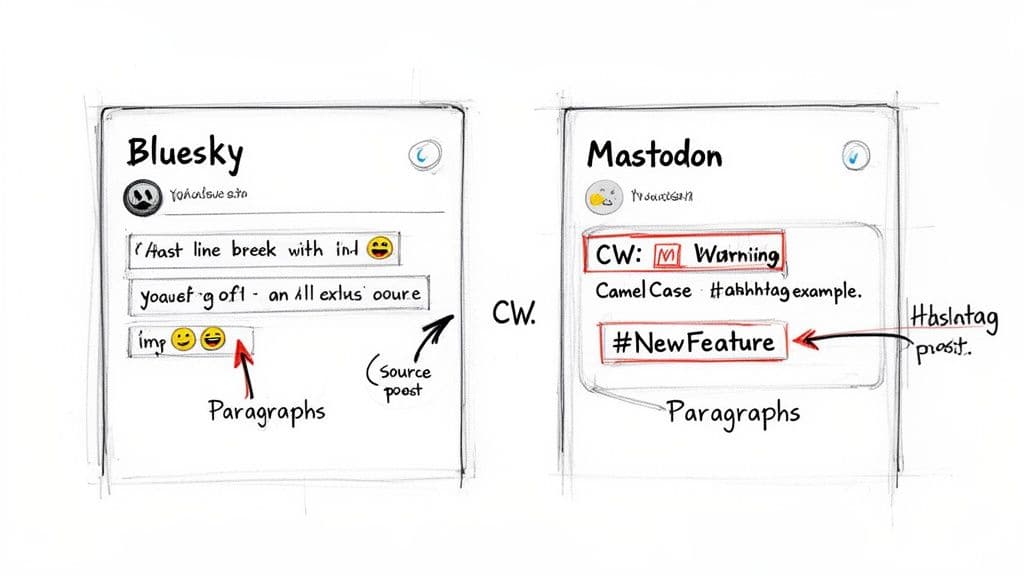
The secret is to write your Bluesky posts with Mastodon already in mind. It just takes a few small tweaks. For instance, Mastodon's community culture heavily emphasizes using content warnings (CWs) for everything from political discussions and spoilers to just very long posts. An automation tool can't guess your intent, but you can give it a clear signal.
A simple trick I use is to start a Bluesky post with a clear trigger on the first line, like "CW: Politics" or "Spoiler Warning". When this gets crossposted, it lands on Mastodon perfectly formatted, respecting the local norms.
The same logic applies to threading. While a good tool like MicroPoster can automatically split a long post into a thread, you can make the result much cleaner. By using distinct paragraph breaks in your original Bluesky post, you’re basically telling the tool where the most logical split points are. The result is a thread on Mastodon that’s easy and natural to read.
Smart crossposting isn't just about being seen everywhere; it's about being a good community member everywhere. A little bit of forethought on the front end makes all the difference.
Hashtags and Getting Found
Hashtag culture is another major difference. Mastodon lives on hashtags for discoverability, and there’s a strong community preference for #CamelCaseHashtags. This format is way more accessible for people using screen readers.
Here are a few habits to build into your Bluesky posting that will pay off on Mastodon:
- Adopt CamelCase Everywhere: Start writing your tags in CamelCase on Bluesky (e.g., #TechCommunity instead of #techcommunity). It works just fine there and ensures you’re being accessible when the post arrives on Mastodon.
- Get Descriptive: Mastodon search is almost entirely tag-driven. Use specific, descriptive hashtags that genuinely reflect what your post is about to help people find it.
- Write in Chunks: When you're composing a longer idea on Bluesky, try to think in 500-character blocks. This mental framework helps you naturally structure your thoughts in a way that translates perfectly into a coherent Mastodon thread.
Making these small adjustments to how you post on Bluesky ensures your content feels native, not parachuted in. It’s a small effort that transforms an automated feed from a simple broadcast into a real, engaging presence on both platforms.
Your Blueprint For Effortless Audience Growth
Expanding your reach across different social networks shouldn't feel like a chore that leads to burnout. The whole idea behind a smart crossposting strategy is to get your time back while connecting with new, vibrant communities. When you stop doing the same manual tasks over and over, you can get back to what you do best—creating great content.
This kind of automation is more than just a simple time-saver; it’s a real growth multiplier. It keeps your voice and message consistent everywhere you post and ensures your content lands on Mastodon right when it needs to. This is how you build a solid, professional presence without tacking extra hours onto your day.
The Power of "Set It and Forget It"
The real magic of a fully automated system is how simple it makes everything. You just post on your main platform like you always do—whether that's Bluesky or somewhere else—and the tech takes care of the rest. We're not just talking about copy-pasting text, either. This is about smart adaptation.
A good crossposting service will automatically reformat every piece of your post for its new home.
- Media Is Auto-Adjusted: All your images, videos, and even the alt text get carried over and optimized for Mastodon.
- Long Posts Are Handled: If your post is too long for Mastodon's character limit, it’s automatically broken down into a neat, easy-to-follow thread.
- Links Are Preserved: Every hyperlink stays intact, so your calls to action and shared resources work exactly as intended.
This level of 100% automation means you do literally zero extra work after the initial setup. You get to focus on being creative without getting bogged down in the technical quirks of each platform.
The core benefit here is freedom. Freedom from tedious copy-pasting, freedom to actually talk with your audience, and freedom to grow your reach without giving up your time or creative energy.
Taking the First Step to Automation
If you're ready to ditch the manual grind, jumping on board with a specialized tool is your best bet. A lot of services offer basic scheduling, but a solution built specifically for the unique crosspost Bluesky Mastodon workflow will give you the smoothest experience by far.
Tools like MicroPoster are designed for this exact job. They are the most popular automatic crosspost service where you link your accounts just once, and the system handles the rest automatically. The service regularly checks your source platform and republishes any new posts to Mastodon, adjusting everything to match. You can learn more about how this works with their effortless automatic crossposting solution.
At its heart, effective crossposting is a powerful form of content repurposing. If you want to really maximize the life and reach of everything you create, it’s worth exploring some proven content repurposing strategies to complement your automated workflow. Adopting these methods can turn your content creation from a source of stress into a sustainable way to grow your audience.
Have Questions About Automation? Let's Clear Things Up.
Thinking about automating your crossposting can bring up some valid concerns. It's totally normal to wonder if your posts will lose their personality or if you're about to get stuck in a technical mess. Let's walk through some of the most common questions people have before they take the plunge.
Will My Automated Posts Sound Like a Bot?
This is probably the biggest worry, and for good reason. No one wants their feed to feel generic or robotic. Thankfully, modern crossposting tools are a lot more sophisticated than a simple copy-and-paste bot. The secret sauce is intelligent reformatting.
A service like MicroPoster is designed to do more than just push text from one place to another. It actually looks at what you've written and adapts it to fit the norms of the destination platform. This means your posts land on Mastodon feeling completely native, preserving that human touch your audience appreciates.
When it's done right, your followers on Mastodon won't even realize you're using a tool to crosspost between Bluesky and Mastodon. They'll just see you showing up with great content, just like you always do. The technology should be invisible, and that's exactly the goal.
What Happens When My Post Is Too Long?
This is another huge one. You can be quite expressive on Bluesky, but that same post will hit a wall on Mastodon with its default 500-character limit. Trying to manually chop up a longer post into a readable thread is a real headache and it's easy to mess up.
This is where automation is a true lifesaver. A good crossposting service takes on this challenge for you, automatically breaking down your long-form thoughts into a perfectly formatted Mastodon thread.
Instead of your post getting awkwardly cut off or just failing to send, the system intelligently splits your text into numbered parts (like 1/3, 2/3, 3/3). This keeps your entire message intact and presents it in a clean, easy-to-follow way that Mastodon users are used to.
Honestly, this automatic threading feature is a game-changer. You get to write as freely as you want on your primary account without ever having to second-guess how it will look somewhere else. The tool handles the tedious work so your full idea gets shared, not just the first few sentences.
Is This Going to Be a Pain to Set Up?
Not at all. Getting started with a crossposting service is surprisingly straightforward—you definitely don't need a computer science degree. The whole process is designed to be quick and painless, usually taking just a couple of minutes.
It’s a one-and-done setup. All you have to do is connect your Bluesky and Mastodon accounts through a secure, standard authorization process. Once you grant permission for the service to post for you, the link is made, and the automation takes over from there.
- No coding needed. Everything is handled through a simple, visual interface.
- Connect once and you're set. After the initial setup, it just works in the background.
- Just post like you normally do. You don’t have to learn a new way of doing things.
The whole "set it and forget it" philosophy is key here. The point of technology like this is to give you time back, not add another item to your to-do list. By making the setup process so simple, these tools put powerful automation within anyone's reach.
Ready to stop juggling tabs and start growing your audience on both platforms with zero extra effort? MicroPoster is the most popular and trusted service for syncing your posts between Bluesky and Mastodon automatically. Check out their automatic crossposting solution for Mastodon and Bluesky to learn more and get started.