
Slapping a few generic hashtags onto a post and hoping for the best just doesn't work anymore. If you want to connect with the right audience, you need to be intentional. That means doing a bit of research, creating a smart mix of broad and niche tags, and understanding that what works on one platform might fall flat on another.
Moving Beyond Hashtag Guesswork

We've all been there—tossing a popular tag like #marketing or #business onto a post and wondering why it gets lost in the noise. True growth doesn't come from shouting into a crowded room; it comes from a strategy that places your content directly in front of your ideal audience.
A lot of common hashtag advice, like "the more, the better," is simply outdated and can even hurt your reach. This guide is your practical roadmap to turning hashtags from an afterthought into one of your most powerful discovery tools. It's time to stop chasing trends and start building a real system for growth.
What This Guide Covers
We’re going to walk through a process that actually gets results. You'll learn how to dig in and find the specific tags your ideal followers are actively searching for and using. This isn't about plugging a keyword into a generator; it’s about learning to speak the language of your community.
From there, we'll dive into crafting the perfect blend of hashtags to maximize your reach. We’ll also break down the specific rules and etiquette for text-first platforms like X, Bluesky, and Mastodon—because a killer strategy on one can be a total dud on another.
Key Takeaway: A winning hashtag strategy is never about sheer volume. It’s about relevance, balance, and tailoring your approach to each platform. The real goal is to join the right conversations, not just any conversation.
The Role of Smart Tools
Let’s be honest: manually researching, adding, and tracking hashtags for every single post is a massive time sink. Throughout this guide, I'll show you how tools like MicroPoster can give you an edge at every step.
Here's a quick look at how they help:
- Auto-Hashtags: Get smart, AI-driven suggestions for relevant tags based on what you’ve written.
- Smarter Scheduling: Plan and schedule your posts in advance with hashtags optimized for each specific platform.
- Performance Analytics: Finally see which tags are driving real engagement, so you can ditch the duds and double down on what works.
Think of this guide as your playbook for creating a repeatable process that actually moves the needle.
How to Find Hashtags That Actually Work

Finding the right hashtags isn't about guesswork or grabbing the most popular tags you can think of. It's a discovery process. Your real goal is to find the specific conversations where your brand, your product, or your voice truly belongs.
Think of yourself as a digital anthropologist. You’re not just looking for keywords; you’re observing the language, behavior, and gathering spots of your ideal community. The best hashtags are almost always the ones your target audience is already using to find each other.
See What’s Working for Competitors and Industry Leaders
A great place to kick off your research is by looking at what the successful accounts in your niche are already doing. But don't just copy and paste their tags—that’s a recipe for blending in. Instead, analyze their approach with a critical eye.
Zero in on the accounts that consistently get great engagement from the exact type of people you want to attract.
As you look through their posts, ask yourself:
- Which hashtags are they using on their highest-performing content?
- Do they use a consistent set of niche tags to cultivate a loyal community?
- How are they jumping on broader, trending topics without it feeling forced?
This isn't about stealing a strategy; it's about understanding the conversational landscape. For instance, a fintech startup might see top influencers using #FinancialFreedom alongside hyper-specific tags like #BudgetingForBeginners. That’s your roadmap to connecting with an audience actively seeking practical advice.
Listen to the Language of Your Audience
Honestly, the most powerful insights you'll ever find come directly from the people you want to reach. What words do they use? How do they talk about their problems, passions, and wins?
The hashtags they use organically in their own posts are pure gold. They reflect genuine conversation, not a marketing strategy.
Try searching for keywords central to your industry and just watch what tags pop up in posts from everyday users. If you're selling artisanal coffee beans, you might find your audience is all over #HomeBarista or #SpecialtyCoffee, while a generic tag like #CoffeeLover gets lost in the noise. These niche communities are where real connections are made.
Pro Tip: Don’t just look at the hashtags people use. Pay close attention to the ones they actively follow. This signals a clear intent to see more content on that topic, making those tags incredibly valuable for getting discovered.
This kind of research helps you build a vocabulary that resonates. When you use the same language as your audience, your content feels less like an ad and more like a welcome addition to a conversation they’re already enjoying. This is the core of learning how to use hashtags effectively.
A smart hashtag strategy isn't about using the same handful of tags every time. It's about building a balanced portfolio for each post to maximize its potential reach and impact. You need a mix of broad, specific, and community-focused tags.
Here's a simple framework to help you build that mix:
Building a Balanced Hashtag Portfolio
A breakdown of different hashtag categories to help you build a balanced and effective strategy for every post.
| Hashtag Type | Description | Strategic Purpose | Example |
|---|---|---|---|
| Broad Industry | High-volume tags that cover your general topic. Think big picture. | Increases potential visibility and impressions. | #Marketing |
| Niche Specific | More focused tags that describe a sub-topic within your industry. | Attracts a more qualified, relevant audience. | #ContentMarketingTips |
| Community | Tags used by tight-knit groups to connect and share ideas. | Builds brand loyalty and positions you as an insider. | #MarketingTwitter |
| Branded | A unique tag for your company, campaign, or event. | Tracks user-generated content and brand mentions. | #MicroPosterApp |
By blending these types, you give your content the best possible chance to be seen by both a wide audience and the specific people who are most likely to engage, follow, and convert.
Automate the Discovery Process
Let's be real: manual research is incredibly insightful, but it's also a huge time sink. This is where tools with built-in auto-hashtag features, like MicroPoster, can become your secret weapon. Instead of spending an hour digging through feeds, you can get smart suggestions based on the actual text of your post.
These tools analyze your content and recommend a strategic mix of hashtags, often pulling from different categories to build a balanced set for you.
They can instantly identify:
- Broad Tags: For general reach (e.g., #SaaS).
- Niche Tags: For attracting a targeted audience (e.g., #SocialMediaTools).
- Trending Tags: For tapping into timely conversations.
This transforms a tedious research chore into a quick, final check before you hit publish. It helps ensure every post is optimized with a well-rounded portfolio of tags designed to find the right people, saving you a ton of time while boosting your results.
Crafting the Perfect Hashtag Mix
Finding a list of hashtags is one thing. Knowing how to combine them is where the real magic happens. If you're just slapping a massive, popular tag like #marketing on every post, you might as well be tossing a message in a bottle into the ocean. It's there, but it gets lost in the noise almost immediately.
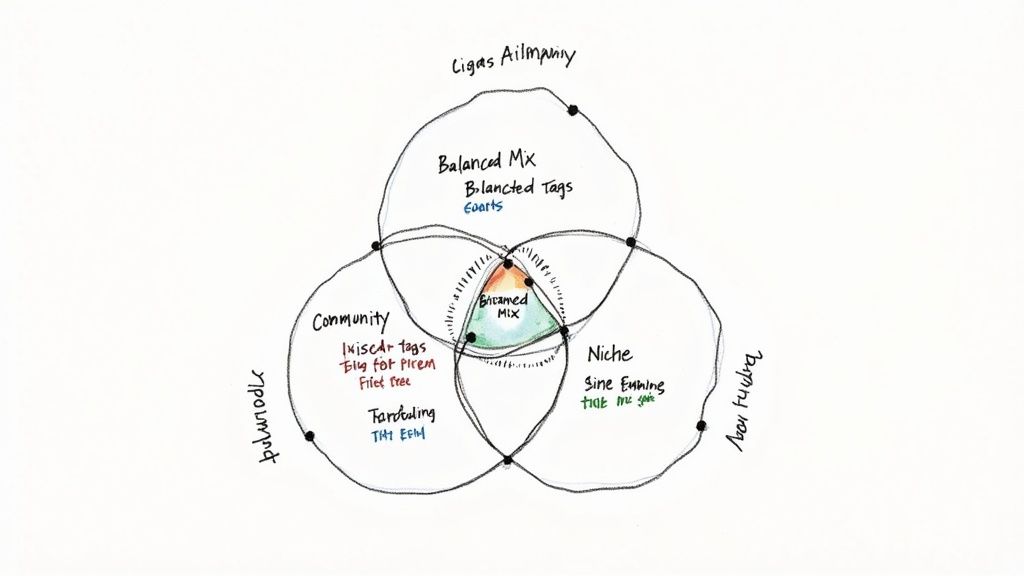
The smart play is to build a balanced formula for every single post. You want to blend different types of tags that serve different purposes. This strategy is about making sure you’re not just reaching a wide audience, but the right audience.
The Three Pillars of a Strong Hashtag Mix
I like to think of a good hashtag strategy as having three core ingredients. Each one targets a different slice of your potential audience, and when you put them together, they create a powerful engine for getting your content discovered.
Here's how I break it down:
- Community Hashtags: Think broad and popular. These are tags like #SocialMediaMarketing or #SaaS. Their job is to get your content in front of a lot of eyes and connect you to the bigger industry conversation.
- Niche Hashtags: These are much more specific and aimed at a focused group. Tags like #ContentStrategy or #LeadGenerationTips are perfect examples. This is how you attract people who are actively looking for the exact information you're sharing.
- Branded Hashtags: These are completely unique to you. It could be your company name, a campaign tag, or something like #YourBrand2024. You use these to build your brand’s footprint, track conversations about you, and gather up user-generated content.
Combining these three types means you’re casting a wide net while also dropping a perfectly baited hook right where your ideal fish are swimming.
A great hashtag mix doesn't just make you visible; it makes you visible to the people who are most likely to care about what you have to say. It's the difference between shouting in a crowd and joining a meaningful conversation.
Putting Your Hashtag Mix into Practice
Let's make this real. Imagine you're a B2B software company posting about a cool new lead-gen feature. A lazy approach would be to just use #software and call it a day. A much stronger, balanced strategy would look more like this:
- Community: #SaaS (This connects the post to the broader software-as-a-service industry.)
- Niche: #LeadGenerationTips (This one targets marketers who are actively looking for this exact solution.)
- Branded: #BrandNameFeature (This highlights their specific product and helps build brand recall.)
See the difference? That mix gets the post in front of a general industry audience, a super-targeted professional audience, and strengthens the brand’s own identity—all at the same time.
A thoughtful hashtag mix is a game-changer, especially for smaller accounts fighting for traction. In fact, some research shows that posts with 11 or more relevant hashtags can see a 79.5% jump in engagement for accounts with under 1,000 followers. This just goes to show how a diverse set of well-researched tags can be a massive growth lever. If you're curious, you can dig into more of these powerful hashtag statistics to see the potential impact.
This is where tools like MicroPoster become incredibly handy. Instead of typing out your tags every time, you can create and save different hashtag "mixes" for your main content pillars. Got a post about company culture? Just grab your pre-built #CompanyCulture mix. It ensures every post is consistently optimized without all the manual grunt work.
Don't Just Copy-Paste: Tailor Your Hashtags for Each Platform
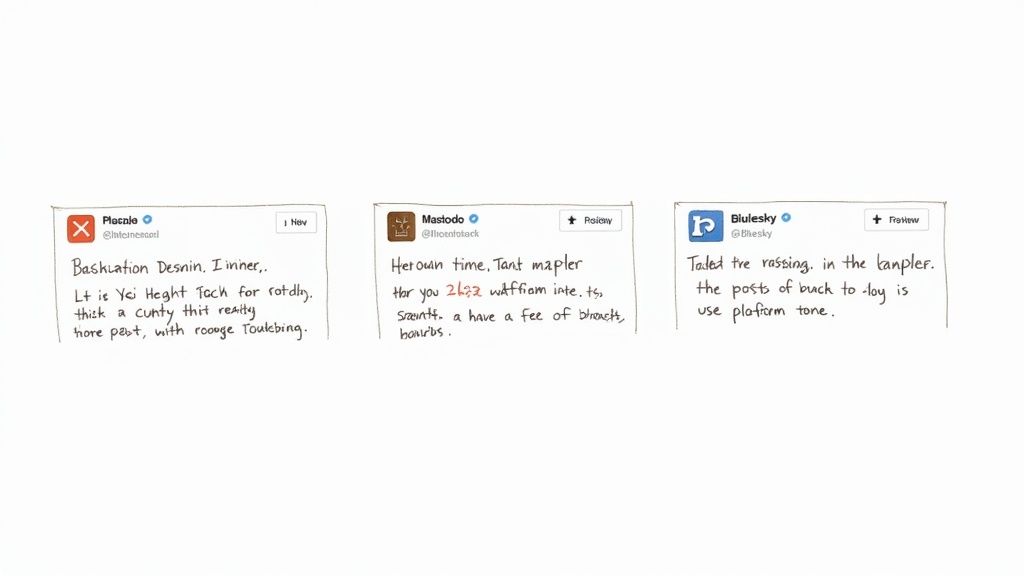
It’s tempting, I know. You craft the perfect post, find a great set of hashtags, and blast it across all your profiles. But this copy-paste approach is a surefire way to get ignored. Every social platform has its own unwritten rules, user behaviors, and even technical quirks.
What's celebrated on one network can look like pure spam on another, killing your engagement from the get-go. To get real results, you have to play by the local rules. That means adapting your hashtag quantity, style, and even placement for every platform you’re on.
Playing the Game on X (Formerly Twitter)
X is all about speed. Conversations erupt and vanish in minutes, and hashtags are your ticket into those real-time discussions. The key here is precision over volume.
Stick to just 1-2 hyper-relevant hashtags. Seriously. The best practice is to weave them right into your sentence for context or drop them at the end. Stuffing a post with a dozen tags just makes it look cluttered and, frankly, a bit desperate.
- This works: "Just launched a new feature to help teams track their quarterly goals! We're excited to see how it boosts productivity. #ProjectManagement #SaaS"
- This doesn't: "New feature launch! #ProjectManagement #SaaS #Productivity #Goals #Tech #Startup #New"
See the difference? The first one is a natural part of the conversation. The second is just shouting keywords into the void. On X, less is more.
Cracking the Code on Mastodon and Bluesky
On decentralized platforms, hashtags aren't just for flair—they're the entire discovery engine. Since there's no all-powerful algorithm pushing your content, users rely on following and searching for specific tags to find interesting posts and people.
This is also where formatting becomes critical. Always use #CamelCase (also called PascalCase), like #SocialMediaMarketing instead of #socialmediamarketing. This isn't just a stylistic choice; it's an accessibility standard. Screen readers can pronounce #CamelCase correctly, making your content understandable for visually impaired users. Skipping this simple step excludes a huge portion of the potential audience.
Key Takeaway: On non-algorithmic platforms, your hashtags are your SEO. Be descriptive, be specific, and always use CamelCase to make sure everyone can find and understand your content.
Facebook's Surprising Hashtag Rules
You'd think established platforms would have similar rules, but you'd be wrong. While its sibling, Instagram, often rewards using a pile of hashtags, Facebook is the complete opposite. What does the data show? Facebook posts with just one single hashtag actually get the most engagement.
Once you start adding more, engagement tends to fall off a cliff. It’s a classic mistake to treat your Facebook strategy like your Instagram one. If you want to dive deeper into this, the full research on social media hashtags is a real eye-opener.
How Smart Tools Make Cross-Platform Posting Easy
Juggling all these different rules manually for every single post is a recipe for burnout and mistakes. This is exactly where a good scheduling tool earns its keep.
With a tool like MicroPoster, you can write your core message once, then tweak the hashtags and formatting for X, Mastodon, and Bluesky right in the editor before anything goes live. It’s a simple workflow that ensures every post is optimized for its destination without you having to do the same work over and over. This is what smart social media automation looks like—maintaining a tailored, high-quality presence everywhere you post, but without all the manual grunt work.
Measuring Your Hashtag Performance
You’ve done all the hard work of researching and crafting what feels like the perfect hashtag mix. So, what now? If you just post and hope for the best, you’re flying blind. The real magic happens when you start measuring your results.
This is how you stop guessing and start knowing. It’s the difference between a strategy that works once and one that keeps getting better over time. Let's dig into what to look for and how to figure out what’s actually moving the needle.
Key Metrics to Monitor
It's easy to get fixated on likes, but they don't tell the whole story. To truly understand your hashtag impact, you need to look at the metrics that show whether you're reaching the right people and getting them to act.
Here's what I always keep an eye on:
- Impressions: This is the total number of times your post was seen. A big jump in impressions tied to a specific hashtag means it’s successfully getting your content onto more screens.
- Reach: This tells you how many unique accounts saw your post. This is your best indicator of whether your hashtags are helping you break out of your follower bubble.
- Engagement: This is the good stuff—replies, reposts, and link clicks. Are people just scrolling past, or are your hashtags pulling in an audience that wants to interact?
If you really want to get into the weeds, a comments analyzer tool can show you the sentiment and common themes in the conversations your posts are sparking.
Running Simple A/B Tests
One of the best ways to figure out what works is to experiment. You don't need a fancy lab coat or a complex setup; a little A/B testing goes a long way.
Here’s a straightforward approach I use all the time:
- Craft two posts with a very similar message or visual. Think of it as a "twin" post.
- On the first post, use one group of hashtags you’ve researched.
- On the second post, use a completely different set of hashtags.
- Post them at similar times but on different days to give each a fair shot.
- After a day or two, check the analytics. Which one performed better on impressions, reach, and engagement?
This simple test gives you real data, not just a gut feeling, about which hashtag set is doing the heavy lifting for you.
Key Insight: A hashtag that crushes it one month might be a dud the next. Trends change, and conversations shift. Consistent measurement is your key to staying ahead of the curve and adapting your strategy before it goes stale.
Using Analytics Dashboards to Simplify Tracking
Trying to track all these numbers manually across different posts is a fast track to a headache. That's where an integrated analytics dashboard, like the one inside MicroPoster, really shines. It does all the tedious work for you.
Instead of juggling spreadsheets or clicking through native analytics, a dashboard puts everything in one place. You can see, clear as day, which hashtags are driving clicks and which ones are just taking up space. This makes it incredibly easy to spot your winners, ditch the losers, and continuously refine your approach for real, measurable growth.
Answering Your Top Hashtag Questions
Even with the best strategy, you're bound to run into a few tricky situations once you start posting. Let's walk through some of the most common questions I hear from people trying to get their hashtag game right.
Hashtags in the Post or in a Comment?
This one trips up a lot of people, especially if you're used to Instagram. On that platform, it's common practice to tuck your hashtags away in the first comment to keep the caption looking clean.
Don't do this on X, Bluesky, or Mastodon. It simply doesn't work.
On these text-first networks, hashtags are a functional part of the post itself. For the platform to see them, index them for search, and show your post to interested people, they have to be in the original post. If you put them in a reply, they become invisible to the platform’s discovery engine, and you’ve just wasted a massive opportunity for reach.
How Often Should I Refresh My Hashtag Lists?
Hashtags aren't a "set it and forget it" tool. While your core branded tags might stick around for a long time, the rest of your list needs regular attention to stay effective.
I recommend a quarterly review. It's the sweet spot—frequent enough to catch new trends but not so often that it becomes a chore.
During your quarterly check-in, you’ll want to:
- Hunt for new trends: What new conversations are bubbling up in your niche?
- Spot oversaturation: Has one of your go-to tags become a spam-fest? If so, it's time to drop it.
- Dig into the data: Look at which tags are actually driving clicks and engagement and which ones are just taking up space.
This is where a tool with built-in analytics really shines. MicroPoster can show you what's working at a glance, turning a tedious task into a quick, data-backed strategy update.
Can I Just Use the Same Hashtags on Every Single Post?
Please don't. Copying and pasting the same block of hashtags over and over is one of the worst habits you can get into. At best, it's lazy and ineffective. At worst, platform algorithms can flag this repetitive behavior as spammy, which can seriously hurt your visibility.
Think about it: every post is different, right? Your hashtags should be, too. They act as specific signposts for that one piece of content. It’s fine to have your main brand or campaign tag for consistency, but the other hashtags must be tailored to what you're actually talking about in that specific post. This is the core principle of how to use hashtags effectively.
Pro Tip: Customizing hashtags for every post tells both the platform and your audience that you’re adding relevant, high-quality content to the conversation, not just shouting into the void.
What Is Hashtag Hijacking, and How Do I Avoid It?
Hashtag hijacking is when someone latches onto a trending hashtag that has zero to do with their post, just to get more eyeballs. Think of a real estate agent using #TaylorSwiftAlbum to post about a new house listing. It’s a desperate grab for attention.
And it almost always backfires. You’ll annoy people who are genuinely following the trend, make your brand look spammy and out of touch, and probably get a lot of angry replies or mutes.
The solution is simple: only use hashtags that are directly and genuinely relevant to your content. No exceptions.
Ready to stop guessing and start growing? MicroPoster gives you the tools you need to find the right hashtags, schedule your content for peak engagement, and track what's working—all in one place. Start your free 7-day trial and publish smarter today on microposter.so.