what is a good engagement rate
What Is a Good Engagement Rate? Your 2026 Benchmark Guide
Unsure what is a good engagement rate? This 2026 guide provides clear benchmarks for X, Threads, and more to help you measure and improve your content strategy.

So, what's a "good" engagement rate, really? Everyone wants a simple answer, but the truth is a little more complicated. While a general benchmark of 1% to 5% is often thrown around, what's considered "good" for you depends entirely on your audience, your niche, and critically, where you're posting.
What Is a Good Engagement Rate in 2026?
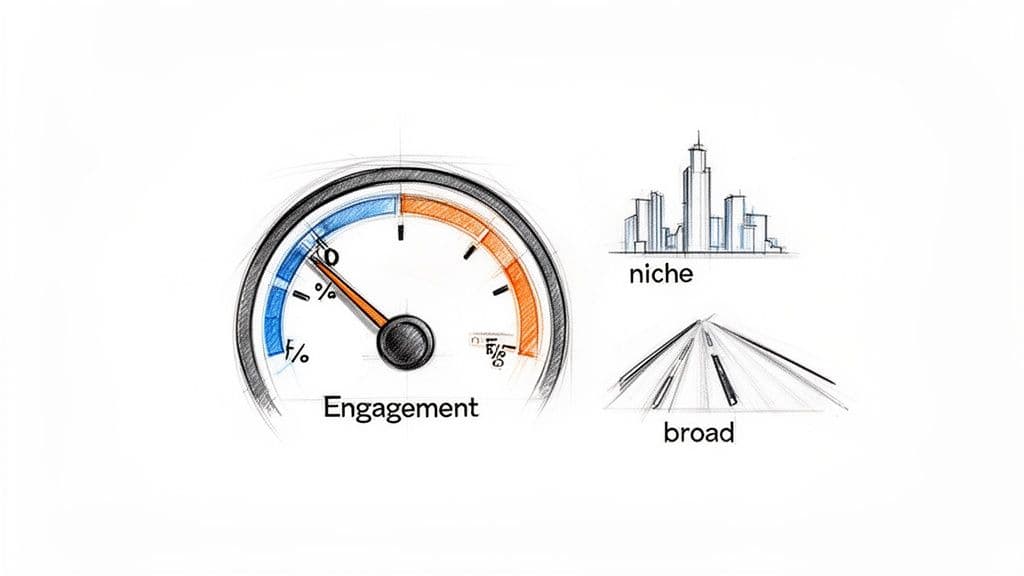
Trying to nail down a universally "good" engagement rate feels like chasing a shadow. You see other creators pulling in tons of interaction and can't help but wonder if your own numbers stack up. The reality? There is no magic number.
Think about it like this: A tight, niche community of 1,000 die-hard fans will naturally have a much higher engagement rate than a general-interest account with 100,000 casual followers. The smaller group is more invested, so a 10% rate might be normal. For the larger account, hitting even 2% would be a huge win. They're playing two different games.
Platform Benchmarks: Why Context Is Everything
This is where most people get tripped up. A number that signals fantastic performance on one platform might be just average on another. User expectations and platform algorithms are worlds apart. For instance, a 2.5% engagement rate is something to celebrate on a professional network like LinkedIn, but it would feel pretty standard on a visually-driven app like Instagram.
To get a clearer picture, let's look at some current benchmarks from 2026. This quick guide breaks down what you should be aiming for on some of the major platforms.
Quick Guide to Good Engagement Rates by Platform (2026 Average)
| Platform | Average Rate | Good Rate (Target) | Great Rate (Exceptional) |
|---|---|---|---|
| X (Twitter) | 0.8% | 1.5% | 2.5% or more |
| Bluesky | 1.2% | 2.0% | 3.5% or more |
| Mastodon | 1.5% | 2.5% | 4.0% or more |
As you can see, the numbers vary significantly. Chasing a single, universal metric is a recipe for frustration. Instead, focus on hitting a competitive rate for the specific channels where you're building your audience. For a more detailed look, you can always explore the full analysis of platform-specific metrics that these figures are based on.
The Real Challenge for Creators: It’s not just about creating great stuff anymore. It's about keeping that connection strong across multiple platforms, each with its own culture and rules. Manually tailoring posts for X, then for Bluesky, then for Mastodon... it’s a massive time sink.
This is exactly where a smart publishing tool like MicroPoster.so becomes indispensable. For creators already putting in the work, the goal is to expand your reach without burning out. It lets you write your core idea once and then intelligently adapts it for each network, helping you grow everywhere without multiplying your effort. You get to stay focused on what you do best—connecting with your audience—while the busywork of distribution gets handled for you.
How to Calculate Your Engagement Rate Correctly
Calculating your engagement rate doesn't have to feel like wrestling with a spreadsheet. At its core, it’s about understanding one thing: how well your content is actually connecting with people.
To get the full picture, you need to use a couple of key formulas. Each one tells a different, but equally important, story about your performance. The right one just depends on the question you’re asking.
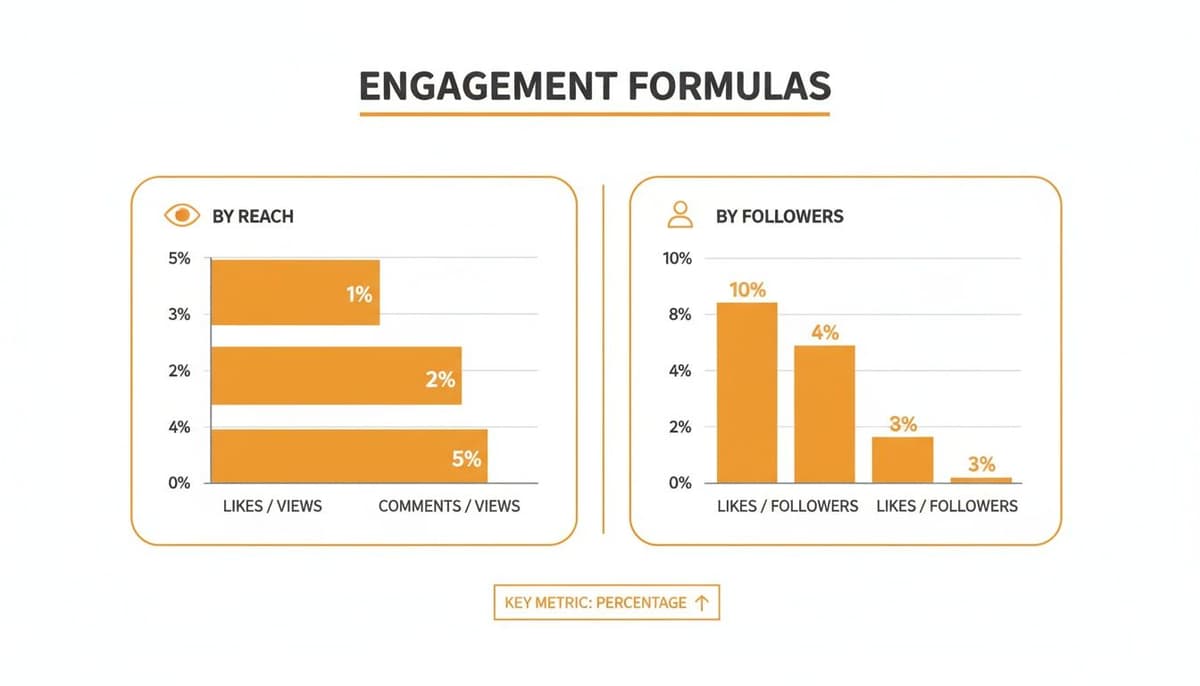
Engagement Rate by Reach (ERR): The Truth Teller
I call this one the “truth-teller” for a reason. Engagement Rate by Reach (ERR) is the single most honest measure of how good your content is. It answers a simple question: of all the people who actually saw your post, what percentage cared enough to interact?
This is my go-to metric because it cuts through all the noise. It doesn't care how many followers you have or what the algorithm decided to do that day. It’s a pure reflection of your post’s quality.
Here’s the simple math behind it:
ERR = (Total Engagements / Post Reach) x 100
Let's say you're a founder announcing a new feature on X. Your post gets 5,000 views (that's your reach) and racks up 150 engagements (likes, replies, reposts).
- (150 Engagements / 5,000 Reach) x 100 = 3% ERR
That 3% is gold. It means for every 100 people who saw your announcement, three of them were moved to act. That’s a powerful signal that your message landed, regardless of your follower count.
Engagement Rate by Followers (ERF): The Loyalty Gauge
The other side of the coin is Engagement Rate by Followers (ERF). Think of this as your community’s loyalty gauge. Instead of looking at a single post's reach, it measures engagement against your total follower count.
While it’s less precise for judging one-off post performance (since not all your followers will see everything), it’s fantastic for tracking the overall health and stickiness of your audience over time.
This is how you calculate it:
ERF = (Total Engagements / Total Followers) x 100
Using that same feature announcement, you have 10,000 followers and the post got 150 engagements.
- (150 Engagements / 10,000 Followers) x 100 = 1.5% ERF
Watching this number over weeks and months tells you if you're building a genuinely connected community or just shouting into the void. A rising ERF is a fantastic sign that your core audience is locked in. Digging into analytics for social media marketing is a must if you want to truly understand what moves these numbers.
Of course, manually tracking all these figures across X, Threads, Bluesky, and Mastodon can turn into a soul-crushing chore. That’s exactly why the upcoming analytics dashboard in MicroPoster.so is being built to automate this entire process. It will calculate and show you both engagement rates in one clean view, freeing you from spreadsheet duty so you can spend your time making more of what works.
And if you’re looking to connect these numbers to your bottom line, our guide on how to measure social media ROI is the perfect next step.
You can’t just Google “what’s a good engagement rate” and expect a useful answer. Most of the stats you’ll find are bloated with data from Facebook or Instagram, which is completely irrelevant when you’re grinding away on microblogging platforms.
What works on one network will fall flat on another. The culture, the algorithm (or lack thereof), and the way people interact are worlds apart. A "good" number on X might be mediocre on Bluesky or downright amazing on Mastodon. You need benchmarks that actually match the digital spaces you inhabit.
Microblogging Engagement Rate Benchmarks by Follower Count
So, what should you really be aiming for? We’ve broken down realistic engagement rate targets for the key microblogging platforms, segmented by your follower count. Think of these as your performance goals—numbers that tell you if you're truly connecting with your audience or just shouting into the void.
| Follower Tier | X (Twitter) | Threads | Bluesky | Mastodon |
|---|---|---|---|---|
| < 1,000 | 2% – 4% | 3% – 6% | 3% – 6% | 4% – 8% |
| 1k – 10k | 1.5% – 2.5% | 2.5% – 4% | 2.5% – 4% | 3% – 5% |
| 10k+ | 1% – 1.5% | 1.5% – 3% | 1.5% – 3% | 2% – 4% |
These numbers tell a story. Newer platforms like Bluesky and Mastodon often have more enthusiastic, tight-knit communities, leading to higher baseline engagement. On a mature and massive platform like X, you're competing with a firehose of content, so even a 1% rate can be a significant achievement for a large account.
Why the Numbers Vary So Much
Let's dig into the why behind these benchmarks.
On X, you're battling a relentless algorithm in a super-fast environment. Content has a very short shelf life. If you have under 1,000 followers, hitting 2% to 4% engagement is a fantastic sign that your initial audience is hooked. Once you grow past 10,000 followers, your rate will naturally settle; anything above 1% is solid, and hitting 1.5% consistently means you’re doing something exceptionally right.
Over on newer platforms like Threads and Bluesky, things feel different. They are still powered by early-adopter energy, which translates to higher engagement right out of the gate. For accounts under 1,000 followers, seeing rates between 3% and 6% is pretty standard. As you scale, maintaining 1.5% to 3% shows you’re building a loyal following that’s growing with you, not just passively consuming your content.
Then there's Mastodon, which plays by a completely different set of rules. With no central algorithm, engagement is all about genuine community interaction within your chosen server (instance).
Because Mastodon is all about the community, the engagement you get is often deeper. I’d take one thoughtful reply there over a dozen mindless likes on another platform any day.
This focus on real connection is why Mastodon boasts some of the highest organic engagement rates you'll see. It’s not unusual for new accounts to see 4% to 8% engagement. Even for large accounts with over 10,000 followers, a rate of 2% to 4% is excellent and proves you’ve become a trusted voice in your corner of the Fediverse.
Why Your Engagement Rate Is Dropping and How to Fix It
It’s a feeling every creator knows all too well. You’re posting great content, sticking to your schedule, but the numbers are… slipping. A little less reach here, a few fewer likes there. It’s maddening, and it leaves you wondering, "Is it me? Is my content just not good anymore?"
Probably not. While it's always good to review your content, a dip in engagement often has less to do with your work and more to do with the shifting sands of the platforms themselves.
The Usual Suspects Behind a Drop in Engagement
Before you overhaul your entire content strategy, let's look at the most common culprits. I’ve seen these trip up even the most seasoned creators:
- Algorithm Changes: This is the big one. Social platforms are always tinkering behind the scenes. One month they want video, the next they want long, thoughtful threads. When the algorithm changes its priorities, the content that used to crush it for you can suddenly feel invisible. It's not your fault; the rules of the game just changed without warning.
- Audience Burnout: Let's be real, our followers are only human. If they see the same type of post from you day after day, they’ll eventually start to scroll right past it. Even the most loyal audience needs variety to stay interested. Predictability can quickly lead to apathy.
- Inconsistent Posting: Life happens. You get busy, miss a few days of posting, and when you come back, it feels like you're starting from zero. That break in rhythm tells both the algorithm and your audience that you might not be fully committed, and your visibility takes a hit.
These things rarely happen in isolation. Take what happened on Instagram, for example. The platform's big push toward Reels led to a staggering 26% drop in median engagement for other post types between 2024 and 2025. Creators who had built their entire strategy around photos suddenly found their reach tanking. You can dig into the data yourself in Buffer's in-depth social media analysis.
The Danger of Relying on a Single Platform
This brings us to a huge, blinking warning sign: putting all your creative energy into one platform is a recipe for disaster. It’s like building a beautiful house on rented land. You're completely at the mercy of the landlord—in this case, a single tech company—and their ever-changing rules.
When that platform decides to pivot, or when its user base starts to fade, your audience and all the equity you’ve built can be swept away overnight. You're left scrambling, trying to win back the favor of an algorithm you can't control.
Relying on one platform makes you a tenant, subject to the landlord's changing rules. Building a presence across multiple platforms makes you the owner of your own audience network, insulating you from the whims of any single algorithm.
So, instead of viewing a drop in engagement on one network as a catastrophe, what if you saw it as a signal? A signal that it’s time to double down on the platforms where you are getting traction. The only problem is, trying to manage that manually is a fast track to burnout.
This is exactly why MicroPoster.so was built. It turns this exact vulnerability into a strategic advantage. Instead of fighting a losing battle against a single, unfriendly algorithm, MicroPoster lets you build a resilient presence across multiple networks without the extra work.
You write your post once, and MicroPoster intelligently formats and sends it to X, Threads, Bluesky, and Mastodon. Suddenly, a dip on one platform doesn’t feel like a crisis. It's just a data point. Your community continues to grow and your engagement stays strong on the other networks, giving you a stable foundation to build a truly future-proof brand.
Practical Ways to Actually Boost Your Engagement Rate
Alright, you know the numbers and you know what might be causing a dip. That's the easy part. Now for the fun stuff: the practical, hands-on tactics you can use to get more people to actually do something with your posts.
These aren't just abstract theories. These are the exact strategies I've used to build communities and launch products on platforms like X. The goal isn't just to be seen—it's to get a reaction.
Stop Burying the Lead: Write a Better Hook
Your first sentence is everything. It's the gatekeeper. If it’s boring, people will scroll right past, and the rest of your brilliant post might as well be invisible. You have to earn their attention from the very first word.
Think about how you scroll. You're flying. You need a reason to hit the brakes.
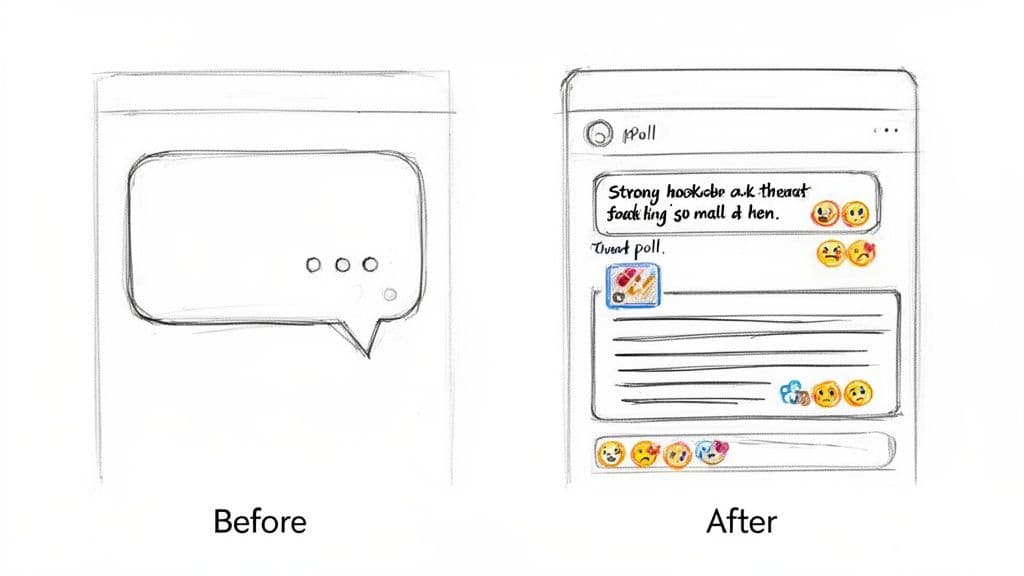
Here’s a classic example I see all the time. The creator is excited, but the post is a dud.
The "Before" (Weak and Forgettable):
- "I just released a new update for my product. It has some great new features that I think users will really like. Check it out."*
It's an announcement, not an invitation. It talks at people.
The "After" (Strong and Magnetic):
- "The #1 feature request we get is finally here. For anyone who's ever felt frustrated by [common pain point], this update is for you. Here’s what we just shipped:"*
See that? It hooks you by speaking directly to a known problem and creates instant curiosity. Mastering this one skill will change the game for you.
Give People a Reason to Reply
If you post statements, you'll get silence. If you want engagement, you have to explicitly invite it. The easiest way to do this? Polls and questions.
They work because they lower the barrier to entry to a single click. But more importantly, they make your audience feel like part of the process.
Instead of just posting, try framing your content like this:
- Let them make a choice: Don't ask, "Do you like this idea?" Ask, "We're building our next feature. Should we focus on A) a better search or B) custom themes?"
- Ask for validation: "Thinking of writing a guide on cold outreach. Would you rather see A) a deep-dive thread or B) a short video walkthrough?"
- Spark a little debate: "What's the one SaaS tool you can't live without? A) Notion, B) Figma, C) Slack, D) Something else (tell me in the replies!)."
Each one of these turns a monologue into a conversation. It’s a small shift that makes a massive difference.
A great post doesn't just broadcast a message; it starts a conversation. The goal isn't just to be heard, but to get a response. That response is the heart of engagement.
Build Your Threads Like a Story
Sometimes you have more to say than a single post allows. That's what threads are for. But a poorly structured thread is just a wall of text that nobody will read. You have to guide your reader.
A thread that people actually finish has a few key ingredients:
- A Killer Hook: The first post sells the entire thread. Make it count.
- Clear Signposts: Use numbers like "1/," "2/," etc., to show people where they are.
- Visual Breaks: A well-placed image, GIF, or screenshot can reset attention.
- A Strong Finish: The last post should wrap it all up and give a clear call to action (CTA), like asking a final question.
Knocking these out manually, especially when you want to post across X, Mastodon, and Bluesky, is a total time-sink. This is where leaning on a good tool is just smart. For instance, in MicroPoster.so, you can just write out your full idea, and its auto-threading feature will break it into a perfectly formatted thread for each platform. It handles the numbering and structure, so you can just focus on writing great content.
The Right Tools Make It All Work
Look, boosting engagement comes down to a mix of smart content and consistent execution. Writing better hooks and asking better questions is crucial, but doing it every single day across multiple platforms is where most people burn out.
This is the point where you should stop grinding and start working smarter.
A tool like MicroPoster.so can bake these tactics right into your workflow:
- Punch Up Your Copy: Use its AI editor to quickly sharpen a hook or rephrase a poll question to make it more compelling.
- Post When People Are Listening: Schedule your content to go live during peak hours for your audience, giving it the best shot at getting seen.
- Never Mess Up a Thread Again: Let the app do the tedious work of splitting your content into perfectly formatted, easy-to-read threads.
When you combine these tactics with the right platform, you move from just "posting" to publishing with intent. You create content designed to get a response, and you do it efficiently. For a deeper dive on this, check out our complete guide on how to improve social media engagement for even more strategies.
Where to Focus Your Efforts for Maximum Engagement
Let's be real—your time is the one thing you can't get back. As a creator, trying to be everywhere all at once is a surefire recipe for burnout, not a blueprint for growth. You have to be smart about where you invest your creative energy.
The secret isn't just knowing what a good engagement rate is; it's about having an engine that constantly brings new people into your world. This calls for a savvy, two-part content strategy.
The Foundation and The Frontier Strategy
Think of your social media world in two distinct zones. First, you have your foundational platforms. This is your home base—networks like X, Threads, and Bluesky where you have those quality, text-based conversations and build a real community.
Then, you have your discovery frontier. This is where you go for explosive organic reach. It’s the one platform you use to get your work in front of thousands of people who have never heard of you before.
Right now, that frontier is TikTok. Period. It has completely eclipsed every other platform in its ability to generate engagement. A 2026 analysis found that TikTok’s median engagement rate was a staggering 27.6%—that's anywhere from three to ten times higher than its closest competitors. Its algorithm is a discovery goldmine, built from the ground up to push content far beyond your follower list. You can dig into the full social media analysis from eMarketer to see just how massive that advantage is.
How MicroPoster Makes This Strategy Work
Okay, so how does a solo creator or a small team actually do this? Manually running your core community channels while also producing high-effort videos for a discovery platform is next to impossible. The answer is to automate one so you can pour your heart into the other.
You can't be everywhere at once, but your content can. The smartest creators automate their core microblogging presence so they can free up their creative energy for high-growth platforms.
This is where a tool like MicroPoster.so changes the game. You can master your foundational platforms by writing your content just once. Draft your insights, your questions, and your updates, and let MicroPoster intelligently post and adapt them across X, Threads, Bluesky, and Mastodon. Your presence stays strong and consistent, without you doing all the tedious, manual work.
This simple bit of automation can free up dozens of hours every month. You then get to reinvest that time—and your best creative ideas—into making killer video content for TikTok. What you end up with is a powerful growth loop:
- TikTok serves as your welcome mat, introducing your brand to a huge, untapped audience.
- MicroPoster ensures that when those new people come looking for you on their favorite text-based apps, they find a thriving, active community waiting for them.
This isn’t about working harder; it’s about having a smarter system. You use automation to maintain your core community, which frees up your creative genius for the platform that will bring you the most growth.
Your Engagement Rate Questions, Answered
Alright, you've got the formulas and the benchmarks down. But when the rubber meets the road, a few practical questions always come up. Let's tackle the most common ones I hear from creators.
How Often Should I Actually Check My Rate?
I've found the sweet spot for most creators is a weekly check-in. This gives you a quick, regular pulse on what’s working and what isn’t, without driving yourself crazy over daily ups and downs.
Think of it like a weekly weigh-in. It’s frequent enough to see if your new content strategy is making a difference, but not so often that you panic over a single off day. A monthly review is also great for zooming out to see the bigger picture of your growth.
Is a High Rate on a Small Audience Really Better?
Without a doubt. A 10% engagement rate with 500 followers who genuinely care about what you post is infinitely more valuable than a 0.5% rate on an audience of 10,000 who barely notice you.
That small, fired-up group is your foundation. They're the ones who will become your champions, your first customers, and the core of a real community.
A small, passionate audience that hangs on your every word will always be more powerful than a large, indifferent crowd. Focus on building connection, not just collecting followers.
How Long Until I See Real Improvement?
This is a marathon, not a sprint. While a single post might go viral and give you a temporary boost, building a sustainably higher engagement rate takes time. Be patient.
If you’re consistently showing up with better hooks, smarter content, and real interaction, you can expect to see a meaningful shift in about one to three months. You're not just changing your tactics; you're building new habits for both yourself and your audience. It's a commitment, but it's one that pays off.
Ready to stop wrestling with spreadsheets and start creating content that actually connects? MicroPoster.so automates your posting to X, Threads, Bluesky, and Mastodon, freeing you up to focus on what matters: building a community that cares. Start your free trial and feel the difference.